Compound Creativity

Stop Reinventing the Wheel Every Quarter

Most marketers have the attention span of a goldfish on espresso. We are so obsessed with 'freshness' and 'innovation' that we end up murdering the very ideas that actually work. If you’re changing your brand vibe more often than you change your socks, you aren't building equity; you're just making expensive noise. Compound Creativity is the brutal reminder that your audience doesn't care about your need for 'creative expression'—they care about recognition. Stop being an idiot who throws away years of mental availability just because you're bored with your own deck.
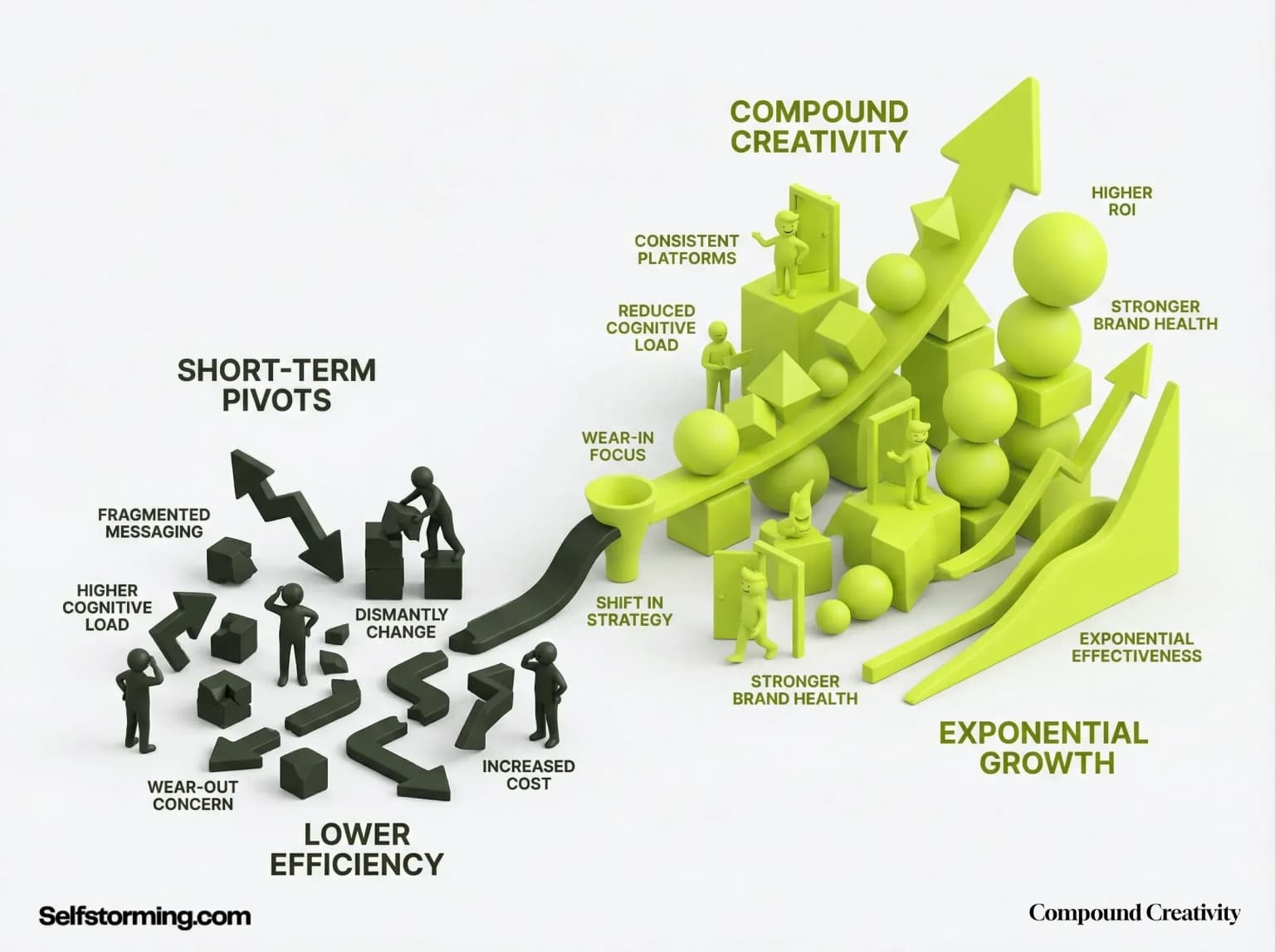
Compound Creativity is the principle that the effectiveness of advertising increases exponentially when creative themes, characters, and styles are maintained over long periods. Drawing on extensive research from the IPA and System1, the law posits that 'wear-in' is a more significant factor than 'wear-out.' By utilizing 'Fluent Devices'—recurring characters or scenarios—brands reduce the cognitive load required for consumers to identify the brand, thereby increasing mental availability. While short-termism drives marketers to pivot frequently, those who double down on consistent creative platforms see significantly higher ROI, stronger brand health metrics, and a more efficient path to market share growth. Consistency isn't just a design choice; it is a mathematical imperative for capital efficiency.

COMPOUND CREATIVITY

Creative effectiveness is a cumulative function of temporal consistency, where the repeated application of distinctive brand assets and thematic narratives builds enduring memory structures that lower the cost of future mental availability.

Compound Creativity marketing law: Stop Reinventing the Wheel Every Quarter - Visual illustration showing key concepts and examples

Key Takeaways

  • Creative consistency is a financial multiplier for marketing budgets over the long term.
  • Fluent Devices (recurring characters/themes) are the most effective drivers of brand growth.
  • The 'Wear-In' period for ads is significantly longer than most marketers realize.
  • Changing creative direction frequently resets brand equity and wastes capital investment.
  • Emotional, 'right-brain' creative elements are essential for building compounding memory structures.

Consequences Of Applying The Law

AspectWhen AppliedWhen Not Applied
Brand Asset ManagementDeployment of Fluent Devices (recurring characters, music, or scenarios) builds rapid brand recognition. Consumers process ads faster, reducing the 'cost of attention' and increasing mental availability.Constant 'creative refreshes' force consumers to re-learn the brand's identity. This creates cognitive friction, where the audience ignores the ad because they fail to link it to the brand within the first two seconds.
Campaign LifecycleHigh-performing creative is run for years, allowing it to 'wear-in' and penetrate the memory of light buyers. ROI improves over time as the creative becomes a mental shortcut for the category.Campaigns are retired prematurely due to internal boredom or agency changes. This resets the 'wear-in' clock, wasting the initial investment and preventing the formation of long-term memory structures.
Media Budget EfficiencyCreative consistency acts as a financial multiplier. Because the creative is familiar, every dollar spent on media works harder to reinforce existing memory nodes rather than trying to build new ones from scratch.Inconsistent creative acts as a 'tax' on the media budget. Higher reach and frequency are required to achieve the same level of recall, leading to lower overall ROAS and higher customer acquisition costs.
Customer AcquisitionConsistent messaging targets Category Entry Points (CEPs) repeatedly, ensuring the brand is the first one recalled when a need arises. This drives growth by capturing a larger share of light buyers.Fragmented messaging attempts to say too many things to too many people. The brand fails to own any specific CEP, resulting in the brand being overlooked during the moment of purchase.
Production & OperationsMarketing spend is skewed heavily toward working media (distribution) rather than non-working media (production). Costs are minimized by iterating on a successful core creative platform.A disproportionate amount of the budget is consumed by agency fees and production costs for 'new' concepts. This reduces the total reach of the campaign and diminishes the brand's voice in the market.
Price Sensitivity & MarginConsistent creative builds a strong, familiar brand image that justifies premium pricing. Mental fluency leads to a 'halo effect' where consumers perceive the brand as more trustworthy and reliable.Lack of creative identity forces the brand to compete on price and promotions. Without a clear, consistent mental image, consumers treat the product as a commodity, eroding long-term profit margins.

Genesis & Scientific Origin

The formalization of Compound Creativity as a marketing law emerged from the intersection of behavioral science and longitudinal effectiveness studies conducted by the Institute of Practitioners in Advertising (IPA) and System1 Research. While the concept of 'brand consistency' has existed for decades, it was the seminal work of Les Binet and Peter Field in 'The Long and Short of It' (2013) that provided the statistical backbone for the law. They demonstrated that brand-building effects (which require creative consistency) build more slowly but decay less rapidly than sales activation effects.

This was further refined by Orlando Wood, Chief Innovation Officer at System1, in his groundbreaking books 'Lemon' (2019) and 'Look Out' (2021), published in association with the IPA. Wood’s research utilized the System1 database of over 50,000 ads to show that creative platforms featuring recurring characters (Fluent Devices) and consistent emotional 'right-brain' triggers outperformed fragmented, short-term campaigns by a staggering margin. The term 'Compound Creativity' itself synthesizes these findings into a singular principle: that creative work is an asset that accrues interest over time, rather than a disposable commodity to be replaced at the end of a fiscal quarter.

Ads with a 'Fluent Device' are 37% more likely to drive large market share gains. (System1/IPA, 2019)

The Mechanism: How & Why It Works

The mechanism of Compound Creativity is rooted in cognitive psychology and the formation of long-term memory structures. To understand why it works, one must look at three core pillars: Mental Fluency, the Myth of Wear-Out, and the Power of the Fluent Device.

1. Mental Fluency and Cognitive Ease: The human brain is inherently lazy. It prioritizes information that is easy to process—a concept known as 'fluency.' When a brand uses consistent creative elements (colors, music, characters, or a specific 'vibe'), it builds a shortcut in the consumer’s mind. Over time, the consumer doesn't need to 'think' to recognize the brand; the recognition is instantaneous. This 'System 1' processing is the holy grail of marketing because it bypasses the critical, price-sensitive 'System 2' brain.

2. The Deconstruction of 'Wear-Out': Marketers often suffer from 'Wear-Out Paranoia.' Because they see their own ads hundreds of times during the production and approval process, they assume the public is also bored. In reality, most of the target audience hasn't even noticed the ad yet. Research shows that 'Wear-In'—the time it takes for an audience to actually encode a creative theme—is much longer than we think. Compound Creativity exploits this by staying the course while competitors are busy pivoting.

3. The Fluent Device: This is the 'engine' of Compound Creativity. A Fluent Device is a recurring creative element—think the GEICO Gecko, the Compare the Market Meerkats, or the M&M’s characters. These devices act as 'fame-builders.' Because they are consistent, they allow the brand to tell new stories within a familiar framework. This lowers the 'cost of entry' for every new ad in the series. Instead of spending the first 15 seconds of a 30-second spot establishing who the brand is, the brand is recognized in the first 2 seconds, leaving more time for emotional resonance or product messaging.

4. Structural Accumulation: From a financial perspective, Compound Creativity works like compound interest. In Year 1, you spend $1M to build recognition. In Year 2, you spend $1M, but you're building on the foundation of Year 1. By Year 5, your $1M spend has the impact of a $5M spend because you aren't starting from zero. Brands that pivot every year effectively reset their 'interest rate' to zero every 12 months, leading to massive capital waste.

Compound Creativity mechanism diagram - How Compound Creativity works in consumer behavior and marketing strategy

Real-World Example:
GEICO

Situation

In the late 1990s, GEICO was a relatively small player in the insurance market. They faced the challenge of selling a low-interest, grudge-purchase product in a hyper-competitive landscape dominated by legacy players with massive budgets.

Result

GEICO leaned into Compound Creativity by introducing the Gecko in 1999 (a 'Fluent Device'). While they have run many different campaign 'legs' (Cavemen, 'Hump Day' Camel, etc.), the Gecko has remained the constant, consistent face of the brand for over two decades. By maintaining this creative anchor, GEICO achieved a level of mental availability that allowed them to become the second-largest auto insurer in the US. Their creative consistency allowed them to spend their media budget on 'fame' rather than 'introduction,' resulting in a market share growth that outperformed competitors who frequently changed their brand positioning and creative style.

Strategic Implementation Guide

1

Identify or Create a Fluent Device

Select a recurring character, visual motif, or sonic brand trigger that can live for at least 5-10 years. This is your 'equity anchor.'

2

Resist the 'New CMO' Pivot

New leadership often wants to 'make their mark' by changing the creative direction. Protect the existing assets with data showing the cost of resetting mental availability.

3

Measure 'Wear-In' Instead of 'Wear-Out'

Use tracking studies to see how long it takes for brand attribution to peak. Do not pull a campaign just because the internal team is tired of it.

4

Maintain a 60/40 Split

Allocate 60% of your budget to long-term brand building (consistent creative) and 40% to short-term activation. Ensure the activation ads still use your distinctive assets.

5

Standardize Your Distinctive Assets

Create a 'Distinctive Asset Palette' (colors, fonts, logos, sounds) and mandate their use across every single touchpoint, from Super Bowl ads to performance retargeting banners.

6

Build a Multi-Year Creative Roadmap

Stop thinking in 'campaigns' and start thinking in 'chapters.' Each year's work should be a continuation of the previous year's narrative, not a departure from it.

7

Audit for 'Left-Brain' Drift

Regularly check if your creative is becoming too abstract, flat, or 'logical.' Use 'right-brain' elements like character, dialogue, and emotional arc to ensure the creative actually compounds in memory.

Frequently Asked Questions

Doesn't using the same creative elements make the brand look 'old' or 'outdated'?

Only to you, because you look at it every day. To the consumer, consistency looks like reliability and 'fame.' Look at brands like Nike or Apple; they evolve their execution while keeping their core creative DNA (the Swoosh, the minimalist aesthetic) incredibly consistent. Evolution is fine; revolution is usually a suicide note for brand equity.

How do we stay consistent across different digital platforms like TikTok and LinkedIn?

Consistency isn't about matching the aspect ratio; it's about matching the 'soul.' Your TikToks can be lo-fi and your LinkedIn posts can be professional, but they should both use the same sonic brand, the same color palette, and the same 'Fluent Device' (if applicable). If a user sees your brand on three different platforms and doesn't immediately know it's you, you've failed.

What if our current creative isn't working? Should we still stay consistent?

If the data shows your creative has zero emotional resonance (a 1-star rating in System1 terms), then yes, change it. But once you find a '3-star' or higher platform, stick with it. The goal of Compound Creativity is to turn a 3-star idea into a 5-star brand through the power of time and repetition.

How does Compound Creativity relate to the 'Long and Short of It'?

They are two sides of the same coin. The 'Long' part of the 60/40 rule *requires* Compound Creativity to work. You cannot build long-term brand effects if you are constantly changing the brand's identity. Consistency is the mechanism that allows the 'Long' effects to actually build over time.

Is Compound Creativity only for big brands with huge budgets?

Actually, it's *more* important for small brands. If you have a small budget, you can't afford to waste a single cent on 're-introducing' yourself. You need every dollar to build on the last one. Small brands that stay consistent punch way above their weight class because they don't leak equity.

We use cookies on our site to enhance your user experience, provide personalized content, and analyze our traffic. Cookie Policy