ESOV Multiplier in Recession

Recessions are for gaining market share.

Look, your CFO is currently sharpening the axe, ready to chop your marketing budget because the economy took a slight tumble. They think they're being 'prudent.' They're actually being idiots. While everyone else is scurrying into their bunkers and going dark, the ESOV Multiplier is sitting there like a golden ticket for anyone with the stones to keep spending. It’s the only time in marketing history where you get a massive discount on market share just because your rivals are terrified of a spreadsheet. Stop nodding and start reading; your career depends on understanding why a recession is actually a gift, not a death sentence. Let's dive into the math of why being the last brand standing pays off in spades.

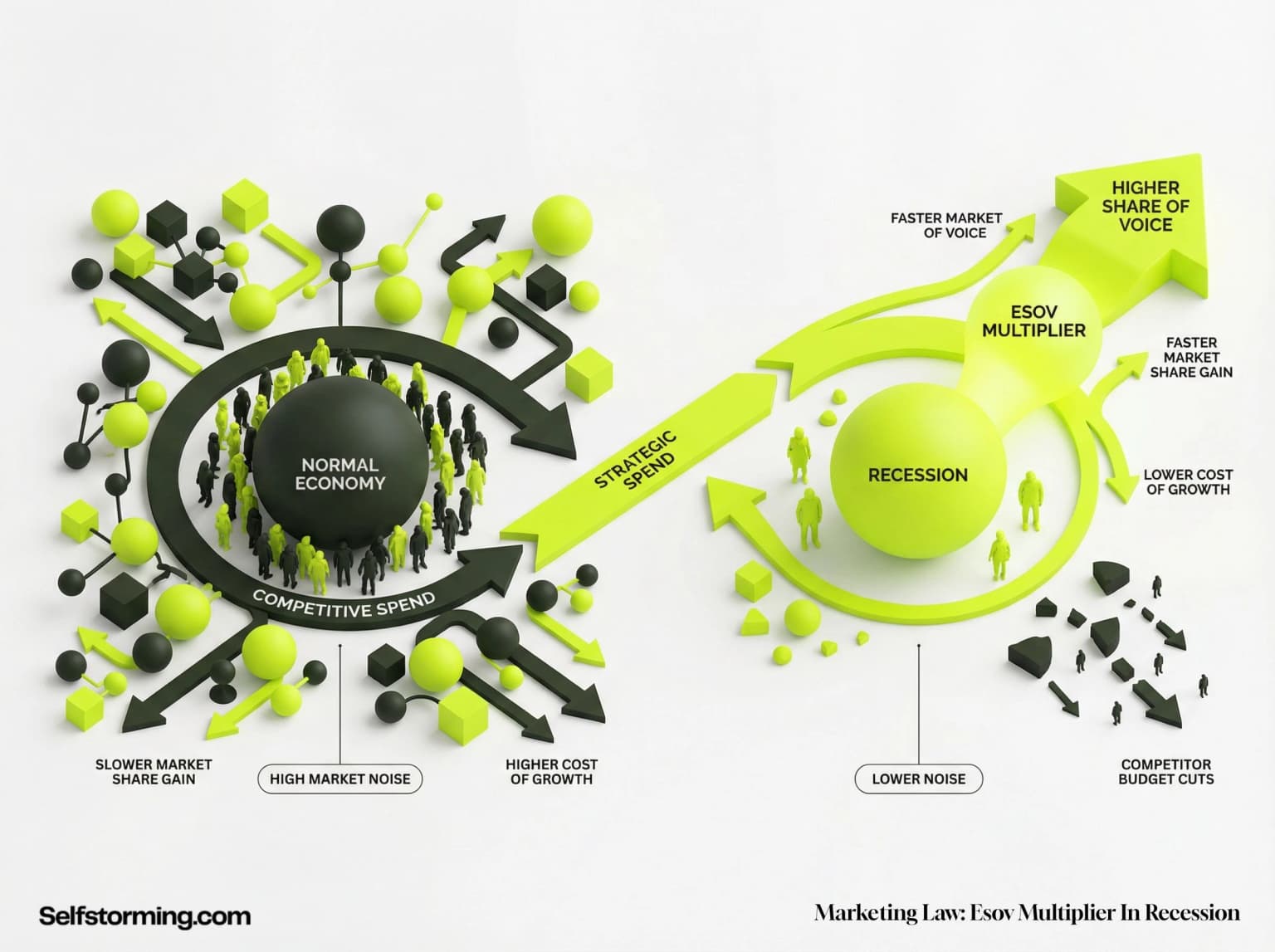
The ESOV (Extra Share of Voice) Multiplier in a recession describes the phenomenon where the effectiveness of marketing spend increases significantly during economic downturns. Because competitors typically slash their advertising budgets, the total 'noise' in the market decreases. A brand that maintains or increases its budget achieves a much higher Share of Voice (SOV) for every dollar spent. This creates a larger gap between SOV and Share of Market (SOM), known as ESOV. Research by Peter Field and the IPA demonstrates that this 'Extra' share is more potent during a recession, leading to faster market share gains at a lower cost per point of growth compared to stable economic periods. Essentially, the 'cost of growth' drops when everyone else stops trying.

ESOV MULTIPLIER IN RECESSION

Market share growth is disproportionately accelerated when a brand maintains or increases its Share of Voice during an economic downturn, capitalizing on the reduced competitive noise and lower media costs resulting from rivals' budget cuts.

ESOV Multiplier in Recession marketing law: Recessions are for gaining market share. - Visual illustration showing key concepts and examples

Key Takeaways

  • Recessions lower the 'Noise Floor,' making every ad dollar work significantly harder.
  • Maintaining spend while others cut creates an automatic, 'free' increase in Share of Voice.
  • ESOV is 1.6x more effective at driving market share growth during economic downturns.
  • Brands that invest in recessions see long-term profit growth that outlasts the recovery.
  • The cost of acquiring new market share is at its lowest during a crisis.

Genesis & Scientific Origin

The concept of the ESOV Multiplier in a recession was primarily codified and popularized by Peter Field and Les Binet, drawing on decades of data from the Institute of Practitioners in Advertising (IPA) Databank. While the relationship between SOV and SOM was established earlier (notably by the PIMS project and John Philip Jones), Field’s specific focus on the 'recession multiplier' emerged prominently in the wake of the 2008 Global Financial Crisis. His landmark study, 'Advertising in a Downturn' (2008), published by the IPA, analyzed how brands that maintained investment outperformed those that cut. This work was further refined in 'The Long and the Short of It' (2013), where Binet and Field quantified the 'Extra' Share of Voice (ESOV) as the primary driver of long-term market share growth, noting its heightened efficiency during contractionary cycles.

Brands that increased SOV during a recession saw 5x the market share growth of those that cut. (IPA, 2008)

The Mechanism: How & Why It Works

The mechanism of the ESOV Multiplier is rooted in the mathematical relationship between a brand's Share of Voice (SOV) and its Share of Market (SOM). Under normal economic conditions, the 'equilibrium' rule suggests that a brand with an SOV equal to its SOM will maintain its market position. To grow, a brand must achieve ESOV (SOV > SOM). Typically, a 10-point gap of ESOV leads to roughly 0.5% of market share growth per year.

However, during a recession, two structural shifts occur. First, the 'Noise Floor' drops. As competitors withdraw or reduce spend, the total category advertising expenditure (the denominator in the SOV calculation) decreases. If a brand keeps its absolute spend constant, its relative SOV increases automatically. Second, media deflation often occurs; as demand for ad space drops, the cost per thousand (CPM) or cost per point (CPP) decreases. This allows the same budget to purchase more impressions, further inflating SOV.

Psychologically, the multiplier works through 'Mental Availability.' When competitors go dark, they stop refreshing the memory structures of their consumers. A brand that continues to advertise faces less interference (the 'clutter' effect), making its messaging more salient. This lack of competition for attention allows the brand to occupy vacant mental real estate. Furthermore, the 'Signaling Theory' suggests that continued advertising during a crisis signals brand strength and stability to consumers, fostering trust when they are most risk-averse. The result is a 'Multiplier Effect' where the efficiency of each percentage point of ESOV is significantly higher—often cited as being 1.6x to 2x more effective—than in a 'hot' economy.

ESOV Multiplier in Recession mechanism diagram - How ESOV Multiplier in Recession works in consumer behavior and marketing strategy

Empirical Research & Evidence

The most definitive evidence for the ESOV Multiplier comes from the IPA Databank (Field, 2008), which examined the performance of brands during the 2008 recession. The research found that brands that increased their SOV during the downturn saw an average market share growth of 1.7% per annum, compared to just 0.6% for those that maintained a neutral SOV. Crucially, Field identified that the 'cost of growth' (the amount of ESOV required to gain 1% of market share) was significantly lower during the recession than in the preceding growth years.

Another pivotal study is the research published in the Journal of Advertising Research (Tellis & Tellis, 2009), which analyzed 40 years of data across multiple recessions. They concluded that 'advertising during a recession increases financial performance of the firm' and that the effects are long-lasting, often persisting for up to three years after the economy recovers. Furthermore, a PIMS (Profit Impact of Market Strategy) study of over 1,000 businesses found that 'aggressive spenders' during recessions gained an average of 1.5 percentage points of market share, while those who cut spend gained nothing or lost ground. The specific citation for the primary multiplier effect is Peter Field's (2008) research published in the IPA report 'Advertising in a Downturn'.

Real-World Example:
Reckitt Benckiser

Situation

During the 2008 Global Financial Crisis, most FMCG (Fast-Moving Consumer Goods) giants like P&G and Unilever were looking for 'efficiencies' and trimming marketing budgets to protect short-term margins.

Result

Reckitt Benckiser took the opposite approach, launching a marketing campaign to increase their investment by 25% across their core brands (like Finish and Dettol) while competitors retreated. While the industry saw declining sales, Reckitt reported a 14% increase in net profit and a 10% increase in revenue. By the time the economy recovered in 2010, Reckitt had captured significant market share from its 'prudent' rivals—share that remained sticky and grew their baseline valuation for the next decade. They didn't just survive the recession; they used it as a lever to permanently rebase their market position.

Strategic Implementation Guide

1

Halt the Panic

Immediately present the ESOV data to your CFO to prevent arbitrary budget cuts. Frame marketing as a 'capital investment' in market share rather than an 'operating expense.'

2

Audit the Competitive Noise

Monitor competitor spend in real-time. If your main rivals cut their spend by 30%, a 0% change in your budget effectively increases your SOV by nearly 43% without spending an extra dime.

3

Reallocate to Brand

Shift the ratio toward brand-building (Long) over activation (Short). Recession-weary consumers are less responsive to 'buy now' pressure but more responsive to brands that offer stability and emotional resonance.

4

Exploit Media Arbitrage

Negotiate aggressively with media owners. During downturns, inventory is high and demand is low. Secure long-term contracts at current deflated rates to lock in a high SOV for the recovery phase.

5

Focus on Broad Reach

Don't fall into the 'loyalty trap.' Use your increased SOV to reach light buyers who are currently being ignored by your competitors. This is where the real market share gains are made.

6

Measure Mental Availability

Track your brand's salience compared to competitors. If your SOV is rising while your 'Share of Mind' is static, refine your creative to ensure it's building memory structures, not just filling space.

7

Plan for the Recovery

The ESOV Multiplier is a 'land grab.' Ensure your physical availability (distribution) is ready to handle the increased demand as mental availability converts to sales.

Frequently Asked Questions

Does the ESOV Multiplier work if my entire category is shrinking?

Yes, and it's arguably more important then. In a shrinking category, you are fighting for a larger slice of a smaller pie. The ESOV Multiplier allows you to capture that slice more cheaply. When the category eventually rebounds, you start from a significantly higher baseline, leading to massive absolute growth.

We are a B2B company; does this still apply to us?

Absolutely. B2B buying cycles are longer, and trust is a huge factor. When your competitors stop showing up in trade press or digital channels, it signals instability. Maintaining presence through the ESOV Multiplier ensures you are the 'safe' choice when the procurement freeze thaws.

Can we achieve the same effect with 'Organic' or 'Earned' media instead of paid?

Unlikely. While organic helps, the SOV/SOM relationship is built on 'Reach.' Organic reach is usually limited to your existing fans. To gain market share, you need to reach the 'light buyers' who don't follow you, and that requires the broad-reach capability of paid media.

What if our brand is already the market leader?

Market leaders have the most to lose and the most to gain. A leader that cuts spend during a recession invites 'Double Jeopardy' in reverse. Using the ESOV Multiplier as a leader acts as a defensive moat, making it prohibitively expensive for challengers to catch up later.

How do I explain 'Extra Share of Voice' to a non-marketer?

Tell them it's like buying real estate during a housing crash. Everyone else is selling (cutting ads), which drives the price down. We are 'buying' the attention of the market while it's on sale, knowing that the value of that attention will double when the economy recovers.

We use cookies on our site to enhance your user experience, provide personalized content, and analyze our traffic. Cookie Policy