95/5 Rule
Most buyers aren't buying right now.
Most B2B marketers are shouting into a void where 95% of their audience is literally deaf to their existence. You're out here optimizing landing pages and burning VC money on 'intent data' while your actual customers are busy doing anything except thinking about your SaaS. It’s a brutal reality check from the Ehrenberg-Bass crowd that most of your market isn't buying today, tomorrow, or even next quarter. Stop acting like every click is a conversion and start realizing you're playing a long game in a room where the lights are mostly off. You aren't 'capturing' demand; you're failing to build it.
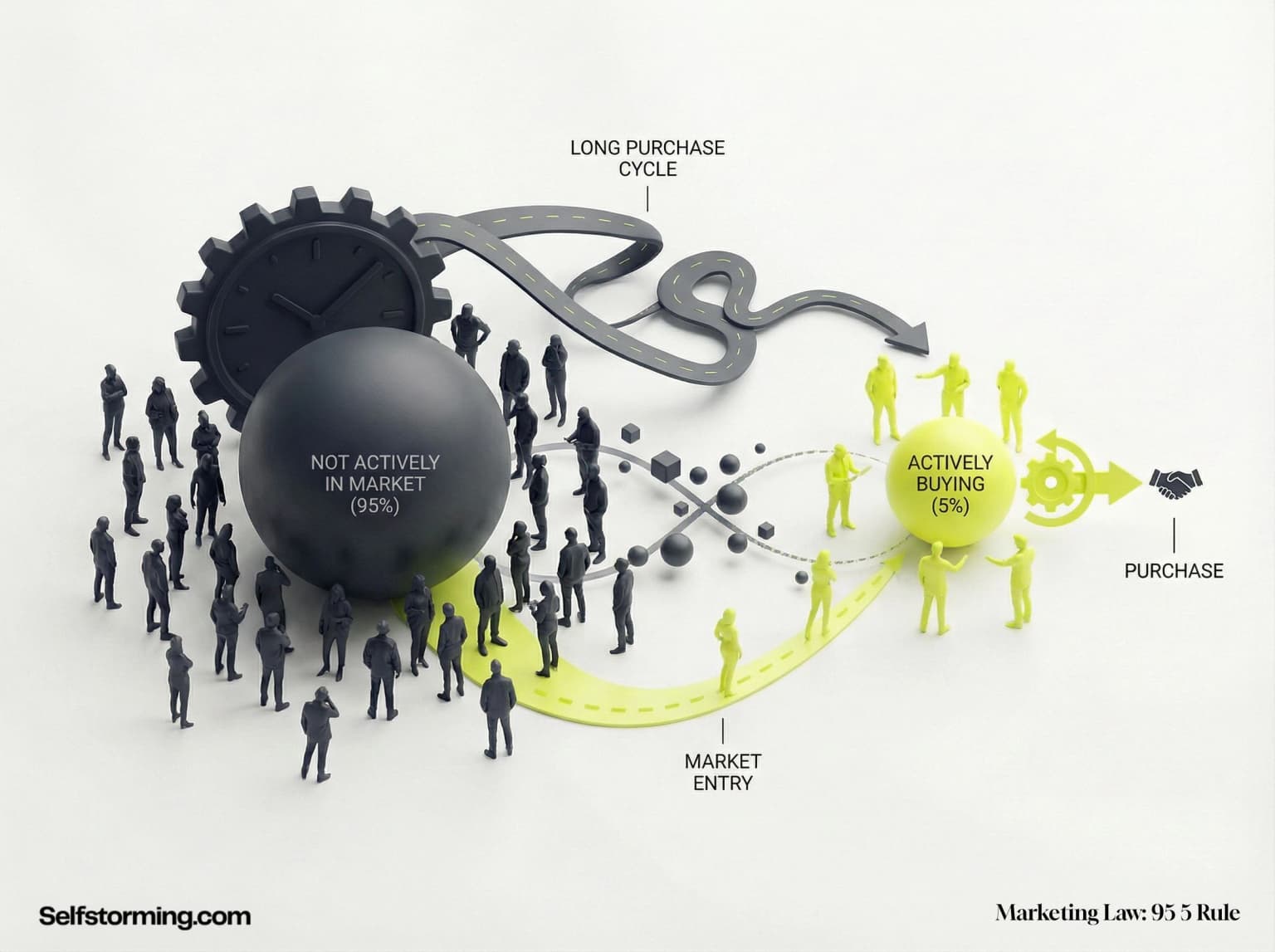
The 95/5 Rule, popularized by the LinkedIn B2B Institute and Professor John Dawes of the Ehrenberg-Bass Institute, posits that at any given moment, only 5% of B2B buyers are 'in-market' for a product or service. The remaining 95% are 'out-of-market' and will not purchase for months or even years. This structural reality of B2B categories means that performance marketing, which targets immediate intent, only addresses a tiny fraction of the potential market. To achieve long-term growth, brands must prioritize 'out-of-market' buyers through consistent brand building and mental availability. By the time a buyer enters the 5% 'in-market' phase, they usually already have a shortlist of brands in mind. If you aren't already in their memory, you've likely lost the sale before it even began. Success in B2B is about being remembered when the buyer finally decides to act.
95/5 RULE
“Business-to-business market structures are defined by long purchase cycles where approximately 95% of potential buyers are not actively in the market for a solution at any given time.”

Key Takeaways
- •95% of your target B2B market is not buying from anyone today.
- •Performance marketing only reaches the 5% who are currently in-market.
- •Growth requires building mental availability in the 95% before they start buying.
- •B2B brands are built in the years between purchase windows, not during them.
- •Advertising's primary job is to ensure your brand is remembered when a trigger occurs.
Genesis & Scientific Origin
The 95/5 Rule emerged from the collaborative research between the LinkedIn B2B Institute and the Ehrenberg-Bass Institute for Marketing Science. While the concept of buying cycles has existed for decades, it was Professor John Dawes who formalized the specific '95/5' ratio in his 2021 report. Dawes analyzed the frequency of B2B purchases across various categories—from banking services to enterprise software—and found a consistent pattern: the vast majority of businesses are not in a 'buying window.' The LinkedIn B2B Institute, led by Peter Weinberg and Jon Lombardo, amplified these findings to challenge the prevailing 'lead generation' obsession in the B2B sector. Their work builds upon the foundational principles of Byron Sharp’s 'How Brands Grow,' applying the laws of mental availability and reach to the specific complexities of B2B procurement. This research was a direct response to the 'Short-Termism' plague identified by researchers like Peter Field and Les Binet, providing a mathematical justification for why B2B brands must invest in long-term brand building rather than just short-term activation.
“Only 5% of B2B buyers are in-market at any given time (Dawes, 2021).”
The Mechanism: How & Why It Works
The mechanism behind the 95/5 Rule is rooted in the physical and temporal constraints of B2B operations. Unlike B2C impulse buys, B2B purchases are typically high-stakes, high-cost, and tied to long-term contracts. A company does not change its cloud provider, its legal firm, or its logistics partner every Tuesday. These products have a 'replacement cycle' that can span three to ten years.
Mathematically, if a business buys a new CRM every five years, they are only 'in-market' for perhaps a few months of that 60-month period. Statistically, this means that in any given week, only 1.6% of the market is looking to buy. The 95/5 split is an average, but the principle remains: the 'Out-of-Market' (OM) audience is significantly larger than the 'In-Market' (IM) audience.
The psychological foundation rests on the concept of 'Mental Availability.' Because buyers spend the vast majority of their time in the OM phase, they are not actively processing product specifications or rational 'why us' arguments. Instead, they are forming passive associations. When a 'Category Entry Point' (CEP) occurs—such as a contract expiring, a system failure, or a business expansion—the buyer's brain searches for brands it already knows. This is the 'Double Jeopardy' of B2B: if you haven't built a memory structure in the 95% phase, you won't even be considered in the 5% phase. The 5% phase is not where you win the customer; it is merely where you harvest the memory you planted years prior. The rule dictates that the primary role of advertising is not to drive an immediate sale, but to ensure that when the 95% transition into the 5%, your brand is the first one they think of.

Empirical Research & Evidence
The most significant empirical validation for this rule is found in the research published by the LinkedIn B2B Institute (Dawes, 2021). In his study titled 'The 95/5 Rule in B2B Marketing,' John Dawes analyzed data regarding the purchase frequency of various B2B services. The research demonstrated that for many B2B categories, the average contract length is approximately five years. This implies that 20% of the market might be 'in-market' over the course of a year, but at any single point in time (such as when an ad is served), only about 5% of potential buyers are actively looking to switch or purchase. Specifically, Dawes and the Ehrenberg-Bass Institute (2021) research published in the LinkedIn B2B Institute report found that B2B buyers of services like corporate banking or payroll software have extremely low churn rates and long inter-purchase intervals. For example, in the corporate banking sector, the average tenure for a relationship can exceed 10 years, meaning the 'In-Market' population at any given moment is closer to 2-3% rather than 5%. This data contradicts the 'performance marketing' assumption that every target prospect is a potential lead. The study concludes that because buyers are out-of-market for so long, the 'decay rate' of memory is the biggest threat to a brand. Therefore, continuous reach is necessary to combat the natural forgetting that occurs during the years-long OM period.
Real-World Example:
Salesforce
Situation
In the early 2000s, Salesforce was a challenger brand in a market dominated by on-premise giants like Oracle and SAP. Most B2B marketers at the time focused on high-intent lead generation and 'feature-war' sales cycles.
Result
Salesforce ignored the standard 'bottom-of-the-funnel' playbook and focused on a massive brand-building campaign centered on the 'No Software' logo. They marketed to the 95% who weren't yet ready to switch their enterprise systems but were frustrated with the status quo. By the time those companies hit their contract renewal or digital transformation triggers (the 5% moment), the 'No Software' cloud concept was the dominant mental association. Salesforce didn't just capture demand; they occupied the mental space of the 95% for a decade. Today, they own roughly 23% of the CRM market share, largely because they spent years building mental availability among buyers who weren't yet 'in-market' for a cloud solution.
Strategic Implementation Guide
Stop the Lead Gen Addiction
Shift your budget from 100% 'Performance/Demand Gen' to a 60/40 split favoring Brand Building. You're starving your future self by only feeding the 5%.
Identify Your Category Entry Points (CEPs)
Research the specific triggers that move your 95% into the 5%. Is it a new CEO? A budget cycle? A hardware failure? Map your creative to these moments.
Optimize for Reach, Not Clicks
Since 95% won't click your 'Book a Demo' button, stop using CTR as a primary metric. Use 'Share of Mind' or 'Unprompted Recall' to measure if the 95% actually know you exist.
Use Distinctive Assets
The 95% are passive observers. They won't read your whitepaper. Use consistent colors, logos, and characters so they can identify your brand in a split second without effort.
Maintain Continuous Presence
Don't 'pulse' your campaigns. The 5% are entering the market every day, unpredictably. If you go dark for three months, you miss the tiny window for a segment of your market.
Simplify the Message
The 95% aren't interested in your technical specs. Give them one clear, emotional, or memorable reason to remember you. Save the specs for the 5% sales deck.
Measure the Long-Term
Track your 'Base Sales' (sales that happen without immediate ad pressure). If your base sales are growing, your brand building with the 95% is working.
Frequently Asked Questions
Does the 95/5 Rule mean I should stop doing lead generation entirely?
Absolutely not. You still need to catch the 5% who are ready to buy today. But if you only do lead gen, you're competing in a bloody price war for a tiny sliver of the market. Lead gen is the harvest; brand building is the irrigation. If you don't irrigate the 95%, eventually there's nothing left to harvest.
What if my product has a shorter buying cycle, like office supplies?
The ratio might shift to 80/20 or 70/30, but the principle is identical. There is always a significant portion of your market that isn't buying right now. Even if they buy every month, they aren't 'in-market' for 29 out of 30 days. The 95/5 Rule is a mental model for understanding that your audience's default state is 'not buying.'
How can I justify 'Brand Building' to a CFO who wants immediate ROI?
Tell them the truth: targeting only the 5% is the most expensive way to grow because it has a hard ceiling. Once you've reached everyone with 'intent,' your CAC (Customer Acquisition Cost) skyrockets. Brand building with the 95% lowers future CAC because it makes your lead gen more efficient when those buyers finally enter the market.
Does 'Intent Data' solve the 95/5 problem?
Intent data is just a way to find the 5% slightly faster. It does nothing for the 95%. In fact, relying solely on intent data often means you're entering the race too late. If you wait for an intent signal to start marketing, your competitors who have been talking to that buyer for the last three years already have the advantage.
What kind of creative works best for the 95%?
Emotional, memorable, and simple creative. The 95% are 'low-involvement' viewers. They aren't looking for a solution yet, so they won't engage with complex logic. They need to 'feel' something about your brand so it sticks in their long-term memory.