B2B Buyers Are Still Human
beings.
Look, I know your sales deck is 45 slides of 'synergistic enterprise solutions' and 'unrivaled scalability,' but here's a reality check: the VP of Procurement doesn't dream in Excel. They dream about not getting fired, looking smart in front of the board, and getting home in time for their kid’s soccer game. If you think B2B is a cold, rational logic-fest, you’re not just wrong; you’re leaving money on the table for competitors who actually understand how brains work. It’s time to stop treating buyers like soulless procurement nodes and start acknowledging the messy, emotional, risk-averse humans they actually are. Your 'rational' approach isn't professional; it's just boring, and in marketing, boring is a death sentence.
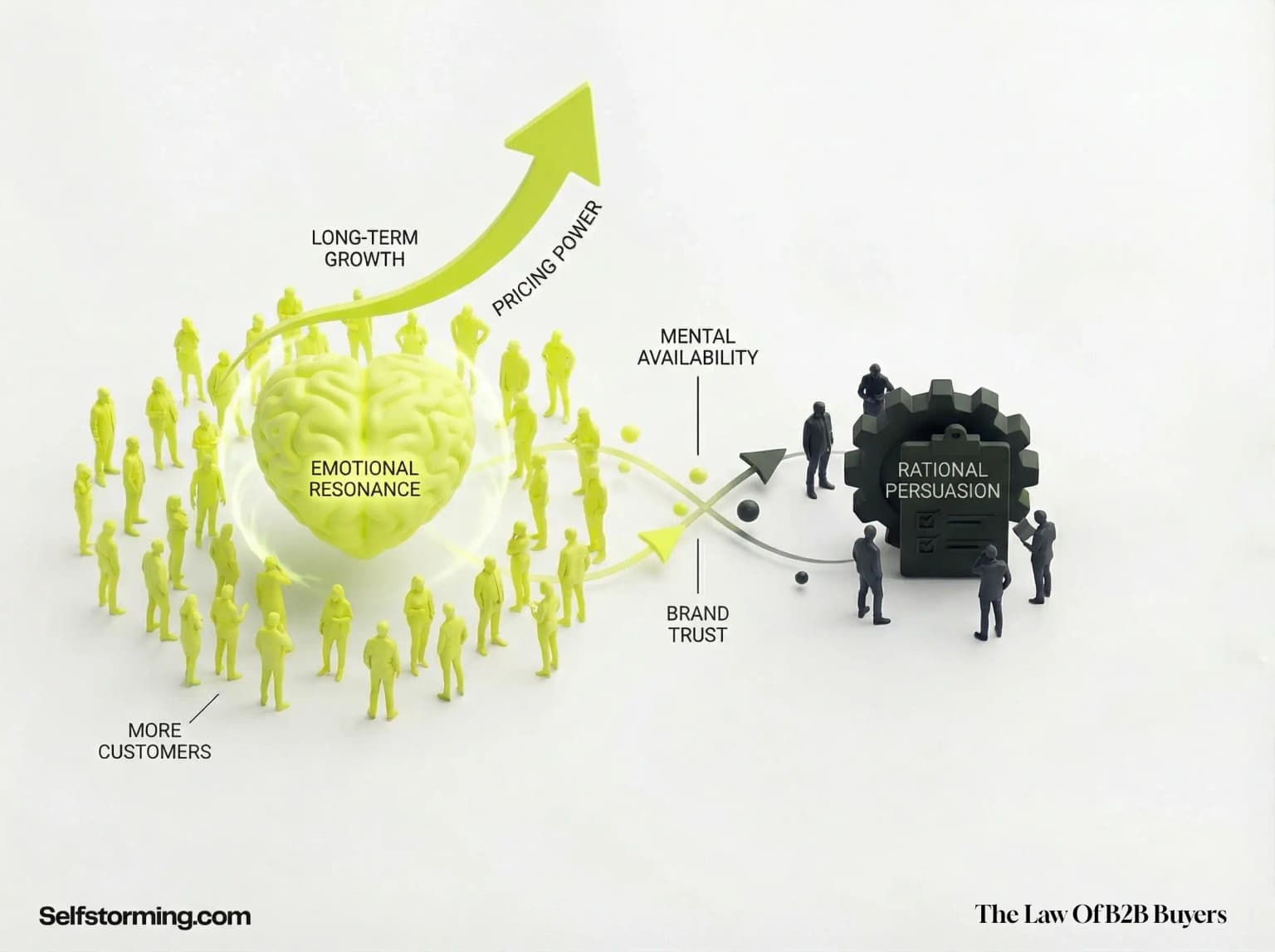
The 'B2B Buyers Are Still Human' law asserts that emotional resonance is more effective than rational persuasion in B2B marketing, contrary to industry myths of the 'logical buyer.' Research from the LinkedIn B2B Institute, Peter Field, and Les Binet demonstrates that emotional brand-building drives significantly higher long-term growth and pricing power than short-term rational activation. Because B2B purchases involve high personal risk (career stakes), buyers rely heavily on 'mental availability' and brand trust to simplify complex decisions. While rational messaging is necessary for the final stages of the funnel to justify a purchase, emotional messaging is the primary engine for reaching the 95% of the market not currently buying. Marketers must balance broad-reach emotional brand building with targeted rational activation to maximize ROI.
B2B BUYERS ARE STILL HUMAN
“Business-to-business purchasing decisions are fundamentally driven by the same emotional triggers, cognitive biases, and heuristic shortcuts as consumer purchases, often exacerbated by the significant personal professional risk associated with high-stakes corporate procurement.”

Key Takeaways
- •B2B buyers prioritize personal career safety over company ROI.
- •Emotional brand building drives 2.4x more business impact than rational messaging.
- •Balance budgets: 50% for long-term brand, 50% for short-term activation.
- •Target the 95% of buyers not currently in-market with emotional creative.
- •Logic justifies the purchase, but emotion drives the initial brand selection.
Genesis & Scientific Origin
The law was formally synthesized and popularized by the LinkedIn B2B Institute, a think tank dedicated to B2B marketing research. Key figures include Peter Field and Les Binet, who applied their decades of 'Long and Short of It' research to the B2B sector. Their landmark study, 'Marketing Effectiveness in the Digital Era' (2019), and subsequent works like 'The 5 Principles of B2B Growth,' challenged the prevailing 'rational-only' dogma in B2B marketing. The research was supported by data from the IPA (Institute of Practitioners in Advertising) and the Ehrenberg-Bass Institute for Marketing Science, proving that the laws of growth (Penetration, Mental Availability) apply as strictly to B2B as they do to B2C.
“Emotional B2B campaigns are 2.4x more likely to drive large business effects over 3+ years (Binet & Field, 2019).”
The Mechanism: How & Why It Works
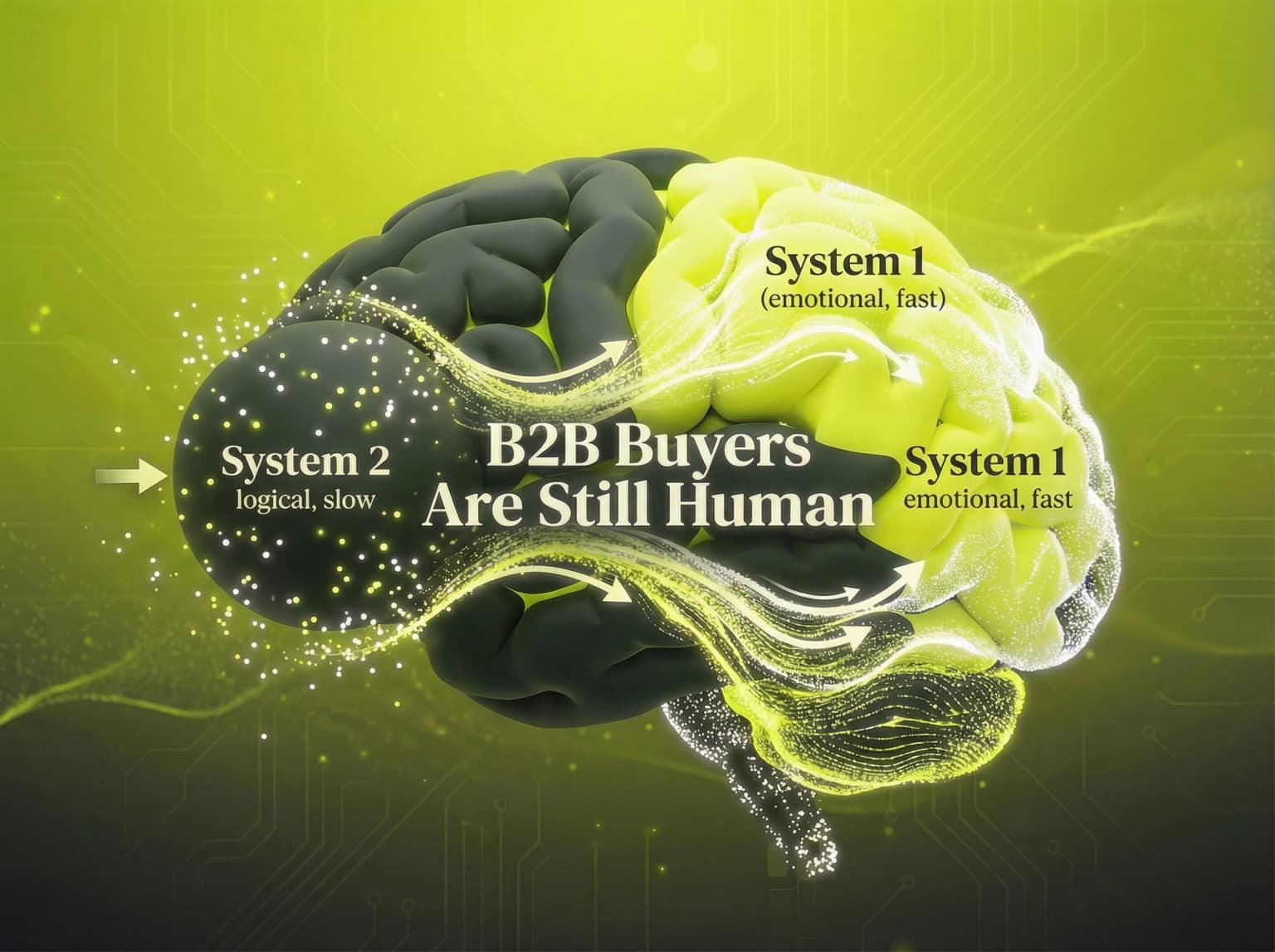
The mechanism behind this law is rooted in evolutionary psychology and behavioral economics. Humans possess two cognitive systems: System 1 (fast, instinctive, emotional) and System 2 (slow, logical, effortful). B2B marketers historically assumed buyers operate exclusively in System 2. However, because B2B decisions are complex and involve overwhelming amounts of data, the brain defaults to System 1 heuristics to manage cognitive load.
1. Risk Mitigation over ROI: In B2C, a bad purchase (e.g., a $3 yogurt) has low stakes. In B2B, a bad purchase (e.g., a $1M software implementation) can cost a buyer their job, their promotion, or their reputation. This makes 'fear of failure' a more powerful driver than 'hope for gain.' Emotional brand building creates 'fame' and 'perceived leadership,' which acts as a safety signal. This is the 'Nobody ever got fired for buying IBM' effect.
2. The 95-5 Rule: At any given time, only about 5% of your total addressable market (TAM) is 'in-market' to buy. The other 95% are 'out-of-market.' Rational, feature-heavy messaging only works for the 5% who are currently comparing specs. For the 95%, rational messaging is ignored because it lacks relevance. Emotional messaging, however, builds 'mental availability'—memory structures that ensure your brand is the first one thought of when that 95% finally enters the market.
3. The Personal Value Gap: Research by CEB (now Gartner) in partnership with Google found that B2B buyers who perceive 'personal value' (e.g., career advancement, pride, popularity) are twice as likely to purchase than those who only see 'business value' (e.g., ROI, efficiency). Business value is the 'table stakes' required to enter the conversation, but personal/emotional value is the 'tie-breaker' that wins the deal.

Empirical Research & Evidence
The LinkedIn B2B Institute (Field & Binet, 2019) analyzed the IPA Databank, which contains thousands of marketing campaigns. Their research, published in 'Marketing Effectiveness in the Digital Era,' found that B2B strategies focusing on emotional brand building were significantly more effective at driving long-term business metrics (profit, share, and penetration) than those focusing on rational activation. Specifically, the study revealed that emotional campaigns produced 2.4x the large business effects compared to purely rational campaigns over a three-year period. Furthermore, the research established the 'B2B 60/40 Rule' (later refined to approximately 50/50 for many B2B sectors), suggesting that for maximum effectiveness, B2B brands should allocate around half of their budget to broad-reach emotional brand building and the other half to targeted rational activation.
Real-World Example:
Salesforce
Situation
Salesforce faced a market where cloud CRM was becoming a commoditized 'utility' sold on features, uptime, and pricing. Most competitors were focused on technical specifications and IT-centric rational messaging.
Result
Salesforce pivoted to the 'Trailblazer' campaign, which focused entirely on the human element. Instead of showing dashboards, they showcased the stories of individual administrators and developers (the 'Trailblazers') whose careers were transformed by the platform. By making the customer the hero and tapping into emotions like pride, community, and career growth, Salesforce built massive mental availability. They moved from being a software tool to a cultural movement within the tech industry. This emotional strategy allowed them to maintain a premium price point and achieve a dominant market share (approx. 23% of the CRM market) that rational competitors couldn't touch.
Strategic Implementation Guide
Stop the 'Feature-Function-Benefit' Vomit
Your first touchpoint should never be a spec sheet. Focus on the 'Why' and the 'Who.' What does the buyer feel before they use you (anxiety, overwhelm) and after (relief, hero-status)?
Adopt the 50/50 Budget Split
Stop dumping 95% of your budget into 'lead gen' (activation). Allocate at least 50% to long-term brand building that targets the 95% of the market not currently buying.
Humanize the Creative
Use real people, faces, and stories. B2B creative is notoriously 'dry.' Use humor, tension, or inspiration to break through the 'sea of sameness.' If your ad looks like a stock photo of two people shaking hands, delete it.
Target the Whole Category
Don't just target 'decision makers.' Target everyone in the firm who might influence the decision or even just recognize the brand. Mental availability works best when the entire committee knows who you are.
Build Distinctive Assets
In a world of blue logos and 'tech' fonts, be different. Create a visual style or a mascot (like Salesforce's characters) that is instantly recognizable without your logo. This builds the memory structures needed for mental availability.
Use Emotion for Reach, Logic for the Close
Use emotional, high-impact creative for your broad-reach top-of-funnel work. Save the whitepapers, ROI calculators, and technical specs for the retargeting and sales enablement phases where the buyer needs to justify their emotional choice to the board.
Measure the Right Things
Stop judging brand campaigns by 'leads generated' this week. Use 'Share of Search' or 'Unprompted Brand Awareness' to measure the health of your emotional brand building over 6-12 month cycles.
Frequently Asked Questions
Doesn't emotional marketing look unprofessional in a serious industry like medical or legal tech?
Professionalism isn't defined by being boring. It's defined by competence. You can be highly competent while still using emotional storytelling. In fact, in high-stakes industries like law or medicine, 'trust' and 'confidence'—which are purely emotional states—are the most important factors in a purchase. If you can't make them feel safe, your 'professional' specs won't matter.
If B2B is emotional, why do we have procurement committees and RFPs?
Procurement committees and RFPs are 'System 2' filters designed to justify a decision, not necessarily to make it. Humans make an emotional choice (System 1) and then use the RFP process to find the logical evidence (System 2) to support that choice. If you haven't won the emotional battle for mental availability before the RFP starts, you're just a number on a spreadsheet.
Does this mean ROI and pricing don't matter?
They matter immensely, but they are 'hygiene factors.' If your ROI is terrible, you'll be disqualified. But if three companies all have good ROI, the winner will be the one the buyer 'feels' better about. Logic gets you on the shortlist; emotion wins the contract.
How do you define 'emotion' in a B2B context? Is it just making people cry?
Rarely. In B2B, 'emotion' usually means 'fame,' 'confidence,' 'belonging,' or 'relief.' It’s about making the brand feel like a 'big deal' so that choosing it feels like the safe, smart, and ambitious thing to do. It's about 'Mental Availability'—being the brand that feels inevitable.
Can small brands afford emotional brand building?
Small brands can't afford *not* to. If you are small and only run rational ads, you will always be compared on price. Emotional distinctiveness is the only way for a small player to punch above their weight and build the 'fame' required to compete with incumbents.