The Long & Short of B2B

B2B needs both quick and slow.

You’re still obsessing over MQLs like they’re the holy grail, while 95% of your market doesn’t even know you exist. Congratulations, you’re efficiently driving your brand into a ditch. Most B2B marketers are just sales assistants with better titles and worse commission, addicted to the short-term hit of 'click-to-lead' metrics while their long-term growth flatlines. If you think your 'Book a Demo' button is building a brand, you're not just wrong—you're expensive. It’s time to stop the lead-gen suicide mission and actually learn how B2B growth works in the real world, not just in your skewed HubSpot dashboard.
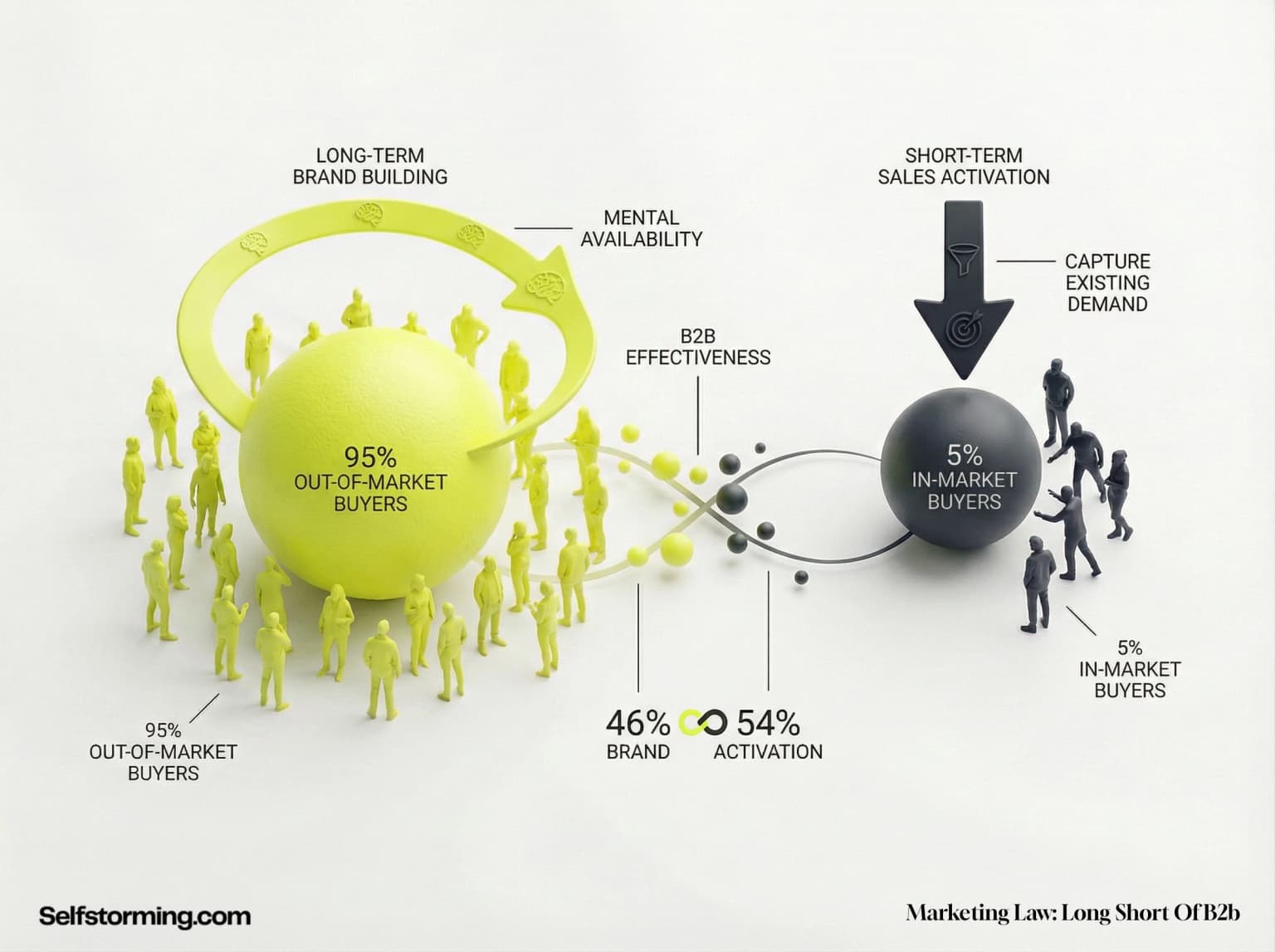
The Long & Short of B2B, pioneered by Les Binet and Peter Field, reveals that B2B growth requires a balanced investment between long-term brand building and short-term sales activation. Unlike B2C's 60/40 split, B2B effectiveness peaks at approximately 46% brand and 54% activation. This is driven by the '95:5 rule,' which posits that at any given time, only 5% of B2B buyers are 'in-market.' Therefore, marketing must build 'mental availability' in the 95% of 'out-of-market' buyers so the brand is the first one recalled when they eventually enter the buying cycle. Relying solely on lead generation (activation) captures existing demand but fails to create new demand, leading to diminishing returns and increased price sensitivity over time.

THE LONG & SHORT OF B2B

B2B marketing effectiveness is maximized when investment is balanced between broad-reach brand building—which creates long-term mental availability and reduces price sensitivity—and targeted sales activation, which converts existing demand into immediate revenue.

The Long & Short of B2B marketing law: B2B needs both quick and slow. - Visual illustration showing key concepts and examples

Key Takeaways

  • Balance your budget at roughly 46% brand and 54% sales activation for peak growth.
  • Target the 95% of out-of-market buyers to build future demand reservoir.
  • Emotional creative builds long-term memory; rational creative drives short-term clicks.
  • Brand building reduces price sensitivity and allows for higher profit margins over time.
  • Measure success over years, not weeks, to capture the compounding effect of brand.

Genesis & Scientific Origin

The principles of 'The Long & Short of B2B' were formally codified by Les Binet (Head of Effectiveness at adam&eveDDB) and Peter Field (Marketing Consultant) in collaboration with the LinkedIn B2B Institute and the IPA (Institute of Practitioners in Advertising). Building upon their seminal 2013 work, 'The Long and Short of It,' which focused primarily on B2C sectors, the duo published 'The Long and Short of B2B' in 2019. This research utilized the IPA Databank, an extensive repository of marketing effectiveness case studies, to analyze over 600 B2B campaigns. Their objective was to determine if the laws of growth identified in consumer markets applied to the complex, multi-stakeholder, and long-cycle world of B2B commerce. The findings confirmed that while the fundamental mechanics of brand and activation remain constant, the optimal ratios and creative strategies require specific adjustments for the B2B context.

At any given time, only 5% of B2B buyers are in-market for a solution.

The Mechanism: How & Why It Works

The fundamental mechanism of the Long & Short of B2B rests on the temporal and psychological distinction between 'Brand Building' and 'Sales Activation.' Brand building works by creating and strengthening memory structures (mental availability) in the minds of potential buyers. This process is slow, emotional, and broad-reach; its effects are cumulative and decay slowly over years. In B2B, this is critical because of the '95:5 Rule,' identified by Professor John Dawes of the Ehrenberg-Bass Institute. In most B2B categories, approximately 95% of potential buyers are not 'in-market' for a solution at any given moment. Therefore, brand building's primary job is to influence the 95% so that when they finally do enter the market—months or years later—your brand is the 'salient' choice.

Sales activation, conversely, is designed to elicit an immediate response (e.g., 'Download Whitepaper' or 'Contact Sales'). It targets the 5% who are currently in-market. Activation is highly efficient at converting existing demand, but it has a high decay rate; its effects disappear almost immediately after the campaign ends. The mathematical tension arises because activation provides high immediate ROI, tempting CFOs and short-sighted marketers to over-invest. However, without brand building to 'prime' the market, activation eventually hits a ceiling of diminishing returns. Brand building lowers the cost of activation by making the brand more recognizable and trusted, and it allows for higher profit margins by reducing price sensitivity. The 46/54 split is the 'sweet spot' where these two forces work in synergy: the brand building creates a reservoir of future demand, and the activation efficiently harvests it.

The Long & Short of B2B mechanism diagram - How The Long & Short of B2B works in consumer behavior and marketing strategy

Empirical Research & Evidence

The LinkedIn B2B Institute (Binet & Field, 2019) research published in 'The Long and Short of B2B' analyzed campaigns from the IPA Databank to measure 'Effectiveness Scores' against the ratio of brand vs. activation spend. The study found that B2B brands that allocated approximately 46% of their budget to brand-building activities (defined as broad-reach, emotional, non-rational messaging) saw significantly higher growth in market share, profit, and revenue compared to those that focused solely on lead generation. Specifically, the research showed that 'fame-based' creative—work that gets the brand talked about and noticed beyond the immediate buying circle—was the most effective driver of long-term B2B growth. Furthermore, the data indicated that the 'crossover point' where brand building begins to outperform activation is typically around the 6-month mark. Campaigns measured over 2+ years showed that brand-heavy strategies produced 2.5x the business impact of activation-only strategies. The research also utilized the 'Extra Share of Voice' (ESOV) metric, proving that B2B brands that maintain a share of voice higher than their share of market (SOV > SOM) grow faster, provided the creative is balanced toward long-term brand memory structures.

Real-World Example:
ServiceNow

Situation

ServiceNow was traditionally perceived as a niche IT Service Management (ITSM) tool. To achieve massive scale, they needed to move beyond the IT department and reach the C-suite as the 'platform of platforms' for digital transformation. Their marketing had been heavily skewed toward 'Short' activation—technical whitepapers and lead-gen forms targeting IT managers.

Result

By shifting to a 'Long' strategy, ServiceNow launched high-production, emotional brand campaigns (e.g., 'The World Works with ServiceNow') targeting broad business audiences. They maintained their lead-gen infrastructure but balanced it with massive brand investment. This resulted in a dramatic increase in brand salience and 'fame,' allowing them to command premium pricing and expand into HR, Finance, and Customer Service sectors. Their market capitalization grew from roughly $14 billion in 2017 to over $100 billion by 2021, validating the 46/54 principle by building a brand that the C-suite actually recognized before the sales rep ever called.

Strategic Implementation Guide

1

Stop the ROI Addiction

Acknowledge that your high ROAS/ROI on lead-gen is a 'short-term' trap. High ROI often means you are only harvesting existing demand, not creating new growth.

2

Rebalance the Budget

Aim for a 46% Brand and 54% Activation split. If you are currently at 90% lead-gen, move 10% toward brand every 6 months to avoid 'activation shock.'

3

Broaden Your Targeting

Stop hyper-targeting only 'decision makers.' Reach everyone in the category. The junior analyst today is the decision maker in three years. Build mental availability early.

4

Differentiate the Creative

Use emotional, human, and memorable creative for brand building (the Long). Save the rational, feature-heavy, 'boring' stuff for the activation (the Short).

5

Extend the Measurement Window

Measure brand health and market share over 12-24 months. Don't kill a brand campaign because it didn't generate 'leads' in the first 30 days.

6

Invest in 'Fame'

Aim for creative that is distinctive and 'big' enough to be noticed by people who aren't currently looking for your product. If it feels 'safe,' it’s probably invisible.

7

Align Sales and Marketing

Educate the sales team that brand marketing isn't 'fluff'; it’s 'pre-selling' that makes their cold calls warm and their close rates higher.

Frequently Asked Questions

Does the 46/54 rule change for early-stage B2B startups?

Yes. In the very early stages (Seed to Series A), you may need to skew more toward activation (70/30) to prove product-market fit and generate immediate cash flow. However, as you scale toward Series B and beyond, you must pivot toward the 46/54 split. If you wait too long to build a brand, your customer acquisition costs (CAC) will eventually skyrocket as you exhaust the 'easy' in-market buyers.

Can we use the same creative for both brand and activation?

Absolutely not. This is a common mistake. Brand creative needs to be emotional, simple, and memorable to build long-term associations. Activation creative needs to be rational, informative, and have a clear call-to-action (CTA). Trying to make one ad do both usually results in a 'muddled middle' that fails at both.

Why is the B2B split different from the B2C 60/40 rule?

B2B typically requires a slightly higher investment in activation (54% vs 40%) because B2B buying cycles are longer and involve more 'friction' (procurement, multiple stakeholders, legal). You need more 'Short' activity to nudge these complex deals across the finish line, but the 'Long' brand building remains the primary engine of growth.

Is Account-Based Marketing (ABM) considered Brand or Activation?

Most ABM is Sales Activation. It is highly targeted and focused on immediate conversion within a specific set of accounts. While it is effective, it does not build broad-market mental availability. You cannot grow a category-leading brand through ABM alone; you need the 'Long' reach to influence the future buyers you haven't identified yet.

How do we measure 'Brand' if not by leads?

Use 'Share of Search' (your brand's search volume vs competitors), 'Unprompted Brand Awareness,' and 'Mental Penetration' (how many Category Entry Points your brand is associated with). These metrics correlate much more closely with future market share than MQLs do.

We use cookies on our site to enhance your user experience, provide personalized content, and analyze our traffic. Cookie Policy