Pratfall Effect
Imperfection makes your brand human.
You’re still out here polishing your brand like a used car salesman in a cheap suit, aren't you? Thinking that if you hide every crack, every delay, and every mediocre feature, people will finally love you. Newsflash: they don't. They see right through your 'industry-leading' nonsense. Humans are hardwired to distrust perfection because perfection is a lie. If you want people to actually believe your strengths, you need to stop acting like you don't have weaknesses. It’s time to lean into the flaw, or keep shouting into the void of indifference. Your choice. This is the Pratfall Effect, and it's the only reason anyone will ever believe your 'world-class' claims.
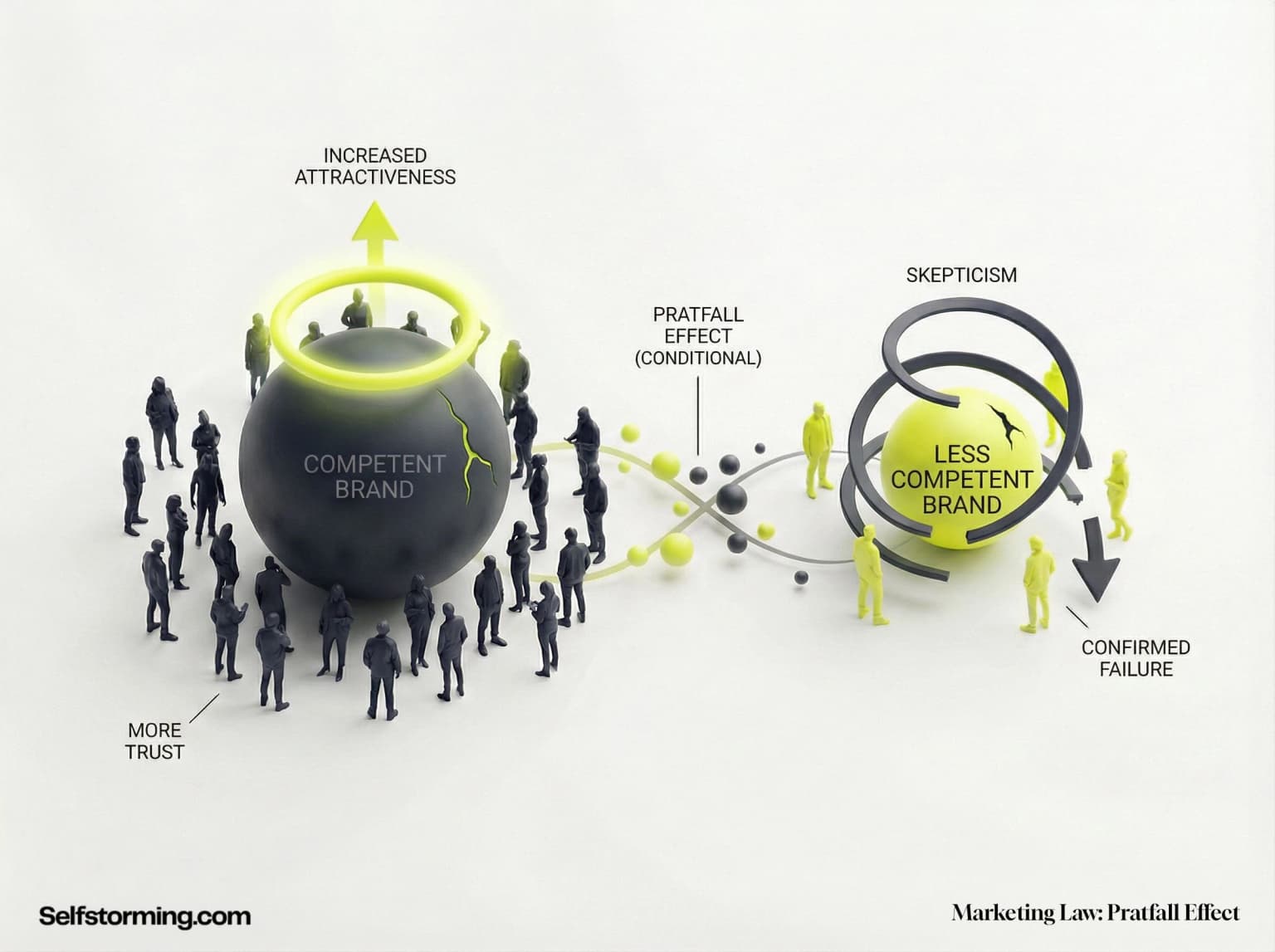
The Pratfall Effect is a psychological phenomenon where an individual's or brand's perceived attractiveness or credibility increases after they make a mistake or admit a flaw—provided they are already perceived as competent. In a marketplace saturated with over-polished, hyperbolic claims, admitting a minor imperfection acts as a powerful signal of honesty. It creates a 'halo of credibility' around the brand's other, more positive claims. By humanizing the entity and breaking the 'too good to be true' barrier, marketers can bypass consumer skepticism. However, the effect is conditional: if a brand is already seen as incompetent, admitting a flaw only confirms their failure. Applied correctly, it transforms liabilities into trust-building assets, making the brand more relatable and its core value propositions significantly more persuasive to an increasingly cynical audience.
PRATFALL EFFECT
“Perceived attractiveness and trustworthiness of a competent entity increase following a minor mistake or the disclosure of a flaw, as the admission signals honesty and mitigates the skepticism typically directed toward flawless presentations.”

Key Takeaways
- •Perfection triggers consumer skepticism; minor flaws build genuine credibility and trust.
- •The effect only works if the brand is already perceived as highly competent.
- •Admitting a flaw signals honesty, making all other brand claims more believable.
- •Choose 'safe' flaws that don't compromise your core product promise or safety.
- •The Pratfall Effect humanizes brands, reducing the social distance between brand and consumer.
Genesis & Scientific Origin
The Pratfall Effect was first formally defined and empirically tested by social psychologist Elliot Aronson in 1966 at the University of Minnesota. Aronson, along with colleagues Ben Willerman and Joanne Floyd, sought to understand the relationship between competence, fallibility, and interpersonal attraction. Their seminal paper, 'The effect of a pratfall on increasing interpersonal attractiveness,' published in Psychonomic Science, challenged the prevailing assumption that perfection was the ultimate driver of likability. In the marketing context, the concept was popularized and brought into the modern evidence-based marketing fold by Richard Shotton in his 2018 book, 'The Choice Factory.' Shotton applied these psychological foundations to consumer behavior, demonstrating how brands could leverage their own 'pratfalls' to build disproportionate levels of trust in an era of peak consumer skepticism. The theory draws heavily from the broader field of Social Perception and has been validated across various cultural and commercial contexts over the last six decades.
“Competent individuals who committed a pratfall were rated 45% more attractive than those who didn't (Aronson et al., 1966).”
The Mechanism: How & Why It Works
The mechanism behind the Pratfall Effect is rooted in the psychology of 'Honest Signaling' and the mitigation of 'Persuasion Knowledge.' When a brand presents itself as perfect, it triggers the consumer’s Persuasion Knowledge Model (PKM). The consumer recognizes the communication as an attempt to manipulate their perception, leading to a defensive stance where every claim is scrutinized or discounted. By admitting a flaw, a brand effectively 'disarms' the consumer. This admission acts as a costly signal; the brand is essentially saying, 'We are so confident in our primary strengths that we can afford to tell you the truth about our secondary weaknesses.' This creates a 'Halo of Credibility.' If a brand is honest about its product being expensive, its delivery being slow, or its taste being bitter, the consumer subconsciously assumes the brand must also be telling the truth about its quality, durability, or effectiveness. Mathematically, this can be viewed as a Bayesian update: the prior probability of a brand's claim being true is low when the brand is perceived as a biased source. However, the admission of a negative attribute increases the perceived reliability of the source, thereby increasing the posterior probability that the brand's positive claims are also true. Furthermore, there is a humanizing element. Social perception research suggests that we find highly competent individuals intimidating or unrelatable. A minor mistake (the pratfall) bridges this social distance, making the entity more approachable. Crucially, the 'Competence Floor' must be met. If the entity is perceived as mediocre or incompetent, a mistake does not humanize; it merely confirms the existing negative perception, leading to a decrease in attractiveness. This is why the Pratfall Effect is a strategy for the strong, not a mask for the weak.

Empirical Research & Evidence
The foundational study by Elliot Aronson, Ben Willerman, and Joanne Floyd (1966), published in Psychonomic Science, utilized a controlled experiment involving 48 male students. Participants listened to tape recordings of a candidate for a 'College Bowl' quiz show. The candidates were manipulated across two variables: competence (high vs. average) and the occurrence of a 'pratfall' (spilling a cup of coffee vs. no spill). The 'superior' candidate answered 92% of the questions correctly and discussed impressive undergraduate achievements, while the 'average' candidate answered 30% correctly and described mediocre achievements. The results showed that the superior candidate who committed the pratfall (spilling coffee) was rated as significantly more attractive (a mean score of 30.2) than the superior candidate who did not commit the pratfall (20.8). Conversely, when the average candidate committed the same pratfall, their attractiveness rating decreased from 17.8 to -2.5. In a more recent marketing-specific application, Richard Shotton's (2018) research published in 'The Choice Factory' involved a study with 626 participants who were shown two versions of an advertisement for a fictitious cookie brand. One version showed a perfect cookie, while the other showed a cookie with a broken edge. Despite the broken edge being a physical flaw, the 'imperfect' cookie was rated as significantly more appealing and trustworthy. This suggests that the visual representation of a flaw functions identically to a verbal admission in triggering the effect.
Real-World Example:
Avis Car Rental
Situation
In the early 1960s, Avis was struggling in the shadow of the market leader, Hertz. They had a 10% market share and were losing money. Traditional marketing wisdom dictated that they should claim to be the best or hide their second-place status. Instead, the agency Doyle Dane Bernbach (DDB) leaned into the weakness.
Result
The 'We're No. 2. We Try Harder' campaign was launched in 1962. By admitting they were not the leader, Avis gained instant credibility. Consumers reasoned that if they weren't the biggest, they had to be better in service to survive. This 'pratfall' (admitting inferiority in size) made their claim of superior service believable. Within a year, Avis went from losing $3.2 million to a profit of $1.2 million, and their market share jumped from 11% to 34% by 1966. It remains one of the most successful applications of the Pratfall Effect in advertising history.
Strategic Implementation Guide
Establish Baseline Competence
Ensure your product or service meets a high standard of core performance before attempting this. If you’re already failing at your main job, admitting it just makes you look like a disaster, not an honest broker.
Identify the 'Safe' Flaw
Select a weakness that is secondary to your core value proposition. If you’re a safety-focused car brand, don't admit to bad brakes; admit to a cramped backseat or a confusing infotainment system.
Connect the Flaw to a Strength
Frame the weakness as the logical trade-off for a major benefit. 'We're expensive because we use the highest quality materials' or 'Our app is slow because it’s doing deep, complex analysis.'
Be Explicit and Direct
Don't bury the admission in fine print. The Pratfall Effect requires the flaw to be noticed to work. Make it a central part of your narrative to maximize the 'honest signaling' impact.
Target High-Skepticism Audiences
Deploy this strategy specifically when targeting savvy, cynical, or high-income demographics who are most likely to be repelled by traditional 'perfect' marketing.
Monitor Brand Perception
Use sentiment analysis to ensure the flaw isn't overshadowing your strengths. The goal is to increase likability, not to become the 'bad' brand.
Maintain Consistency
Don't admit a flaw and then immediately return to hyperbolic puffery. The credibility gained from a pratfall is fragile and requires a consistent tone of honesty.
Frequently Asked Questions
Can a startup with no reputation use the Pratfall Effect?
It's risky. The Pratfall Effect requires a baseline of perceived competence. If the audience doesn't know you're good yet, admitting a flaw might just define you as 'the brand that's not quite there.' Startups should first establish their 'Superior Candidate' status before spilling the coffee.
Does this work for luxury brands that rely on perfection?
Yes, but the 'flaw' must be carefully chosen. For luxury, the flaw is often 'exclusivity' or 'difficulty of acquisition.' Ferrari doesn't admit their cars are unreliable; they 'admit' they are difficult to drive and hard to get. This reinforces the core value of elite performance.
Is there a limit to how many flaws I should admit?
Absolutely. One well-chosen flaw builds credibility; a list of flaws builds a bankruptcy filing. The goal is a strategic strike of honesty, not a total confession of inadequacy. Stick to one 'pratfall' per campaign.
How does the Pratfall Effect interact with the 60/40 Rule?
The Pratfall Effect is primarily a brand-building tool (the 60%). It builds long-term mental availability and trust. Using it in short-term activation (the 40%) can sometimes slow down the 'buy now' impulse, so it's best utilized in top-of-funnel creative.
Will my legal team let me do this?
Probably not without a fight. Legal and compliance departments are trained to minimize risk by hiding flaws. Your job is to prove that the 'risk' of being ignored and distrusted by appearing perfect is actually higher than the risk of admitting a minor truth.
Sources & Further Reading
Related Marketing Laws
Social Proof Effect
People copy the behavior of others, especially in uncertainty.
The Generation Effect
People remember better what they've actively completed themselves.
Peak-End Rule
People judge experiences by their peak moment and ending, not the average.
Costly Signaling
Expensive advertising signals quality and commitment to customers.