Social Proof Effect
People follow what others do.
Look, your 'unique selling proposition' is cute, but let’s be real: your customers are basically sheep in expensive sneakers. They don't want to make a decision; they want to see what everyone else is doing so they don't look like an idiot. If you’re still trying to 'convince' people with logic while ignoring the fact that we’re all hardwired to follow the herd, you’re not just wasting money—you’re fighting a losing battle against human evolution. Put down the focus group report and start looking at the line outside the store. That’s where the real marketing happens. People aren't looking for the 'best' option; they're looking for the 'safest' option, and safety is found in numbers. If you aren't manufacturing that sense of momentum, you're invisible.
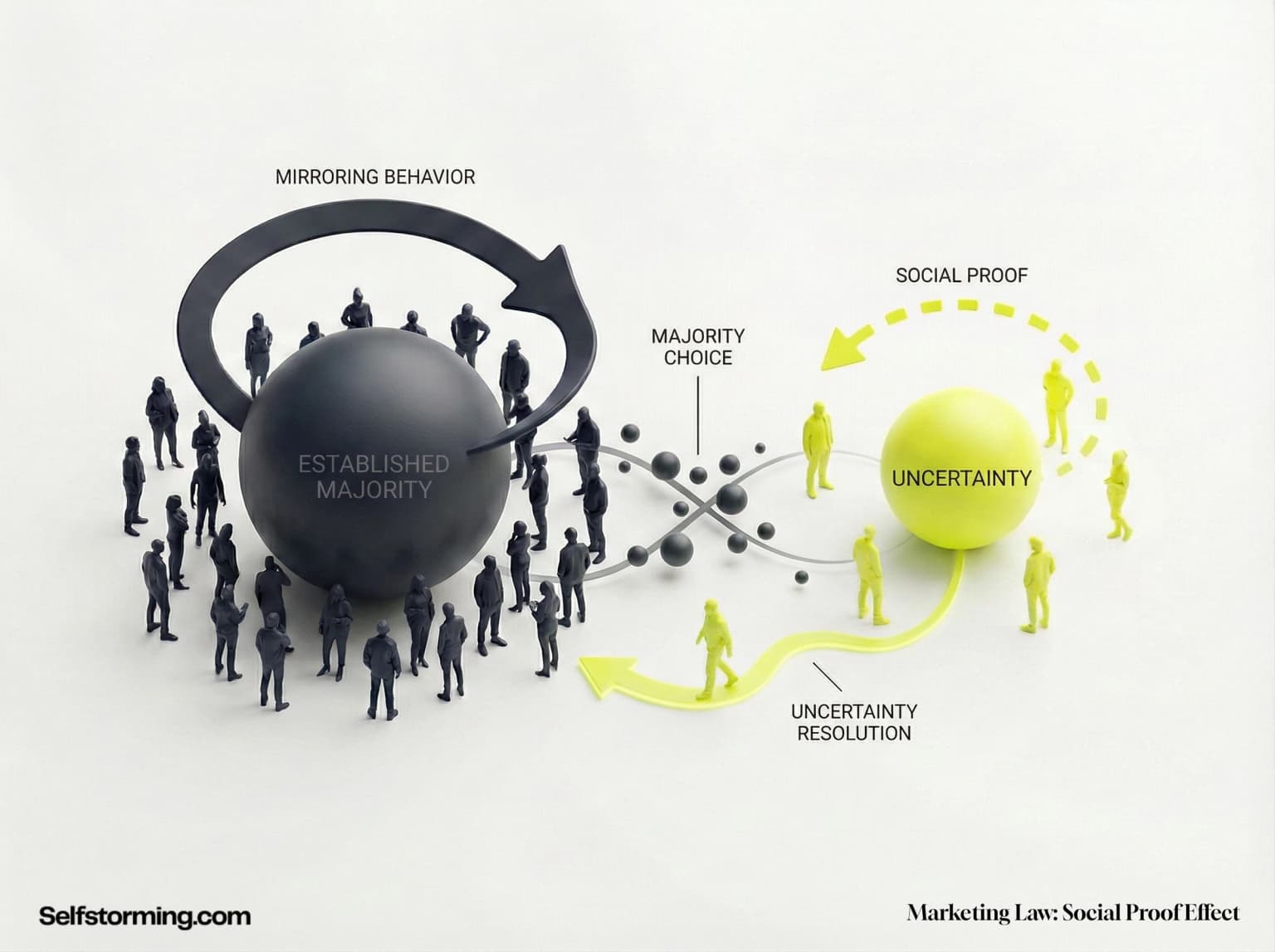
The Social Proof Effect is a psychological and behavioral phenomenon where individuals look to the actions and behaviors of others to determine their own, particularly in states of uncertainty. Rooted in evolutionary survival, this 'herd mentality' acts as a cognitive shortcut (heuristic) to reduce the mental energy required for decision-making. In a marketing context, social proof transforms 'popularity' into a proxy for 'quality.' When consumers see others using a product, leaving positive reviews, or forming a queue, the perceived risk of purchase drops significantly. It is not merely a suggestion but a structural force that dictates market leadership. Brands that successfully signal high volume and mass acceptance trigger 'informational social influence,' where the crowd’s choice is perceived as the most rational evidence of value, regardless of the product's objective features.
SOCIAL PROOF EFFECT
“The phenomenon where individuals mirror the actions of others to resolve uncertainty, operating on the heuristic that the majority's behavior reflects the most effective or appropriate choice.”

Key Takeaways
- •Uncertainty is the catalyst; social proof is the psychological cure.
- •People don't want the best; they want the most popular 'safe' choice.
- •Specific numbers beat vague claims every single time in social proof.
- •Similarity matters: we follow people who look, act, and work like us.
- •Negative social proof (highlighting low adoption) will actively kill your conversion rates.
Genesis & Scientific Origin
The scientific foundation of social proof was established long before it became a buzzword in digital marketing agencies. The earliest rigorous exploration of this phenomenon can be traced back to Muzafer Sherif (1935) and his experiments on the 'autokinetic effect.' Sherif placed subjects in a dark room with a single stationary point of light. Due to a visual illusion, the light appears to move. When individuals were tested alone, their estimates of the light's movement varied wildly. However, when placed in groups, their estimates converged into a collective norm. This demonstrated that people don't just mimic others; they actually use the group to construct their own reality. This was further refined by Solomon Asch (1951) in his famous conformity experiments, which showed that individuals would provide an obviously incorrect answer about the length of a line simply to align with the unanimous (but wrong) consensus of a group. However, it was Dr. Robert Cialdini who formalized 'Social Proof' as one of the six pillars of persuasion in his seminal 1984 book, Influence: The Psychology of Persuasion. Cialdini’s work shifted the focus from laboratory conformity to practical application, illustrating how the 'Power of Us' dictates everything from cult behavior to the success of television laugh tracks. More recently, Richard Shotton in The Choice Factory (2018) has re-contextualized these findings for the modern era, proving that social proof remains the most potent weapon in a marketer's arsenal for overcoming consumer inertia.
“92% of consumers hesitate to make a purchase when there are no customer reviews available.”
The Mechanism: How & Why It Works
The Social Proof Effect operates through two primary psychological drivers: Informational Social Influence and Normative Social Influence. Informational influence occurs when we assume the actions of others reflect superior knowledge. In a world of infinite choice and 'bounded rationality'—a term coined by Herbert Simon—we simply do not have the cognitive bandwidth to evaluate every product. We use the 'Wisdom of the Crowds' as a proxy for research. If a restaurant is full, we assume the food is good; if a software has 10,000 users, we assume it works. This is a System 1 process (as defined by Daniel Kahneman), occurring rapidly and intuitively without conscious deliberation. Normative influence, on the other hand, is driven by the desire to be liked or the fear of being social outcasts. We conform to group standards to maintain social harmony and avoid the 'pain' of being different. From a statistical perspective, social proof functions as a feedback loop. This is known as 'Preferential Attachment' in network science: the probability of a new user choosing a brand is proportional to the number of users the brand already has. This creates a 'Winner-Take-All' dynamic where the leader gains more momentum simply because they are the leader. Furthermore, social proof is amplified by 'similarity.' We are significantly more likely to follow the lead of someone we perceive to be like us (same age, job title, or geography). This is why 'people also bought' algorithms are so effective—they aren't just showing you more products; they are showing you the footprints of your tribe.

Empirical Research & Evidence
One of the most cited and robust studies on the application of social proof is the hotel towel reuse experiment conducted by Noah Goldstein, Robert Cialdini, and Vladas Griskevicius. Their research, published in the Journal of Consumer Research (Goldstein, Cialdini, & Griskevicius, 2008), aimed to see if social proof could outperform traditional environmental appeals. The researchers tested different signs in hotel rooms. The standard environmental appeal stated: 'Help save the environment. You can show your respect for nature and help save the environment by reusing your towels.' The social proof appeal stated: 'Join your fellow guests in helping to save the environment. In a study conducted in late 2003, 75% of the guests who stayed in this hotel... participated in our new resource savings program by using their towels more than once.' The results were staggering: the social proof message increased reuse by 26% compared to the standard appeal. Even more fascinating was their follow-up test using 'local norms.' When the sign said '75% of guests who stayed in this room reused their towels,' the reuse rate jumped by 33%. This study proves that social proof is not just about 'the crowd' in general, but about the specific crowd that the individual identifies with in that moment. It also highlights that descriptive norms (what people actually do) are far more persuasive than injunctive norms (what people should do for the environment).
Real-World Example:
McDonald's
Situation
In the mid-20th century, McDonald's faced the challenge of scaling a new, standardized fast-food concept in a market where 'hamburgers' were often associated with low-quality roadside stands.
Result
McDonald's utilized one of the most famous applications of social proof in history: their signs. Starting in 1955, the signs didn't just list the name; they tracked the volume. First it was 'Over 1 Million Served,' then 5 million, then hundreds of millions, eventually reaching 'Over 99 Billion Served.' By constantly updating this counter, McDonald's wasn't just bragging about their sales; they were providing a continuous, visual signal of safety and mass acceptance. The psychological message was clear: 'If billions of people have eaten here and survived, it’s a safe bet for you too.' This created a massive barrier to entry for competitors. Even today, despite the rise of gourmet burger chains, McDonald's maintains its dominance by leaning into its status as the default choice for the masses, effectively using the Social Proof Effect to maintain its position as a global market leader.
Strategic Implementation Guide
Audit Your Uncertainty Points
Identify the exact moment in the customer journey where the buyer feels the most risk (e.g., the checkout page or the initial demo request). This is where social proof must be deployed most aggressively.
Quantify the Momentum
Stop using vague terms like 'many customers.' Use hard, specific numbers. 'Joined by 12,453 marketers' is infinitely more persuasive than 'Trusted by experts.' Specificity creates credibility.
Segment for Similarity
Don't show a B2B enterprise buyer a testimonial from a solo freelancer. Use dynamic content to show social proof from the user's specific industry, job title, or location. People follow people like themselves.
Leverage the Expert Heuristic
If you lack mass volume, use 'Authority Social Proof.' One endorsement from a recognized industry leader can outweigh a thousand reviews from anonymous users by tapping into the Halo Effect.
Visualize the Activity
Use real-time notifications (e.g., 'Someone in London just bought...') to create a sense of 'Live Social Proof.' This mimics the effect of a crowded store in a digital environment, reducing the feeling of isolation.
Kill Negative Social Proof
Never say 'Only 10% of people recycle' if you want people to recycle. Highlighting the rarity of a behavior discourages it. Always frame the desired behavior as the majority behavior.
Show the 'Messy' Middle
Don't just show 5-star reviews. A 4.7-star average with a few honest, minor critiques is perceived as more authentic and trustworthy than a perfect 5.0, which triggers 'scam' alarms.
Frequently Asked Questions
Is social proof less effective in B2B marketing than in B2C?
Actually, it’s often *more* effective in B2B. In B2C, the risk is usually just a few wasted dollars. In B2B, a bad purchase can cost someone their job or their reputation. This 'professional risk' makes B2B buyers hyper-reliant on social proof. They want to know who else in their industry is using your tool so they can justify the decision to their boss. 'Nobody ever got fired for buying IBM' is the ultimate B2B social proof mantra.
Can you have too much social proof?
Only if you are positioning your brand as an 'exclusive' or 'luxury' item. For high-status goods, mass social proof can actually trigger 'snob effect' (counter-conformity), where the buyer wants to be different from the crowd. However, for 95% of brands, there is no such thing as too much proof—only poorly communicated proof.
What if my brand is brand new and has no customers yet?
You 'borrow' social proof. Use 'Ingredient Social Proof' (e.g., 'Powered by AWS'), 'Founder Social Proof' (mentioning your team's past successes), or 'Early Adopter Social Proof' (giving the product away to influencers in exchange for early feedback). You aren't lying; you're just highlighting the credibility you *do* have while you build the volume.
Does social proof work on 'experts' who know the psychology?
Yes. Awareness of the bias does not grant immunity to it. Experts are still human and still use heuristics to save time. In fact, experts often rely on the 'Expert Consensus' (what their peers are doing) even more heavily to maintain their standing within their professional community.
Are reviews the only form of social proof?
Hardly. Social proof includes: user counts, celebrity endorsements, expert certifications, 'as seen in' media logos, case studies, social media follower counts, and even the 'Pratfall Effect' (admitting a small flaw to make your strengths more believable). Anything that signals 'others have been here and liked it' counts.
Sources & Further Reading
Related Marketing Laws
Pratfall Effect
Admitting a weakness increases credibility and likability.
The Generation Effect
People remember better what they've actively completed themselves.
Peak-End Rule
People judge experiences by their peak moment and ending, not the average.
Costly Signaling
Expensive advertising signals quality and commitment to customers.