Price-Quality Heuristic
Price tells the story of quality.
You’re sitting there sweating over a 10% discount to 'stimulate demand' while your brand value bleeds out in the gutter. You think you're being competitive, but you're actually just telling your customers that your product is a piece of junk. Most marketers treat pricing as a math problem; real strategists treat it as the most potent psychological weapon in the arsenal. If you don't understand that the price tag is the product, you're not playing the game—you're just the casualty.
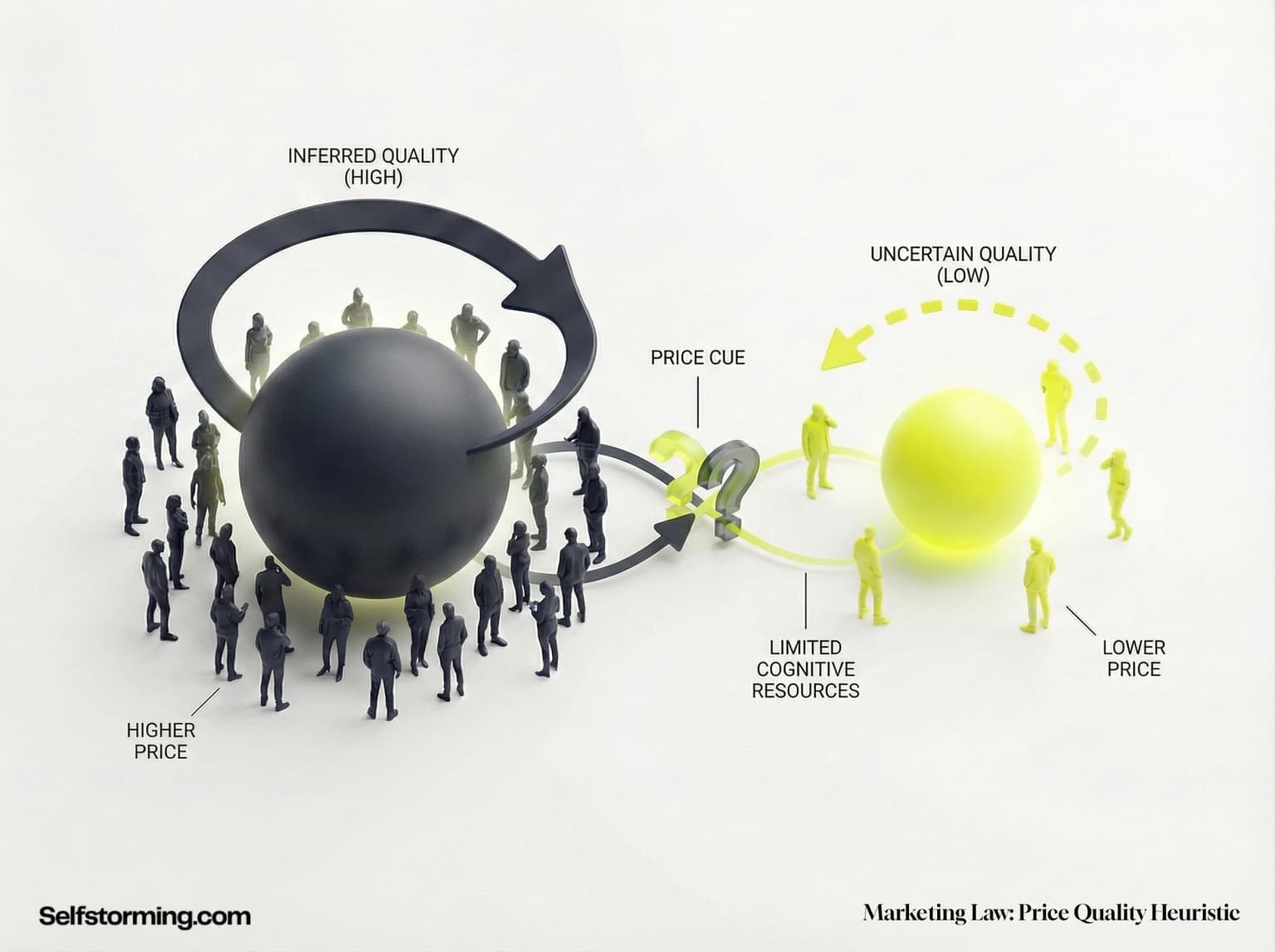
The Price-Quality Heuristic is a cognitive shortcut where consumers use the price of a product as a primary indicator of its intrinsic quality, especially when they lack the expertise or time to evaluate the product objectively. In environments of high uncertainty or 'informational asymmetry,' a higher price functions as a powerful signal of prestige, durability, and superior performance. Conversely, aggressive discounting often triggers a 'cheapness signal,' leading consumers to assume the product is flawed or inferior. This heuristic is not merely a perception; neurobiological research proves that higher prices can actually increase the physical pleasure derived from a product. For marketers, this means pricing is a positioning tool, not just a cost-plus calculation. Charging more doesn't just increase margins—it literally makes the product 'better' in the mind of the buyer.
PRICE-QUALITY HEURISTIC
“Consumers utilize price as a surrogate informational cue to infer the latent quality of a product or service under conditions where objective evaluation is difficult or cognitive resources are limited.”

Key Takeaways
- •Price is a psychological signal of quality, not just a financial transaction.
- •Higher prices can neurologically increase the actual enjoyment of a product.
- •Discounting is a 'brand tax' that signals inferiority to the consumer.
- •The heuristic is strongest when consumers lack expertise in the category.
- •Premium pricing requires consistent high-end contextual cues to avoid cognitive dissonance.
Genesis & Scientific Origin
The academic formalization of the Price-Quality Heuristic traces back to the mid-20th century, notably pioneered by Tibor Scitovsky in his 1945 seminal paper 'Some Consequences of the Habit of Judging Quality by Price' published in The Review of Economic Studies. Scitovsky argued that in a complex market, consumers are often unable to judge the technical merits of a product, leading them to rely on price as a 'handy guide.' This was further expanded by Gabor and Granger (1966), who identified the 'price-quality relationship' as a fundamental component of consumer choice. In the modern era, behavioral economists like Richard Shotton have revitalized these concepts, demonstrating how price acts as a 'contextual cue' that shapes the entire consumption experience, moving it from a rational economic choice to a psychological phenomenon.
“Identical wine labeled $45 vs $5 showed significantly higher activity in the brain's reward center (Plassmann et al., 2008).”
The Mechanism: How & Why It Works
The Price-Quality Heuristic operates through several deep-seated psychological and economic channels. At its core is 'Cue Utilization Theory,' which suggests that products are composed of various cues (intrinsic like ingredients, extrinsic like brand and price). When intrinsic cues are difficult to process—say, when buying a complex software package or a bottle of wine—the brain defaults to the most visible extrinsic cue: the price. This is a System 1 process; it’s fast, automatic, and requires zero mental heavy lifting.
Furthermore, the heuristic is reinforced by 'Signaling Theory.' In economic terms, a high price is a 'signal' that the manufacturer has 'skin in the game.' The logic follows that a firm would not risk its reputation or the high costs of premium positioning on a sub-par product. Therefore, the price acts as a credible proxy for quality. There is also the 'Expectancy Effect'—a form of self-fulfilling prophecy. When a consumer pays more, they expect a better experience. This expectation primes the brain to focus on the positive attributes of the product while ignoring flaws, a phenomenon known as 'motivated reasoning.'
Beyond mere perception, the heuristic taps into 'Social Signaling' or 'Veblenian' consumption. Here, the high price is the feature itself, signaling the buyer's status and resource access to their peer group. In these cases, the demand curve can actually invert (the Veblen effect), where demand increases as price rises because the exclusivity of the product is its primary utility. Finally, there is the 'Neurobiology of Value.' fMRI studies show that higher prices don't just change what people say about a product; they change the actual neural firing in the medial orbitofrontal cortex—the part of the brain associated with pleasure. If they think it's expensive, they literally enjoy it more.

Empirical Research & Evidence
A landmark study demonstrating the biological reality of this heuristic was conducted by researchers at the California Institute of Technology and Stanford University, published in the Proceedings of the National Academy of Sciences. The research, titled 'Marketing actions can moderate neural representations of experienced pleasantness' (Plassmann, O'Doherty, Shiv, & Rangel, 2008), utilized functional magnetic resonance imaging (fMRI) to monitor the brain activity of 20 participants during a wine-tasting task.
Participants were told they were tasting five different Cabernet Sauvignons, identified by their retail prices: $5, $10, $35, $45, and $90. In reality, only three wines were used, and two were presented twice with different price tags (e.g., the $5 wine was also presented as the $45 wine). The results were staggering. Participants consistently reported that they liked the 'expensive' wines significantly more than the 'cheap' ones, even when the liquid was identical. More importantly, the fMRI scans showed significantly higher activity in the medial orbitofrontal cortex—the brain's primary reward center—when participants believed they were drinking the $45 or $90 wine compared to the $5 or $10 wine. This study proved that the Price-Quality Heuristic isn't just a social lie we tell ourselves; it actually alters the physical experience of the product at a neurological level.
Real-World Example:
Chivas Regal
Situation
In the 1950s, Chivas Regal was a struggling Scotch whisky brand with stagnant sales and low market share. Despite having a product that was arguably as good as its competitors, it was failing to gain traction in the premium segment.
Result
The brand's management decided on a radical, counter-intuitive strategy: they significantly raised the price of Chivas Regal without changing the product, the packaging, or the advertising. This became known as the 'Chivas Regal Effect.' Almost immediately, sales began to soar. By simply making the product more expensive, they signaled to consumers that Chivas was a superior, luxury spirit. The higher price point created a new mental category for the brand, moving it from 'just another Scotch' to 'the premium choice.' This move successfully leveraged the Price-Quality Heuristic to build a multi-billion dollar brand equity that persists to this day.
Strategic Implementation Guide
Audit your 'Cheapness Signals'
Identify every touchpoint where a low price or aggressive discount might be signaling low quality. If your 'Premium' service is constantly on 50% off Groupon, you're killing your brand.
Decouple Price from Cost
Stop using cost-plus pricing. Your customer doesn't care what it cost you to make; they care what it's worth to them. Price for the perception you want to own, not the margin you want to protect.
Establish a High Anchor
Introduce a 'Super-Premium' version of your product at a significantly higher price point. Even if nobody buys it, it anchors the perception of the entire brand and makes your 'standard' premium tier look like a bargain by comparison.
Invest in 'Contextual Cues'
The Price-Quality Heuristic works best when supported by other signals of quality. If you charge more, your packaging, website UX, and customer service must feel 'expensive.' High price + cheap packaging = cognitive dissonance.
Avoid the 'Middle-Market Trap'
Don't price in the 'mushy middle.' Either be the clear value leader or the clear premium leader. The middle is where brands go to be ignored and eventually replaced by private labels.
Reframe Discounts as 'Rewards'
If you must lower the price, never call it a 'sale.' Frame it as an 'exclusive loyalty reward' or a 'limited-time access' to preserve the integrity of the base price signal.
Educate on the 'Cost of Quality'
Use your marketing to explain *why* it's expensive. Detail the rare ingredients, the artisan process, or the rigorous testing. This provides the rational 'permission' for the consumer to follow their Price-Quality Heuristic.
Frequently Asked Questions
Is there a limit to how much I can raise prices before it backfires?
Yes, it's called the 'Threshold of Ridiculousness.' If the price gap between you and the category average is too wide without a clear 'Reason to Believe' (RTB), the heuristic breaks down and is replaced by 'Price Fairness' concerns. You need to provide enough contextual cues to justify the leap.
Does the Price-Quality Heuristic work in B2B markets?
It's actually more powerful in B2B. Business buyers are risk-averse. A low price for a critical software or consulting service signals high risk. They would rather pay a premium to 'buy the certainty' that the product won't fail and get them fired.
What happens if my competitors all start discounting?
Let them. While they engage in a race to the bottom, they are effectively training the market to view their products as commodities. By holding your price (or raising it), you differentiate yourself as the only 'quality' option left in a sea of cheap alternatives.
Can I use this heuristic if I'm selling a commodity like salt or paper?
Absolutely. Look at Maldon Sea Salt or Moleskine notebooks. They took commodities and used premium pricing, distinctive packaging, and 'origin stories' to trigger the Price-Quality Heuristic, allowing them to charge 5-10x the category average.
How do online reviews affect the Price-Quality Heuristic?
Reviews are 'Social Proof' cues that can sometimes override the price cue. If a product is expensive but has 1-star reviews, the heuristic fails. However, if reviews are generally positive, the high price will amplify the perceived quality even further.
Sources & Further Reading
Related Marketing Laws
Anchoring Effect
The first number you see influences all subsequent judgments.
Decoy Effect
A third option changes preferences between the original two.
Loss Aversion
Losses hurt twice as much as equivalent gains feel good.
Pain of Paying
Payment method affects perceived value and spending behavior.