Pain of Paying
Make it less painful to pay.
Look, your product is probably fine, but the moment you ask for a credit card, you’re basically inviting your customer to a root canal. The Pain of Paying isn't some fluffy 'customer experience' buzzword; it’s a neurological reality where spending money literally triggers the same brain regions as physical pain. If you’re still forcing people to count out digital pennies like it’s a 19th-century bazaar, you’re stabbing your conversion rate in the neck. We’re going to look at why credit cards turn rational adults into spendthrifts and how you can stop your checkout process from feeling like a slow-motion car crash for the customer's wallet.
The 'Pain of Paying' is a fundamental principle in behavioral economics and marketing science which posits that the method of payment significantly influences the perceived value of a purchase and the consumer's willingness to spend. Discovered through neuroeconomic research, the law states that different payment modes trigger varying levels of activation in the insula—the brain region associated with physical pain and negative emotions. Payments that are more 'salient' or 'transparent' (like physical cash) cause higher psychological distress, leading to reduced spending. Conversely, decoupling the act of payment from the act of consumption (via credit cards, digital wallets, or subscriptions) reduces this 'pain,' effectively lowering the psychological barrier to purchase and increasing the total transaction value. For marketers, mastering this law is the difference between a high-friction hurdle and a seamless path to revenue.
PAIN OF PAYING
“The psychological discomfort or negative affective response experienced by individuals during the process of parting with wealth, which varies in intensity based on the transparency, timing, and medium of the payment method.”

Key Takeaways
- •Payment method is not neutral; it dictates how much customers are willing to spend.
- •Cash is the most 'painful' medium; digital and credit are the least.
- •Decoupling payment from consumption reduces the neurological sting of spending.
- •Physical currency symbols ($, £) act as visual triggers for psychological pain.
- •Subscription and pre-payment models 'depreciate' pain, increasing long-term customer satisfaction.
- •Reducing payment friction is often more effective than lowering the actual price.
Genesis & Scientific Origin
The foundational concept of the 'Pain of Paying' was formally introduced and explored by Drazen Prelec and George Loewenstein in their seminal 1998 paper, 'The Red and the Black: Mental Accounting of Savings and Debt,' published in the journal Marketing Science. Prelec, a professor at MIT, and Loewenstein, a professor at Carnegie Mellon University, sought to challenge the classical economic assumption that money is perfectly fungible and that the method of payment is irrelevant to the utility of the purchase. Their research integrated psychology and economics to explain why consumers experience 'moral tax' when paying for immediate consumption. This work was further expanded by neuroscientists like Brian Knutson, who used fMRI technology to prove that the brain's insula fires in response to high prices, providing a biological basis for the psychological theory originally proposed by Prelec and Loewenstein.
“Credit card users are willing to pay up to 113% more than cash users for the same item (Marketing Letters, 2001).”
The Mechanism: How & Why It Works
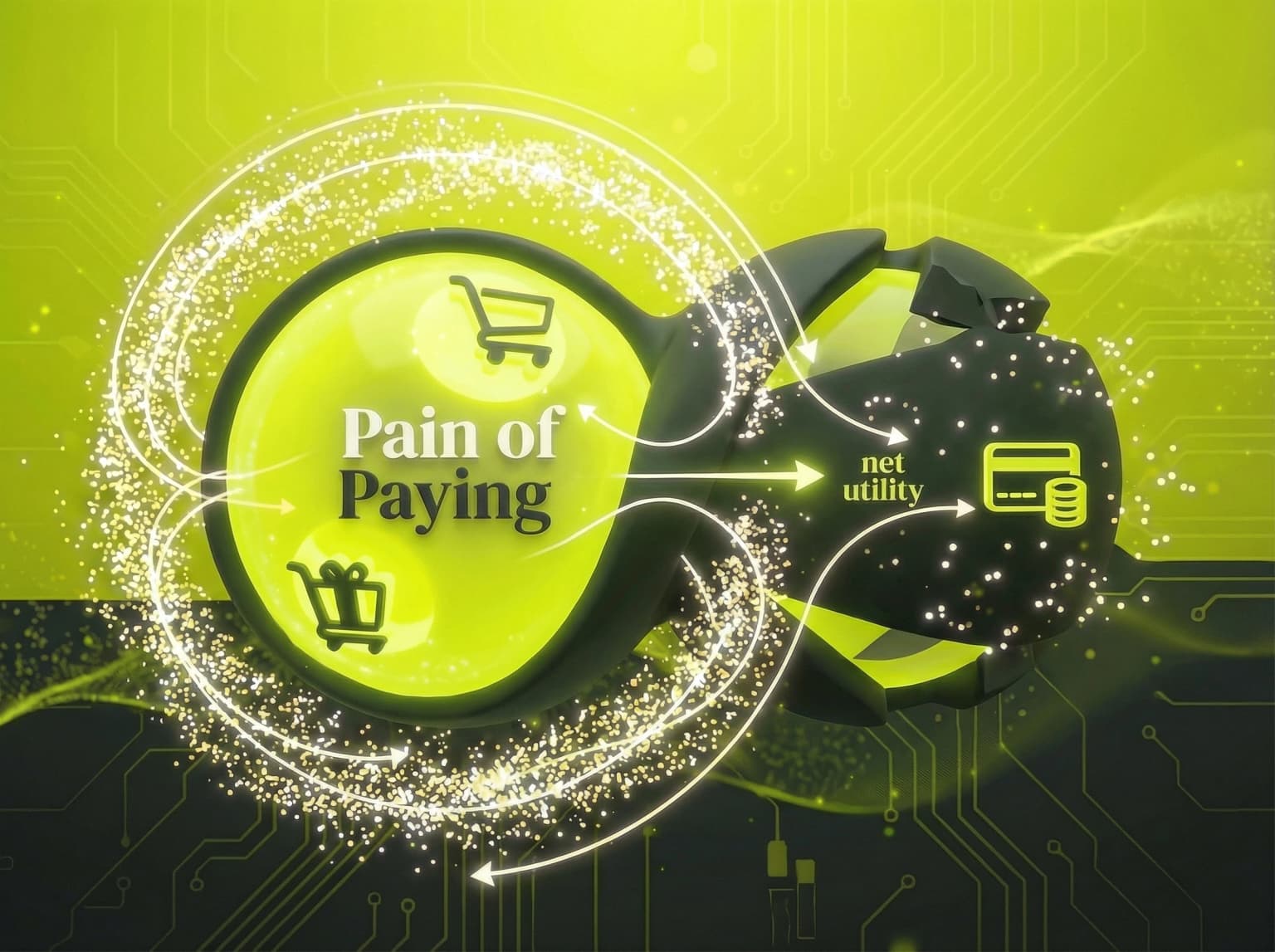
The mechanism of the Pain of Paying operates through a psychological framework known as 'Double-Entry Mental Accounting.' In this model, every purchase involves two simultaneous mental 'entries': the pleasure of acquisition and the pain of payment. The net utility of the transaction is the difference between these two.
How and why it works comes down to several structural factors:
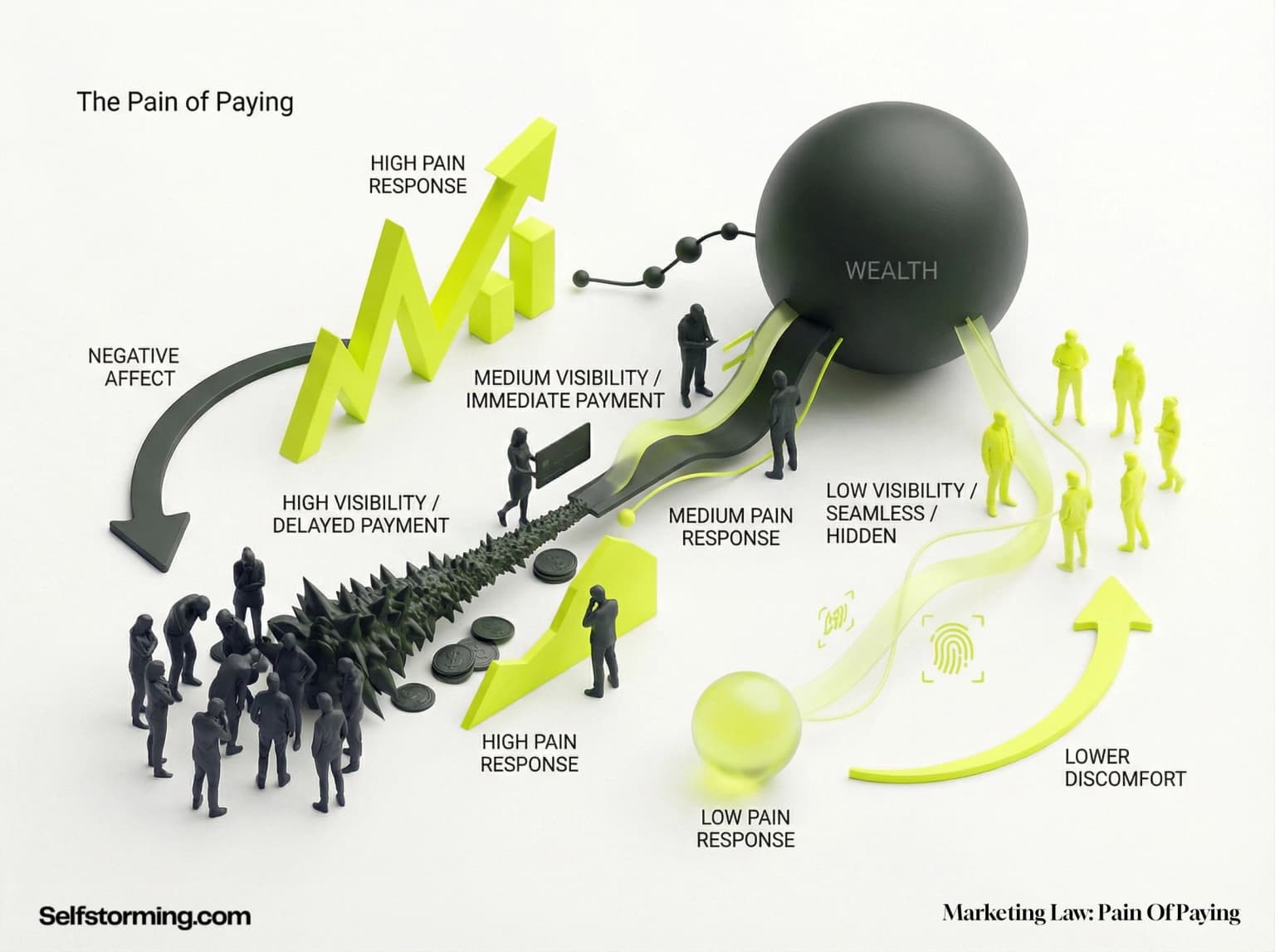
1. Coupling and Salience: Coupling refers to the degree to which a payment is mentally linked to the consumption of the product. When you pay with cash, the 'pain' is highly salient—you physically see the money leaving your possession. This 'tight coupling' makes the cost feel immediate and heavy. Credit cards and digital payments 'decouple' the transaction. The payment is delayed (the bill comes later) and abstract (a plastic swipe or a facial scan), which significantly reduces the immediate neurological sting.
2. The Insula Activation: Neuroeconomic studies have shown that when a consumer views a price they perceive as too high, the insula—a part of the cerebral cortex—activates. This is the same region that processes physical pain, social exclusion, and disgusting smells. The Pain of Paying is, therefore, not a metaphor; it is a biological deterrent designed to protect resources.
3. Timing and Payment Depreciation: Pre-payment (like a cruise or a subscription) allows the pain to 'depreciate' over time. By the time the consumer actually uses the service, the 'cost' has been mentally processed and 'paid off,' leaving only the 'pleasure' of consumption. Conversely, 'post-payment' (like a taxi meter) forces the consumer to watch the cost rise in real-time, maximizing the pain and ruining the experience.
4. Opportunity Cost vs. Out-of-Pocket Loss: Humans are naturally loss-averse. Paying feels like a loss of an existing asset rather than a trade for a new one. The more abstract the payment method, the less it feels like a 'loss' and the more it feels like a simple 'transactional step.'

Empirical Research & Evidence
One of the most famous and cited studies confirming this law is 'Always Leave Home Without It: A Further Investigation of the Credit-Card Effect on Willingness to Pay,' published in Marketing Letters (Prelec & Simester, 2001). In this experiment, researchers Drazen Prelec and Duncan Simester conducted a sealed-bid auction for highly desirable tickets to a sold-out Boston Celtics basketball game.
The methodology was simple but brilliant: half of the participants were told they had to pay in cash, while the other half were told they could pay by credit card. The results were staggering. The average bid for the 'credit card' group was $60.64, while the average bid for the 'cash' group was only $28.51. The use of a credit card—a less salient payment method—effectively increased the participants' willingness to pay by 113%.
This study provided definitive evidence that the payment medium itself acts as a variable in the valuation process. It wasn't that the credit card group had more money; it was that the 'pain' of bidding $60 via credit card was psychologically equivalent to the 'pain' of bidding $28 in cash. The researchers concluded that credit cards 'anesthetize' the brain against the immediate pain of parting with money.
Real-World Example:
Uber
Situation
Before the rise of ride-sharing, the traditional taxi industry relied on a 'high-pain' payment model. Passengers would watch a physical meter tick upward throughout the journey, and at the end of the trip, they had to physically handle cash or wait for a slow credit card terminal to process, often while the driver watched, creating social pressure.
Result
Uber revolutionized the industry not just through an app, but by virtually eliminating the Pain of Paying. By requiring a stored payment method and automating the transaction at the moment the door closes, Uber 'decoupled' the payment from the ride. The passenger never has to reach for a wallet or see a final total in a high-stress moment. This frictionless experience led to significantly higher usage rates and a willingness to accept 'Surge Pricing' that would have been rejected in a cash-based taxi environment. Uber’s growth was fueled by making the financial transaction invisible, proving that reducing friction is more valuable than reducing price.
Strategic Implementation Guide
Remove Currency Symbols
In your pricing displays, minimize or remove the '$' or '€' symbols. Research from Cornell University shows that diners spend significantly more when menus omit currency signs, as the symbol itself is a visual trigger for the 'pain' of spending.
Prioritize Digital and Contactless
If you have a physical point of sale, move heaven and earth to implement Apple Pay, Google Pay, and 'Tap-to-Pay.' The faster and more 'magical' the transaction, the less the insula has time to register a 'pain' response.
Implement Pre-payment Models
Whenever possible, move the payment to the beginning of the relationship. Subscriptions, credits, or 'top-up' accounts (like the Starbucks app) allow the user to feel the 'pain' once and then enjoy 'free' consumption for the rest of the month.
Bundle Your Offerings
Instead of 'nickel and diming' customers for every feature, bundle everything into a single price. Multiple small payments trigger multiple 'pain' responses. A single large payment triggers only one, and it is often perceived as less painful than the sum of its parts.
Use 'Play Money' for Micro-transactions
In gaming or digital ecosystems, convert real currency into 'Gems,' 'Coins,' or 'Points.' This extra layer of abstraction further distances the user from the reality of spending real-world wealth.
Optimize the 'Post-Purchase' Moment
Immediately after the payment is made, pivot the focus to the value and benefits. Use 'confirmation' pages to celebrate the purchase rather than just providing a receipt, which helps mitigate 'buyer's remorse'—the lingering echo of the pain of paying.
Avoid 'Metered' Pricing in Real-Time
If you offer a service, never show the cost accumulating in real-time unless absolutely necessary for transparency. The 'taxi-meter effect' creates constant anxiety that prevents the user from enjoying the value they are receiving.
Frequently Asked Questions
Does the Pain of Paying apply to B2B transactions where it's not 'personal' money?
Absolutely. While the money might belong to a corporation, the decision-maker is still human. Corporate procurement processes are often designed to be high-friction to *intentionally* trigger the pain of paying and slow down spending. However, for a B2B seller, reducing the administrative 'pain'—the paperwork, the approval loops, and the invoice complexity—works on the same psychological principle as reducing the 'cash pain' for a consumer.
Is removing the pain of paying unethical or manipulative?
It’s about friction, not deception. If you're hiding the price, that's a 'Dark Pattern' and it’s garbage. But if you're making a transparent price easier to pay, you're just improving the user experience. The goal is to align the payment experience with the value the customer is actually getting. If they love your product but hate your checkout, that’s a failure of design, not a triumph of ethics.
Does the pain of paying disappear in a completely cashless society?
It doesn't disappear, but it evolves. As we become more accustomed to digital payments, our 'pain threshold' shifts. This is why we see 'Buy Now, Pay Later' (BNPL) services exploding. They are the new frontier of reducing the pain of paying by splitting the cost and delaying the sting. The brain still registers the loss, but the threshold for what feels 'expensive' continues to climb as the payment becomes more abstract.
How does this law affect luxury brands specifically?
Luxury brands often lean *into* the pain of paying to create a sense of 'exclusivity' and 'sacrifice.' However, the most successful ones still handle the transaction with extreme discretion. In a high-end boutique, you rarely see a cash register. The payment is handled 'off-stage' or via a mobile device while you sip champagne. They acknowledge the price is high (the 'prestige' pain) but remove the 'transactional' pain.
Can 'too little' pain of paying be a bad thing for a brand?
Yes, it's called 'Payment Depreciation.' if a customer pays for a gym membership via auto-pay and never goes, they eventually feel like they are 'wasting' money without getting value. This leads to churn. Sometimes, a small amount of 'pain' (like a monthly invoice that highlights value) is necessary to remind the customer that they are actually using and benefiting from the service.
Sources & Further Reading
Related Marketing Laws
Anchoring Effect
The first number you see influences all subsequent judgments.
Price-Quality Heuristic
Higher price signals higher quality in consumers' minds.
Decoy Effect
A third option changes preferences between the original two.
Loss Aversion
Losses hurt twice as much as equivalent gains feel good.