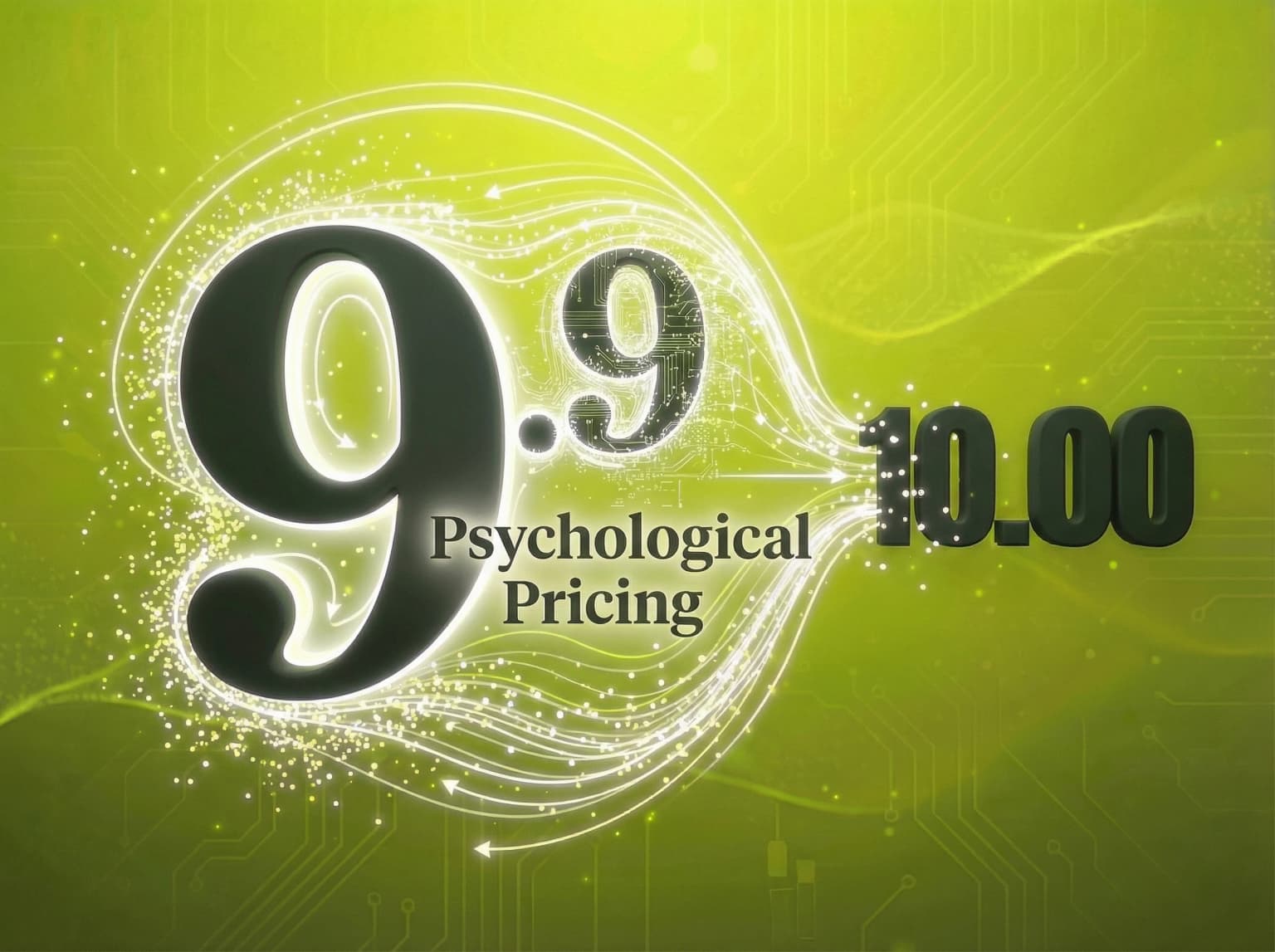
Psychological Pricing

Charm prices actually do work.

Stop pretending your customers are rational actors weighing utility in a spreadsheet. They’re not. They’re caffeinated primates with a left-digit bias and a pathological fear of round numbers. You think $9.99 is a 'hack'? Please. It’s the oldest trick in the book, and yet, your CFO still thinks 'prestige pricing' means rounding up to the nearest hundred just to look 'premium.' We're diving into the cognitive shortcuts that make people think they’re getting a deal when they’re actually just failing second-grade arithmetic. Buckle up, because your pricing strategy is probably leaving money on the table or, worse, boring your prospects to death with round numbers that signal 'I didn't put any thought into this.'

Psychological pricing is the strategic practice of setting price points that leverage cognitive biases to influence a consumer's perception of value and magnitude. Beyond the ubiquitous 'charm pricing' ($0.99 endings), the law encompasses the Left-Digit Effect, where the human brain processes the first digit of a price as the primary anchor for magnitude, and the Precision Effect, where complex numbers are perceived as smaller and more 'honest' than rounded ones. This field of marketing science demonstrates that consumer response to price is non-linear; a one-cent difference can trigger a disproportionate shift in purchase intent if it crosses a cognitive threshold. By aligning numerical presentation with the consumer's emotional or rational state, brands can manipulate the perceived 'pain of paying' and significantly increase conversion rates without altering the actual product value.

PSYCHOLOGICAL PRICING

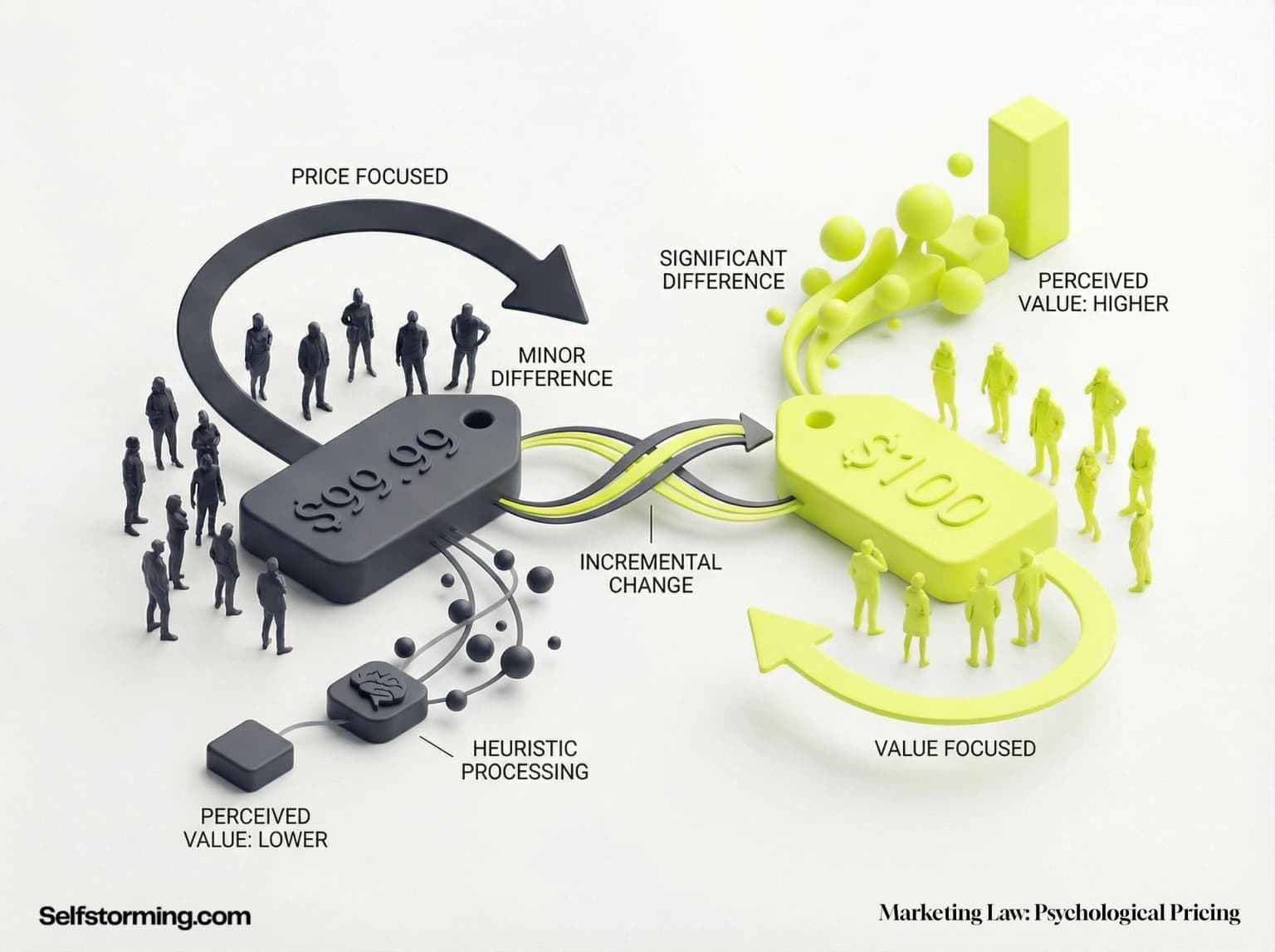
Consumer perception of value is fundamentally altered by the specific numerical structure and symbolic representation of a price, leading to non-linear responses to incremental price changes based on heuristic processing and cognitive shortcuts.

Psychological Pricing marketing law: Charm prices actually do work. - Visual illustration showing key concepts and examples

Key Takeaways

  • The left-most digit determines the initial cognitive anchor for price magnitude.
  • Charm pricing ($0.99) signals value and is best for utilitarian goods.
  • Rounded prices ($100) signal luxury and are best for emotional purchases.
  • Precise numbers ($482.10) are perceived as smaller and more honest than rounded ones.
  • Visual presentation (font size, commas, currency symbols) significantly impacts the 'pain of paying.'

Genesis & Scientific Origin

While the practice of charm pricing dates back to the late 19th century—often attributed to newspaper magnate Melville E. Stone who encouraged $0.99 pricing to force clerks to open the cash register for change (preventing theft)—the formal scientific study of psychological pricing emerged in the mid-20th century. Key foundations were laid by researchers like Robert Schindler of Rutgers University and Thomas Nagle, who began documenting the 'odd-ending' phenomenon. However, the most significant academic breakthrough occurred with the formalization of the 'Left-Digit Effect' in the early 2000s. Institutions like the University of Chicago and MIT Sloan School of Management have since conducted the definitive large-scale field experiments that moved psychological pricing from 'retailer's intuition' to a rigorous branch of behavioral economics and marketing science.

Prices ending in '9' can increase demand by up to 40% compared to lower prices (Anderson & Simester, 2003).

The Mechanism: How & Why It Works

The mechanism of psychological pricing operates through four primary cognitive channels: Numerical Magnitude Encoding, The Left-Digit Effect, The Precision Effect, and Emotional Fluency.

1. Numerical Magnitude Encoding: The human brain does not process numbers as abstract symbols but as magnitudes on a mental number line. This process is 'noisy.' Because we process digits from left to right, the first digit we encounter sets a powerful anchor. In a price like $3.99, the brain encodes the '3' before it even processes the cents. By the time the '.99' is registered, the magnitude is already anchored in the '3-dollar range' rather than the '4-dollar range.' This is known as the 'comparison hypothesis,' where the perceived distance between $3.99 and $4.00 feels much larger than one cent because the leftmost digit changes.

2. The Left-Digit Effect: This is the most potent weapon in the pricing arsenal. Research suggests that the left-digit effect is most influential when the left digits of two prices differ. For instance, the difference between $4.00 and $2.99 is perceived as significantly greater than the difference between $4.01 and $3.00, despite both being roughly a dollar. This is because the shift from 4 to 2 is a more dramatic cognitive leap than 4 to 3.

3. The Precision Effect: Consumers subconsciously associate precise numbers (e.g., $1,482.34) with smaller magnitudes than rounded numbers (e.g., $1,500). This occurs because we use precise numbers for small values in daily life. Furthermore, a precise price signals that the seller has calculated the cost meticulously, reducing the consumer's suspicion of 'price padding.' This is particularly effective in high-stakes negotiations like real estate or B2B contracts.

4. Emotional Fluency and Rounding: There is a counter-intuitive 'roundedness' effect. Rounded prices ($100) are processed quickly and fluently by the brain, which aligns with emotional, hedonic purchases (a luxury watch, a vacation). Non-rounded, 'charm' prices ($99.75) require more cognitive resources to process, which aligns better with rational, utilitarian purchases (detergent, insurance). If you force a consumer to do 'math' on a luxury item, you might kill the emotional spark that leads to the sale.

Psychological Pricing mechanism diagram - How Psychological Pricing works in consumer behavior and marketing strategy

Empirical Research & Evidence

The most cited large-scale evidence for the efficacy of psychological pricing comes from research published in Marketing Science (Anderson & Simester, 2003). In this study, researchers collaborated with a national mail-order catalog to conduct a field experiment. They manipulated the price of a specific women’s clothing item across different versions of the catalog. The item was priced at $34, $39, and $44 in three separate, randomly distributed groups.

The results were startling: the $39 price point significantly outsold the $34 price point, despite being $5 more expensive. The demand for the item at $39 was approximately 40% higher than at $34. This experiment demonstrated that the '9-ending' serves as a powerful cue for a 'deal' or 'sale,' even when a lower absolute price is available. The study also tested whether adding 'Sale' signs alongside the prices would negate the effect; surprisingly, the 9-ending effect remained robust even when explicit sale cues were present. This research proved that the psychological impact of the number 9 transcends simple price-comparison logic and acts as a primary driver of purchase intent in retail environments.

Real-World Example:
J.C. Penney

Situation

In 2012, under the leadership of CEO Ron Johnson (formerly of Apple), J.C. Penney famously attempted to eliminate 'psychological pricing' in favor of 'Fair and Square' pricing. They moved away from $9.99 endings and constant couponing to flat, rounded numbers like $10 or $20.

Result

The result was a catastrophic failure. Sales plummeted by 25% in the first quarter following the change. Customers felt the 'thrill of the hunt' and the perception of value had vanished. Without the .99 endings and the artificial anchors of 'original' vs. 'sale' prices, the brand lost its mental availability as a value destination. Johnson was ousted, and the brand immediately reverted to psychological pricing to survive.

Strategic Implementation Guide

1

Identify the Purchase Context

Determine if your product is a 'Hedonic' (emotional/luxury) or 'Utilitarian' (functional/rational) purchase. Use rounded prices for the former and charm prices ($0.99) for the latter.

2

Exploit the Left-Digit Anchor

When setting prices, prioritize dropping the leftmost digit by one. A price of $199 is vastly more effective than $200 because the anchor is '1' instead than '2'.

3

Apply the Rule of 100 for Discounts

For items under $100, express discounts as a percentage (e.g., 25% off). For items over $100, express them as a dollar amount (e.g., $25 off). The larger number always wins the perception battle.

4

Use Precision in High-Ticket B2B

If you are selling a service for roughly $50,000, quote $48,760. It looks calculated, honest, and harder to negotiate down than a round number.

5

Minimize Visual Magnitude

In your creative, display the 'cents' in a smaller font size than the 'dollars.' This physically reduces the perceived magnitude of the price in the consumer's visual cortex.

6

Remove Currency Symbols in Luxury Settings

For high-end dining or luxury goods, remove the '$' sign. The symbol itself triggers the 'pain of paying' in the brain; removing it focuses the consumer on the experience rather than the cost.

7

Align Phonetic Length

Choose prices that have fewer syllables when spoken. Research suggests that prices that take longer to say are perceived as being higher in magnitude.

Frequently Asked Questions

Does $9.99 still work when everyone knows it's a trick?

Yes, because it's not a 'trick' you can outthink; it's a biological processing shortcut. Even when consumers are aware of the tactic, their brains still encode the left digit first. The cognitive load required to 'correct' the price to the nearest round number is a task most consumers won't perform unless they are in a high-involvement, hyper-rational state.

When should I absolutely avoid charm pricing?

Avoid it when you are selling prestige, luxury, or high-end 'gift' experiences. A $5,000 engagement ring priced at $4,999.99 looks cheap and desperate. In these cases, the roundedness of the price signals quality and ease of decision-making, which is what the luxury consumer is actually buying.

How does the 'Comma Effect' influence price perception?

The inclusion of a comma (e.g., $1,200 vs $1200) increases the perceived price. This is because the comma adds a phonetic syllable ('one-thousand two-hundred' vs 'twelve-hundred') and increases the visual length of the number. If you want a price to seem lower, kill the comma.

Is there a difference between .99 and .95 endings?

While .99 is the classic 'sale' signal, .95 is often perceived as 'cleaner' and less aggressive while still maintaining the left-digit advantage. Many modern DTC brands use .95 or .97 to differentiate themselves from 'discount' retailers like Walmart while still exploiting the cognitive bias.

Can psychological pricing backfire on brand trust?

Only if the 'original' price (the anchor) is clearly fraudulent. If you use 'artificial' anchoring where a product is perpetually '70% off,' consumers eventually learn the 'real' price and the anchor loses its power. However, the .99 ending itself rarely damages trust; it’s simply seen as the standard language of commerce.

We use cookies on our site to enhance your user experience, provide personalized content, and analyze our traffic. Cookie Policy