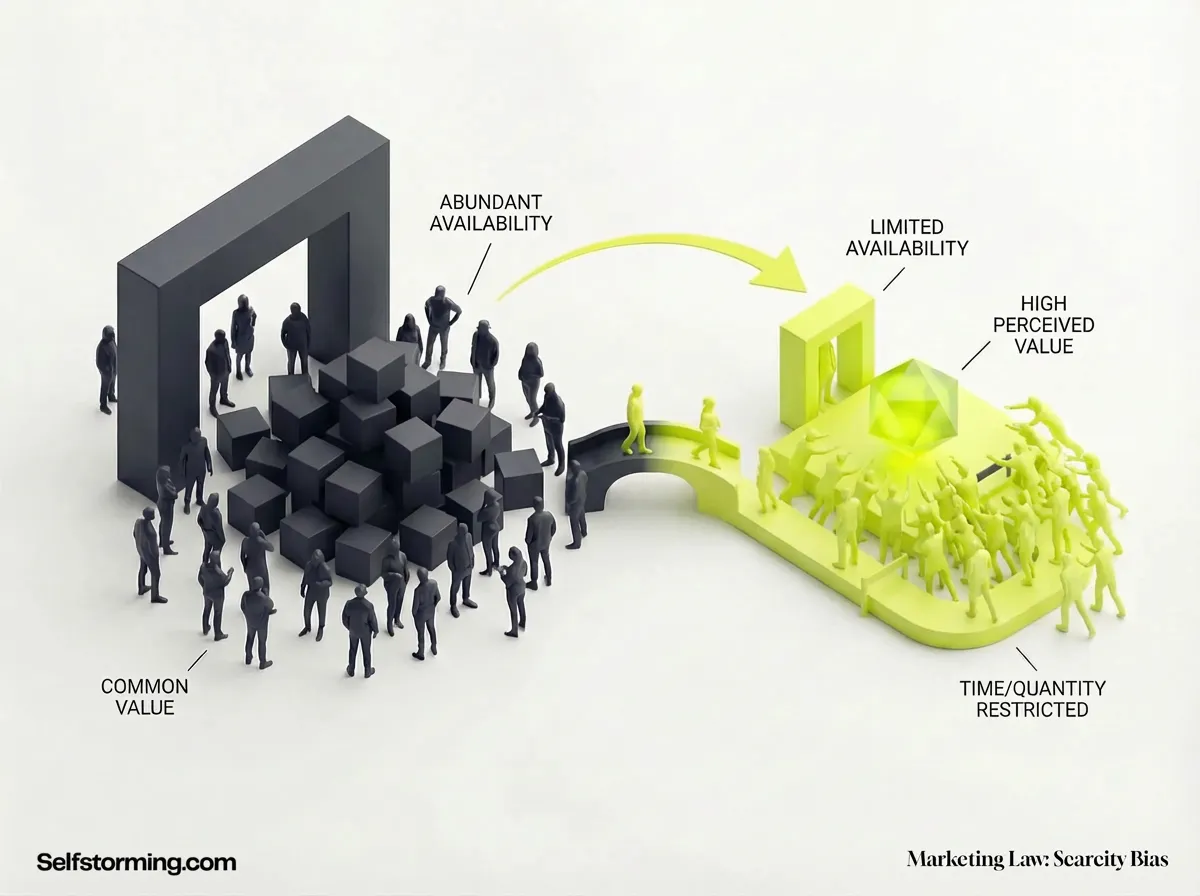
Scarcity Bias
Less availability creates more demand.
Look, if your product is always available, in every color, with a permanent 20% discount, you’re not 'customer-centric'—you’re wallpaper. You’re the boring, reliable utility that people ignore until they’re desperate. Scarcity Bias is the psychological cattle prod that turns a 'maybe later' into a 'shut up and take my money' moment. It’s the reason people pay five times the retail price for a sneaker made of recycled plastic just because there are only 500 pairs. We are biologically hardwired to want what we can’t have, and if you aren’t exploiting that primitive lizard-brain panic, you’re just leaving margin on the table for your competitors to scoop up. Let’s stop being 'accessible' and start being indispensable by being strategically unavailable.
Scarcity Bias is a cognitive shortcut where individuals assign higher value to resources that are perceived as rare, dwindling, or difficult to obtain. Rooted in evolutionary survival and modern behavioral economics, this principle operates through two primary channels: the heuristic that 'rare is good' and the psychological reactance triggered when our freedom of choice is threatened by limited supply. In a marketing context, scarcity bypasses the rational, slow-thinking brain and activates the urgent, lizard-brain impulse to secure an asset before it's gone. Whether through temporal constraints (time-limited) or quantity constraints (limited stock), the bias creates a 'competitive itch' that shifts the consumer's focus from 'Do I need this?' to 'How do I get this before they do?' When executed with authenticity, it is one of the most powerful levers for increasing perceived value and accelerating the sales cycle.
SCARCITY BIAS
“The perceived value of an object or opportunity increases significantly as its availability decreases or is restricted by time, quantity, or exclusivity.”

Key Takeaways
- •Scarcity triggers psychological reactance, making consumers fight to regain their freedom of choice.
- •Rare items are heuristically judged as higher quality than abundant counterparts.
- •Socially-driven scarcity (high demand) outperforms supply-driven scarcity in most categories.
- •Time-limited offers accelerate purchase by bypassing rational cost-benefit analysis.
- •Authenticity is critical; fake scarcity destroys brand trust and long-term mental availability.
Genesis & Scientific Origin
While the concept of scarcity has been a cornerstone of economic theory since Adam Smith, its formalization as a cognitive bias in psychology is most famously attributed to Dr. Robert Cialdini. In his seminal 1984 work, 'Influence: The Psychology of Persuasion,' Cialdini identified scarcity as one of the six key pillars of social influence. Cialdini, a Professor Emeritus of Psychology and Marketing at Arizona State University, developed this framework through years of 'participant observation'—embedding himself in the training programs of car salesmen, fundraisers, and telemarketers to observe real-world persuasion in action. His research was further supported by the work of Jack Brehm, who in 1966 proposed the Theory of Psychological Reactance, explaining why we rebel against the loss of freedom that scarcity represents. These academic foundations bridged the gap between abstract economic supply-and-demand curves and the messy, irrational reality of human decision-making.
“68% of consumers report making a reactive purchase due to a perceived time-limited offer.”
The Mechanism: How & Why It Works
The Scarcity Bias functions through a complex interplay of three psychological and neurological mechanisms: Heuristic Processing, Psychological Reactance, and Social Proof.
First, the Heuristic Shortcut: The human brain is notoriously lazy. Instead of conducting a thorough cost-benefit analysis for every purchase, we use mental shortcuts. We have learned through experience that things that are difficult to get are usually better than things that are easy to get. Rarity becomes a proxy for quality. If a product is 'limited edition,' our brain skips the part where it asks if the product is actually good and jumps straight to the conclusion that it must be valuable because it’s rare.
Second, Psychological Reactance: Proposed by Jack Brehm (1966), this theory suggests that whenever our free choice is limited or threatened, the need to retain our freedom makes us want it significantly more. When a marketer tells us a deal is 'only available for the next 24 hours,' they aren't just giving us a deadline; they are threatening our freedom to buy that item at that price tomorrow. This perceived loss of autonomy creates an emotional state—reactance—that can only be relieved by taking the action (buying the product) to re-establish our control.
Third, Social Proof and Competition: Scarcity is rarely a solo experience. When we see a 'low stock' alert, we don't just see a number; we see evidence that other people are buying it. This triggers a competitive impulse. We aren't just buying a product; we are winning a race against other consumers. This is why 'emergent scarcity' (something becoming scarce because of high demand) is far more powerful than 'fixed scarcity' (something that was always rare). The neurological 'rush' of winning a scarce item activates the brain's reward centers (the ventral striatum) more intensely than an easy acquisition, creating a dopaminergic loop that reinforces the behavior.

Empirical Research & Evidence
One of the most famous and cited demonstrations of Scarcity Bias is the 'Cookie Jar Study' conducted by Stephen Worchel, Jerry Lee, and Akanbi Adewole. Journal of Personality and Social Psychology (Worchel, Lee, & Adewole, 1975). In this experiment, the researchers asked 200 undergraduates to rate the quality and value of chocolate chip cookies. They used two jars: one containing ten cookies and one containing only two. Despite the cookies being identical, participants consistently rated the cookies in the two-item jar as more desirable, more attractive, and more expensive.
To dive deeper, the researchers introduced a second variable: change in scarcity. In one condition, the jar started with ten cookies and was then replaced with a jar of two (emergent scarcity). In another, the jar always had two (constant scarcity). The results were definitive: the cookies that became scarce due to 'high demand' from other participants were rated the highest of all. This proved that scarcity isn't just about the quantity available, but the perceived speed at which that quantity is disappearing due to social competition. The study's methodology highlighted that the value isn't inherent in the object, but in the social context of its availability.
Real-World Example:
Supreme
Situation
The New York-based skateboarding brand Supreme revolutionized the 'drop' model of retail. Instead of releasing an entire seasonal collection at once, they release a very limited number of items every Thursday at 11:00 AM. They never restock sold-out items, regardless of demand.
Result
This strategy created a permanent state of scarcity that fueled a multi-billion dollar secondary resale market. By intentionally undersupplying the market, Supreme transformed basic apparel—and even mundane items like bricks and crowbars—into high-value assets. Their website often crashes due to traffic, and physical stores require literal police presence for crowd control. The result is a brand with nearly 100% full-price sell-through and a 'cult' status that traditional marketing budgets cannot buy. They proved that by saying 'no' to more sales today, you build an invincible brand for tomorrow.
Strategic Implementation Guide
Audit for Accidental Abundance
Look at your current offering. Are you offering too many choices, too often? Consolidate your SKUs. If everything is available all the time, nothing is special. Create 'vaulted' products that only appear once a year.
Weaponize the Ticking Clock
Use deadlines that actually matter. Don't use those fake evergreen countdown timers that reset when the page refreshes—customers aren't idiots. Use hard cut-offs for seasonal offers or 'flash' sales that end abruptly. The pain of the 'miss' must be real for the bias to work.
Display Visual Depletion
On your e-commerce site, don't just say 'In Stock.' Say 'Only 4 left at this price' or '12 people are looking at this right now.' Use progress bars that show a stock level decreasing. This triggers the 'emergent scarcity' found in the Worchel study.
Implement Tiered Access
Create a 'Members Only' or 'Inner Circle' group that gets 24-hour early access to new releases. This combines Scarcity with Social Proof and Exclusivity. People will pay or perform actions (like signing up for a newsletter) just to be on the 'right' side of the scarcity fence.
Master the 'Sold Out' Badge
Never hide sold-out items immediately. Leave them on the site for a short period with a prominent 'SOLD OUT' badge. This serves as social proof that your products are in high demand, making the items that are still available look more attractive by association.
Limit Quantity Per Customer
Ironically, telling people they can only buy two of an item often makes them buy two, even if they only wanted one. It signals that the item is so valuable that the 'house' has to protect its supply. It’s the ultimate reverse-psychology play.
Concentrate Your Media Spend
Instead of a thin 'always-on' ad budget, concentrate your spend into short, high-intensity bursts that coincide with your limited availability windows. This creates a 'fame' effect where it feels like everyone is talking about the thing that is about to disappear.
Frequently Asked Questions
Isn't using scarcity just a cheap way to manipulate people into buying things they don't need?
If you're using fake timers and 'only 1 left' lies, then yeah, you're a hack. But real scarcity is just honest communication about supply and demand. If you only have 50 units, telling people you only have 50 units isn't manipulation—it's helpful information. The 'manipulation' happens in the customer's lizard brain; you're just the one holding the mirror. Don't apologize for the way humans are wired.
Does Scarcity Bias work in B2B, or is it just for sneakers and gadgets?
It’s arguably more powerful in B2B. 'We only have the capacity to onboard two more clients this quarter' is a devastatingly effective closing line. In B2B, scarcity isn't usually about physical widgets; it's about time, expertise, and access to the A-team. If your agency is always 'ready to start tomorrow,' you’re telling the prospect you have no other friends. Be busy. It’s the best marketing you’ve got.
What happens if I use scarcity too often? Does it lose its power?
Absolutely. It’s called 'Scarcity Fatigue.' If you have a 'Going Out of Business' sale every six months, you’re the rug store that everyone laughs at. For scarcity to work, the 'threat' of missing out must be credible. If you cry wolf too many times, your customers will build up 'Persuasion Knowledge'—a mental defense mechanism that makes them immune to your tactics and makes your brand look desperate.
Can scarcity actually backfire and drive customers away?
Yes, if the friction is too high. If you make it so hard to buy that it becomes an annoying chore rather than an exciting challenge, people will just go to Amazon. The goal is 'Desirable Difficulty.' It should feel like an achievement to get the product, not a bureaucratic nightmare. If they feel like you're intentionally being a jerk, they'll move from 'wanting' to 'resenting' real fast.
How does scarcity interact with the 'Long and Short of It' strategy?
Scarcity is a 'Short-Term' activation beast. It’s designed to convert Mental Availability into an immediate sale. However, if used consistently as part of a 'Drop' culture (like Supreme), it becomes a 'Long-Term' brand builder by creating a mythos of exclusivity. It’s the bridge between the two: it drives the sale today while building the 'must-have' allure that fuels the brand for the next decade.
Sources & Further Reading
Related Marketing Laws
Social Proof Effect
People copy the behavior of others, especially in uncertainty.
Pratfall Effect
Admitting a weakness increases credibility and likability.
The Generation Effect
People remember better what they've actively completed themselves.
Peak-End Rule
People judge experiences by their peak moment and ending, not the average.