Darty: Long Lasting Passport
Darty tasked Publicis Conseil with addressing the high rate of appliance disposal in France. The goal was to increase the second-hand market share by overcoming consumer skepticism regarding the reliability of used goods. The client needed a scalable, trustworthy solution that would prove an appliance's maintenance history and encourage consumers to choose repair and resale over disposal, ultimately supporting a circular economy model.
Creative Idea
Applied an automotive service logbook concept to home appliances to guarantee resale trust.
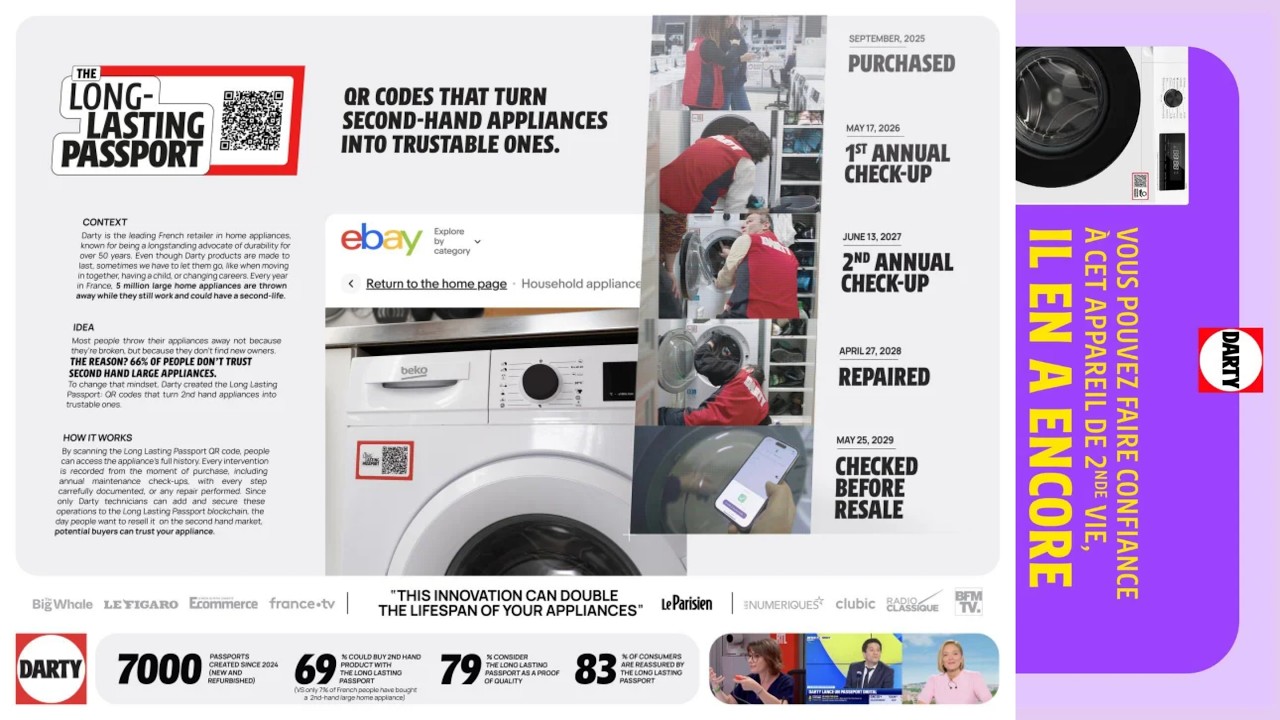
Darty introduced a blockchain-backed digital passport for home appliances, providing a verified repair and maintenance history. By mirroring the transparency of automotive service logs, it eliminated consumer distrust in second-hand goods, effectively transforming discarded appliances into certified, reliable assets.
Turning Home Appliances Into Certified Assets
The Olympic Connection
One of the most unique applications of this technology occurred during the Paris 2024 Olympic Games. Appliances used within the Athletes' Village were equipped with these digital passports. This allowed future buyers of these reconditioned, high-profile units to verify their specific usage history during the Games, effectively turning standard household machines into verified collector items.
Engineering Trust Through Tech
The project was built in collaboration with Arianee, a French Web3 and blockchain specialist, to ensure the data remains tamper-proof. To maintain user privacy, the system stores zero personal consumer data. Instead, the passport is tethered strictly to the product ID and its unique lifecycle. This technical architecture was designed to be an open platform, inviting other manufacturers and recyclers to join a common standard for appliance traceability.
Preempting European Regulation
While the campaign addresses the immediate consumer fear that 66% of French buyers feel when purchasing second-hand goods, it also serves a strategic regulatory purpose. The initiative was engineered to align with the upcoming EU Ecodesign for Sustainable Products Regulation. By creating this infrastructure now, Darty is positioning itself ahead of mandatory EU directives that will eventually require digital passports for a wide range of consumer electronics.
Scaling the Lifecycle
The rollout began with a pilot of 4,000 products in late 2024, with an aggressive roadmap to scale to 1,000,000 tagged appliances by the end of 2026. By treating appliances like vehicles with a CARFAX-style service logbook, the brand aims to combat the disposal of 23 million appliances annually in France, many of which are discarded prematurely due to a lack of accessible repair history.
Creative Strategy Deconstructed
Company
Darty leveraged its extensive network of official technicians and repair services to provide verified, tamper-proof lifecycle data for home appliances.
Category
Retailers typically focus on selling new products, often ignoring the lifecycle and second-hand potential of the appliances they distribute.
Customer
Consumers wanted to buy second-hand to save money and be sustainable but feared purchasing broken or unreliable home appliances.
Culture
Rising environmental awareness and upcoming EU regulations regarding product repairability created a cultural demand for sustainable, traceable consumption.
Company
Darty leveraged its extensive network of official technicians and repair services to provide verified, tamper-proof lifecycle data for home appliances.
Category
Retailers typically focus on selling new products, often ignoring the lifecycle and second-hand potential of the appliances they distribute.
Strategy:
Transform product history into a verified asset to bridge the trust gap in circular markets.
Customer
Consumers wanted to buy second-hand to save money and be sustainable but feared purchasing broken or unreliable home appliances.
Culture
Rising environmental awareness and upcoming EU regulations regarding product repairability created a cultural demand for sustainable, traceable consumption.
Strategy:
Transform product history into a verified asset to bridge the trust gap in circular markets.
Results
The campaign successfully introduced a new industry standard in France for second-hand appliance trust. 66% of consumers originally distrusted second-hand appliances, but 83% of consumers felt reassured by the Long-Lasting Passport certification according to a 2024 BVA Xsight study. The initiative earned extensive national broadcast coverage across major news channels including France 2, BFM Business, and RTL. Other major industry manufacturers and retailers including Thomson, Envie, Proline, and Beko joined the ecosystem initiative.
83%
consumers reassured
66%
initial distrust overcome
4+
major brand partners adopted
Strategy Technique
Build an Utility, Not an Ad
Darty created a functional digital tool that solves the core barrier to circularity. By building a utility that provides verifiable data, they turned a brand service into the primary reason for consumer trust.
Explore Technique
Creative Technique
Borrow a Familiar Format
The campaign uses the familiar concept of an automotive service logbook to explain a new digital product. This analogy instantly makes a complex blockchain technology feel intuitive and trustworthy for everyday consumers.
Explore Technique
Craft Breakdown
Darty's campaign stands out through seamless service design and digital integration, transforming a physical appliance sticker into a secure blockchain-verified maintenance passport.
The development of a secure, blockchain-backed web application seamlessly connected via physical QR codes creates a trustworthy digital history for physical goods.
Integrating technicians into the digital logging workflow during routine service visits cleanly embeds the solution into everyday real-world interactions.