Too Good: Paid Sick Leave For Cows
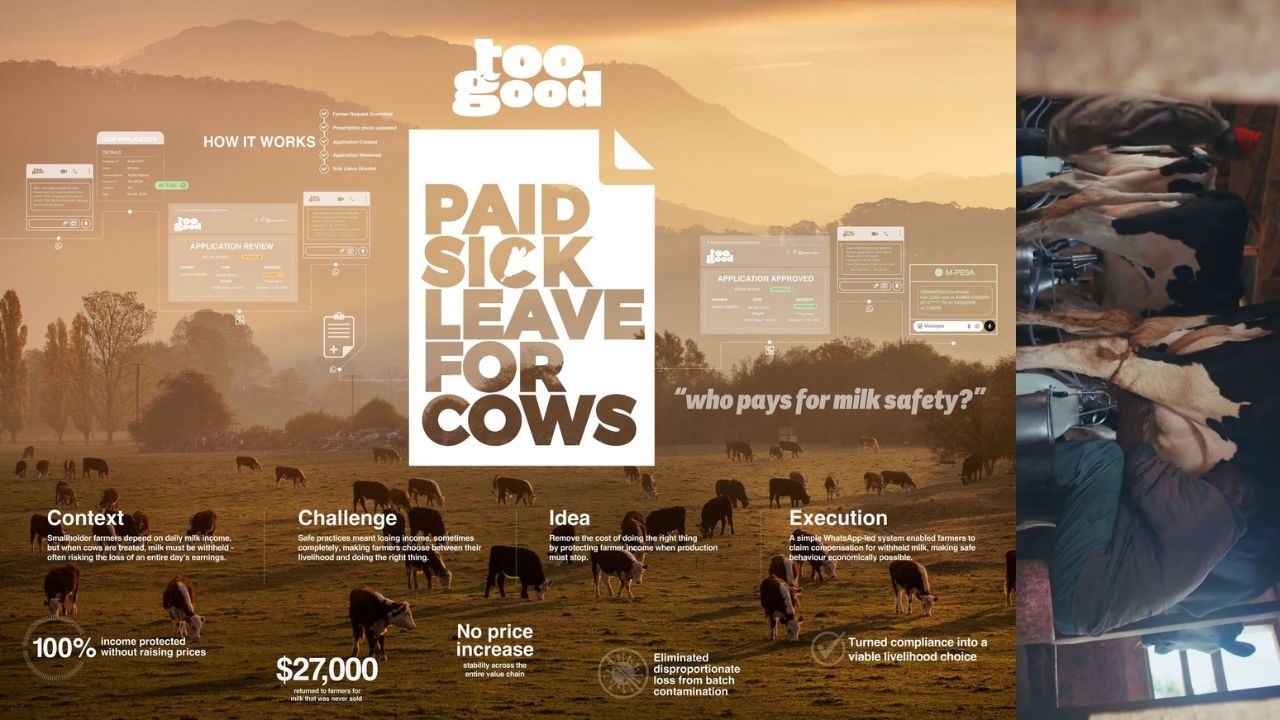
Too Good tasked The Partnership Agency with addressing the high prevalence of antibiotic-contaminated milk in Kenya. The client needed a solution that protected smallholder farmers from the financial loss of mandatory withdrawal periods without raising consumer prices. The goal was to ensure food safety while maintaining the livelihoods of nearly two million dairy farmers, effectively bridging the gap between economic survival and public health standards.
Creative Idea
The brand treated cows as employees to fund their mandatory recovery time.
Too Good reclassified dairy cows as economic workers to provide farmers with paid sick leave during antibiotic withdrawal periods, removing the financial pressure to sell contaminated milk and ensuring a safer, more sustainable dairy supply chain for everyone.
From Economic Workers to Cannes History
Bridging the Rural Tech Divide
The campaign’s success relied on a sophisticated hybrid infrastructure that balanced accessibility with high-level security. Because WhatsApp is the primary communication tool for smallholder farmers in Kenya, the agency built a custom bot that allowed users to register cows and submit veterinary evidence without needing specialized software. Behind the scenes, this front-end simplicity triggered a blockchain-based smart contract system. This ensured that every payment was transparent, immutable, and delivered instantly, removing the administrative friction that often plagues agricultural support programs.
A New Model for Systemic Change
Beyond the immediate public health benefits, the initiative fundamentally altered the economics of the dairy supply chain. By reclassifying cows as economic workers, the brand transformed a regulatory burden into a shared value proposition. This shift addressed the root cause of antibiotic contamination—the financial desperation of farmers during mandatory withdrawal periods. By protecting 100% of the participating farmers' daily incomes during recovery, the program proved that corporate social responsibility could be both profitable and life-saving.
Redefining African Creative Excellence
The project served as a watershed moment for the regional industry, culminating in Kenya’s first-ever Cannes Lions Grand Prix. According to Megha Dutta, the campaign demonstrated that African creativity is not merely capable of competing on the global stage but is uniquely positioned to solve complex systemic problems. The work was so effective that it helped Publicis Groupe Africa secure the Regional Network of the Year title at the 2026 festival, proving that the most impactful ideas are those that align business interests with the tangible realities of the people they serve.
Creative Strategy Deconstructed
Company
Too Good leveraged its position as a clean-label dairy brand to restructure supply chain economics for smallholder farmers.
Category
The dairy industry typically ignores the financial burden placed on farmers during mandatory antibiotic withdrawal periods.
Customer
Farmers felt the crushing tension between protecting their daily income and adhering to necessary food safety regulations.
Culture
The growing global demand for ethical, transparent, and sustainable food systems made this systemic intervention highly resonant.
Company
Too Good leveraged its position as a clean-label dairy brand to restructure supply chain economics for smallholder farmers.
Category
The dairy industry typically ignores the financial burden placed on farmers during mandatory antibiotic withdrawal periods.
Strategy:
Align corporate financial incentives with ethical supply chain behaviors to solve systemic industry failures.
Customer
Farmers felt the crushing tension between protecting their daily income and adhering to necessary food safety regulations.
Culture
The growing global demand for ethical, transparent, and sustainable food systems made this systemic intervention highly resonant.
Strategy:
Align corporate financial incentives with ethical supply chain behaviors to solve systemic industry failures.
Results
The initiative successfully returned $27,000 to Kenyan farmers for withheld milk over an 8-month period, protecting 100% of farmer income during the withholding window. Milk rejection at the processing factory was reduced to near 0. The campaign scaled across leading Kenyan retailers including Chandarana Foodplus, Zucchini Food Market, and Greenspoon, delivering products with 0% antibiotic residue. The program has been recognized and supported by KIEP, The World Bank, the Finnish Government, and the Visa Foundation.
$27,000
returned to farmers for withheld milk in 8 months
100%
farmer income protected during withholding period
Near 0
milk rejection at factory
Strategy Technique
Turn Brand Values Into Action
The brand moved beyond empty sustainability claims by funding a tangible economic safety net. It proved their commitment to food safety by absorbing the financial risk that previously forced farmers into unsafe practices.
Explore Technique
Creative Technique
Define, Label and Group
The campaign creatively redefines livestock as economic workers. This label shifts the entire perspective on animal welfare and farm economics, making the solution feel like a natural, logical extension of labor rights.
Explore Technique
Craft Breakdown
This campaign excels by reframing a complex agricultural and public health issue through a brilliant legal and structural hack, executed seamlessly via accessible mobile technology.
The conceptual framing of 'Paid Sick Leave for Cows' is a masterclass in copywriting, turning a dry supply-chain policy into an instantly understandable and emotionally resonant narrative.
Using WhatsApp as the primary interface ensures the solution is highly accessible to smallholder farmers without requiring complex app installations.