IKEA Canada: SHT (Second Hand Tax)
IKEA Canada, through Edelman Canada, aimed to increase second-hand sales in its Ontario As-Is marketplace and promote sustainable consumption. They needed to address the customer barrier of double HST taxation on used items, seeking to boost engagement and sales.
Creative Idea
IKEA introduced a -13% 'Second Hand Tax' to eliminate double HST on used items.
IKEA introduced SHT - a counter tax of -13% - to eliminate the unfair double HST on second-hand items in its As-Is marketplace, making sustainable shopping more accessible and challenging the government to change policy for consumers.
Turning SHT Into A National Tax Reform Movement
The 13 Percent Loophole
The creative team at Edelman Canada spent months auditing tax codes to uncover a staggering statistic: the Canadian government collects an estimated $720 million annually by taxing the same items every time they are resold. To highlight this "double taxation" during a cost - of - living crisis, IKEA launched a cheeky -13% "SHT" (Second Hand Tax) discount in its "As-is" sections. This effectively "refunded" the Harmonized Sales Tax (HST) to customers, making IKEA the first brand in Canadian history to formally propose federal tax law changes through a marketing campaign.
Massive Lift in Circular Sales
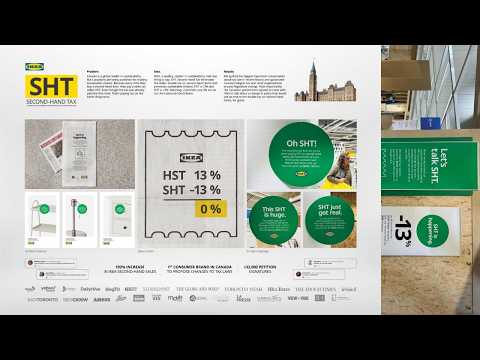 The initiative triggered an immediate shift in consumer behavior, resulting in a 192% increase in "As-is" sales and a 16% boost in overall store foot traffic. Beyond the registers, the campaign generated over 50 million impressions and a 2,200% surge in mentions of the term "Second-Hand Tax" - a phrase that didn't exist in the public lexicon before the launch. 81% of consumers reported increased purchase intent, while IKEA’s sustainability perception rose by 11%.
From Furniture Store to Parliament
Led by Chief Creative Officer Anthony Chelvanathan and CEO Selwyn Crittendon, the campaign moved from store aisles to the halls of power. The "SHT" acronym, a deliberate play on "SHT happens," resonated so deeply that it garnered rare bipartisan support from the Canadian Taxpayers Federation and the Retail Council of Canada. The momentum culminated in over 35,000 signatures on a Change.org petition and direct meetings between IKEA leadership and the Prime Minister of Canada to discuss permanent legislative reform.
Creative Strategy Deconstructed
Company
IKEA leveraged its existing 'As-Is' marketplace and commitment to sustainability to offer a tangible solution to a consumer pain point.
Category
The retail category typically applies standard sales taxes, often overlooking the specific burden on second-hand goods and sustainable choices.
Customer
Consumers felt unfairly penalized by double taxation on second-hand purchases, desiring fair pricing and recognition for sustainable shopping efforts.
Culture
A growing cultural emphasis on sustainability, coupled with cost-of-living concerns, made the fairness of taxation a highly resonant public issue.
Company
IKEA leveraged its existing 'As-Is' marketplace and commitment to sustainability to offer a tangible solution to a consumer pain point.
Category
The retail category typically applies standard sales taxes, often overlooking the specific burden on second-hand goods and sustainable choices.
Strategy:
Empower sustainable consumer choices by directly challenging systemic financial barriers and advocating for fairness.
Customer
Consumers felt unfairly penalized by double taxation on second-hand purchases, desiring fair pricing and recognition for sustainable shopping efforts.
Culture
A growing cultural emphasis on sustainability, coupled with cost-of-living concerns, made the fairness of taxation a highly resonant public issue.
Strategy:
Empower sustainable consumer choices by directly challenging systemic financial barriers and advocating for fairness.
Results
The campaign resulted in a 192% increase in IKEA second-hand sales, garnered 35,000 petition signatures, and positioned IKEA as the first consumer brand in Canada to propose changes to tax laws. It successfully put money back into Canadians' pockets by eliminating the double tax on second-hand items, generated widespread public discussion, and led to the government agreeing to meet and discuss ending the double tax for good.
+192%
increase in IKEA second-hand sales
35,000
petition signatures collected
1st
consumer brand to propose tax law changes in Canada
Strategy Technique
Make the Product Misbehave
IKEA made its own pricing system misbehave by introducing a negative tax - the SHT counter-tax of -13% - that deliberately broke conventional retail pricing logic. This playful act of defiance highlighted the absurdity of double-taxing second-hand goods and turned a pricing quirk into a sustainability statement.
Explore Technique
Creative Technique
Turn Message into Product
The campaign literally turned the concept of a 'Second Hand Tax' into a tangible, negative tax applied at checkout. This transformed a policy critique into a direct consumer benefit and a product feature.
Explore Technique
Craft Breakdown
The campaign effectively leveraged a clever acronym and a clear, relatable financial incentive to mobilize public opinion and engage with government on a sustainability issue, demonstrating strong strategic thinking and public relations.
The campaign successfully framed a tax issue as a sustainability problem, generating significant public and media attention, and engaging government officials to achieve policy discussion.
The strategic decision to absorb the 'second-hand tax' and rebrand it as 'SHT' was highly effective in creating a memorable, impactful, and actionable initiative that resonated with Canadians.
The use of the "SHT" acronym was a brilliant and memorable piece of copywriting that simplified a complex tax issue and created a relatable, shareable campaign hook.
The campaign effectively utilized social media platforms and online petitions to amplify its message, mobilize public support, and create a groundswell of digital engagement.
“The synergy between a bold strategic initiative (absorbing the tax), clever copywriting (SHT acronym), and robust public relations efforts created a powerful and widely resonant campaign that achieved both brand and policy objectives.”