Street Pong
A smart city initiative wanted to enhance the pedestrian experience and promote innovative urban solutions. They aimed to transform mundane waiting times at traffic lights into engaging, positive interactions for urban dwellers, fostering community connection.
Creative Idea
Transformed traffic light waiting into an interactive, competitive game.
This campaign transformed the mundane act of waiting at a traffic light into an engaging, interactive Pong-like game, fostering spontaneous social connection between strangers and making urban waiting times enjoyable and memorable.
The Viral Fake That Forced a Reality
From Post-Production to Hardware
The project began as a concept mock-up in 2012, using video effects to simulate a game that didn't actually exist. After the video garnered over 5 million views on YouTube and Vimeo within weeks, the massive public demand forced the student team at HAWK University to turn their "fake" idea into a functional product. Founders Sandro Engel, Amelie Künzler, and Holger Michel spent two years navigating strict German traffic regulations to prove the device wouldn't distract drivers. The first functional units finally launched in Hildesheim on November 18, 2014.
Engineering Spontaneous Social Connection
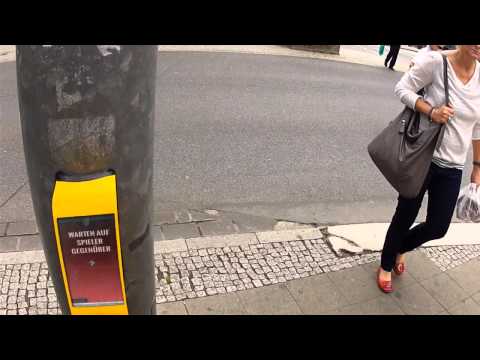
The technology, later rebranded as ActiWait, uses a touchscreen integrated into standard pedestrian push-button boxes. These units communicate wirelessly to sync the game in real-time across the street. To ensure safety, the game is hard-coded to activate only during the red phase; the moment the light turns green, the game terminates to display a "Walk" signal. Beyond the original Pong game, the team developed modules for speed dating, news feeds, and navigation maps to further utilize the "boring time" spent at intersections.
Tactical Urbanism and the High-Five
The campaign is a landmark in Tactical Urbanism, proving that "The Fun Theory" can be more effective at stopping jaywalking than legal threats. During the pilot phase, the intersection saw near-constant engagement, effectively eliminating illegal crossings. The "signature" moment of the campaign - the mid-street high-five between opposing players - became a symbol for how smart city design can break the social silence of urban environments. To scale the project, the team turned to Indiegogo, seeking €35,000 to bring the interactive units to cities worldwide.
Creative Strategy Deconstructed
Company
The smart city initiative credibly delivered interactive digital screens integrated into existing pedestrian signal boxes, enabling real-time multiplayer gaming.
Category
Pedestrian crossings typically involve passive, often boring, waiting, with people usually disengaged or on their phones.
Customer
Pedestrians felt bored and disconnected during mandatory waiting times, seeking distraction or a more engaging urban experience.
Culture
A prevailing culture of seeking instant entertainment, digital interaction, and novel social connections in everyday public spaces made this resonate.
Company
The smart city initiative credibly delivered interactive digital screens integrated into existing pedestrian signal boxes, enabling real-time multiplayer gaming.
Category
Pedestrian crossings typically involve passive, often boring, waiting, with people usually disengaged or on their phones.
Strategy:
Transform unavoidable urban downtime into an opportunity for engaging, spontaneous social interaction.
Customer
Pedestrians felt bored and disconnected during mandatory waiting times, seeking distraction or a more engaging urban experience.
Culture
A prevailing culture of seeking instant entertainment, digital interaction, and novel social connections in everyday public spaces made this resonate.
Strategy:
Transform unavoidable urban downtime into an opportunity for engaging, spontaneous social interaction.
Strategy Technique
Solve a Daily Annoyance
The campaign directly addressed the daily annoyance of tedious waiting at pedestrian crossings. By introducing an engaging game, it transformed a frustrating moment into a fun, interactive experience.
Explore Technique
Creative Technique
Gamification
The campaign successfully gamified a common urban experience - waiting at a traffic light - by introducing an interactive digital game. This turned passive waiting into an active, competitive, and social activity.
Explore Technique
Craft Breakdown
The campaign's exceptional craft lies in seamlessly integrating a robust, interactive digital game into existing urban infrastructure, creating a delightful and spontaneous public experience through ingenious physical and digital design.
The interactive game's software and logic are robustly engineered, providing a responsive and intuitive experience within a demanding public setting.
The thoughtful design of the public interaction transforms a mundane wait into a spontaneous, social game that fosters unexpected connections and transforms urban space.
The visual design of the Pong game, including the skateboard icon, paddles, and clear scoring, is simple, engaging, and perfectly suited for a small public screen.
The successful integration of the digital screen and interactive system into existing pedestrian signal boxes demonstrates clever engineering for robust outdoor, public use.
“The magic of this campaign arises from the seamless synergy between its digital interactivity, thoughtful experiential design, and robust technological implementation in a public space.”