New Zealand Herpes Foundation: The Best Place in the World to Have Herpes
The New Zealand Herpes Foundation tasked Motion Sickness with dismantling the severe social stigma surrounding herpes, which caused depression in 30 percent of diagnosed Kiwis. They needed to reach a broad national audience to normalize the condition, increase educational engagement, and move the needle on public perception, despite a limited budget and the deeply uncomfortable nature of the topic.
Creative Idea
Reframed herpes destigmatization as a competitive national sport using a global leaderboard and icons.
To dismantle the crippling shame of herpes, the campaign reframed destigmatization as a matter of national pride, challenging New Zealanders to learn their way to the top of a global leaderboard hosted by beloved national icons.
Winning the World Cup of Destigmatisation
The Trojan Horse of Kiwi Humour
To tackle a virus affecting 80% of the population, the team at Motion Sickness and FINCH avoided clinical lectures in favour of a 1970s retro-NZ aesthetic. The strategy used "humour as a Trojan horse" to bypass the immediate "ick" factor associated with the word. By casting "New Zealand royalty" like former All Blacks coach Sir Graham Henry, rugby legend Sir Buck Shelford, and former Director-General of Health Sir Ashley Bloomfield, the campaign framed herpes education as a patriotic duty. Sir Graham’s aggressive scrawling of "HERPES" on a chalkboard was a deliberate tactic to confront the word's bogeyman status head-on.
Gamifying Public Health
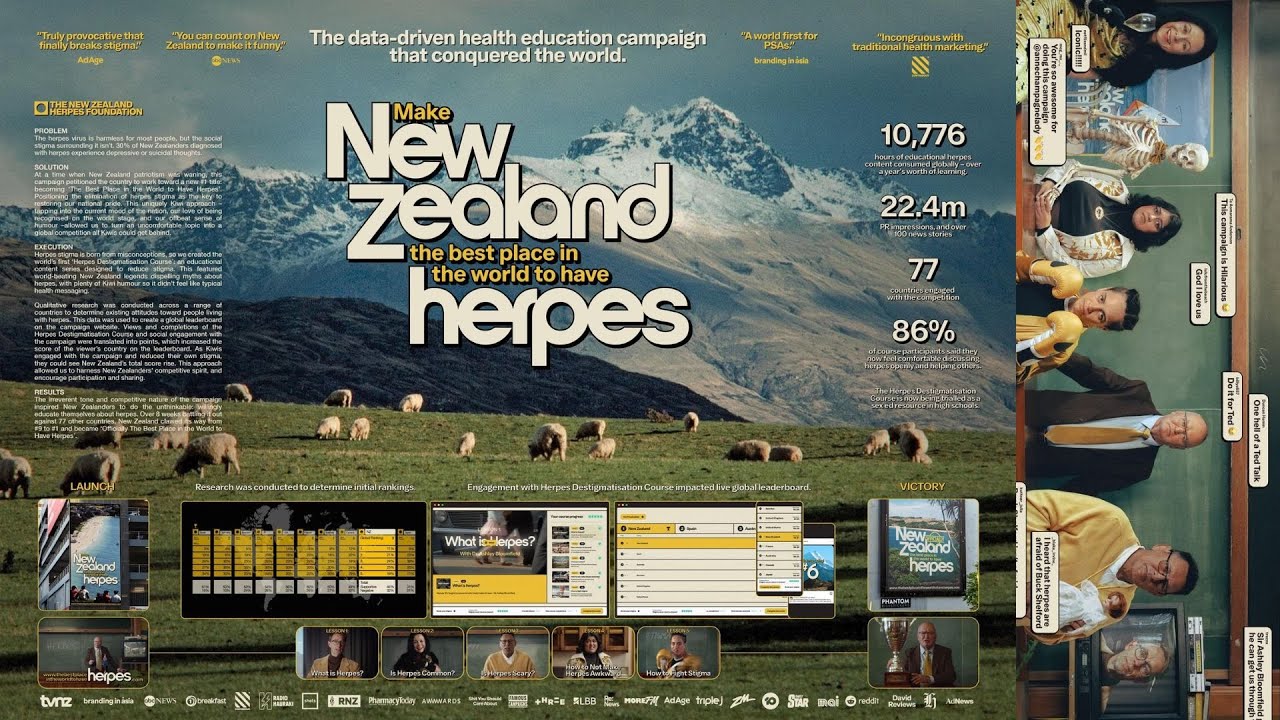 The digital heart of the campaign, developed by ED. Studio, was a custom interactive site featuring a live Herpes Stigma Index. This leaderboard gamified the experience - similar to Duolingo - allowing Kiwis to earn points for their country by consuming a 6-part educational course. The impact was unprecedented: over 10,776 hours of content were viewed, the equivalent of 1.2 years of continuous learning. Within eight weeks, New Zealand climbed from 9th to 1st place on the global index.
High Stakes on a Bequest Budget
Despite its massive scale, the campaign was funded by a bequest left to the Foundation in a will. The production leaned into hyper-local cultural touchpoints, such as Sir Graham’s viral complaint that "pies are pushing seven bucks," to ground the absurd premise in relatable Kiwi reality. The result was a 2,593% ROI and a profound shift in sentiment: 69% of participants reported a reduction in their own stigma, while 86% felt more comfortable discussing the condition.
Creative Strategy Deconstructed
Company
A foundation with a bequest budget and the authority to address a hidden, widespread public health crisis.
Category
Public health campaigns usually rely on somber warnings or clinical facts that often reinforce existing social stigmas.
Customer
Kiwis felt intense shame and isolation despite the virus's prevalence, fearing social rejection more than the medical symptoms.
Culture
A period of declining national confidence where citizens were eager for any opportunity to prove New Zealand's global superiority.
Company
A foundation with a bequest budget and the authority to address a hidden, widespread public health crisis.
Category
Public health campaigns usually rely on somber warnings or clinical facts that often reinforce existing social stigmas.
Strategy:
Leverage competitive national identity to transform a stigmatized health burden into a collective achievement.
Customer
Kiwis felt intense shame and isolation despite the virus's prevalence, fearing social rejection more than the medical symptoms.
Culture
A period of declining national confidence where citizens were eager for any opportunity to prove New Zealand's global superiority.
Strategy:
Leverage competitive national identity to transform a stigmatized health burden into a collective achievement.
Results
The campaign achieved significant impact, including 10,776 hours of lessons watched, which equates to over 1 year of herpes education. It generated 100+ herpes news stories and produced 22,400,000 PR impressions. Most importantly, 86% of course participants reported feeling comfortable discussing herpes openly after completion. The 'Destigmatisation Course' is now being trialled for high school sex education curriculums in New Zealand. The campaign also received widespread media coverage from outlets like ABC News, AdAge, and TVNZ, and was named 'Campaign of the Week' by Contagious.
86%
participants comfortable discussing herpes
22.4M
PR impressions
10,776
hours of education watched
Strategy Technique
Find the Missing Conversation
The campaign boldly claimed the most uncomfortable conversation in public health, using humor and nationalistic fervor to replace silence and suicidal ideation with open, competitive education.
Explore Technique
Creative Technique
Gamification
By turning education into a competitive "Herpes Stigma Index," the campaign transformed a private, shameful health issue into a collective, gamified mission for national improvement and global dominance.
Explore Technique
Craft Breakdown
The campaign's success lies in its brilliant use of national identity and self-deprecating humor to tackle a taboo subject. By framing a health issue as a competitive national challenge, it transformed a source of shame into a point of pride.
The central hook—making NZ the 'best place to have herpes'—is a masterclass in provocative, counter-intuitive messaging.
The consistent use of the yellow/black palette and the retro-classroom aesthetic creates a cohesive, authoritative yet accessible brand identity.
The use of a real-time global leaderboard to gamify education and drive national engagement was a highly effective strategic choice.
Leveraging well-known national figures like Sir Graham Henry adds immediate credibility and a sense of 'national duty' to the cause.
“The synergy between the provocative copywriting and the gamified media strategy (the leaderboard) turned a passive educational tool into a viral national movement.”