2026HyundaiAutomotiveCase video
Hyundai: Vision Pulse: Sight Beyond Seeing
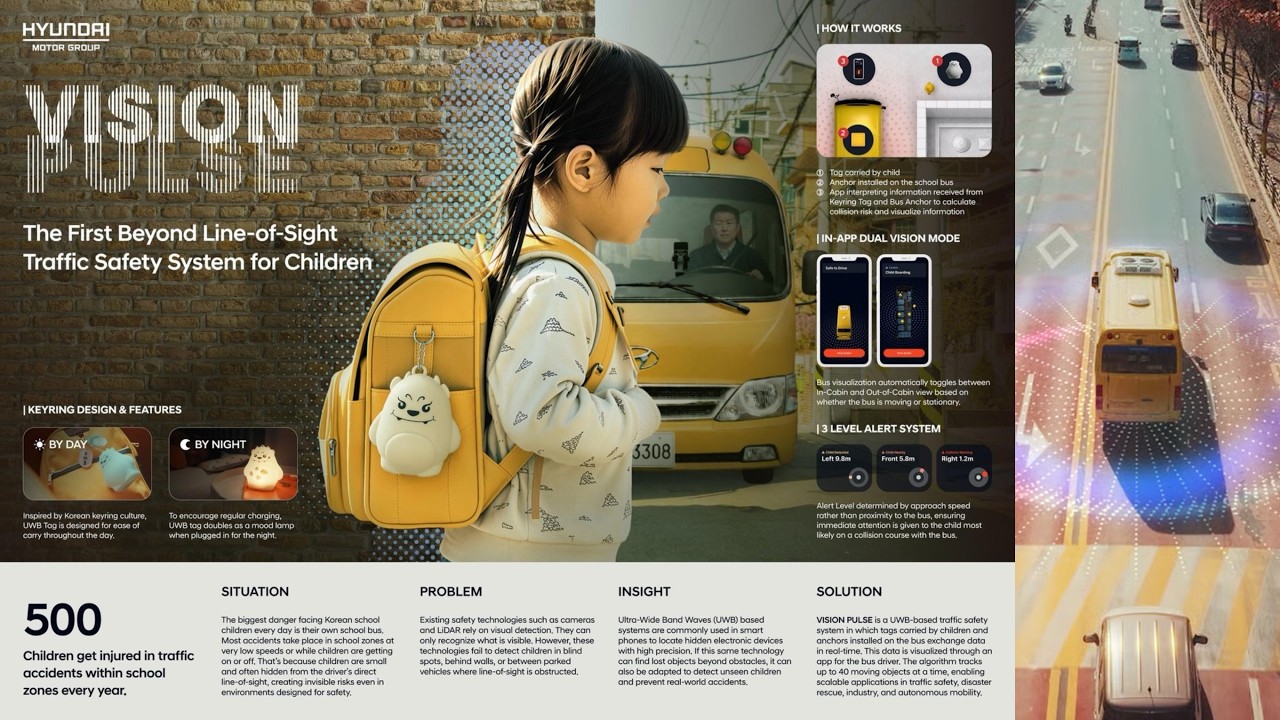
Hyundai sought to address the persistent, deadly issue of school bus blind-spot accidents in dense urban areas. The client needed a solution that overcame the limitations of traditional sensors like cameras and LiDAR. They tasked Paulus with creating a system that ensured consistent, reliable child detection while encouraging daily adoption, ultimately aiming to protect children beyond the vehicle's line of sight.
Creative Idea
A safety tag that protects by day and comforts by night as a lamp.
Hyundai transformed life-saving UWB safety technology into a child-friendly keyring that doubles as a bedside nightlight, ensuring children consistently carry the device while bridging the gap between automotive engineering and daily emotional habits.
Beyond the Blind Spot: Engineering Human Rituals
From Logistics to Kindergarten
While the pilot program focused on school safety in South Korea, the technology’s utility extends far beyond the classroom. The system was validated at Kia’s PBV Conversion Center in Hwaseong and the Busan Port Authority, where it successfully reduced forklift-pedestrian proximity hazards. By utilizing Ultra-Wideband (UWB) signals, the system achieves 10-centimeter accuracy within a 100-meter radius, maintaining a reaction speed of 1 to 5 milliseconds. This performance holds steady at >99% detection accuracy even in total darkness or heavy rain, proving that the hardware is robust enough for high-stakes industrial environments.
Leveraging Existing Infrastructure
A significant hurdle for new automotive safety tech is the cost of implementation. Vision Pulse bypasses this by integrating with Hyundai/Kia’s Digital Key 2 technology. Because the necessary UWB anchors are already pre-installed in many modern vehicle fleets, the system requires zero additional hardware costs for the vehicles themselves. This architectural efficiency allows the campaign to scale rapidly across existing consumer and commercial fleets without requiring complex retrofitting.
A Design-Led Safety Philosophy
Creative Director Saffaan Qadir and the team at Paulus emphasized that the project’s success relied on behavioral psychology as much as radio-frequency engineering. By tapping into local keyring decoration culture, the team ensured the safety tag was viewed as a desirable accessory rather than a medical or tracking device. This design choice effectively solved the "compliance problem" that plagues most wearable safety tech. By turning the charging dock into a bedtime mood lamp, the agency transformed a chore-based safety requirement into a seamless, comforting nightly ritual for children.
4C Framework deconstruction
Company
Hyundai leveraged its proprietary UWB algorithm and expertise in robotics to create a beyond line-of-sight detection system.
Category
Automotive brands typically rely on expensive, visible hardware like cameras and LiDAR that fail in blind-spot scenarios.
Customer
Parents and schools needed a reliable, foolproof way to protect children from accidents in dense, high-traffic urban environments.
Culture
The prevalence of Korean keyring decoration culture allowed the safety tag to be adopted as a personal accessory.
Company
Hyundai leveraged its proprietary UWB algorithm and expertise in robotics to create a beyond line-of-sight detection system.
Category
Automotive brands typically rely on expensive, visible hardware like cameras and LiDAR that fail in blind-spot scenarios.
Strategy:
Solve critical safety failures by embedding protective technology into the user's existing daily rituals.
Customer
Parents and schools needed a reliable, foolproof way to protect children from accidents in dense, high-traffic urban environments.
Culture
The prevalence of Korean keyring decoration culture allowed the safety tag to be adopted as a personal accessory.
Strategy:
Solve critical safety failures by embedding protective technology into the user's existing daily rituals.
Results
Following the successful trial of the Vision Pulse system, Hyundai Motor Group spun off WHEREB, a specialized UWB startup to commercialize and expand the technology.
0.006s
response time
40
simultaneous objects tracked
Strategy Technique
Build an Utility, Not an Ad
Hyundai moved beyond traditional advertising by creating a functional tool that solves a real-world safety friction. The solution integrates seamlessly into the user's life, making the brand an essential part of their daily routine.
Explore Technique
Creative Technique
Turn Message into Product
The campaign physically embedded the safety technology into a desirable, everyday object. By turning a functional safety tag into a child's nightlight, it ensured consistent usage through a natural, non-intrusive daily ritual.
Explore Technique
Craft Breakdown
This campaign elevates automotive safety technology by blending human-centered product design with innovative UWB radio engineering. The transformation of a safety tag into a cute, glowing night-light keyring brilliantly bridges child behavior with life-saving tech.
The clever dual-purpose physical design turns a safety beacon into a desirable child backpack charm and bedtime mood lamp, solving the charging habit friction seamlessly.
Repurposing UWB radio waves and developing custom algorithms to detect non-line-of-sight obstacles at ultra-low latency (0.006s) sets a new automotive safety precedent.
“The synergy between human-centered physical product design and advanced non-line-of-sight signal processing transforms complex technology into a warm, reliable safeguard.”