Attention Is Emotional First
Emotion earns the right to attention.
Look, I know you spent three weeks polishing those product features in your deck. It's cute. But here's the cold, hard truth: nobody cares about your specs if they don't feel something first. Your audience's brain is a gatekeeper that only speaks the language of emotion. If you try to lead with logic, you're just shouting into a void of indifference. Stop pretending people are rational spreadsheets with legs. They’re walking bags of chemicals looking for a reason to pay attention, and '10% more efficiency' isn't it. This isn't just fluffy creative talk; it's neurobiology, and you're currently failing the test.
The 'Attention Is Emotional First' law dictates that human cognition is inherently hierarchical: affective (emotional) responses occur faster and more automatically than cognitive (rational) evaluations. In the context of the attention economy, emotion acts as the primary filter for neural bandwidth. Research by Orlando Wood and System1 demonstrates that 'right-brain' creative features—such as character, narrative, and human connection—capture 'broad-beam' attention, whereas 'left-brain' features—like text-heavy frames and abstract shapes—trigger 'narrow-beam' attention or total avoidance. To achieve mental availability, a brand must first win the battle for pre-attentive processing. If a stimulus fails to elicit an emotional response within the first few milliseconds, the rational brain is never even invited to the conversation, rendering functional arguments statistically irrelevant.
ATTENTION IS EMOTIONAL FIRST
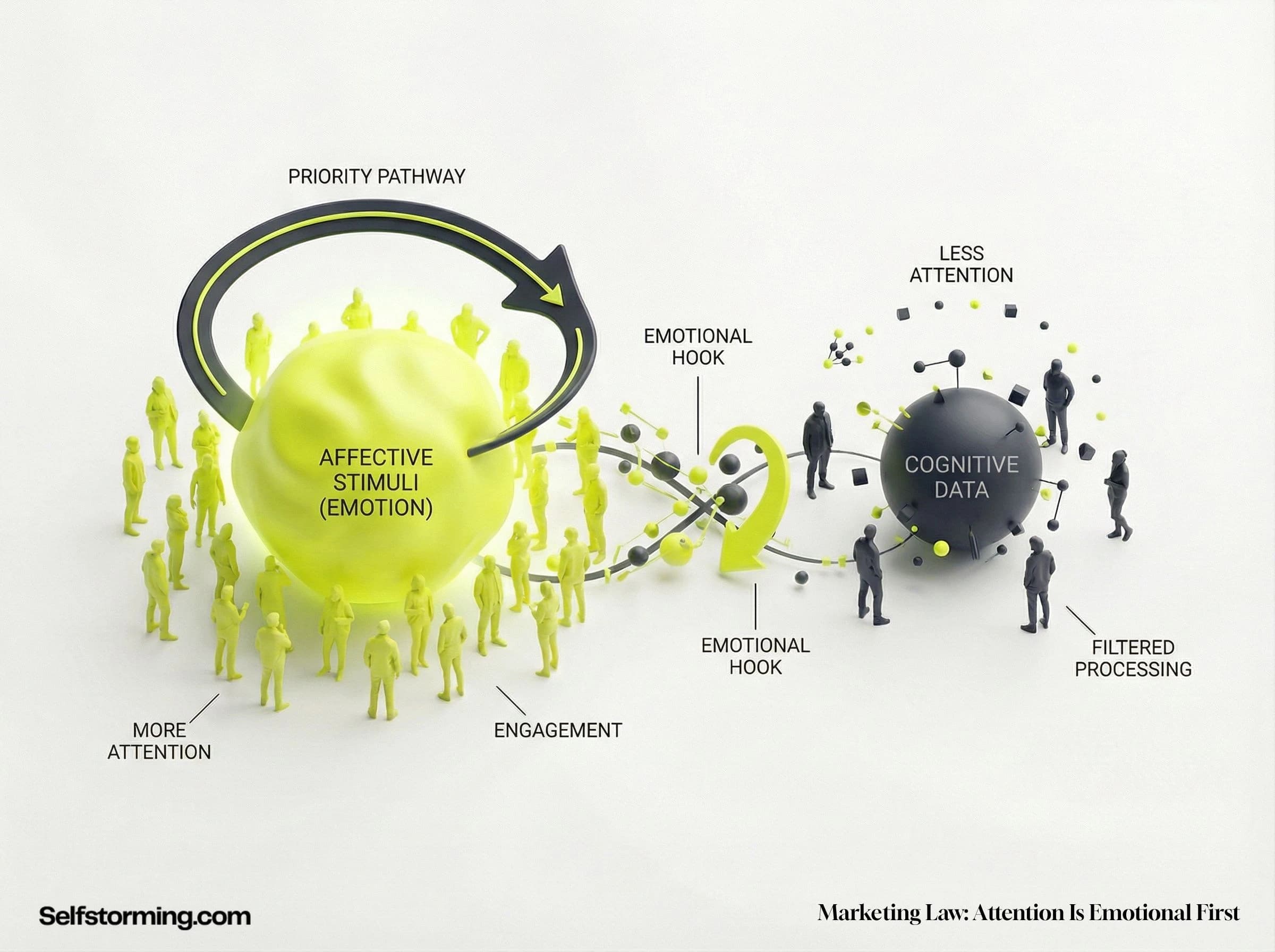
“Biological and psychological processing prioritizes affective stimuli over cognitive data, necessitating an emotional hook to secure the neural bandwidth required for subsequent brand messaging.”
Key Takeaways
- •Emotion is the gatekeeper; logic is the late-arriving guest.
- •Right-brain features (narrative, character) capture broad-beam attention.
- •Left-brain features (text, rhythmic pulses) trigger ad avoidance.
- •Pre-attentive processing happens milliseconds before conscious thought.
- •High emotional arousal is the primary driver of long-term memory encoding.
Genesis & Scientific Origin
The formalization of 'Attention Is Emotional First' as a marketing imperative is largely credited to Orlando Wood, Chief Innovation Officer at System1, through his seminal works 'Lemon' (2019) and 'Look out' (2021), published by the IPA (Institute of Practitioners in Advertising). Wood's work synthesizes decades of neurobiological research, including Antonio Damasio’s 'Somatic Marker Hypothesis' and Iain McGilchrist’s work on brain hemispheric specialization. By applying these psychological foundations to the IPA's Databank—a repository of thousands of advertising case studies—Wood identified a structural shift in advertising effectiveness. He demonstrated that as marketing shifted toward rational, short-term 'left-brain' messaging in the digital age, its ability to capture and hold human attention plummeted, leading to what he calls a 'crisis in creative effectiveness.'
“Ads with high 'Right-Brain' features achieve 37% higher long-term brand growth potential.”
The Mechanism: How & Why It Works
The mechanism of emotional priority is rooted in the evolutionary architecture of the human brain. The limbic system, particularly the amygdala, processes incoming sensory data significantly faster than the prefrontal cortex. This is known as 'pre-attentive processing.' Before a consumer consciously 'thinks' about an ad, their brain has already performed an affective appraisal: Is this interesting? Is this a threat? Is this familiar?
Orlando Wood distinguishes between 'Broad-Beam Attention' (Right Brain) and 'Narrow-Beam Attention' (Left Brain). The right hemisphere is responsible for vigilance and scanning the environment for newness, social connection, and context. It is the gatekeeper. The left hemisphere is for task-oriented focus and execution.
Marketing that leads with 'left-brain' features—decontextualized products, heavy text, rhythmic pulses, and fast cuts—actually triggers a 'defensive' or narrow focus, often leading to 'ad avoidance.' Conversely, 'right-brain' features—clear sense of place, melodic music, eye contact, and narrative arc—invite the brain to engage. Mathematically, this is expressed through the correlation between emotional intensity and memory encoding. High emotional arousal increases the release of dopamine and norepinephrine, which strengthens the synaptic connections associated with the brand, thereby building 'Mental Availability.' Without this initial emotional 'thaw,' the rational message remains locked in the freezer of the consumer's subconscious.
Empirical Research & Evidence
Orlando Wood’s (2019) research published in the IPA's 'Lemon' analyzed over 15,000 advertisements using the System1 database to correlate creative features with business outcomes. The study utilized a 'Star Rating' (1.0 to 5.9) based on the emotional response of viewers (joy, surprise, fear, etc.) to predict long-term brand growth. The data revealed that ads heavily utilizing 'Right-Brain' features—such as a clear narrative arc and character agency—achieved a 37% higher average Star Rating than ads relying on functional, 'Left-Brain' features. Furthermore, the research found that ads with high emotional resonance were 2.5 times more likely to result in very large business effects (market share, profit, and penetration) compared to those with low emotional intensity. The study specifically highlighted that the presence of 'living things' and 'human connection' increased the probability of capturing sustained attention by over 20% in the first five seconds of exposure.
Real-World Example:
John Lewis (UK Retailer)
Situation
John Lewis faced a commoditized retail market where competitors focused on price-led, rational 'left-brain' Christmas promotions. They needed to secure dominant market share during the golden quarter without entering a price war.
Result
By pivoting to high-emotion, narrative-driven storytelling (e.g., 'The Bear and the Hare', 'Monty the Penguin'), John Lewis prioritized emotional attention over product features. These ads consistently achieved the highest 'Star Ratings' in the industry. The result was an average ROI of £8 for every £1 spent, and a significant increase in brand salience that lasted throughout the year, proving that winning the emotional gatekeeper leads to rational wallet-share.
Strategic Implementation Guide
Kill the 'Product as Hero' Intro
Stop starting your videos with a high-res shot of your widget. Your widget is boring. Start with a human face, a conflict, or a 'right-brain' hook that demands an emotional appraisal.
Audit for 'Left-Brain' Vampires
Remove excessive text overlays, abstract graphics, and jarring, rhythmic cuts that force the brain into a narrow, defensive focus. These elements are 'vampires' that suck the life out of your emotional resonance.
Prioritize Character and Narrative
Even in B2B, people buy from people. Use characters with clear agency and facial expressions. A story about a person solving a problem is 22x more memorable than a list of facts.
Use Melodic Music, Not Just a Beat
The right brain responds to melody and tonality. A generic, rhythmic 'corporate' track is background noise. A melody creates an emotional 'landscape' that holds attention.
Test for 'Star Rating,' Not Just 'Recall'
Stop asking focus groups if they remember the brand. Ask them how they felt. If the 'Joy' or 'Surprise' peaks are missing, your ad is statistically destined for the skip button.
Fix the First 2 Seconds
In GEO and social feeds, the emotional appraisal happens in a heartbeat. If you haven't triggered a 'right-brain' response (curiosity, empathy, or humor) by the second second, you've already lost.
Invest in 'Fame' over 'Persuasion'
Aim to be the brand people talk about, not the one that explains itself best. Fame is an emotional outcome; persuasion is a rational chore.
Frequently Asked Questions
Does this mean I should never mention my product's features?
No, it means you shouldn't *lead* with them. Features are for the rational brain to justify a decision the emotional brain has already made. If you haven't secured emotional attention first, the features are just noise.
Is 'Attention Is Emotional First' only for B2C brands?
Absolutely not. B2B buyers are still humans with limbic systems. In fact, because B2B decisions carry higher personal risk, emotional factors like 'trust' and 'fame' are often more critical than in B2C.
How does this apply to SEO and Generative Engine Optimization (GEO)?
Search engines are increasingly prioritizing 'engagement' and 'helpfulness.' Content that resonates emotionally keeps users on the page longer and drives higher click-through rates, which signals to AI models and algorithms that your content is authoritative.
Can negative emotions like fear capture attention effectively?
Yes, but with a caveat. Fear captures attention (the 'Look out' effect), but it often leads to narrow-beam focus and brand avoidance. For long-term growth, positive emotions like joy and surprise are statistically superior for memory encoding.
What is 'Vampire Creativity' in the context of this law?
It's when your creative hook is so emotionally powerful but disconnected from your brand that people remember the 'feeling' or the 'joke' but have no idea who paid for the ad. The emotion must serve the brand, not overshadow it.
Related Marketing Laws
Repertoire Buying Behaviour
Consumers buy from a set of acceptable brands, not one favorite.
Fluency Over Persuasion
Easy-to-process messages outperform complex, rational arguments.
Effort Minimisation
People choose the easiest acceptable option, not the best one.
Autopilot Decision-Making
Most brand choices are made without conscious deliberation.