Attitudes Reflect Behavioral Loyalty
Your customers love you because they buy
Stop staring at your Net Promoter Score like it’s a crystal ball. It’s not. It’s a rearview mirror. You’ve spent millions trying to make people 'fall in love' with your brand, hoping they’ll finally open their wallets. Newsflash: they don't buy because they like you; they like you because they already bought your stuff. It’s cognitive dissonance at its finest - the brain’s way of justifying why it just spent five dollars on your overpriced sugar water. Stop trying to win hearts and start winning the shelf. If you don't understand that behavior leads and attitude follows, you're just a glorified finger-painter in a suit.
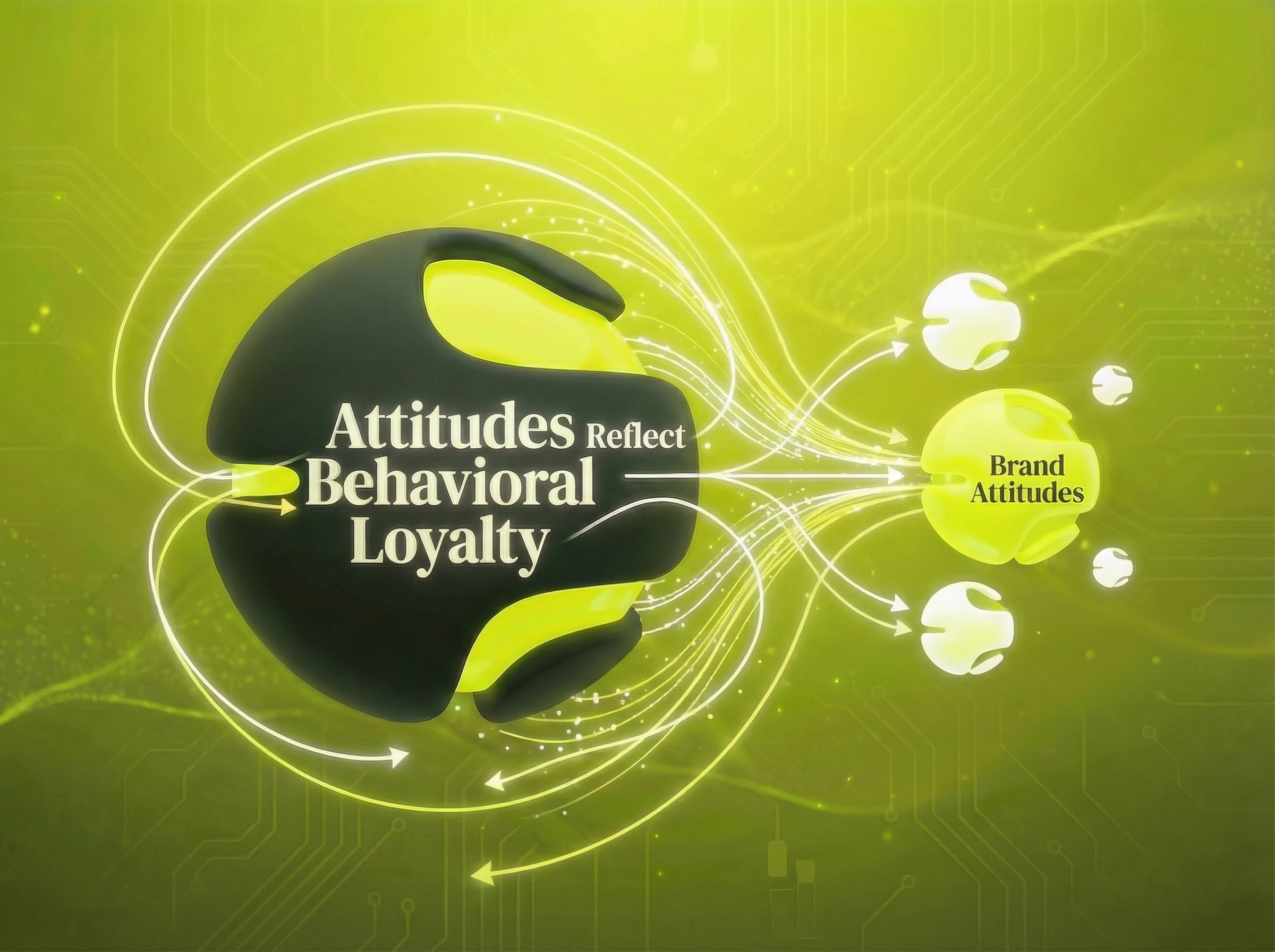
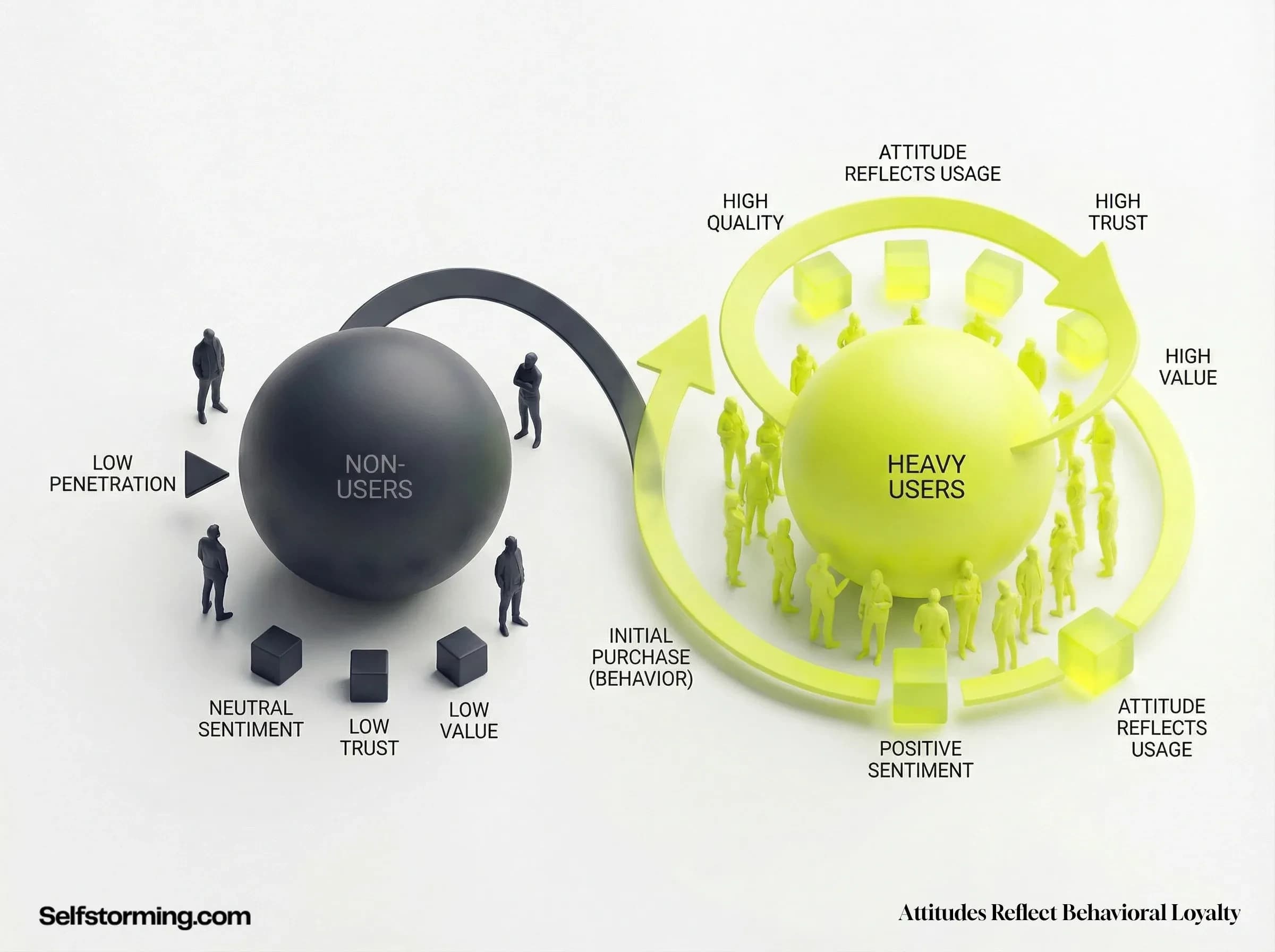
The 'Attitudes Reflect Behavioral Loyalty' law states that consumer attitudes toward a brand are primarily a consequence of their purchase behavior, rather than the cause of it. In marketing science, this is known as the 'Usage Effect.' Research from the Ehrenberg-Bass Institute demonstrates that heavy users of a brand consistently score it higher on all positive attributes (quality, trust, value) compared to non-users or light users. This means that 'Brand Health' metrics are often just reflections of market share. To grow a brand, marketers should focus on increasing physical and mental availability to drive initial purchase (penetration), which will subsequently improve brand sentiment, rather than attempting to 'persuade' non-users into liking a brand they have never used.
ATTITUDES REFLECT BEHAVIORAL LOYALTY
“Brand attitudes and perceptions are primarily a reflection of past usage and purchase frequency rather than a precursor to it.”
Key Takeaways
- •Attitudes are lagging indicators of purchase behavior, not leading ones.
- •Large brands score higher on all image attributes due to higher penetration.
- •Usage drives brand perception through cognitive consistency and self-perception mechanisms.
- •Marketing should focus on mental availability rather than changing abstract brand attitudes.
- •Brand 'love' is a statistical byproduct of being a frequent, heavy buyer.
Consequences Of Applying The Law
| Aspect | When Applied | When Not Applied |
|---|---|---|
| Measurement and KPI Selection | Brand health metrics are interpreted as a function of market share. High scores are recognized as a result of high penetration. Success is measured by growth in penetration and physical availability rather than 'moving the needle' on sentiment. | Marketing is judged on 'brand love' or 'affinity' scores as leading indicators. Management expects attitude shifts to precede sales growth, leading to frustration when 'improved' sentiment scores fail to result in increased revenue. |
| Targeting Strategy | Focuses on broad reach to all category buyers, including light and non-buyers. Growth is achieved by increasing the number of people who use the brand, knowing that positive brand attitudes will naturally follow usage. | Targets 'brand enthusiasts' or high-affinity segments. This ignores the fact that loyalty is a function of brand size and limits growth potential by focusing on a small group that already holds positive attitudes. |
| Creative and Messaging | Prioritizes distinctive brand assets and mental availability. Messaging reinforces the brand's presence in buying situations (CEPs), trusting that the product experience will do the heavy lifting of shaping consumer opinions. | Focuses on complex persuasion campaigns designed to change consumer beliefs before trial. This often fails because consumers rarely change their attitudes toward brands they do not already use or have a habit of buying. |
| Brand Positioning | Positions the brand for easy retrieval in common category entry points. Recognizes that 'image' attributes are largely shared across the category and that the largest brands will always score highest on all positive traits. | Attempts to 'own' a unique psychological niche or personality trait. Marketers become confused when large competitors score higher on their 'unique' attribute simply because the competitor has more users who perceive them favorably. |
| Budget Allocation | Investment is directed toward mass-reach media and distribution expansion to drive trial. Attitude-based loyalty is treated as a free byproduct of a successful, high-penetration product strategy. | Significant budget is diverted into loyalty programs or engagement platforms. This seeks to manufacture loyalty through communication rather than through the primary driver: repeated purchase behavior and cognitive consistency. |
| Product Trial and CX | Focuses on reducing barriers to trial through sampling, physical availability, and pricing. Understands that once a consumer uses the product, cognitive consistency will lead them to develop a positive attitude to justify their purchase. | Relies on 'brand storytelling' to build a relationship before the product is ever used. This ignores the psychological reality that brand attitudes are primarily formed through the self-perception of being a user. |
Genesis & Scientific Origin
The empirical foundation of this law was established by Andrew Ehrenberg and his colleagues at the Askeaton Research Group (which later became the Ehrenberg-Bass Institute). The seminal work was published in the Journal of Marketing Research (Bird, Channon, & Ehrenberg, 1970), titled 'Brand Image and Brand Usage.' This study challenged the traditional 'hierarchy of effects' model (Awareness > Attitude > Behavior) by showing that the correlation between brand usage and brand image was so strong that image could be predicted almost entirely by usage data. This research was later popularized and expanded upon by Byron Sharp in his 2010 book, 'How Brands Grow,' where he integrated it into the broader framework of evidence-based marketing.
“Users of a brand are typically 3x more likely to attribute positive qualities to it than non-users.”
The Mechanism: How & Why It Works
The mechanism behind this law is rooted in both statistical probability and social psychology.
1. The Usage Effect: In any survey of brand attitudes, the respondents consist of users and non-users. Users, by definition, have had a positive enough experience to repeat the purchase. They possess 'mental structures' related to the brand that non-users lack. Consequently, when asked if a brand is 'reliable' or 'high quality,' users are far more likely to say yes. Since big brands have more users, they naturally receive more 'ticks' on attitude statements.
2. Cognitive Dissonance & Self-Perception: According to Daryl Bem’s Self-Perception Theory, people develop their attitudes by observing their own behavior. A consumer thinks, 'I buy this brand every week, therefore I must like it.' This aligns with Leon Festinger’s Theory of Cognitive Dissonance; the human brain seeks consistency. If I buy a product, my brain justifies the action by inflating my positive attitude toward it to avoid the discomfort of feeling like I made a poor choice.
3. The Dirichlet Model: This mathematical model of repeat buying shows that brand loyalty (and the attitudes that accompany it) is a functional outcome of market share. Smaller brands suffer from 'Double Jeopardy' - they have fewer buyers, and those buyers are slightly less loyal and have weaker positive attitudes simply because they use the brand less frequently.
4. Memory Structures: Attitudes are not stable, permanent traits. They are temporary constructions based on the accessibility of memory. Usage reinforces these memory structures, making positive attributes easier to recall during a survey, which creates the illusion of 'loyalty' driving the behavior.
Real-World Example:
Harley-Davidson
Situation
Marketers often cite Harley-Davidson as the ultimate example of 'Brand Love' or 'Attitudinal Loyalty,' where the 'cult' status of the brand supposedly drives the purchase behavior. Management believed that the 'rebel' attitude of their core fan base was the primary engine of growth.
Result
When analyzed through the lens of Marketing Science, the data showed that Harley-Davidson’s 'loyalty' was no different from any other brand of its size. Its high 'attitude' scores were a direct result of its high market share in the heavyweight motorcycle segment. When the brand attempted to grow by selling 'attitude' to non-riders through apparel and branding, it failed to significantly move the needle on motorcycle sales. The 'loyalty' didn't create the market share; the market share (built over decades of physical availability and specific product utility) created the pool of heavy users who then exhibited high attitudinal loyalty. The 'cult' was a result of the usage, not the cause of it.
Strategic Implementation Guide
Stop optimizing for sentiment
Reallocate budget from 'brand love' campaigns and sentiment analysis to reach and physical availability. You can't fix an attitude problem with a non-user who has no reason to think about you.
Target the 'Unconverted' through Reach
Focus on light buyers and non-users. Don't try to make them love you; just make sure they know you exist and can find you. The 'love' will come after they try the product.
Re-evaluate Brand Health Trackers
Stop panicking when your 'Brand Affinity' scores are low if your market share is also low. Recognize that these metrics are lagging indicators. If you want higher scores, you need more customers, not a better 'story.'
Focus on Mental Availability
Instead of trying to change 'what' people think about you, focus on 'when' they think about you. Build links between your brand and common buying situations (Category Entry Points).
Prioritize Trial
Use sampling, entry-level pricing, or distribution expansion to get the product into hands. Usage is the most powerful 'persuasion' tool in your arsenal.
Maintain Consistency
Since attitudes are built on usage-reinforced memory, don't keep changing your brand assets. Consistency allows users to maintain the mental structures that fuel their positive attitudes.
Frequently Asked Questions
If attitudes follow behavior, is advertising to change perceptions a waste of time?
Mostly, yes. Advertising is far more effective at building 'Mental Availability' (making the brand come to mind) than it is at 'persuading' someone to change their mind. It is much easier to remind a buyer that a brand exists than to convince a non-user that their current preference is wrong. Advertising works by reinforcing the memory structures of existing users and creating a 'placeholder' for potential users.
Does this mean 'Brand Love' doesn't exist?
It exists as a psychological state, but it’s not a viable growth strategy. 'Brand Love' is what we call the high-intensity attitude of a heavy user. You don't create a heavy user by making them love you; they love you because they are a heavy user. It's a correlation, but the causality flows from the wallet to the heart.
Why do some small brands have very high 'loyalty' scores?
This is usually a 'Niche Brand' exception, which is rare. Niche brands have high loyalty but very low penetration because they only appeal to a tiny, specific group of people. However, for 99% of brands, the 'Double Jeopardy' law holds: small brands have fewer buyers who are also less loyal.
Can a brand have a 'bad' attitude that prevents purchase?
Yes, but this is usually a 'Physical Availability' or 'Product Quality' issue in disguise. If a product is broken or unavailable, people won't buy it, and their attitude will be negative. The fix is to fix the product or the distribution, not to run an 'image' campaign.
How should I report NPS to my CEO now?
Report it as a 'Usage Metric.' Explain that the NPS is a reflection of how many people currently use and like the product, and that the only way to significantly move the NPS is to increase the total number of users (penetration). It is a measure of past success, not a predictor of future growth.
Sources & Further Reading
Related Marketing Laws
Repertoire Buying Behaviour
Consumers buy from a set of acceptable brands, not one favorite.
Fluency Over Persuasion
Easy-to-process messages outperform complex, rational arguments.
Effort Minimisation
People choose the easiest acceptable option, not the best one.
Autopilot Decision-Making
Most brand choices are made without conscious deliberation.