Maintain Investment in Downturn
Don't cut your growth during downturns.
Look, I get it. The CFO is breathing down your neck, the economy is tanking, and your first instinct is to slash the ad spend to zero to 'save' the quarter. It feels safe. It feels responsible. It’s also the fastest way to ensure your brand becomes a historical footnote. While your competitors are busy huddling in the dark, you have a once-in-a-decade opportunity to buy market share at a discount. If you cut now, you aren't saving money; you're just paying for your funeral in installments. Stop being a coward and start being a strategist.
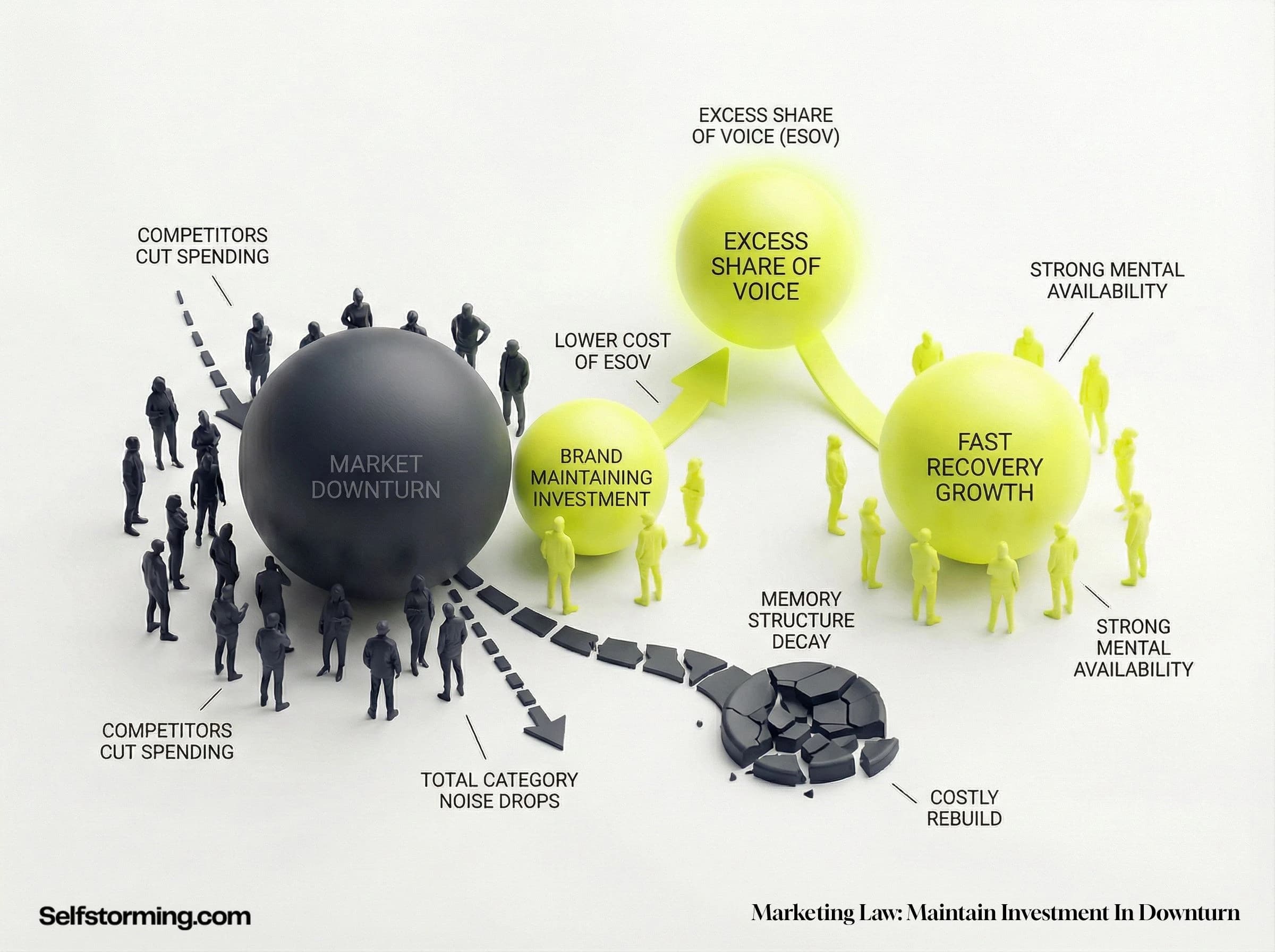
Maintaining or increasing marketing investment during an economic downturn is a calculated play for market share, not an act of bravado. When competitors reduce their spending, the total category 'noise' drops, which significantly lowers the cost of achieving Excess Share of Voice (ESOV). ESOV—defined as a Share of Voice that exceeds your current Share of Market—is the primary driver of brand growth. Brands that maintain presence build stronger mental availability during periods of consumer price sensitivity, positioning themselves as stable and reliable. Data from the IPA shows that brands maintaining investment grow up to five times faster during the recovery phase than those that go dark. Cutting spend leads to a decay in memory structures that costs significantly more to rebuild later.
MAINTAIN INVESTMENT IN DOWNTURN
“Sustained or increased share of voice relative to market share during periods of negative economic growth correlates with accelerated market share acquisition and superior long-term profitability during the subsequent recovery phase.”
Key Takeaways
- •Recessions are the cheapest time to buy long-term market share via ESOV.
- •Going dark causes memory decay that is 3x more expensive to fix later.
- •Maintain the 60/40 brand-to-activation ratio to ensure post-recession recovery speed.
- •Relative Share of Voice (SOV) matters more than absolute dollar spend.
- •Stability and emotional resonance outperform 'recession-themed' sales pitches.
Genesis & Scientific Origin
The empirical foundation for maintaining investment during downturns was primarily codified by Peter Field and Les Binet through their extensive analysis of the Institute of Practitioners in Advertising (IPA) Databank. While the concept of 'advertising through a recession' has been discussed since the 1920s (notably by Roland S. Vaile), it was Field's 2008 report, 'Advertising in a Downturn,' and subsequent updates following the 2020 pandemic, that provided the statistical rigor required to move the concept from 'marketing folklore' to a proven law of Marketing Science. Their work analyzed over 800 case studies across multiple decades of economic cycles.
“Brands that increase spend in a recession see 4.5x higher growth during recovery.”
The Mechanism: How & Why It Works
The fundamental mechanism driving this law is the relationship between Share of Voice (SOV) and Share of Market (SOM), specifically the concept of Excess Share of Voice (ESOV). In any stable market, a brand's SOM tends to follow its SOV. If SOV > SOM, the brand typically grows (positive ESOV). If SOV < SOM, the brand typically shrinks (negative ESOV).
During a downturn, most brands instinctively cut their marketing budgets. This causes the total 'noise' or aggregate advertising spend in the category to plummet. If Brand A maintains its absolute budget while its competitors cut theirs by 50%, Brand A’s relative Share of Voice increases dramatically without spending an extra cent. This 'accidental' ESOV is the cheapest market share a brand will ever buy.
Psychologically, this works through the maintenance of Mental Availability. Consumers do not stop thinking during a recession; they become more risk-averse. Brands that remain visible signal stability and 'fitness.' When the recovery begins, these brands occupy the primary 'repertoire' positions in the consumer's mind. Conversely, brands that go dark suffer from 'decay of memory structures.' Rebuilding these neural pathways after a two-year hiatus is exponentially more expensive than the cost of maintaining them during the slump.
Furthermore, media costs (CPM/CPC) often decrease during a recession due to lower demand. This creates a 'double-whammy' effect: your dollars go further, and they face less competition, resulting in a massively inflated ESOV for the same capital outlay. The law of 'equilibrium' suggests that if you don't defend your mental territory, someone else will occupy it, and the cost of eviction is always higher than the cost of defense.
Empirical Research & Evidence
Research published in the IPA Databank (Field, 2008) titled 'Advertising in a Downturn' analyzed 880 corporate case studies. The study found that brands that increased their marketing budgets during the 2008 financial crisis saw an average market share growth of 1.7 percentage points per year of the recession, compared to just 0.6 percentage points for those that maintained or cut spend. More critically, the 'recovery' growth for maintainers was 4.5x higher than for cutters. Field’s analysis demonstrated that for every 10 points of ESOV gained during a recession, a brand could expect an average of 0.5% growth in market share, a much higher efficiency than in 'peacetime' markets.
Real-World Example:
Lego
Situation
During the 2008 global financial crisis, most toy manufacturers, including Mattel and Hasbro, significantly reduced their marketing spend to protect margins as consumer spending on non-essentials plummeted.
Result
Lego took the opposite approach, expanding into new markets (Asia) and increasing their global marketing investment. By maintaining presence and launching 'Lego Movie' precursors and new product lines, Lego’s profits rose by 63% in 2009 alone, reaching an all-time high of $395 million. While the rest of the category was stagnant or declining, Lego used the lack of competitive noise to cement its position as the world's leading toy brand, a position it has not relinquished since.
Strategic Implementation Guide
Audit Competitor Spend
Use monitoring tools to track the SOV of your top three competitors. If they cut spend, calculate the 'gap' and identify how much absolute spend you need to maintain to achieve a +10% ESOV.
Shift to Long-Term Brand Building
Resisting the urge to pivot entirely to 'sales activation' or 'discounting.' Maintain a 60/40 or 70/30 split in favor of brand-building to protect mental availability.
Negotiate Media Rates
Use the recessionary drop in demand to lock in long-term, high-value placements at lower CPMs. This is the time to buy 'trophy' assets that were previously unaffordable.
Update Creative for Empathy, Not Desperation
Avoid 'we're in this together' clichés. Use emotional messaging that reinforces the brand's enduring value and stability without focusing on the 'gloom' of the economy.
Focus on Light Buyers
Do not retreat into 'loyalty' programs. Recessions are the best time to capture the 'light buyers' of competitors who are no longer being reached by those competitors' advertising.
Protect Physical Availability
Marketing spend is useless if your product isn't on the shelf. Ensure your supply chain and distribution are prioritized alongside your media spend.
Measure 'Mental Availability' Metrics
Track Salience and Top-of-Mind awareness monthly. If these metrics dip, your SOV is likely insufficient, regardless of what your ROI dashboard says.
Frequently Asked Questions
Doesn't maintaining spend during a recession destroy our short-term ROI?
Yes, it might. And that’s exactly why you should do it. Short-term ROI is a efficiency metric, not a growth metric. In a downturn, ROI often drops because consumer demand is lower. If you optimize for ROI, you will cut spend to zero. The goal isn't 'efficiency' right now; it's 'market share acquisition.' You are buying future profits at a discount today.
Our category is genuinely shrinking. Why spend to reach people who can't buy?
Because they will buy eventually. Brand building is about planting seeds for the recovery. If you wait until the recovery to start advertising, you'll be starting from zero while your competitors (who stayed active) are already harvesting. You are advertising to the 'future buyer' who is currently on a 'buying pause'.
Should we change our messaging to focus on discounts and price?
Rarely. Deep discounting erodes brand equity and trains consumers to only buy on price. While you should highlight 'value,' you should do so by reinforcing the quality and reliability of the brand. Let the generic brands fight the price war; you stay in the mind as the 'worth it' choice.
What if my budget is actually cut by the CFO? What's the 'Plan B'?
If your absolute dollars are cut, you must maximize 'Distinctiveness.' Use high-impact, emotional creative that 'punches above its weight.' If you can't win on volume (SOV), you must win on 'impact per impression.' But make it clear to leadership that this is a 'controlled retreat' that will cost more to fix later.
Is there any scenario where cutting spend is the right move?
Only if your company is facing an actual liquidity crisis (i.e., you will go bankrupt next month if you don't cut). If the choice is 'brand health' vs. 'company survival,' choose survival. But if the choice is 'meeting an arbitrary profit target' vs. 'long-term market dominance,' the CFO is making a mistake.
Sources & Further Reading
Related Marketing Laws
Long and Short of It
Brand building and activation do different jobs and require different strategies.
60/40 Rule (Contextual)
Long-term brand investment typically outperforms short-term activation alone.
Short-Term ROI Bias
Short-term metrics undervalue long-term brand effects.
Brand Effects Compound
Long-term brand investment creates compounding returns over time.