Pyramid of Truth
Triangulate Three Truths Into One Core Idea
Most strategy is the search for one idea that's both true and interesting. The Pyramid of Truth is a way of forcing that idea to be honest. You line up three truths - what's real about your brand, what's real about the people you're talking to, and what's going on in the wider culture - and you keep pushing until they meet at a single point. That meeting point, sitting at the apex, is your core idea.
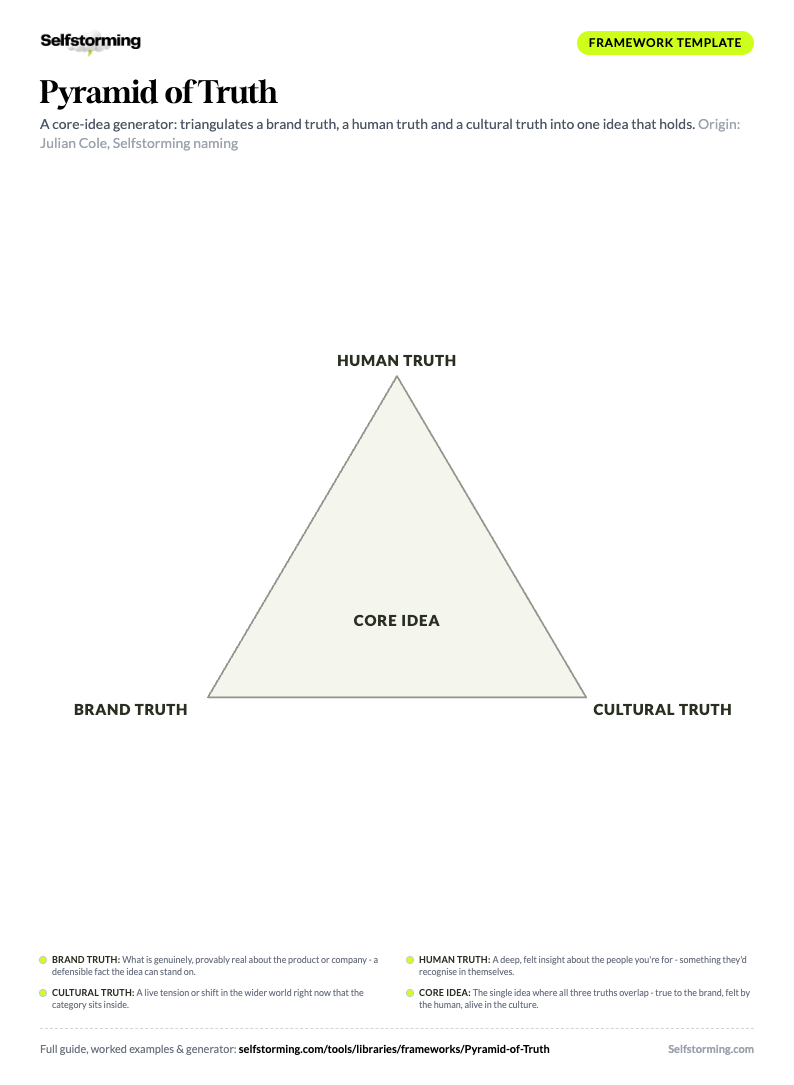
Print it. Fill it in.
The Pyramid of Truth as a printable A4 worksheet - write straight into the framework, on paper or in any PDF app.
Download the PDF templateKnowledge Worth Paying For
A working library of brand strategy frameworks - with worked examples on real brands, sources, and decision criteria. Not vibes.
One good deck covers the subscription. The rest is profit.
Three truths stacked into one idea, base to apex: Brand Truth (what is genuinely, provably real about your product or company), Human Truth (a deep, felt insight about the people you're for), and Cultural Truth (a live tension or shift happening in the wider world). Where the three overlap sits the Core Idea - one ambitious, grounded idea that no single truth could produce alone. Use it to find a strategic platform that is both true and interesting.
Liquid Death
DTC canned water (USA, founded 2019)A pyramid where the cultural truth does the heavy lifting. The brand truth is almost mundane - it's just water in a can. But stacked under a sharp human truth and a live cultural tension, that ordinary base produces an idea no other water brand would dare: sell water like a heavy-metal energy drink and make sustainability funny instead of preachy.

Dove
Personal care brand (global, founded 1957)A pyramid only Dove could build, because the base has held for twenty years. Brand truth: two decades of refusing to retouch real women. Human truth: filters make people feel quietly worse about their own face. Cultural truth: a hyper-real beauty filter went viral and scared everyone. Stack them and you get an idea that turns the brand's oldest belief into a live act of defiance.

Duolingo
Language-learning app (global, founded 2011)A pyramid where the human truth unlocks an unusual tone. The brand truth is a free, gamified app. The human truth - that we abandon self-improvement the moment it feels like homework - pushes the idea away from earnest education and toward something chaotic and entertaining, which the cultural truth about brands behaving like people made possible.
Liquid Death, Dove, Duolingo - filled in, line by line. Unlock to read them.
Liquid Death (DTC canned water (USA, founded 2019))
A pyramid where the cultural truth does the heavy lifting. The brand truth is almost mundane - it's just water in a can. But stacked under a sharp human truth and a live cultural tension, that ordinary base produces an idea no other water brand would dare: sell water like a heavy-metal energy drink and make sustainability funny instead of preachy.
Brand Truth: It's plain water in a tallboy aluminium can - infinitely recyclable, no plastic, no sugar, no gimmick in the liquid itself.
Human Truth: People want hydration without feeling lectured to, and they'd love a healthy choice that doesn't make them look boring.
Cultural Truth: A backlash against performative, worthy wellness branding - audiences crave brands that mock the cliches instead of joining them.
Core Idea: Murder your thirst. Make health the most metal choice in the room.
Dove (Personal care brand (global, founded 1957))
A pyramid only Dove could build, because the base has held for twenty years. Brand truth: two decades of refusing to retouch real women. Human truth: filters make people feel quietly worse about their own face. Cultural truth: a hyper-real beauty filter went viral and scared everyone. Stack them and you get an idea that turns the brand's oldest belief into a live act of defiance.
Brand Truth: Twenty years of the Real Beauty stance - no retouching, no digital distortion, real women instead of impossible ideals.
Human Truth: People look in the mirror, then look at the filtered version, and quietly start believing the real face is the flawed one.
Cultural Truth: TikTok's hyper-realistic 'Bold Glamour' filter exploded across millions of videos, blurring the line between a face and a fantasy and alarming parents and teens alike.
Core Idea: No filter should tell you how to look - so turn your back on it.
Duolingo (Language-learning app (global, founded 2011))
A pyramid where the human truth unlocks an unusual tone. The brand truth is a free, gamified app. The human truth - that we abandon self-improvement the moment it feels like homework - pushes the idea away from earnest education and toward something chaotic and entertaining, which the cultural truth about brands behaving like people made possible.
Brand Truth: A free, bite-sized, gamified app with streaks and a memorably unhinged green owl as its mascot.
Human Truth: People genuinely want to learn a language but quietly quit the second it starts to feel like dull, guilt-ridden homework.
Cultural Truth: Audiences reward brands that act like chaotic, self-aware characters online rather than polished corporate voices.
Core Idea: Make learning so entertaining that quitting feels like missing the show.
1. Brand Truth
What is genuinely, provably real about our product, company, or way of doing things that we could stand behind in court?
The foundation. A concrete, defensible fact about your brand - how it's made, what it does, where it came from, how it behaves. It keeps the idea honest by anchoring it to something you can actually deliver.
Good answer: We refuse to add sugar even when competitors do, and it costs us shelf appeal. Specific, provable, and it carries a built-in trade-off that makes it believable.
Wrong answer: We're passionate about quality. Not a truth, a hygiene claim. Every brand says it, none can be sued over it, and it anchors nothing.
2. Human Truth
What does the person we're for actually feel, want, or struggle with - deeply enough that they'd recognise themselves in it?
The middle tier. A felt insight about real human behaviour or emotion - the kind that makes someone say how did you know that. Human truths tend to be durable, because feelings change far slower than trends.
Good answer: People want to look like they didn't try too hard, while trying very hard. Uncomfortably accurate, widely felt, and it opens a creative door.
Wrong answer: Our customers value convenience. A research bullet, not a human truth. It describes behaviour without revealing the feeling underneath it.
3. Cultural Truth
What live tension, shift, or contradiction is happening in the wider world right now that this category sits inside?
The upper tier. An observation about the cultural moment - a shift in values, a backlash, a rising tension. It keeps the idea timely and gives it something larger to push against. Cultural truths move fastest, so they need checking often.
Good answer: We're exhausted by performative wellness and quietly suspicious of anything that calls itself a journey. Specific to now, charged, and full of creative tension.
Wrong answer: Technology is changing how we live. True since 1900, therefore useless. A cultural truth that fit any decade fits no campaign.
4. Core Idea
What single idea sits exactly where all three truths overlap - true to the brand, felt by the human, and alive in the culture?
The apex. One short, decisive idea that could only exist because all three truths are true at once. It should feel a little ambitious and a little risky. This is the strategic platform every execution then hangs from.
Good answer: Permission to do nothing, on purpose. It resolves the three corners into one direction that's both grounded and provocative.
Wrong answer: Quality you can trust for the modern world. A sentence that touches all three truths and means nothing - the corners met but produced fog, not a point.
Decide your starting point: You don't have to find the three truths in a blank room. Right here on Selfstorming you can find inspiration and directions, or generate a first-draft Pyramid of Truth in minutes. Treat that draft as a head start, then run it through the steps below to pressure-test each truth and sharpen the idea at the apex.
Build the base first - the brand truth: Start with what's provably real about your product or company, because it's the hardest to fake and the easiest to check. Sort candidates into defensible and aspirational. Keep only the defensible ones - the base has to bear weight, and a wishful claim collapses the whole pyramid.
Dig for the human truth, past the research bullet: Don't stop at what people do; push to what they feel underneath it. Keep asking but why does that matter to them until you hit something a real person would flinch at recognising. If the statement is comfortable, you haven't reached the truth yet.
Read the cultural truth off the present, not the past: Name a live tension in the world right now that your category sits inside - a backlash, a shift, a contradiction people are feeling. Check it's specific to this moment. If your cultural truth would have been true ten years ago, it's a platitude, not a truth.
Stress-test each corner for tension: A truth that doesn't pull against the others is a description. For each one, ask what does this rule out. If a corner rules nothing out, sharpen it until it does. The friction between the corners is the raw material for the idea.
Find the overlap, not the average: Resist the urge to write a sentence that blandly mentions all three. Instead, sit with the tension between them and look for the one idea that only makes sense because all three are true at once. The core idea resolves the corners; it doesn't summarise them.
Pressure-test the apex against the corners: Take your candidate core idea and trace it back down to each truth. If it doesn't connect cleanly to all three, either the idea is weak or one of the truths is. Both are useful findings. A strong apex should make all three corners feel necessary, not decorative.
Turn the apex into a platform, not a poster: A core idea earns its place only if it changes what you do next - the campaign, the product roadmap, the brief. Write the next three executions that would only make sense under this idea. If you can't, the apex isn't sharp enough yet.
Best for: Finding a single strategic platform or campaign idea that is both true and interesting - and aligning senior stakeholders behind why it's the right one. / Generating a quick tactical message, a performance ad headline, or a one-off execution where triangulating three truths is overkill.
Output: One decisive Core Idea at the apex, backed by three named truths that justify it - a platform a brief can hang from. / A long list of messages or a full positioning document. The pyramid converges on one idea; it doesn't sprawl into a campaign matrix.
Time to complete: A focused workshop or two (a day or so), with the human and cultural truths ideally informed by real research rather than guesswork. / Five minutes before a deadline. Rushed truths produce a pretty triangle built on assumptions, which is worse than no triangle at all.
vs Idea Cascade: Use the Pyramid of Truth to find the idea - converging three truths into one core platform at the top. / Use Idea Cascade to take that idea and cascade it downward into message and execution. The Pyramid converges; the Cascade unfolds. They run in sequence.
vs Insight & Tension Statement: Use the Pyramid when you want three distinct sources of truth - brand, human, culture - triangulated into one defensible idea. / Use an Insight & Tension Statement for a faster, single-axis route: one human insight plus the tension it creates. Lighter, quicker, less rounded.
vs Get Who To By: Use the Pyramid to discover the strategic idea before you know exactly what you're asking anyone to do. / Use Get Who To By once you have the idea and need a tight campaign brief - get whom, to do what, by saying what. Action-shaped, not idea-shaped.
The Pyramid of Truth is a Selfstorming-named tool, renamed in 2026 from its earlier label Eye of the Pyramid. The underlying move - triangulating a brand truth, a human truth, and a cultural truth into a single idea - is not ours and is not new. The three truths approach is a long-standing piece of agency planning craft, taught and practised across consultancies for decades; the brandgym, for instance, documents it as the triangle of truth behind brands like Jack Daniel's, and planners such as Darby Hughes have written up their own 3 Truths versions. We make no claim to inventing the idea. What Selfstorming adds is a clean, named, repeatable structure - base to apex, with the core idea forced to the top - and a generator that drafts the corners so you can spend your time pressure-testing them instead of staring at a blank triangle.
The fair criticism of any three-truths model is that it gives the comforting feeling of rigour without guaranteeing any. A team can fill all three corners with accurate, agreeable statements, overlap them into a vague sentence, and walk out convinced they have a strategy when they have a description. The discipline lives entirely in how uncomfortable the truths are allowed to be - and most workshops sand the edges off. The cultural truth is especially fragile: read it wrong or read it late, and the whole idea ages badly. And because the structure is so satisfying to fill in, it can flatter weak thinking - a beautifully drawn pyramid is not evidence of a good idea, only of a completed template. Used honestly, with truths sharp enough to create real tension, it's a strong way to find an idea that holds. Used lazily, it's expensive wallpaper.
What is the Pyramid of Truth framework?
The Pyramid of Truth is a strategic framework for finding one core idea by triangulating three truths: a Brand Truth (what's provably real about your product or company), a Human Truth (a deep, felt insight about the people you're for), and a Cultural Truth (a live tension in the wider world). Where the three overlap, at the apex, sits your Core Idea - one ambitious, grounded idea that no single truth could produce alone. It's used to find a platform that is both believable and interesting.
Who created the Pyramid of Truth?
The Pyramid of Truth is a Selfstorming-named tool, renamed in 2026 from our earlier Eye of the Pyramid. The underlying idea - triangulating brand, human, and cultural truths into one idea - is classic agency planning craft, not ours. The three truths approach has been practised across consultancies for decades and documented widely, for example as the triangle of truth at the brandgym. We don't claim to have invented it - what we add is a clean, repeatable structure and a generator to draft the corners.
What are the three truths in the Pyramid of Truth?
Brand Truth is what's genuinely, provably real about your product or company - a fact you could defend under scrutiny. Human Truth is a deep insight into what your people actually feel or struggle with, the kind that makes someone say how did you know that. Cultural Truth is a live, dateable tension or shift in the wider world. The Core Idea at the apex is what emerges where all three overlap - and the magic is in their friction, not their sum.
How is the Pyramid of Truth different from the Idea Cascade?
They run in opposite directions and in sequence. The Pyramid of Truth converges - it pulls three truths together to find one core idea. The Idea Cascade diverges - it takes a single idea and unfolds it downward into message and execution. Use the Pyramid to discover the idea, then the Cascade to roll it out. One narrows to a point; the other widens from it.
Does the Pyramid of Truth work for B2B?
Yes, and it can be unusually useful there. B2B brands drift into feature lists and generic 'trusted partner' language precisely because they skip the human and cultural truths. The Pyramid forces a B2B team to name what their buyer actually feels (the fear of choosing the wrong vendor, say) and what's shifting in their world, which is how you escape the sea of identical 'innovative collaboration platform' messaging.
What makes a truth strong enough to use in the Pyramid of Truth?
Tension. A strong truth rules something out - it makes a choice that a competitor couldn't comfortably copy. If a statement could sit in any brand's deck (we value quality, technology is changing the world), it's a description, not a truth. The test for each corner is what does this rule out. If the answer is nothing, sharpen it until the answer is something specific and slightly uncomfortable.
How is the Pyramid of Truth different from a single insight statement?
An insight statement usually works off one axis - a human insight and the tension it creates. The Pyramid of Truth deliberately uses three distinct sources - brand, human, and culture - and forces them to meet. That makes it slower but more rounded: the resulting idea is harder to argue with because it's already answered objections from three directions. Use the single insight when you want speed; use the Pyramid when the idea has to be defensible.
When should you not use the Pyramid of Truth?
When you need a quick tactical message rather than a strategic platform, when you have no real human or cultural insight to work with (guessed corners build a pyramid on sand), or when the work is pure performance optimisation that a core idea can't move. It's also a poor fit for fast reactive content, where a cultural truth would be stale before the post ships. The Pyramid is for finding ideas that last, not lines that ship today.
A core-idea generator: triangulates a brand truth, a human truth and a cultural truth into one idea that holds.
The reason this works is that each truth catches a different lie. The brand truth stops you promising things you can't deliver. The human truth stops you talking about features nobody feels. The cultural truth stops you saying something that worked in 2014 and lands flat today. An idea built on all three is hard to argue with, because every objection has already been answered by one of the corners.
The danger, of course, is filling the corners with comfortable nonsense - three bland statements that technically meet but generate nothing. A truth that doesn't create tension with the other two isn't a truth, it's a description. The whole point is the friction between the corners; the core idea is what resolves it.
Generate this for your brief - or grab the template
Generate a ready Pyramid of Truth from your brief straight into editable slides, or start from the free template.