Idea Cascade
Turn One Bold Idea Into Message And Execution
Most campaigns die in the gap between a good idea and a working brief. Someone has a genuinely brave thought in a meeting, everyone nods, and then over the next three weeks it gets sanded down into a banner ad and a hashtag. The Idea Cascade exists to stop that erosion. It takes one bold idea at the top and forces it - intact - down through what you say and how it shows up.
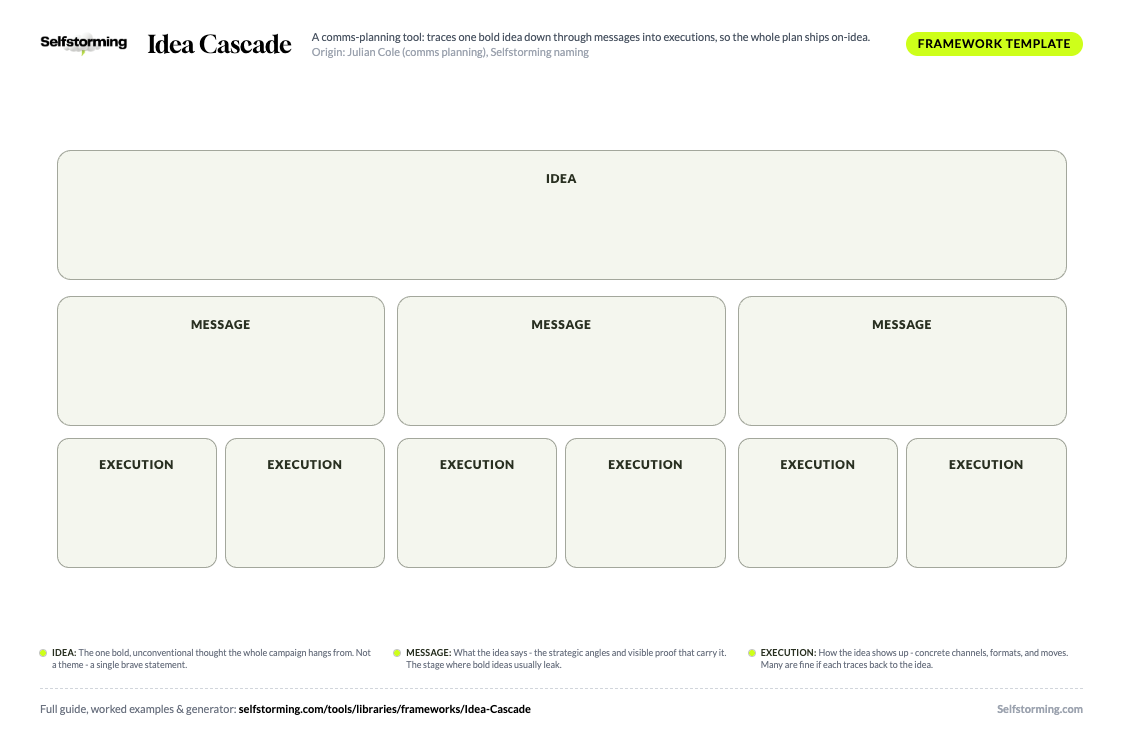
Print it. Fill it in.
The Idea Cascade as a printable A4 worksheet - write straight into the framework, on paper or in any PDF app.
Download the PDF templateKnowledge Worth Paying For
A working library of brand strategy frameworks - with worked examples on real brands, sources, and decision criteria. Not vibes.
One good deck covers the subscription. The rest is profit.
Three cascading stages from one idea to many moves. Idea (stage 1): the single bold, unconventional thought worth saying. Message (stage 2): what it says - the strategic angles and proof that carry the idea. Execution (stage 3): how it shows up - the channels, formats, and tactics. The rule that makes it work: every stage must trace cleanly back to the idea above it. It's a creative-direction tool for keeping a brave idea intact from thought to launch.
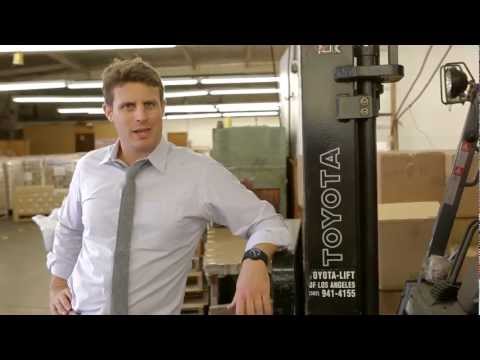
Dollar Shave Club
DTC razor subscription (USA, founded 2011)One idea - nobody is excited about razors, so sell the relief of never thinking about them again - cascades into a single deadpan founder monologue and a decade of executions that never once drift from the joke.
Nobody is excited about razors, so don't sell razors - sell the relief of never thinking about them again, in a voice that refuses to take the category seriously.
Great blades, about a dollar, delivered - the drugstore razor aisle is over.
The one-take founder monologue shot in the warehouse ('Our Blades Are F***ing Great').
Pre-roll and social cut-downs of the film pointed straight at sign-up.
We sound like a person, not a multinational.
Packaging inserts and order emails written in the same deadpan voice.
The 'We've Got Your Back. And Your Bikini Line.' line extension.
Subscription means never running out and never deciding again.
Tiered boxes pitched as 'set it and forget it'.
Restock reminders framed as a favour, not an upsell.
Liquid Death
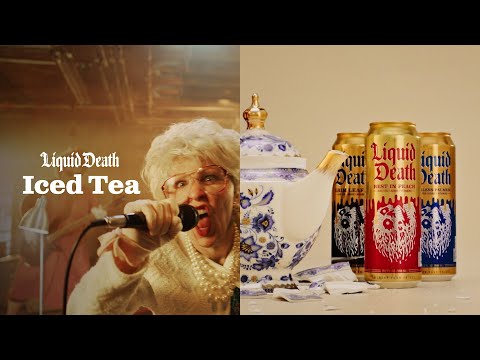
Canned water challenger (USA, founded 2019)The purest cascade in the library. One absurd idea - sell plain water like a death-metal energy drink - produces dozens of wildly different stunts that are all unmistakably the same brand. Range with zero drift.
Market plain canned water like a death-metal energy drink and tell people to 'murder your thirst' - the exact opposite of wellness branding.
It is just water, but it hates marketing as much as you do.
Tallboy cans designed to look great in your hand on camera.
Deadpan brand films skewering bottled-water clichés.
Make the healthy choice the most metal thing in the room.
'Kegs for Pregs' non-alcoholic party stunt.
'Your Grandma's Energy Drink' spot flipping the energy category.
Turn the haters into the campaign.
'Greatest Hates' - a sold-out album of real hate comments set to metal.
Limited can drops and recycled merch fans collect and resell.
Old Spice
Legacy men’s grooming brand (USA, P&G)A textbook cascade. One insight - women buy most of the men’s body wash - becomes an absurd hyper-masculine fantasy, then a message, then an execution engine that spat out hundreds of films without ever losing the joke.
Stop selling to men - sell the women who actually buy the body wash an impossibly perfect man, and make the impossibility itself the joke.
Your man could never be this man, but he could smell like him.
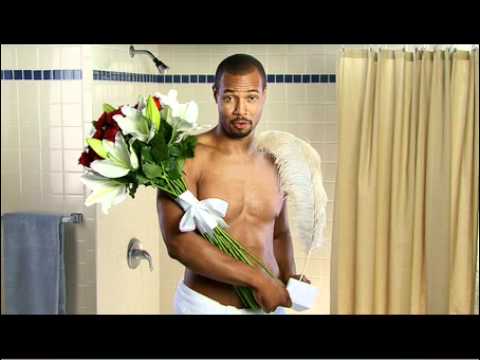
The one-take 'The Man Your Man Could Smell Like' film.
Media bought against women's TV slots, not men's.
Keep the bit alive in real time.
Around 180 personalised reply videos filmed live in a single day.
Replies aimed at celebrities and fans to feed the news cycle.
Extend the character without losing the absurdity.
'MomSong' and the over-the-top musical sequels.
Talking-muscle and 'Smellcome to Manhood' follow-ups.
Dollar Shave Club, Liquid Death, Old Spice - filled in, line by line. Unlock to read them.
Dollar Shave Club (DTC razor subscription (USA, founded 2011))
One idea - nobody is excited about razors, so sell the relief of never thinking about them again - cascades into a single deadpan founder monologue and a decade of executions that never once drift from the joke.
Idea: Nobody is excited about razors. So stop selling razors and sell the small relief of never having to remember to buy them - said by a guy who clearly isn't taking himself too seriously.
Message: Our blades are great, they cost about a dollar, and you'll never stand in the drugstore razor aisle again. That's the whole pitch.
Execution: A 90-second founder monologue shot in one warehouse take, packaging and emails written in the same dry voice, a 'We've Got Your Back. And Your Bikini Line.' follow-up - a whole brand that sounds like one person who finds the category funny.
Idea: Nobody is excited about razors, so don't sell razors - sell the relief of never thinking about them again, in a voice that refuses to take the category seriously.
Message: Great blades, about a dollar, delivered - the drugstore razor aisle is over. (Execution: The one-take founder monologue shot in the warehouse ('Our Blades Are F***ing Great').; Pre-roll and social cut-downs of the film pointed straight at sign-up.)
Message: We sound like a person, not a multinational. (Execution: Packaging inserts and order emails written in the same deadpan voice.; The 'We've Got Your Back. And Your Bikini Line.' line extension.)
Message: Subscription means never running out and never deciding again. (Execution: Tiered boxes pitched as 'set it and forget it'.; Restock reminders framed as a favour, not an upsell.)
Liquid Death (Canned water challenger (USA, founded 2019))
The purest cascade in the library. One absurd idea - sell plain water like a death-metal energy drink - produces dozens of wildly different stunts that are all unmistakably the same brand. Range with zero drift.
Idea: Healthy things get marketed like a yoga retreat. Do the exact opposite - make plain canned water look and sound like the most metal thing on the shelf, and tell people to 'murder your thirst'.
Message: It's just water. But it's water that hates marketing as much as you do - so it comes in a tallboy, costs more than it should, and is funnier than your energy drink.
Execution: Tallboy cans you'd actually be proud to hold, a sold-out album of real customer hate comments set to metal, 'Kegs for Pregs', 'your grandma's energy drink' - dozens of stunts, one idea underneath every single one.
Idea: Market plain canned water like a death-metal energy drink and tell people to 'murder your thirst' - the exact opposite of wellness branding.
Message: It is just water, but it hates marketing as much as you do. (Execution: Tallboy cans designed to look great in your hand on camera.; Deadpan brand films skewering bottled-water clichés.)
Message: Make the healthy choice the most metal thing in the room. (Execution: 'Kegs for Pregs' non-alcoholic party stunt.; 'Your Grandma's Energy Drink' spot flipping the energy category.)
Message: Turn the haters into the campaign. (Execution: 'Greatest Hates' - a sold-out album of real hate comments set to metal.; Limited can drops and recycled merch fans collect and resell.)
Old Spice (Legacy men’s grooming brand (USA, P&G))
A textbook cascade. One insight - women buy most of the men’s body wash - becomes an absurd hyper-masculine fantasy, then a message, then an execution engine that spat out hundreds of films without ever losing the joke.
Idea: Stop selling to men. The women buying the body wash are the real audience - so sell them an impossibly perfect man, and make the impossibility itself the gag.
Message: Your man could never actually be this man. But he could smell like him. Look at me, now back at me, now back to the savings.
Execution: One absurd shower-to-sailboat-to-horse monologue, then ~180 personalised reply videos filmed live in a single day, then MomSong and the talking-muscle spots - a decade of executions, one ridiculous premise.
Idea: Stop selling to men - sell the women who actually buy the body wash an impossibly perfect man, and make the impossibility itself the joke.
Message: Your man could never be this man, but he could smell like him. (Execution: The one-take 'The Man Your Man Could Smell Like' film.; Media bought against women's TV slots, not men's.)
Message: Keep the bit alive in real time. (Execution: Around 180 personalised reply videos filmed live in a single day.; Replies aimed at celebrities and fans to feed the news cycle.)
Message: Extend the character without losing the absurdity. (Execution: 'MomSong' and the over-the-top musical sequels.; Talking-muscle and 'Smellcome to Manhood' follow-ups.)
1. Idea
What is the one unconventional thing this brand is willing to say or do that a cautious competitor never would?
Stage one: the one bold, unconventional thought the whole campaign hangs from - the WOW. Not a theme, not a territory, not three options. A single decisive idea sharp enough that you could say it out loud in a meeting and feel slightly nervous. If it's safe, it won't survive the cascade with any energy left.
Good answer: Charge people to download our app, then donate every cent - because the best way to prove we're not after your data is to refuse the usual deal. One brave, specific thought you can feel.
Wrong answer: A campaign about trust and transparency. That's a topic, not an idea. Every brand in the category could put it on a slide. There's nothing in it to cascade.
2. Message
What does the idea actually say, and what proof and angles make people believe it?
Stage two: what the idea says out loud - the HOW. The strategic angles, the single-minded line, and the proof points that carry the idea into people's heads. This is where most cascades quietly fail: a bold idea gets translated into a cautious, committee-friendly message that arrives at launch already drained of its nerve.
Good answer: We make money only when you do, so we'll say the thing other brands won't - here's the contract, in plain language, on the homepage. Sharp angle plus visible proof.
Wrong answer: We're committed to building trust through transparent communication. A sentence that hedges the idea back into safety. The brave thought went in; corporate mush came out.
3. Execution
How does the idea show up in the real world - which channels, formats, and concrete moves?
Stage three: how the idea shows up - the NOW. The concrete tactics, channels, formats, and moves that put the idea in front of people. Many moves are fine here, even encouraged, as long as every one of them is visibly the same idea in different clothes. Range is good; randomness is the idea drifting.
Good answer: The full contract printed as the hero of a billboard. A founder video reading the data policy aloud. A live counter of money donated. Different formats, one unmistakable idea.
Wrong answer: A generic launch film, three product-feature posts, and an influencer unboxing. Competent tactics that could belong to any brand - the idea is nowhere in them. That's drift, not execution.
Decide your starting point: You don't have to brainstorm the idea from a cold start. Right here on Selfstorming you can find inspiration and directions, or generate a first-draft Idea Cascade in minutes. Treat the draft as a head start, then run it through the steps below to sharpen the idea and make sure the message and execution actually descend from it. Workshop-from-scratch and AI-draft-then-refine are both valid - most teams move faster from a draft.
Get the idea down to one brave sentence: Write the top stage as a single unconventional thought, not a theme or three options. Pressure-test it: would a cautious competitor be too nervous to say it? If any rival could put the same line on a slide, it's a topic, not an idea - keep going until it makes you slightly uneasy.
Translate, don't dilute, into the message: For the middle stage, write what the idea actually says plus the angles and proof that make it believable. The whole risk lives here. After drafting the message, hold it up against the idea and ask: did the nerve survive, or did the committee win?
Make the proof visible, not claimed: A bold idea needs evidence people can see, not adjectives. Replace every 'we're committed to' with something demonstrable - a contract, a number, a public action. Claims hedge an idea; proof carries it.
Open the base into many moves: For the execution stage, list as many concrete tactics, channels, and formats as the idea can fuel. Breadth is healthy at the bottom of a cascade. Don't self-censor here yet - generate widely, then filter in the next step.
Trace every execution back up the cascade: For each tactic, draw the line from execution to message to idea. If a tactic can't be traced cleanly back to the idea, it's drift - cut it, however nice it looks. What survives is range; what you cut was randomness.
Lead with the earned and the bold: Bold ideas reward channels where people share, react, and talk - so sequence the brave, earned-first moves early to set the tone, then let paid and performance amplify what's already proven the idea works.
Brief comms, creative, and production from the same cascade: The whole point is that one artifact aligns three teams. Hand the same Idea Cascade to PR, creative, and production so nobody quietly re-sands the idea in their own corner. One idea, one cascade, three rooms reading it.
Best for: Taking one bold creative idea and developing it intact into message and execution. Aligning comms, creative, and production around a single brave thought. / Finding the message in the first place, mapping competitive position, or planning pure performance media. The Cascade assumes you already have a brave idea to protect.
Output: A three-stage artifact: one idea at the top, the message and proof in the middle, a grid of executions at the base - each traceable upward. / A single tagline, a positioning statement, or a media flowchart. The Cascade is about developing an idea, not stating a position or buying impressions.
Time to complete: A focused working session to sharpen the idea and message, then a longer pass to open and filter the execution layer with the production team. / A multi-month research and positioning project. The Cascade is downstream of strategy - it develops an idea fast, it doesn't discover one slowly.
vs Get Who To By: Use the Idea Cascade to develop a bold creative idea down into message and execution, keeping the idea intact. / Get Who To By writes the action-shaped brief (get WHO to do WHAT by saying WHICH) before the idea exists. Use it to set the task; use the Cascade to develop the idea that answers it.
vs Pyramid of Truth: Use the Idea Cascade to flow from one idea down to many executions - it diverges as it descends. / The Pyramid of Truth converges - it triangulates several insights up into one idea. Use the Pyramid to find the idea; use the Cascade to take it to launch. They run in opposite directions.
vs Message Map: Use the Idea Cascade when one idea needs to stay one idea all the way to execution, across channels. / A Message Map says different things to different audiences - it fans the message out by segment. Use the Map when the audience splits; use the Cascade when the idea must hold its shape.
The Idea Cascade is Selfstorming's own naming - it was renamed in 2026 from the earlier WOW / HOW / NOW label, where WOW was the bold idea, HOW the message, and NOW the execution. The underlying logic isn't proprietary, though: cascading from one big idea down through message to execution is classic creative-strategy practice, the same descent you'll find described in agency planning at shops like Ogilvy, BBH, and Wieden+Kennedy and in the IPA effectiveness literature (Binet and Field) on building campaigns around a single durable idea. So be clear about what's what - the three-stage descent is shared craft; Idea Cascade is simply Selfstorming's name for it, chosen because it describes the motion better than three rhyming syllables did.
The honest criticism is that a cascade can flatter a weak idea by giving it impressive plumbing. A neat three-stage diagram makes a timid thought look like a campaign, and teams can spend their energy perfecting the cascade instead of the idea at the top. Effectiveness thinkers like Binet and Field would also push back on any tool that fixates on the bold creative gesture while ignoring reach, consistency, and the long-term brand-building math. Both points are fair. The defence is the same as the discipline: the cascade is only as good as stage one, and its real value is exposing dilution - not manufacturing brilliance from a thought that was never brave to begin with.
What is the Idea Cascade framework?
The Idea Cascade is a three-stage creative-direction tool for taking one bold idea and developing it into a working campaign without losing its nerve. Stage one is the Idea - the single unconventional thought. Stage two is the Message - what it says and the proof that carries it. Stage three is the Execution - the channels and moves. Each stage must descend faithfully from the one above, so the brave idea survives all the way to launch.
Who created the Idea Cascade?
The Idea Cascade is Selfstorming's own name for the tool - it was renamed in 2026 from the earlier WOW / HOW / NOW label (WOW the idea, HOW the message, NOW the execution). The underlying logic of cascading from one big idea down to execution is shared creative-strategy craft, not a single author's invention - you'll see the same descent in agency planning and IPA effectiveness writing. The name is Selfstorming's; the discipline belongs to the trade.
How is the Idea Cascade different from Get Who To By?
Different points in the process. Get Who To By writes the brief before the idea exists - it states the task as 'get WHO to do WHAT by saying WHICH'. The Idea Cascade comes after you have a brave idea and need to develop it down into message and execution. Get Who To By sets the problem; the Idea Cascade develops the creative answer and keeps it intact to launch.
Does the Idea Cascade work for B2B?
Yes, and B2B is where ideas get diluted fastest - more stakeholders, more risk-aversion, more 'let's not be too bold'. The Idea Cascade earns its keep precisely there, because its main job is making dilution visible. The catch is the same as anywhere: stage one has to be genuinely bold. A timid B2B idea cascades into a timid B2B campaign, structure or no structure.
Why is the middle stage where Idea Cascades usually break?
Because the message is where committees do their work. A brave idea goes in at the top, then the message stage is where 'let's soften that', 'legal might worry', and 'can we make it warmer' happen - and the idea arrives at launch drained. The Idea Cascade's discipline is to hold the message against the idea and check the nerve survived. If the message would sit happily under a blander idea, the cascade leaked.
How is the Idea Cascade different from the Pyramid of Truth?
They run in opposite directions. The Pyramid of Truth converges - it triangulates several insights upward into one idea. The Idea Cascade diverges - it flows from one idea downward into many executions. Use the Pyramid to find the idea, then use the Cascade to take that idea to launch. One narrows to a point; the other fans out from it.
When should I not use the Idea Cascade?
Skip it for pure performance or price-led media where the 'idea' is just an offer and there's nothing creative to cascade, and for campaigns that need to say different things to different audiences (use a Message Map - the Cascade keeps one idea intact, it doesn't fan it out by segment). It's also the wrong tool for finding the idea in the first place - get the idea with a Venn Diagram or Get Who To By, then cascade it.
A comms-planning tool: traces one bold idea down through messages into executions, so the whole plan ships on-idea.
Three stages, cascading: Idea (the one unconventional thought you're willing to say out loud), Message (what that idea actually says, the angles and proof that carry it), and Execution (how it lands in the real world - the channels, formats, and moves). The discipline is that each stage has to be a faithful descendant of the one above it. If the execution doesn't obviously come from the idea, the idea got lost somewhere in the middle.
The usual failure isn't a bad idea. It's a good idea with a timid cascade - one brave thought at the top, then a message that hedges it and an execution that buries it. This page walks the three stages, the question that unlocks each, and how to keep the bold thought alive all the way down.
Generate this for your brief - or grab the template
Generate a ready Idea Cascade from your brief straight into editable slides, or start from the free template.