Positioning Statement
The One Sentence Your Whole Strategy Hangs On
The positioning statement is the single most-copied sentence in marketing and the single most-ignored. Almost every brand has one buried in a deck somewhere. Almost none of them act on it. It's the template you fill in during the kickoff, paste into slide 14, and then quietly forget while the campaign does whatever the campaign feels like.
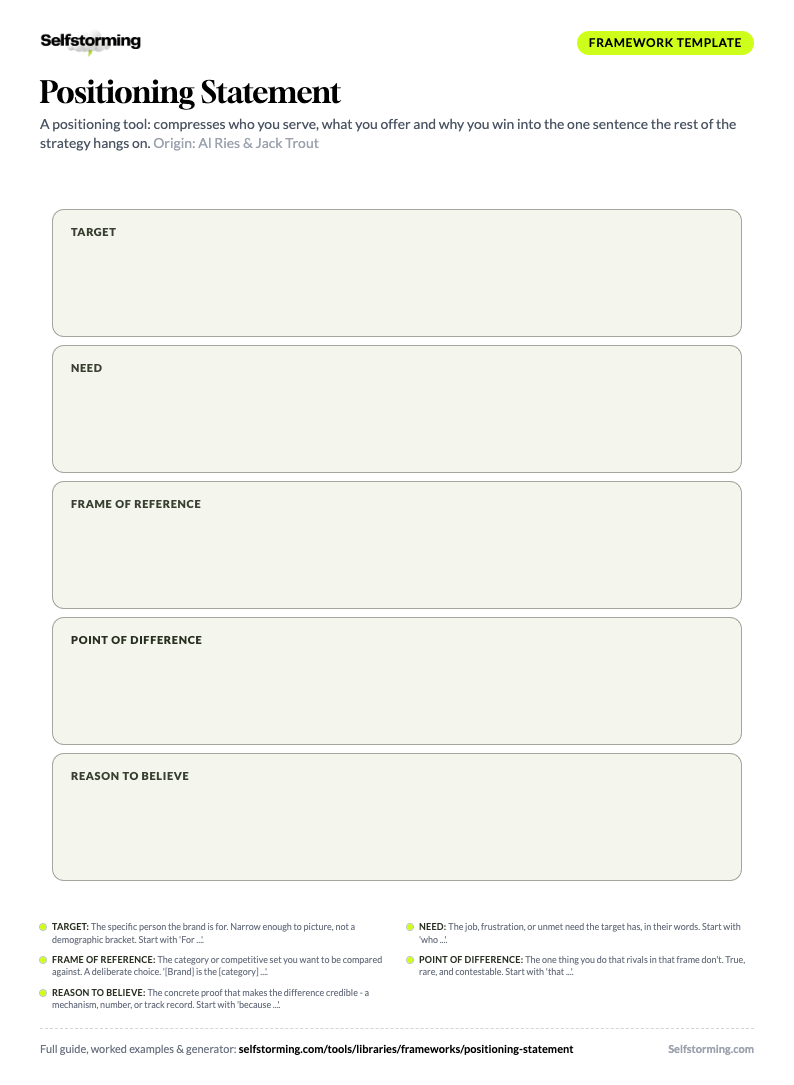
Print it. Fill it in.
The Positioning Statement as a printable A4 worksheet - write straight into the framework, on paper or in any PDF app.
Download the PDF templateKnowledge Worth Paying For
A working library of brand strategy frameworks - with worked examples on real brands, sources, and decision criteria. Not vibes.
One good deck covers the subscription. The rest is profit.
One sentence built from five slots: Target (the specific person it's for), Need (the job or frustration they have), Frame of reference (the category you want to be compared against), Point of difference (the one thing rivals in that frame don't do), and Reason to believe (the proof that makes the difference credible). The format: For [target] who [need], [brand] is the [frame] that [difference], because [reason to believe]. It's an internal alignment tool, not a tagline - if it reads like ad copy, you've written the wrong artifact.
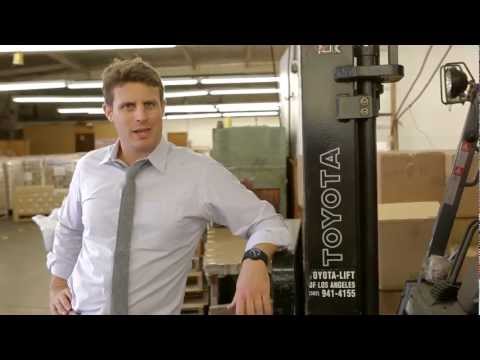
Dollar Shave Club
DTC razor subscription (USA, founded 2011)Positioning so sharp it fit in a 90-second video. Dollar Shave Club named the enemy (overpriced, over-engineered razors), picked a frame nobody owned (a razor subscription), and made 'cheap, good enough, and mailed to your door' the entire point - then sold to Unilever for a billion dollars.
Specsavers
Optician and hearing-care chain (UK / Guernsey, founded 1984)Positioning that lives entirely in one line. Specsavers picked an unusual frame - not 'best eyewear' but 'the optician you go to so you don't make an embarrassing mistake' - and turned 'affordable, everywhere, hard to regret' into a whole brand. 'Should've gone to Specsavers' is the point of difference wearing a punchline.
Guinness
Irish stout brand (Ireland, founded 1759)Positioning where the point of difference is the wait. In a category that competes on cold, fast and easy, Guinness reframed its slowest, most awkward attribute - the famous 119-second pour - into proof that good things take time. The frame choice turns a flaw into the entire reason to believe.

Dollar Shave Club, Specsavers, Guinness - filled in, line by line. Unlock to read them.
Dollar Shave Club (DTC razor subscription (USA, founded 2011))
Positioning so sharp it fit in a 90-second video. Dollar Shave Club named the enemy (overpriced, over-engineered razors), picked a frame nobody owned (a razor subscription), and made 'cheap, good enough, and mailed to your door' the entire point - then sold to Unilever for a billion dollars.
Target: For ordinary guys who are sick of overpaying for fancy razors they don't really need.
Need: who resent the markup, the ten-blade nonsense, and asking a shop assistant to unlock a cabinet for a pack of blades.
Frame of reference: Dollar Shave Club is the razor subscription
Point of difference: that mails you decent blades for a few dollars a month - no stores, no gimmicks, no guilt.
Reason to believe: because it cuts out retail and the big brands' marketing markup and ships direct, so cheap blades are the whole business model, not a loss-leader.
Specsavers (Optician and hearing-care chain (UK / Guernsey, founded 1984))
Positioning that lives entirely in one line. Specsavers picked an unusual frame - not 'best eyewear' but 'the optician you go to so you don't make an embarrassing mistake' - and turned 'affordable, everywhere, hard to regret' into a whole brand. 'Should've gone to Specsavers' is the point of difference wearing a punchline.
Target: For ordinary people who need glasses or a hearing test and don't want to overthink, overpay, or get it wrong.
Need: who quietly worry that the cheap option means a bodged prescription, and the premium option means being upsold designer frames they can't justify.
Frame of reference: Specsavers is the high-street optician
Point of difference: that makes a proper eye test and decent glasses cheap and convenient enough that not going to them is the actual mistake.
Reason to believe: because its joint-venture partnership model and huge scale keep prices low across hundreds of stores, so 'should've gone to Specsavers' is a genuine value promise, not just a gag.
Guinness (Irish stout brand (Ireland, founded 1759))
Positioning where the point of difference is the wait. In a category that competes on cold, fast and easy, Guinness reframed its slowest, most awkward attribute - the famous 119-second pour - into proof that good things take time. The frame choice turns a flaw into the entire reason to believe.
Target: For drinkers who'd rather have one proper pint with real character than three identical cold lagers.
Need: who find most beers interchangeable and want a drink that feels like an occasion, not just refreshment.
Frame of reference: Guinness is the stout worth waiting for
Point of difference: that turns the slow, two-part pour and the settling pint into the whole ritual, not an inconvenience to apologise for.
Reason to believe: because the nitrogen-and-CO2 pour genuinely needs time to settle into that creamy head, so 'good things come to those who wait' is baked into how the pint is physically made.
1. Target
Who is this specifically for - the one person who lights up when they hear it, not the widest crowd we can defend in a meeting?
The narrow, named audience the statement is built around. Not a demographic bracket, not 'everyone who could possibly buy.' The target is the person whose problem you understand better than anyone, the one you'd happily lose other customers to serve well.
Good answer: For solo founders shipping their first product without a finance team. Specific enough that you can picture them, their week, and the thing keeping them up. You could write an email to this person tomorrow.
Wrong answer: For modern businesses of all sizes. A target that excludes nobody targets nobody. If the line fits a Fortune 500 and a freelancer equally, it's a market, not a target.
2. Need
What is the actual job, frustration, or unmet need this person is trying to solve - in their words, not our feature list?
The pain or job-to-be-done that makes the target reach for a solution. Framed from inside their head, not from inside your product roadmap. The sharper the need, the more obvious the difference later becomes.
Good answer: who dread invoicing because their current tool feels built for accountants, not for them. A felt frustration with a clear emotional edge. You can hear the sigh.
Wrong answer: who want to optimise their workflows and drive efficiency. Nobody wakes up wanting to optimise a workflow. That's your language for their problem, which means you haven't found their problem yet.
3. Frame of reference
What category or competitive set do we want to be compared against - and is that the fight we can actually win?
The mental shelf you want customers to file you on. This is a choice, not a fact. The same product can pick a category where it's the obvious winner or one where it's the cheap imitation. Choosing the frame is half of positioning.
Good answer: Robinhood is the investing app - not 'the discount brokerage.' By framing against apps, not brokers, the difference (no fees, phone-first) becomes the whole point instead of a footnote.
Wrong answer: We are the leading all-in-one solution. 'Solution' is not a frame of reference - it's where positions go to die. If a customer can't picture the shelf, you haven't chosen one.
4. Point of difference
What is the one thing we do that rivals inside this exact frame genuinely don't - and would struggle to copy?
The single distinction that earns you the spot. Inside the chosen frame, it has to be both true and rare. One sharp difference beats five soft ones, because the mind only files one thing per brand anyway.
Good answer: that designs the whole product in the browser, with your whole team editing the same file at once. Specific, demonstrable, and most rivals in the frame literally cannot do it. That's a difference.
Wrong answer: that offers a seamless, intuitive, best-in-class experience. Every brand in every frame claims this. A difference no competitor would deny isn't a difference - it's a description of wanting to be liked.
5. Reason to believe
What's the proof that makes the difference credible - the thing that turns a claim into something a skeptic would actually buy?
The evidence behind the difference. A feature, a mechanism, a track record, a number, a design choice - something concrete that a doubtful customer could check. Without it, the point of difference is just a confident sentence.
Good answer: because it runs in the browser with no install, so a designer in Lisbon and a dev in Lagos edit the same canvas live. A mechanism you can name and verify. The proof is baked into how the thing works.
Wrong answer: because we're passionate about our customers' success. Passion is not proof. If the reason to believe can't be checked by a stranger, it's a feeling wearing the costume of evidence.
Decide your starting point: You don't have to stare at a blank template. Right here on Selfstorming you can pull inspiration, sharpen the slots against the real market, or generate a first-draft positioning statement in minutes. Treat the draft as a head start, not a verdict, then run it through the steps below to pick a real target, choose the frame deliberately, and proof every slot against what customers actually believe. Workshop-from-scratch and AI-draft-then-pressure-test are both valid; most teams move faster from a draft.
Pick one real target, then make it narrower: Write down who the statement is for, then cut it in half. If you're afraid of who you're excluding, you're getting close. A target you can picture writing an email to beats a target you can defend in a board meeting.
Get the need in their words, not yours: Interview five customers or read five support tickets. Note the exact phrases they use for the problem. If your need slot says 'optimise efficiency' and your customers say 'I waste my whole Friday on this,' use theirs. The felt need is the one that sells.
Choose the frame of reference deliberately: List two or three categories you could plausibly be filed under. Pick the one where your difference becomes the headline, not the asterisk. Robinhood as 'an investing app' wins; Robinhood as 'a discount brokerage' loses. The frame is a strategic decision disguised as a noun.
Find the true point of difference - just one: Inside the chosen frame, ask what you do that rivals genuinely can't or won't. Apply the opposite test: would a competitor ever claim the reverse? If no, it's table stakes. Keep cutting until you have one difference sharp enough to defend.
Back it with a reason to believe a skeptic could check: For your difference, name the concrete proof - a mechanism, a number, a design choice, a track record. If the proof is 'we care' or 'we're passionate,' you don't have a reason to believe; you have a hope. Find the verifiable thing underneath.
Assemble the sentence and read it out loud: Snap the five slots into the format - For [target] who [need], [brand] is the [frame] that [difference], because [reason to believe]. Read it aloud. If it sounds like a tagline, you've drifted into messaging. If it sounds like a strategist explaining a choice, you're there.
Run the competitor swap test: Paste a rival's name into your statement. If it still reads as true, your statement isn't positioning anything - it's describing the category. Rewrite until the sentence breaks the moment a competitor's name goes in.
Use it as a filter, not a poster: A finished positioning statement earns its keep when it kills work. Hold the next three creative briefs, feature requests, and audience targets up against it. The ones that don't trace back to the statement are the ones to question.
Best for: Crystallising a single, decision-shaping sentence that defines target, frame, difference, and proof. Aligning teams and briefs around one claim before any external messaging exists. / Mapping a full brand identity from skin to soul, or building customer-facing copy. The statement is one focused output, not a whole identity system.
Output: One sentence assembled from five named slots, plus the working notes behind each choice. Sharp, internal, and built to be argued with. / A multi-layer diagram, a tone-of-voice guide, or a campaign concept. Those are downstream of the statement, not the statement itself.
Time to complete: A focused session - a couple of hours to draft, plus a few customer conversations to pressure-test the need and difference. The format moves fast because it forces choices. / A multi-month research programme. If you need deep consumer segmentation and competitive modelling first, do that, then write the statement as the summary.
vs Brand Onion: Positioning Statement is market-facing and competitive - it explicitly names a frame, a difference, and a rival set. Use it to win an argument with the category. / Brand Onion is internal and non-competitive - it maps attributes, benefits, personality, values, and essence with no rival in sight. Use the Onion for identity, the statement for the fight.
vs Brand Key (Unilever): Positioning Statement is one tight sentence you can write in an afternoon and remember by heart. Strong when you need shared language and momentum now. / Brand Key has 8 sections including roots, insight, and discriminator with full consumer-target rigour. Use the Key when you need depth and evidence the single sentence can't carry.
vs Brand Archetypes: Positioning Statement is about what you're better at and for whom - a logical, competitive claim. Use it to make the strategic choice concrete. / Brand Archetypes (Jung, Mark & Pearson) give you a narrative personality - Hero, Outlaw, Sage - to bring the statement to life. Use Archetypes for voice and story, the statement for the substance underneath.
The discipline of positioning was named and popularised by Al Ries and Jack Trout, first in a 1972 series of Advertising Age articles and then in their 1981 book Positioning: The Battle for Your Mind. Their core argument was counterintuitive for the era - positioning happens not on the page but in the prospect's mind, which is crowded, lazy, and resistant to new information, so the job is to occupy a simple, ownable spot rather than to say more. The now-ubiquitous fill-in-the-blank template - for [target] who [need], [brand] is the [frame] that [difference], because [reason to believe] - was popularised by Geoffrey Moore in Crossing the Chasm (1991), where he turned the abstract idea into a repeatable sentence tech companies could actually write. Variants of the same skeleton later showed up in product-marketing playbooks everywhere, which is exactly why it's both the most-used and most-abused template in the business.
The honest critique of the positioning statement is that the template is too easy to pass. Because every slot can be filled with a true-of-anyone phrase, teams produce confident sentences that differentiate nothing - 'for modern businesses who want to do more, we are the platform that helps you succeed, because we care' is grammatically a positioning statement and strategically a void. It also tends to rot: written once at kickoff, it slides into a deck and becomes internal jargon nobody acts on, while the actual brand drifts wherever the latest campaign takes it. A deeper objection is that positioning is a perception you earn in the customer's head, not a sentence you author in a document - you can write the perfect statement and still own no position. And the framework's whole obsession with a unique point of difference is challenged head-on by Byron Sharp and the Ehrenberg-Bass school in How Brands Grow, whose data suggests that for large brands, mental and physical availability and distinctive assets drive growth far more than meaningful differentiation does. Used well, the statement is a forcing function for focus; used lazily, it's a comfort blanket that confuses writing about a position with having one.
What is a positioning statement?
A positioning statement is one internal sentence that defines who a brand is for, what need it serves, which category it competes in, what makes it different, and why that difference is believable. It's a strategy tool, not advertising - its job is to align a team on a single, defensible claim before any customer-facing message gets written. Done well it acts as a filter: anything that doesn't trace back to the statement gets questioned.
What's the positioning statement formula?
The classic Geoffrey Moore formula is: For [target] who [need], [brand] is the [frame of reference] that [point of difference], because [reason to believe]. Five slots, one sentence. Target is the specific person it's for, need is their job or frustration, frame of reference is the category you choose to be compared against, point of difference is the one thing rivals in that frame don't do, and reason to believe is the proof that makes it credible.
Is a positioning statement the same as a tagline?
No, and confusing them is the most common mistake. A tagline is external, short, and optimised to be remembered - Just Do It. A positioning statement is internal, longer, and optimised to make decisions - it tells your team who you're for and why you win. They feed each other: a sharp statement makes it far easier to write a tagline. But if your statement rhymes or fits on a billboard, you've drifted into messaging and lost the strategy.
Is the Positioning Statement the same as the Brand Onion?
No - they do different jobs. The Positioning Statement is market-facing and competitive: it names a target, a frame of reference, and a point of difference relative to rivals. The Brand Onion is internal and non-competitive: it maps attributes, benefits, personality, values, and essence with no competitor in sight. Most teams use the Onion to define the identity, then write the Positioning Statement to pick the fight. They're complements, not substitutes.
Does a positioning statement work for B2B?
Yes, and arguably it works harder, because B2B brands drift into 'leading all-in-one platform' soup faster than anyone. The discipline of naming a specific target, a real frame of reference, and one contestable difference is exactly what separates a brand like Figma or Stripe from the dozen forgettable tools in the same category. The trap is the same too: B2B teams love safe, true-of-anyone language. Run the competitor swap test and it usually falls apart.
How is a positioning statement different from a value proposition?
They overlap but aim at different readers. A value proposition is customer-facing and answers 'why should I buy this?' in the buyer's language, often on the homepage. A positioning statement is internal and answers 'who are we for, what fight are we in, and why do we win?' for your own team. The statement is the strategic source; the value prop is one of the things you derive from it once the position is clear.
A positioning tool: compresses who you serve, what you offer and why you win into the one sentence the rest of the strategy hangs on.
Done right, it's a forcing function. Five slots - target, need, frame of reference, point of difference, reason to believe - that, when you snap them together, produce one sentence that tells you who you're for, what you're better at, and why anyone should believe you. The discipline is in what it makes you leave out. You can't be for everyone, against every competitor, better at every dimension. The template won't let you.
Done wrong, it becomes a true-of-anyone mush. For modern teams who want to move faster, we are the platform that helps you do more with less, because we care about your success. Every word is true. None of it is positioning. This page walks through each slot, the question that unlocks it, and how to tell a statement that sharpens decisions from one that just sounds like it does.
Related Frameworks
Brand Key
Eight sections, built outside-in: Root strengths (your heritage and core competence), Competitive environment (the real alternatives), Targe
Insight & Tension Statement
Three stacked layers, bottom to top: Observation (the behaviour or data you can actually see), Tension (the contradiction the person feels -