Brand Onion
How to Define Your Brand From Skin To Soul
The Brand Onion is the most-used and most-abused tool in agency planning. Done well, it's the cleanest way to put a brand on one page - five concentric layers from outer attributes down to inner essence, with every layer forced to be coherent with the one beneath it. Done badly, it's a frame around five generic adjectives - innovative, human, premium, authentic, trusted - and a brand book that nobody opens twice.
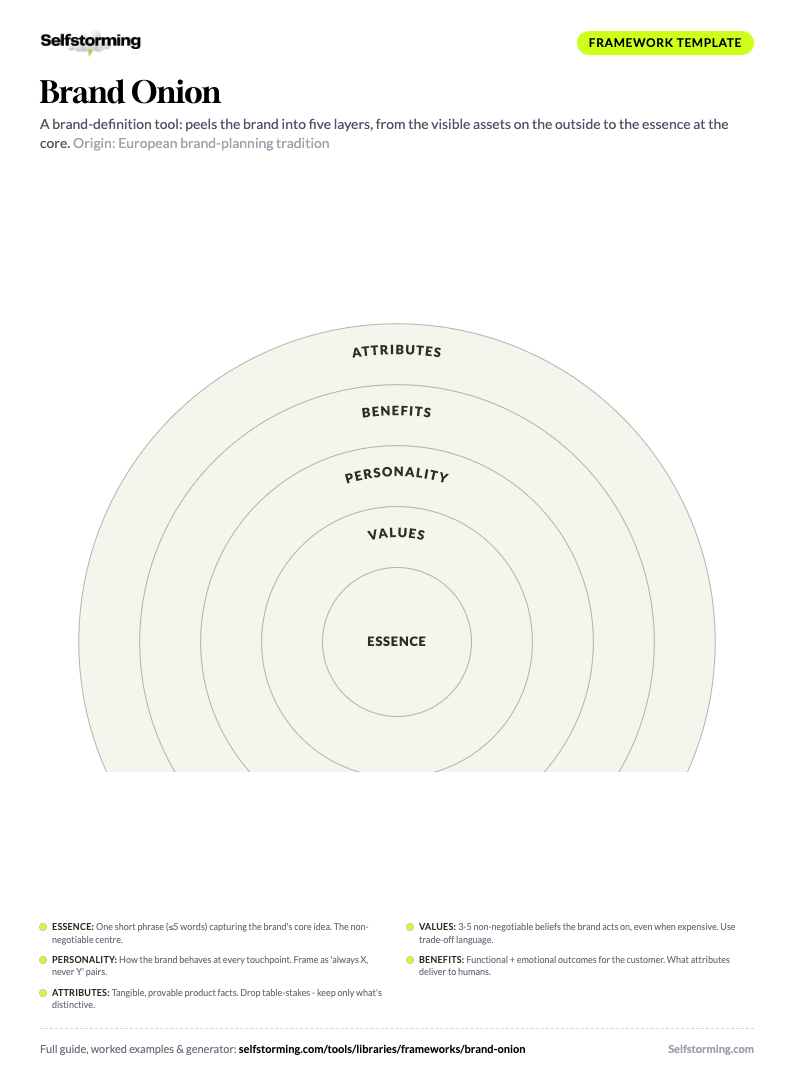
Print it. Fill it in.
The Brand Onion as a printable A4 worksheet - write straight into the framework, on paper or in any PDF app.
Download the PDF templateKnowledge Worth Paying For
A working library of brand strategy frameworks - with worked examples on real brands, sources, and decision criteria. Not vibes.
One good deck covers the subscription. The rest is profit.
Five concentric layers from outer to inner: Attributes (provable product facts), Benefits (functional + emotional outcomes), Personality (how the brand behaves), Values (non-negotiable beliefs that predict trade-offs), and Essence (one short phrase capturing the core idea). The rule that makes the Onion work: every outer layer must be a faithful expression of the inner. Use it for internal alignment, not customer-facing messaging.
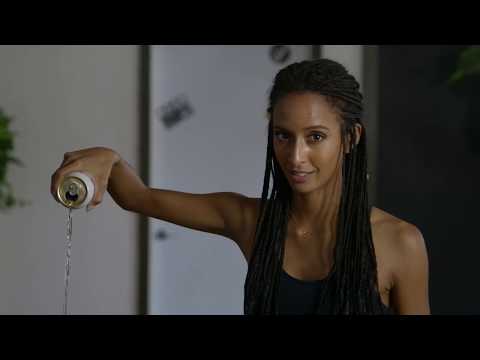
Liquid Death
DTC challenger water (USA, founded 2019)A lesson in extreme inside-out coherence: a 'boring' category (water) made unmistakable because every outer layer faithfully expresses a sharp inner essence. The brand grew from a Facebook video to a multi-billion valuation by following the Onion logic relentlessly.
Coca-Cola
Global soft-drink brand (USA, founded 1886)The Onion at its most disciplined over the longest run. Coca-Cola sells brown sugar water and has done so for over a century, which only works because the inner layers - happiness, togetherness, optimism - never wobble while the outer attributes get re-shot for every era. When the centre is that fixed, the product almost stops mattering.

Aviation Gin
American craft gin brand (USA, founded 2006, Reynolds-owned 2018)An Onion where the personality layer is the whole engine. The liquid is a genuinely good American-style gin, but it's the dry, self-deprecating Ryan Reynolds voice that gives a commodity spirit a defensible identity - exactly the moment the framework earns its keep.

Liquid Death, Coca-Cola, Aviation Gin - filled in, line by line. Unlock to read them.
Liquid Death (DTC challenger water (USA, founded 2019))
A lesson in extreme inside-out coherence: a 'boring' category (water) made unmistakable because every outer layer faithfully expresses a sharp inner essence. The brand grew from a Facebook video to a multi-billion valuation by following the Onion logic relentlessly.
Essence: Death to plastic.
Values: Disrespect convention. Sustainability, not preaching. Fans, not buyers.
Personality: Runs a horror trailer where the ad should be. Names a flavour after a murder pun. Records its hate comments as a metal album.
Benefits: Functional: hydrate without contributing single-use plastic. Emotional: belong to a tribe that thinks the bottled-water industry is ridiculous.
Attributes: Tallboy aluminium cans. Heavy-metal album-cover graphics. Names like 'Mountain Water' and 'Berry It Alive'. Horror-trailer ad campaigns.
Coca-Cola (Global soft-drink brand (USA, founded 1886))
The Onion at its most disciplined over the longest run. Coca-Cola sells brown sugar water and has done so for over a century, which only works because the inner layers - happiness, togetherness, optimism - never wobble while the outer attributes get re-shot for every era. When the centre is that fixed, the product almost stops mattering.
Essence: Open happiness.
Values: Optimism over realism. Togetherness over individualism. Universal over niche.
Personality: Prints your name on the bottle. Films the shared table, not the solo sip. Shows up at every World Cup and Christmas.
Benefits: Functional: a cold, instantly recognisable refreshment available almost everywhere on Earth. Emotional: a small, shared moment of uncomplicated happiness with other people.
Attributes: The contour bottle you'd know in the dark. The fixed red. The Spencerian script logo. A secret formula and a distribution network that reaches more places than clean water.
Aviation Gin (American craft gin brand (USA, founded 2006, Reynolds-owned 2018))
An Onion where the personality layer is the whole engine. The liquid is a genuinely good American-style gin, but it's the dry, self-deprecating Ryan Reynolds voice that gives a commodity spirit a defensible identity - exactly the moment the framework earns its keep.
Essence: Gin that doesn't take itself seriously.
Values: Wit over pomp. Smoothness over harshness. Mischief over prestige.
Personality: Casts the owner as the punchline. Turns a rival's PR disaster into an ad within days. Keeps the joke shorter than the pour.
Benefits: Functional: a smooth, soft American gin that goes down without the juniper punch-in-the-face. Emotional: feel like you're in on the joke, drinking the gin that's too clever for the snobs.
Attributes: Aviation cocktail heritage and aviator branding. Seven botanicals steeped for 18 hours. Ryan Reynolds as owner and deadpan spokesman. Ads that hijack other brands' missteps within days.
1. Attributes
What are the tangible, demonstrable, hard-to-fake facts about what this product or service is?
The provable specifications. Drop anything that's table-stakes in your category - keep only what's actually distinctive or signals something deeper. Attributes are easiest to write but hardest to make matter without the inner layers in place.
Good answer: Tallboy aluminium can. Sparkling water with no sugar. Schwarzenegger as the spokesperson. Each attribute does double duty - it's a fact AND it signals the essence ("death to plastic").
Wrong answer: High quality, made with love, customer-focused. These aren't attributes - they're claims competitors make verbatim. If the line could appear on a bank's website, an architecture firm's homepage, AND a SaaS landing page, it isn't an attribute.
2. Benefits
What does this product actually deliver to a human - both rationally and emotionally?
What attributes give people once they translate into an outcome. Two layers: functional (the rational job) and emotional (how that feels). Most brands stop at functional and wonder why their advertising is forgettable.
Good answer: Functional: ship side projects without paying for hosting. Emotional: feel like a builder, not a tenant. Sharp benefits read like an answer to "so what?" twice.
Wrong answer: Saves time, increases productivity, drives growth. Generic outcomes that fit any tool. No human is in the sentence. The benefit could be transplanted to a competitor unchanged.
3. Personality
If the brand walked into the room as a person, how would they behave - and what would they refuse to do?
How the brand acts at every touchpoint - voice in emails, tone in customer service, body language in ads. Write it as three things the brand visibly does, one per line, not adjectives. A behaviour forces a decision; a vibe forgives everything.
Good answer: Puts the price in the first line. Answers a dumb ticket like a smart one. Signs the apology with a real name. Three things you could watch the brand do. Anyone writing a tweet can check their draft against them.
Wrong answer: Approachable, premium, modern. Three adjectives that survive any rewrite. Tells writers nothing about how to write. Tells designers nothing about how to design.
4. Values
What would this brand sacrifice to stay true to itself, even when the trade-off is expensive or inconvenient?
Non-negotiable beliefs the brand acts on. Real values frame trade-offs. They tell the team what gets killed when two priorities collide, which is why they survive contact with the budget.
Good answer: Speed over perfection. Craft over scale. Optimism over cynicism. Each one is contestable - you can name brands that picked the opposite. That's what makes them real values.
Wrong answer: We value innovation, integrity, and our customers. Every brand on Earth claims this. The words do no work. If they vanished from the slide, nobody would notice.
5. Essence
If we deleted everything else and could keep one phrase, what would describe what this brand fundamentally is?
The non-negotiable centre. One short phrase (≤5 words) that captures what makes this brand unmistakably itself. Internal language, not a tagline. The essence rarely changes once it's right - the layers above it evolve.
Good answer: Death to plastic (Liquid Death). Calm, opinionated software craft (Linear). Both are decisive, distinctive, and predict the next ten brand decisions.
Wrong answer: Innovation, simplicity, and trust. Three words instead of one phrase, every word a category descriptor that fits 100 competitors. Not an essence - a placeholder.
Decide your starting point: A workshop is not the only way in. You don't have to fill the Onion in a blank room - right here on Selfstorming you can find inspiration and directions, or generate a full first-draft Onion in minutes. Treat that draft as a head start, then run it through the steps below to refine it and proof/research it against the real market. Workshop-from-scratch and AI-draft-then-pressure-test are both valid; most teams move faster starting from a draft.
Audit the current state first: Before drawing a fresh onion, list every essence statement, value, personality trait, benefit, and attribute scattered across your decks, website, and brand book. Most teams discover three contradictory essences and twelve duplicate values. The Onion's first job is to expose that mess.
Start from the outside, not the centre: Begin with attributes - they're the most provable and least controversial. Sort them into distinctive vs table-stakes. Drop the table-stakes - they don't belong in a strategic artifact.
Translate attributes into benefits twice: For every attribute, ask so what? until you reach a functional benefit. Then ask so what? again until you reach an emotional benefit. Most teams stop at the functional layer and wonder why their advertising is forgettable.
Write personality as behaviour: Puts the price in the first line. Answers a dumb ticket like a smart one. Vague personalities ("approachable, premium") generate vague creative. Three things the brand visibly does give a writer something to check a draft against - and breaking character becomes immediately legible.
Test values with the trade-off question: For each candidate value, ask what would we sacrifice to honour this? If the answer is nothing, it's not a value - it's a marketing word. Real values predict the brand's behaviour when keeping them is expensive.
Compress essence to five words or fewer: Iterate until the phrase passes the new-hire test - someone joining tomorrow could understand what the brand is from this phrase alone. Authentic athletic performance works. Innovation through technology doesn't.
Pressure-test inside-out: Take three recent product or creative decisions. Trace each one inward through the layers to the essence. If a decision doesn't connect cleanly, either the decision was wrong, the essence is wrong, or the layers between them are missing. All three are useful findings.
Distribute the artifact, not the deck: A finished Brand Onion fits on one page. Print it. Put it in onboarding. Reference it in every brief. The 40-slide deck explaining how you got there can stay in Drive.
Best for: Internal alignment, creative briefing, onboarding new agencies or hires. Forcing teams to articulate what the brand is from skin to soul in one workshop. / External-facing positioning copy, competitive analysis, customer research synthesis. The Onion is internal scaffolding.
Output: A one-page artifact with five concentric layers, each filled with short, decisive language. Everything outer traces back to the essence. / A 40-slide deck of 'territories,' mood boards, and adjective lists. That's a brand book, not a Brand Onion.
Time to complete: One focused workshop (4-8 hours) with cross-functional stakeholders, plus a week of refinement. The structure forces decisions, so it moves fast. / Six-month brand strategy projects with consumer research and three rounds of stakeholder reviews. Different deliverable.
vs Brand Pyramid (Keller's CBBE): Onion is non-hierarchical and emphasises layered coherence (skin to soul). Better for agencies and brands that think in terms of expression and DNA. / Pyramid is hierarchical and culminates at a single peak (resonance). Better when you want a clear ladder from features → benefits → emotion → essence.
vs Brand Key (Unilever): Onion is simpler, more visual, faster to facilitate. Five layers, one diagram. Strong for fast-moving teams that need shared vocabulary now. / Brand Key has 8 sections including roots, target, insight, RTB, discriminator. Use the Key when you need consumer-target rigour and competitive context the Onion ignores.
vs Golden Circle (Sinek): Onion gives you the full identity surface (5 layers, including outer attributes). Better when you need a brief-ready spine, not just a purpose narrative. / Golden Circle has 3 rings (Why/How/What) optimised for storytelling and pitch decks. Better for keynote talks and founder narratives, not internal briefs.
The Brand Onion has no single inventor. It emerged in late-1980s and 1990s European agency planning as one of several competing 'one-page brand' tools, alongside the Brand Pyramid, Brand Wheel, Brand Key (Unilever), and Brand Pillar. Practitioners often credit firms in the Wolff Olins and Saffron Brand Consultants lineage with popularising the layered visual, though similar diagrams appeared in Bates and JWT planning frameworks during the same period. The Onion model entry on Wikipedia documents parallel use across cultural anthropology (Hofstede) and brand strategy - the same metaphor of concentric layers shows up wherever practitioners need to talk about external expression vs internal core. The model spread because it gave junior planners a teachable structure for translating positioning into briefs.
Critics like Martin Weigel and Tom Fishburne (Marketoonist) have argued the layered approach creates an illusion of strategic control while actually distancing the brand from real consumer behaviour. The pushback is fair: an onion filled with confident-sounding adjectives can feel like progress while the brand drifts further from how people actually notice, choose, and buy. The honest way to use it is as internal scaffolding you pressure-test against real behaviour and distinctive assets - not as proof the strategy is working.
Is the Brand Onion the same as a Brand Pyramid or Brand Key?
No, but they're close cousins. Brand Onion is non-hierarchical, concentric, and emphasises coherence between layers. Brand Pyramid (Keller's CBBE) is hierarchical and culminates at a single peak (resonance). Brand Key (Unilever) has eight sections including target, insight, and competitive context the Onion ignores. Use the Onion for fast internal alignment, the Pyramid for academic rigour, the Brand Key for full strategic positioning with consumer-target depth.
Who created the Brand Onion?
There's no single official inventor. The model emerged in 1980s-1990s European agency planning, with the lineage often traced through firms like Wolff Olins, Saffron Brand Consultants, Bates, and JWT. Wikipedia's Onion model entry documents parallel use across cultural anthropology (Hofstede) and brand strategy. Crediting any one person is historically inaccurate - it's an agency-craft tool, not an academic model.
How is this different from Brand Archetypes?
Brand Archetypes (Jung, Mark & Pearson) give you a narrative shorthand for personality - Hero, Sage, Outlaw, Lover, etc. They're an input to the Personality layer, not a replacement for the whole Onion. Use Archetypes to find the character, then write it down as things the brand does; use the Onion to make sure that personality is consistent with attributes, benefits, values, and essence.
Should we share the Brand Onion with customers?
Generally no. The Onion is internal scaffolding for teams making decisions about the brand. Customers don't need to know your essence - they need to feel its consequences in your product, your service, and your communications. Sharing the artifact externally tends to feel performative and undermines the very coherence the document was meant to enforce.
How often should we revisit the Brand Onion?
Annually as a sanity check; whenever you make a major strategic move (new market, acquisition, leadership change) as a deeper review. The layers shouldn't change every quarter - if they do, you didn't have an essence, you had a mood. Stable inner layers and evolving outer expressions is the healthy pattern.
Does this work for B2B brands?
Yes - and arguably it works harder, because B2B brands tend to drift into 'innovative collaboration platform' generic soup. The Onion forces a B2B team to commit to a specific personality and values, which is what makes the difference between Linear and the seventeen other issue trackers. Look at Linear, Notion, or Stripe's outer expressions - the inner layers are doing real work.
A brand-definition tool: peels the brand into five layers, from the visible assets on the outside to the essence at the core.
The Onion is a thinking tool, not a wallpaper poster. Its job is to make a team commit to what the brand is, what it isn't, and which decisions follow. If you can fill it out and nothing in your roadmap, hiring, or creative briefs would change as a result, you didn't build a Brand Onion - you decorated one. This page walks through what each layer is, the question that unlocks it, and how to spot the difference between an Onion that does work and an Onion that just sits there.
Related Frameworks
Brand Pyramid
Four levels, bottom to top: Salience (do people know you, and for what?), Meaning (what are you - performance facts plus imagery association
Brand Archetypes
Twelve characters drawn from Jungian psychology, grouped into four families by core human motivation: Independence & Fulfillment (Innocent,
Brand Ladder
The Brand Ladder is a five-rung model that climbs from Features (what it is) to Functional benefits (what it does for you) to Emotional bene
Purpose, Vision & Mission
Three tiers, narrowing to a point: Mission at the base (what we do every day, concretely, and for whom - present tense), Vision in the middl