Golden Circle
Why, How, What - Building a Brand From the Inside Out
The Golden Circle is the most-quoted slide in the history of brand strategy and the most misused. Simon Sinek's claim is disarmingly simple: every organisation knows what it does, some know how they do it, and very few can say why they do it - the purpose, the cause, the belief that gets you out of bed when the spreadsheet says go back to sleep. His diagram is three rings: Why at the centre, How around it, What on the outside. The whole argument hangs on one move: great brands communicate from the inside out, most communicate from the outside in.
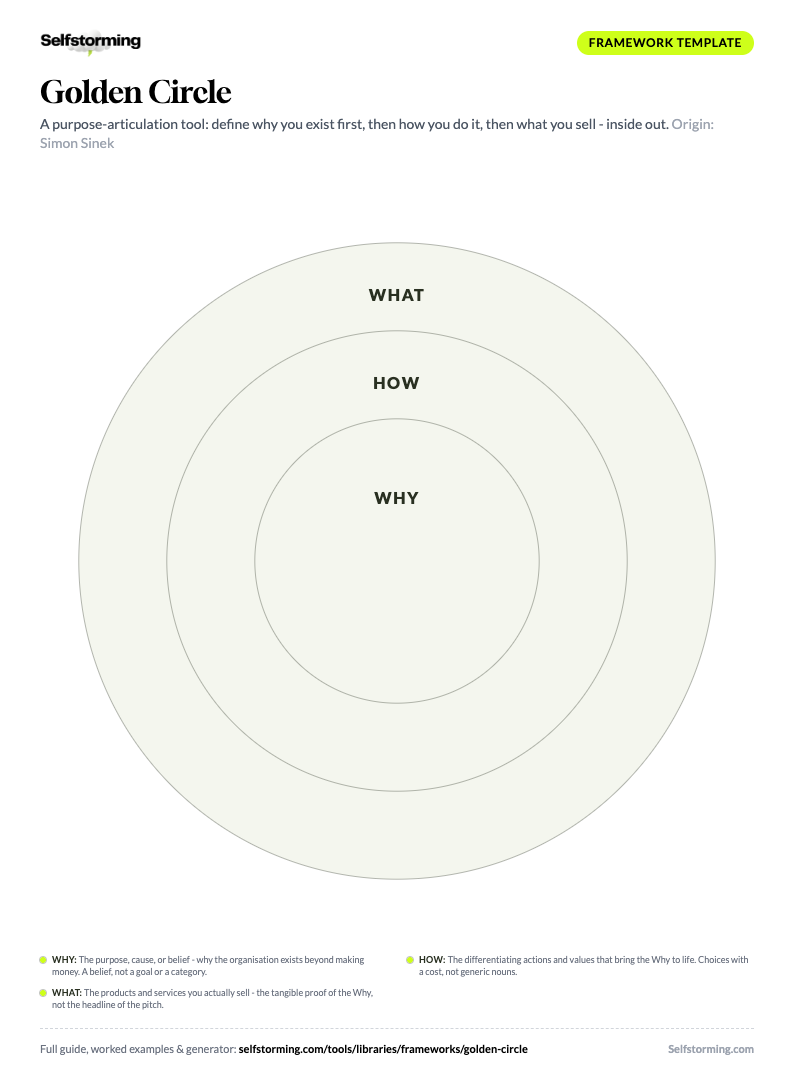
Print it. Fill it in.
The Golden Circle as a printable A4 worksheet - write straight into the framework, on paper or in any PDF app.
Download the PDF templateKnowledge Worth Paying For
A working library of brand strategy frameworks - with worked examples on real brands, sources, and decision criteria. Not vibes.
One good deck covers the subscription. The rest is profit.
Three concentric rings, centre out: Why (the purpose, cause, or belief - why the organisation exists beyond making money), How (the differentiating actions and values that bring the Why to life), and What (the products and services you actually sell). The one rule that makes it work: communicate from the inside out - Why first, then How, then What. Most brands do the reverse and wonder why nobody remembers them. Use it for narrative, pitch, and purpose alignment, not as a full brand identity system.
Headspace
Meditation and mental-health app (UK/USA, founded 2010)Shows the Golden Circle working in a category drowning in sameness. There are hundreds of meditation apps; Headspace led with a belief about demystifying mental health rather than a feature list of timers and bells. The Why is what made a former monk's voice feel like a movement instead of an app.

Apple
Consumer technology (USA, founded 1976)Sinek's own canonical example, and for good reason. Apple sells the same components as everyone else, yet leads with a belief - challenge the status quo - and lets the products arrive as proof. Swap Apple's What for a rival's and the pitch still works, which is the inside-out logic in its purest form. The belief is the product; the laptop is the receipt.

Nike
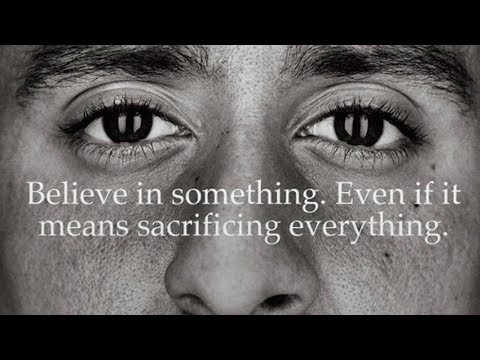
Global sportswear and athletic brand (USA, founded 1964)A Why that has nothing to do with shoes and everything to do with belief. Nike doesn't sell cushioning, it sells the conviction that anyone with a body is an athlete and greatness is a choice - and the trainers are simply how you buy in. 'Dream Crazy' is inside-out communication at full volume: lead with the belief, accept the cost, let the product follow.
Headspace, Apple, Nike - filled in, line by line. Unlock to read them.
Headspace (Meditation and mental-health app (UK/USA, founded 2010))
Shows the Golden Circle working in a category drowning in sameness. There are hundreds of meditation apps; Headspace led with a belief about demystifying mental health rather than a feature list of timers and bells. The Why is what made a former monk's voice feel like a movement instead of an app.
Why: Everyone deserves to be healthier and happier - looking after your mind should be as normal as brushing your teeth.
How: Mysticism out, science and play in.
What: Guided meditations, sleepcasts, courses and workplace plans.
Apple (Consumer technology (USA, founded 1976))
Sinek's own canonical example, and for good reason. Apple sells the same components as everyone else, yet leads with a belief - challenge the status quo - and lets the products arrive as proof. Swap Apple's What for a rival's and the pitch still works, which is the inside-out logic in its purest form. The belief is the product; the laptop is the receipt.
Why: We challenge the status quo - the people crazy enough to think they can change the world are the ones who do.
How: Beautifully simple, controlled end to end.
What: iPhone, Mac, iPad, Watch and AirPods, plus services.
Nike (Global sportswear and athletic brand (USA, founded 1964))
A Why that has nothing to do with shoes and everything to do with belief. Nike doesn't sell cushioning, it sells the conviction that anyone with a body is an athlete and greatness is a choice - and the trainers are simply how you buy in. 'Dream Crazy' is inside-out communication at full volume: lead with the belief, accept the cost, let the product follow.
Why: If you have a body, you're an athlete - and greatness isn't a gift for the few but a decision anyone can make.
How: Belief and athlete first, product last.
What: Trainers, apparel and gear, plus apps and stores.
1. What
What do you actually make or sell - the tangible products, services, and proof points a customer can point at?
The outer ring. The literal things you sell: the products, the services, the features, the price tags. Easiest to articulate, least persuasive on its own. In the Golden Circle, What isn't the pitch - it's the evidence. It's the thing people buy as proof they belong to the Why.
Good answer: Electric cars, home batteries, and solar roofs. On their own, a product list. Sat outside a clear Why ("accelerate the world off fossil fuel"), each What reads as proof of the belief rather than a spec sheet.
Wrong answer: Leading the entire pitch with the What. "We sell project-management software with Gantt charts and integrations." Accurate, forgettable, and indistinguishable from the other forty tools doing the same thing. The What is true; it just isn't a reason to care.
2. How
How do you bring that belief to life in a way competitors can't easily copy - what are the specific actions, values, and choices that prove the Why is real?
The differentiators. The handful of values and operating choices that turn the Why from a slogan into something you can watch happen. How is where the belief earns credibility - the visible trade-offs, the way you build, the things you'll do that a Why-less competitor wouldn't bother with.
Good answer: We design the product before we design the spreadsheet. We refuse features that make the thing heavier. We ship slower and apologise less. Each How is a choice with a cost - which is exactly why it makes the Why believable.
Wrong answer: Through innovation, quality, and a customer-first approach. Three nouns that prove nothing and cost nothing. A How that any competitor could claim verbatim isn't differentiating you - it's decorating you.
3. Why
Why does this organisation exist beyond making money - what do you believe, and what cause would you still pursue if the product changed?
The non-negotiable centre. The purpose, cause, or belief that explains why anyone outside the founder's family should care. Not a goal ("grow 40%") and not a category ("we sell insurance") - a belief that predicts what the brand fights for and what it refuses. The Why rarely changes; everything around it is just evidence for it.
Good answer: We believe the planet shouldn't be a casualty of the energy you use (a credible Why for an energy or transport brand). It's contestable, it predicts behaviour, and you could build a decade of decisions on it without checking back with the marketing team.
Wrong answer: Our why is to deliver excellent products and great customer experiences. That's not a belief - it's the price of admission. If your competitor's lawyers would happily sign the same sentence, it isn't a Why, it's a hygiene factor in a halo.
Decide your starting point: You don't have to find your Why in a silent room with a whiteboard and a facilitator who keeps saying "go deeper." Right here on Selfstorming you can pull inspiration and directions, or generate a first-draft Golden Circle in minutes. Treat that draft as a provocation, not gospel, then run it through the steps below to pressure-test it against what your brand actually does.
Start with Why, not What: The whole point is the order. Resist the gravitational pull to begin with the product. Write the belief first - the cause you'd pursue even if the product line changed. If you can't write a Why without naming what you sell, you don't have one yet.
Sanity-check the Why against the money test: Ask "would this Why survive if it cost us a quarter?" A real Why predicts uncomfortable trade-offs. If your purpose conveniently always aligns with the most profitable option, you've found a marketing line wearing a Why costume.
Make How a list of choices with a cost: For each value in the How ring, name the thing you give up to honour it. "We ship slower" costs you launch velocity. "We refuse certain clients" costs you revenue. A How with no cost is a brochure adjective.
Demote the What to evidence: Rewrite your product list so each item reads as proof of the Why, not as the headline. The test: read your What out loud after your Why and check whether it sounds like a reason or a receipt.
Rehearse the inside-out pitch: Write your homepage hero, your sales opener, and your investor line in Why-How-What order. Then write them in the default What-How order. Read both aloud. The first should sound like a conviction; the second like a catalogue.
Pressure-test with a stranger: Show the three rings to someone who's never seen your brand. Ask them to guess what you sell from the Why alone. If they can't get within a category, your Why is either too vague to mean anything or too clever to land.
Pair it with a real identity tool: The Golden Circle is a narrative spine, not a full brand system. Once the Why is solid, feed it into a Brand Onion or Positioning Statement to give it the attributes, personality, and market claim the three rings deliberately leave out.
Best for: Founder narratives, keynote talks, pitch decks, homepage hero copy, and any moment where the job is to make people care before you make them compare. / Full brand identity, audience definition, competitive positioning, or creative briefs - the three rings have no room for any of it.
Output: A three-ring diagram and a Why-How-What narrative you can deliver out loud - a story with a sequence, not a system. / A one-page brand artifact covering attributes, personality, values, and essence. That's a Brand Onion, not a Golden Circle.
Time to complete: An afternoon, sometimes an hour - the structure is small enough that the hard part is honesty about the Why, not the drafting. / A multi-week brand strategy project with research, stakeholder rounds, and competitive analysis. Different deliverable, different tool.
vs Brand Onion: Golden Circle is 3 rings optimised for narrative and persuasion order (Why-How-What). Better for storytelling, pitches, and founder talks. / Brand Onion has 5 layers including attributes, personality, and essence. Better when you need a brief-ready identity spine, not just a purpose story.
vs Purpose / Vision / Mission: Golden Circle is a communication framework - it tells you the order to say things in. Faster, more visual, built for delivery. / Purpose/Vision/Mission separates the enduring cause from the future ambition and the present plan. Use it when you need to distinguish why-we-exist from where-we're-going from how-we'll-get-there.
vs Positioning Statement: Golden Circle leads with belief and is audience-agnostic - it's about your conviction, not your customer's choice set. / A Positioning Statement nails target, category, point of difference, and reason to believe. Use it when the strategic question is 'why us over them' for a specific buyer, not 'why us at all'.
The Golden Circle was introduced by author and consultant Simon Sinek in his 2009 book Start With Why: How Great Leaders Inspire Everyone to Take Action, and exploded in reach through his 2009 TEDx talk "How Great Leaders Inspire Action" (TEDxPugetSound) - one of the most-watched TED talks of all time. Sinek's framing rests loosely on the biology of the brain: he maps What to the neocortex (rational thought and language) and Why/How to the limbic system (feeling, trust, and decision-making), arguing that because purchase decisions are made in the limbic brain, communicating from the Why outward reaches the part of us that actually decides. The model spread because it gave leaders and founders a memorable, repeatable way to talk about purpose at a moment when "why" had become a fashionable word in management.
The Golden Circle is loved on stage and challenged in the literature. The biology claims are the softest target: the clean limbic-vs-neocortex story Sinek tells is pop neuroscience - the brain doesn't split feeling and reason into a tidy inner and outer ring, and no peer-reviewed work supports the diagram as a model of how decisions are made. Critics also point to survivorship bias: Sinek's showcase examples are cherry-picked winners, and for every purpose-led brand that succeeded you can find one that started with Why and went bankrupt anyway. The deeper objection is that "Why" is the easiest thing in branding to fake - a confident sentence on a slide passes as purpose, while most organisations' honest why is "make money," and dressing that up as a cause produces purpose theatre rather than strategy. Used as a communication-sequencing lens it's genuinely useful. Used as a theory of why brands win, it claims far more than it can prove.
What is the Golden Circle?
The Golden Circle is a brand and leadership framework created by Simon Sinek in his 2009 book Start With Why. It's three concentric rings - Why at the centre (your purpose or belief), How around it (the actions and values that bring the Why to life), and What on the outside (the products and services you sell). Its core argument is that great organisations communicate from the inside out, leading with Why, while most lead with What and never reach Why - which is why their messaging is forgettable.
What are Why, How, and What in the Golden Circle?
Why is the purpose, cause, or belief - the reason the organisation exists beyond making money. How is the set of differentiating actions and values that prove the Why is real - choices with a genuine cost, not generic nouns. What is the tangible products and services you sell. The trick is the order: lead with Why, let How make it credible, and present What as evidence of the belief rather than the headline of the pitch.
Is the Golden Circle the same as Purpose, Vision, Mission?
No, though they overlap. Purpose/Vision/Mission separates three distinct things: the enduring cause (purpose), the future you're building toward (vision), and the present plan to get there (mission). The Golden Circle is narrower and is really about communication order - it tells you to say things Why-first. The Why ring is close to a purpose statement, but the Golden Circle has no equivalent of vision or mission. Use Purpose/Vision/Mission when you need to distinguish why-we-exist from where-we're-going; use the Golden Circle when you need a memorable narrative sequence.
Who created the Golden Circle?
Simon Sinek, an author and consultant, introduced it in his 2009 book Start With Why and popularised it through his 2009 TEDx talk "How Great Leaders Inspire Action," which became one of the most-viewed TED talks ever. It isn't an academic model - it's a practitioner framework, and its scientific framing has been widely questioned.
Is the science behind the Golden Circle real?
The framework is useful; the neuroscience is shaky. Sinek maps What to the neocortex and Why/How to the limbic system, arguing decisions happen in the limbic brain so you should communicate Why-first. That's a memorable metaphor but not supported by peer-reviewed brain science - the brain doesn't separate reason and feeling into neat rings. Treat the limbic story as a teaching device, not a fact, and judge the framework on whether leading with Why actually makes your communication better. Usually it does.
Why shouldn't I just lead with what my product does?
Because "what your product does" usually sounds exactly like what your competitor's product does. Feature lists are accurate and forgettable. Leading with Why gives people a reason to care before you ask them to compare, and turns your product from a spec sheet into proof of a belief they might share. The What still matters - it just makes a poor opening line.
Can the Golden Circle replace a full brand strategy?
No. Three rings is a narrative spine, not a brand system. It says nothing about your audience, your personality, your attributes, or your competitive position. It's an excellent opening move and a terrible finished product. Once your Why is solid, feed it into a Brand Onion for full identity or a Positioning Statement for a market-facing claim.
How do I know if my Why is real or fake?
Apply two tests. First, the money test: would the Why survive if honouring it cost you a quarter? A real Why predicts uncomfortable trade-offs; a fake one always conveniently agrees with the most profitable option. Second, the operations test: does anything in how you actually run the company change to honour this belief? If nothing changes, you've written a slogan, not a Why. A purpose you invented for a deck is worse than no purpose, because people can smell the retrofit.
A purpose-articulation tool: define why you exist first, then how you do it, then what you sell - inside out.
Most brands describe themselves like a CV. "We make great software. It's fast and well-designed. Want some?" That's What, then How, and the Why never shows up to the interview. The Golden Circle flips the order: lead with the belief, let the How prove it, and the What becomes the thing people buy as evidence they share the belief.
It's a brilliant communication lens and a shaky theory of biology, and we'll be honest about both. This page walks through each ring, the question that unlocks it, the way real brands use it, and where Sinek's TED-stage confidence outruns the evidence.
Related Frameworks
Brand Onion
Five concentric layers from outer to inner: Attributes (provable product facts), Benefits (functional + emotional outcomes), Personality (ho
Brand Pyramid
Four levels, bottom to top: Salience (do people know you, and for what?), Meaning (what are you - performance facts plus imagery association
Brand Archetypes
Twelve characters drawn from Jungian psychology, grouped into four families by core human motivation: Independence & Fulfillment (Innocent,
Brand Ladder
The Brand Ladder is a five-rung model that climbs from Features (what it is) to Functional benefits (what it does for you) to Emotional bene