Brand Archetypes
Give Your Brand a Character People Recognise
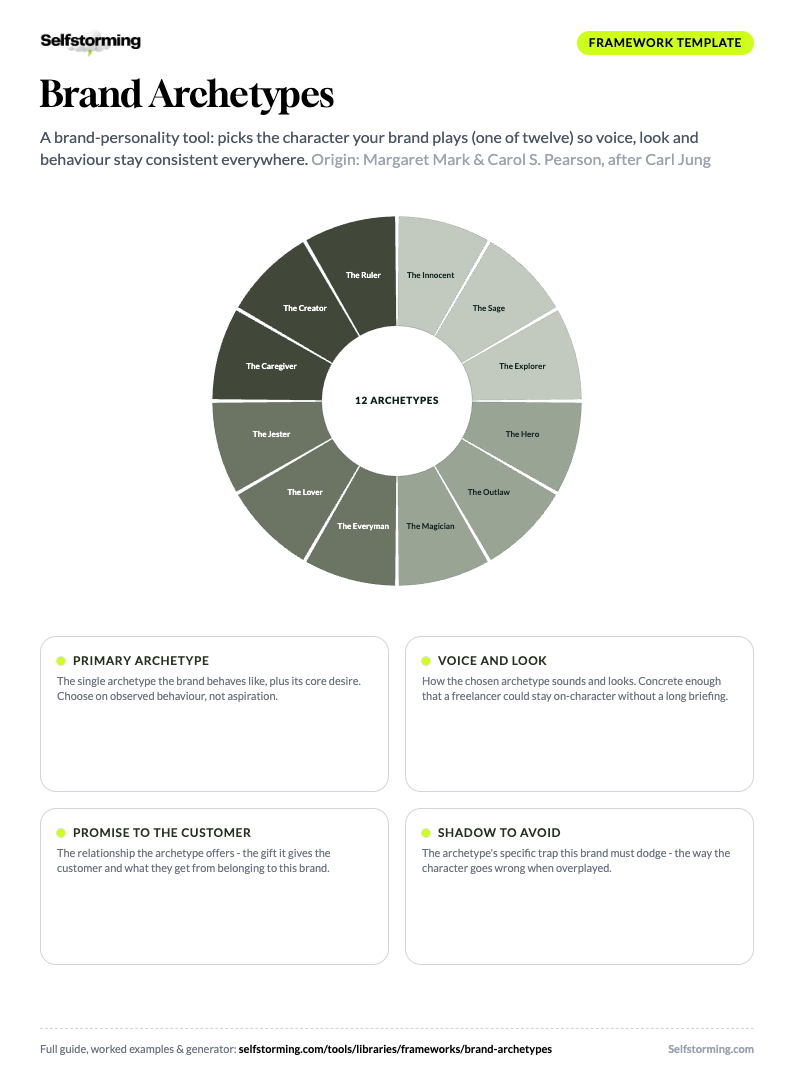
Brand Archetypes are the twelve human characters - Hero, Outlaw, Sage, Jester, Lover and eight friends - that brands borrow so a stranger can understand them in roughly two seconds. The idea is older than marketing: Carl Jung argued that certain characters live in everyone's head already, which is why a kid in Tokyo and a pensioner in Glasgow both instantly get what 'the rebel' or 'the wise old mentor' means. Margaret Mark and Carol Pearson took those characters off the psychiatrist's couch and pointed out the obvious - the most enduring brands behave like one of them, consistently, for decades.
Print it. Fill it in.
The Brand Archetypes as a printable A4 worksheet - write straight into the framework, on paper or in any PDF app.
Download the PDF templateKnowledge Worth Paying For
A working library of brand strategy frameworks - with worked examples on real brands, sources, and decision criteria. Not vibes.
One good deck covers the subscription. The rest is profit.
Twelve characters drawn from Jungian psychology, grouped into four families by core human motivation: Independence & Fulfillment (Innocent, Sage, Explorer), Mastery & Risk (Hero, Outlaw, Magician), Belonging & Connection (Everyman, Lover, Jester), and Stability & Control (Caregiver, Creator, Ruler). Each archetype has a core desire, a goal, and a gift it gives the customer - and a shadow it falls into when overplayed. Pick one primary archetype, maybe a secondary, then make the voice, the look, and the promise all behave like that character. The rule that makes it work: an archetype is how the brand acts, not a sticker on the deck.
Nike
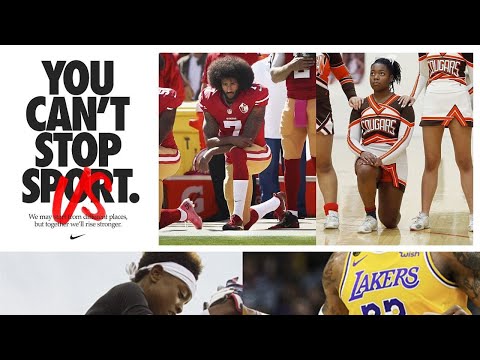
Global sportswear and footwear brand (USA, founded 1964)The cleanest Hero (Mastery & Risk family) in modern marketing, lived consistently for forty years. Nike rarely sells the shoe - it sells the customer's own potential to overcome something, casting them as the athlete with a battle to win and itself as the gear that helps them win it. 'Just Do It' isn't a slogan, it's the Hero's entire worldview in three words.
Hero. Core desire: to prove your worth through courageous effort and triumph over adversity - the customer is the athlete, and inside every body there's an athlete waiting to be summoned.
Voice: urgent, commanding, motivational without being soft, second-person and in your face ('you'). Look: high-contrast, sweat-and-grit cinematography, slow-motion grit, real and elite athletes pushed to the edge, the swoosh as a finish line.
Promise: we'll back the part of you that refuses to quit. Whatever you're up against - the clock, the doubt, the limits - we make the gear and tell the story that says you can rise to it.
Apple
Consumer technology brand (USA, founded 1976)A Creator-Magician (Stability & Control / Mastery & Risk) that built one of the most valuable brands on Earth by handing people both the tools to make things and the wonder of technology that feels like sorcery. Apple casts the customer as the artist and itself as the magic behind the curtain - which is why it can charge what it charges for an aluminium rectangle.
Creator (with a strong Magician streak). Core desire: to give form to a vision and make things of enduring value - and to make the powerful feel effortless, even magical. The customer leaves as a maker, not a consumer.
Voice: minimal, confident, quietly poetic, lets the product breathe and the silence sell. Look: clean white space, hero product shots, human creativity (music, film, design) made by ordinary people on the device, every detail obsessively considered.
Promise: we hand you tools good enough to make the thing in your head real, and we make the technology disappear so the creativity doesn't. The genius is yours; we just removed everything in the way.

Old Spice
Men's grooming and personal-care brand (USA, founded 1937, relaunched 2010)A standout Jester (Belonging & Connection family) and a masterclass in committing to the bit. A dusty heritage brand reinvented itself by becoming the funniest thing in a deeply earnest aisle - absurd, surreal, fast - and never once broke character. It proves a Jester archetype works when the humour is the strategy, not a garnish on a serious message.
Jester. Core desire: to live in the moment and bring joy - to be the brand that refuses to take grooming, or itself, remotely seriously.
Voice: absurd, surreal, confident, deadpan-then-ridiculous, machine-gun fast. Look: saturated, theatrical, deliberately over-the-top set pieces and non-sequitur visuals that signal 'this is a joke and we're in on it'.
Promise: buying this is the fun, unserious choice in a category that wants to sound like a pharmaceutical. We make you smile - and smelling good is just the side effect.

Nike, Apple, Old Spice - filled in, line by line. Unlock to read them.
Nike (Global sportswear and footwear brand (USA, founded 1964))
The cleanest Hero (Mastery & Risk family) in modern marketing, lived consistently for forty years. Nike rarely sells the shoe - it sells the customer's own potential to overcome something, casting them as the athlete with a battle to win and itself as the gear that helps them win it. 'Just Do It' isn't a slogan, it's the Hero's entire worldview in three words.
Primary archetype: Hero. Core desire: to prove your worth through courageous effort and triumph over adversity - the customer is the athlete, and inside every body there's an athlete waiting to be summoned.
Voice and look: Voice: urgent, commanding, motivational without being soft, second-person and in your face ('you'). Look: high-contrast, sweat-and-grit cinematography, slow-motion grit, real and elite athletes pushed to the edge, the swoosh as a finish line.
Promise to the customer: Promise: we'll back the part of you that refuses to quit. Whatever you're up against - the clock, the doubt, the limits - we make the gear and tell the story that says you can rise to it.
Shadow to avoid: Shadow to avoid: the arrogant bully. The Hero can tip into relentless chest-beating that exhausts the audience and looks for fights just to stay heroic. Nike dodges it by aiming the courage at the customer's struggle, not at flexing its own dominance.
Apple (Consumer technology brand (USA, founded 1976))
A Creator-Magician (Stability & Control / Mastery & Risk) that built one of the most valuable brands on Earth by handing people both the tools to make things and the wonder of technology that feels like sorcery. Apple casts the customer as the artist and itself as the magic behind the curtain - which is why it can charge what it charges for an aluminium rectangle.
Primary archetype: Creator (with a strong Magician streak). Core desire: to give form to a vision and make things of enduring value - and to make the powerful feel effortless, even magical. The customer leaves as a maker, not a consumer.
Voice and look: Voice: minimal, confident, quietly poetic, lets the product breathe and the silence sell. Look: clean white space, hero product shots, human creativity (music, film, design) made by ordinary people on the device, every detail obsessively considered.
Promise to the customer: Promise: we hand you tools good enough to make the thing in your head real, and we make the technology disappear so the creativity doesn't. The genius is yours; we just removed everything in the way.
Shadow to avoid: Shadow to avoid: the manipulative illusionist and the perfectionist who prizes the artefact over the audience. Apple has to keep the magic anchored to real capability, or the 'transformation' curdles into hype and the craft into precious self-indulgence.
Old Spice (Men's grooming and personal-care brand (USA, founded 1937, relaunched 2010))
A standout Jester (Belonging & Connection family) and a masterclass in committing to the bit. A dusty heritage brand reinvented itself by becoming the funniest thing in a deeply earnest aisle - absurd, surreal, fast - and never once broke character. It proves a Jester archetype works when the humour is the strategy, not a garnish on a serious message.
Primary archetype: Jester. Core desire: to live in the moment and bring joy - to be the brand that refuses to take grooming, or itself, remotely seriously.
Voice and look: Voice: absurd, surreal, confident, deadpan-then-ridiculous, machine-gun fast. Look: saturated, theatrical, deliberately over-the-top set pieces and non-sequitur visuals that signal 'this is a joke and we're in on it'.
Promise to the customer: Promise: buying this is the fun, unserious choice in a category that wants to sound like a pharmaceutical. We make you smile - and smelling good is just the side effect.
Shadow to avoid: Shadow to avoid: frivolity that nobody takes seriously, and joke fatigue. The Jester's trap is being all punchline and no product - Old Spice has to keep the humour anchored to a real reason to buy, or it becomes a comedy channel that happens to sell soap.
1. The Innocent
How do we help people feel safe, optimistic, and good - the way things were meant to be?
Part of the Independence & Fulfillment family. The Innocent wants to be happy and good, free of complication. Core desire: to experience paradise. Goal: to be happy. Gift to the customer: reassurance, simplicity, and the feeling that life can be wholesome. Fits brands selling purity, nostalgia, wellbeing, or honest simplicity - and any category drowning in cynicism where being plainly good is the differentiator.
Brands that live it: Innocent Drinks (it's in the name) and Aveeno - both trade on wholesome, do-no-harm simplicity and a gentle, optimistic tone.
The shadow: The shadow is naive denial. Pushed too far, the Innocent becomes saccharine and unbelievable - a brand pretending the world is sunshine while customers live in the real one. Nobody trusts a smile that wide.
2. The Sage
How do we help people understand the world through knowledge and truth?
Part of the Independence & Fulfillment family. The Sage seeks truth and wants to understand the world. Core desire: to find the truth. Goal: to use intelligence and analysis to understand. Gift to the customer: wisdom, clarity, and the confidence of being well-informed. Fits research-led brands, premium-considered products, education, media, and B2B categories where expertise is the whole sell.
Brands that live it: Aesop (considered, almost scholarly product and store craft) and The Economist - both reward the customer for being smarter than average.
The shadow: The shadow is the dogmatic know-it-all. Overplayed, the Sage lectures instead of guides, becomes pedantic and cold, and forgets that nobody likes the cleverest person in the room when they keep reminding you.
3. The Explorer
How do we help people find themselves through freedom and discovery?
Part of the Independence & Fulfillment family. The Explorer craves freedom and the authentic life found out there, away from the crowd. Core desire: freedom to find out who you are. Goal: to experience a better, more authentic, more fulfilling life. Gift to the customer: autonomy, adventure, and permission to leave the beaten path. Fits outdoor, travel, automotive, and any brand selling escape from the ordinary or the cubicle.
Brands that live it: Patagonia and Jeep - both promise the open road or the open trail, and an identity built on going where others won't.
The shadow: The shadow is aimless wandering. Overdone, the Explorer becomes a restless brand that never commits to anything, mistaking a permanent gap year for a strategy. Freedom with no point is just being lost with better photos.
4. The Hero
How do we prove our worth through courage, mastery, and the will to win?
Part of the Mastery & Risk family. The Hero wants to prove worth through bold, difficult action and triumph over adversity. Core desire: to prove your worth through courageous acts. Goal: to master the world and win. Gift to the customer: competence, courage, and the belief they can rise to a challenge. Fits performance brands, sports, fitness, tools, and any category where the customer is trying to overcome something.
Brands that live it: Under Armour and Duracell - both frame the customer as someone with a battle to win and themselves as the gear that helps them win it.
The shadow: The shadow is the arrogant bully. Overplayed, the Hero turns every message into a chest-beating challenge, exhausts the audience, and starts looking for problems to fight just to stay heroic. Constant war is tiring to watch.
5. The Outlaw
How do we break the rules that deserve breaking and free people from the broken system?
Part of the Mastery & Risk family. The Outlaw (or Rebel) exists to disrupt, break conventions, and tear down what doesn't work. Core desire: revolution against the broken order. Goal: to overturn what isn't working. Gift to the customer: liberation, attitude, and permission to rebel. Fits challenger brands, counterculture products, and any category bloated with smug incumbents begging to be mocked.
Brands that live it: Harley-Davidson and Diesel - both sell membership in a tribe that refuses to behave, and an identity built on not asking permission.
The shadow: The shadow is destruction for its own sake, and the cliche is everyone claiming it. Half of all challenger brands declare themselves the Outlaw, which makes the rebellion suspiciously crowded. Rebellion without a real enemy is just a brand swearing for attention.
6. The Magician
How do we make dreams real and transform the world for people?
Part of the Mastery & Risk family. The Magician makes the impossible feel inevitable and turns vision into reality. Core desire: to understand the fundamental laws and use them to make things happen. Goal: to make dreams come true; transformation. Gift to the customer: wonder, transformation, and the feeling that something magical just happened. Fits transformative tech, entertainment, beauty, and brands that change how the world works.
Brands that live it: Dyson (engineering that feels like sorcery) and Polaroid - both turn a mundane category into a moment of 'how did they do that?'
The shadow: The shadow is the manipulative illusionist. Overplayed, the Magician overpromises transformation it can't deliver, drifts into hype, and becomes the snake-oil seller the moment the magic turns out to be a press release.
7. The Everyman
How do we belong with everyone else - down to earth, no airs, just one of us?
Part of the Belonging & Connection family. The Everyman (or Regular Guy/Gal) just wants to belong and be one of the crowd, no pretension. Core desire: connection with others. Goal: to belong, to fit in. Gift to the customer: belonging, realism, and the comfort of being understood without trying. Fits accessible, value, household, and mass-market brands that win by being decent and relatable rather than aspirational.
Brands that live it: IKEA and Greggs - both unpretentious, for everyone, and proudly allergic to luxury airs.
The shadow: The shadow is blandness and losing yourself in the crowd. Overdone, the Everyman becomes so eager to be liked by everyone that it stands for nothing and disappears. Relatable is good; invisible is not.
8. The Lover
How do we create intimacy, beauty, and the feeling of being desired?
Part of the Belonging & Connection family. The Lover is about intimacy, sensuality, beauty, and deep connection. Core desire: intimacy and experience. Goal: to be in a relationship with the people, work, and surroundings they love. Gift to the customer: desirability, pleasure, and the feeling of being special. Fits beauty, fashion, fragrance, food, hospitality, and any category sold on sensory pleasure and closeness.
Brands that live it: Chanel and Magnum - both sell intimacy, indulgence, and the promise that the customer becomes more desirable.
The shadow: The shadow is neediness and losing identity in the other. Overplayed, the Lover becomes desperate to please, trades self-respect for approval, and tips from seductive into try-hard. Desire that begs isn't desire.
9. The Jester
How do we help people lighten up, live in the moment, and enjoy the joke?
Part of the Belonging & Connection family. The Jester wants to have a great time and bring joy, living fully in the now. Core desire: to live in the moment with full enjoyment. Goal: to have a great time and lighten up the world. Gift to the customer: fun, levity, and permission to not take everything so seriously. Fits snacks, drinks, entertainment, and any category where the competition is taking itself far too earnestly.
Brands that live it: Old Spice and M&M's - both win by being the funniest brand in a humourless aisle and never breaking character.
The shadow: The shadow is frivolity and being taken seriously by no one. Overdone, the Jester becomes a brand that's all punchline and no substance - laughed at, then forgotten, and never trusted with anything that matters.
10. The Caregiver
How do we protect and care for people who need us?
Part of the Stability & Control family. The Caregiver is driven to protect and nurture others. Core desire: to protect and care for others. Goal: to help others. Gift to the customer: safety, compassion, and the feeling of being looked after. Fits healthcare, childcare, insurance, non-profits, and any brand whose core promise is 'we've got you'.
Brands that live it: Dove and Johnson & Johnson - both built on nurture, reassurance, and genuine concern for the person on the other side.
The shadow: The shadow is martyrdom and smothering. Overplayed, the Caregiver becomes guilt-trippy and self-sacrificing to the point of manipulation, or so protective it treats customers like helpless children. Care that controls isn't care.
11. The Creator
How do we help people make something of enduring value and express themselves?
Part of the Stability & Control family. The Creator wants to make things of lasting value and give form to a vision. Core desire: to create things of enduring value. Goal: to realise a vision; to build. Gift to the customer: imagination, craft, and the tools to express themselves. Fits design tools, craft brands, building products, and any category that puts the customer in the maker's seat.
Brands that live it: Lego and Adobe - both hand the customer raw material and the identity of 'someone who makes things'.
The shadow: The shadow is perfectionism and never shipping. Overdone, the Creator gets lost in its own craft, prizes the artefact over the audience, and becomes self-indulgent - beautiful work nobody asked for and nobody uses.
12. The Ruler
How do we create order, control, and a world that runs the way it should?
Part of the Stability & Control family. The Ruler wants control and to create a prosperous, stable, well-ordered world. Core desire: control. Goal: to create a prosperous, successful community or order. Gift to the customer: status, leadership, and the confidence of backing the established authority. Fits luxury, premium, finance, and category-leader brands that sell mastery, prestige, and being the safe top choice.
Brands that live it: Rolex and Mercedes-Benz - both sell authority, status, and the reassurance of choosing the established leader.
The shadow: The shadow is tyranny and arrogance. Overplayed, the Ruler becomes controlling, snobbish, and out of touch, defending its throne instead of earning it - the kind of brand that confuses being expensive with being superior.
Decide your starting point: A workshop is not the only way in. You don't have to find your archetype in a blank room - right here on Selfstorming you can find inspiration and directions, or generate a first-draft archetype read in minutes. Treat that draft as a head start, then run it through the steps below to refine it and proof/research it against the real market. Pick-from-scratch and AI-draft-then-pressure-test are both valid; most teams move faster starting from a draft.
Pick a primary archetype on behaviour, not aspiration: Don't choose the character you'd like to be at a party - choose the one your brand actually behaves like when nobody's watching the brand deck. Run the twelve past your product, your pricing, and your customer service. The honest answer is usually narrower and less flattering than the workshop fantasy, and that's the useful one.
Add a secondary archetype only to break the cliche: A pure archetype reads like a stock photo. A secondary character adds the texture that makes you specific - a Ruler with a Jester streak, a Sage with an Outlaw edge. Keep the secondary subordinate; it seasons the primary, it doesn't co-headline. Two equal archetypes is just an identity that can't decide.
Define the voice and the look as that character would: Write down how the archetype talks (a Jester and a Sage do not write the same email) and how it looks (the Outlaw and the Caregiver do not share a colour palette). Make it concrete enough that a freelancer could write an on-character tweet without a forty-slide briefing.
Name your shadow and post it on the wall: Every archetype has a trap - the Hero's bully, the Lover's neediness, the Ruler's snobbery. Write yours down explicitly. Knowing the specific way your character goes wrong is more useful day to day than knowing the character itself, because the shadow is what you'll drift into under pressure.
Brief everything from the archetype: An archetype that lives only in the brand book is a costume in a drawer. Use it as the sanity check on every ad, every product decision, every support reply. If a piece of work would make a customer say 'that doesn't sound like them', the work is wrong, not the archetype.
Pressure-test against the market, not the mirror: Archetypes have no built-in competitive rigour, so check who else in your category is wearing the same one. If three rivals are all the Outlaw, your rebellion is invisible - either pick a sharper secondary or contest the character harder than they do. Distinctiveness comes from how you live it, not from the label.
Revisit only when behaviour genuinely changes: The primary archetype should be stable for years - if it changes every campaign, you didn't have one, you had a mood board. Re-read it on a major strategic move (new market, new leadership, new product line), but resist the urge to redecorate the character every planning cycle.
Best for: Giving a brand a recognisable character that aligns voice, look, and behaviour - especially when a team needs a fast, teachable shorthand for 'who are we and how do we act?' / Deciding where to compete, who the target is, or whether the character is defensible in your category. Archetypes describe personality, not market position.
Output: A chosen primary archetype (maybe a secondary), with the core desire, the voice and look it implies, the promise to the customer, and the shadow to avoid - usually on a single page. / A competitive map, a consumer insight, or a positioning claim. Those are downstream deliverables the archetype feeds, not what it produces on its own.
Time to complete: A short workshop or a couple of hours - the twelve characters are pre-defined, so the work is choosing honestly and defining how you'll live it, not inventing from scratch. / A multi-week research project. If you're spending weeks, you've probably wandered into positioning and segmentation work the archetype doesn't cover.
vs Brand Onion: Use Archetypes when you specifically need a rich, recognisable character for the personality of the brand - the archetype is the best possible input to the Onion's personality layer. / The Brand Onion covers the full identity surface (attributes, benefits, personality, values, essence). Use the Onion when you need the whole spine, not just the character.
vs Brand Pyramid: Use Archetypes to give the Pyramid's emotional right side (Imagery and Feelings) a concrete character, so the brand evokes a recognisable person rather than a spec sheet. / The Brand Pyramid is a diagnostic equity ladder tied to metrics (awareness to loyalty). Use it to measure how strong the brand is; the archetype only describes who it is.
vs Golden Circle (Sinek): Use Archetypes when you want a personality and behaviour the whole team can act out consistently across touchpoints, beyond a single purpose narrative. / The Golden Circle (Why/How/What) is built for purpose storytelling and pitch decks. Better for a founder narrative or keynote than for defining day-to-day brand behaviour.
Brand Archetypes trace back to Carl Jung, the Swiss psychiatrist who argued that the human mind shares a collective unconscious populated by recurring characters - archetypes like the Hero, the Sage, the Trickster, the Mother - that show up across every culture's myths, dreams, and stories because they're wired into how people make sense of the world. The branding application came from Margaret Mark and Carol S. Pearson in their 2001 book 'The Hero and the Outlaw: Building Extraordinary Brands Through the Power of Archetypes', which mapped twelve archetypes onto brand strategy and argued that the most enduring brands consistently embody a single archetype that speaks to a deep, universal human motivation. Pearson had already developed an archetype system in her earlier work ('Awakening the Heroes Within'); Mark, an advertising strategist, connected it to how brands build meaning. The model spread fast because it gave marketers a shared, teachable vocabulary for something they'd always sensed but struggled to name - that the strongest brands feel like a recognisable person.
The honest critique of Brand Archetypes is that they're seductive precisely because they're so easy, and easy is dangerous. Twelve boxes inevitably oversimplify real brands - very few great brands are a tidy single character, and forcing one can flatten the specific, contradictory texture that made the brand interesting in the first place. They also pigeonhole: once a team decides it's 'the Sage', it can start ignoring everything that doesn't fit the type. The deeper problem is that an archetype is trivially easy to wear as a costume - to perform in the launch film and abandon in the pricing, the product, and the support queue, where customers actually live - and a personality that's only skin-deep reads as a lie. There's also no built-in consumer or competitive rigour: the wheel tells you who to be but nothing about who your customer is, where you can win, or whether the character is even available in your category. Which leads to the most visible failure mode - cliche. Every challenger declares itself the Outlaw, every premium player the Ruler, every running shoe the Hero, until the labels stop distinguishing anything. The fair way to use archetypes: as a sharp input to personality that you pressure-test against real behaviour and real competitors, not as a finished strategy you can frame and forget.
What are the 12 brand archetypes?
The twelve, grouped into four families by core motivation. Independence & Fulfillment: Innocent, Sage, Explorer. Mastery & Risk: Hero, Outlaw, Magician. Belonging & Connection: Everyman, Lover, Jester. Stability & Control: Caregiver, Creator, Ruler. Each has a core desire (the Hero wants to prove worth, the Lover wants intimacy, the Sage wants truth), a gift it gives the customer, and a shadow it falls into when overplayed.
Who created brand archetypes?
The underlying psychology is Carl Jung's - his theory of the collective unconscious and recurring archetypes across human culture. The branding application came from Margaret Mark and Carol S. Pearson in their 2001 book 'The Hero and the Outlaw', which mapped twelve archetypes onto brand strategy. Pearson built the archetype system; Mark, an ad strategist, connected it to how brands create meaning. So the idea is Jung, but the twelve-archetype branding model people use today is Mark & Pearson.
Can a brand have more than one archetype?
Yes, but carefully. The strongest brands lead with one primary archetype and use at most one secondary to add texture and break the cliche - a Ruler with a Jester streak, a Sage with an Outlaw edge. The secondary seasons the primary; it never co-headlines. Two co-equal archetypes is usually a sign the team couldn't choose, and the result is a brand that sounds like two strangers sharing a logo.
Is Brand Archetypes the same as the Brand Onion?
No - they do different jobs and work well together. Brand Archetypes give you a single rich character for the brand's personality (Hero, Sage, Jester, etc.). The Brand Onion is a full identity model with five layers - attributes, benefits, personality, values, essence. The archetype is the best possible input to the Onion's personality layer, but it doesn't cover attributes, benefits, or essence. Use the archetype to nail the character, the Onion to define the whole brand.
Does Brand Archetypes work for B2B?
Yes, and it often helps more than in B2C, because B2B brands tend to collapse into identical 'trusted, innovative, expert' soup. Picking an archetype forces a B2B team to commit to an actual character - a Sage that genuinely teaches, a Caregiver that genuinely reassures, an Outlaw that genuinely challenges the category's lazy incumbents. That commitment is exactly what makes one expert-led brand feel different from the seventeen identical ones in the same category.
How do I choose the right brand archetype?
Choose on behaviour, not aspiration. Don't pick the character you'd like to be at a party - pick the one your brand already acts like when nobody's watching the deck. Run all twelve past your product, your pricing, and your customer-service replies, and the honest answer is usually narrower than the workshop fantasy. Then check the market: if your obvious archetype is crowded with rivals, either out-execute them or add a secondary character that makes you specific. You can generate a first-draft archetype read in minutes and pressure-test it from there.
A brand-personality tool: picks the character your brand plays (one of twelve) so voice, look and behaviour stay consistent everywhere.
The trap is that archetypes are almost too easy to like. Pick a character, slap it on a moodboard, feel strategic, go to lunch. But an archetype isn't a costume you wear in the ad and take off in the customer-service email. It's a behavioural commitment: a Caregiver brand that's curt on the phone is just lying, and people can smell a lie faster than they can read a tagline. This page walks through all twelve, the core desire each one answers, the brands that actually live them, and the shadow each one falls into when a team treats the archetype as decoration instead of a decision.
Related Frameworks
Brand Onion
Five concentric layers from outer to inner: Attributes (provable product facts), Benefits (functional + emotional outcomes), Personality (ho
Brand Pyramid
Four levels, bottom to top: Salience (do people know you, and for what?), Meaning (what are you - performance facts plus imagery association
Brand Ladder
The Brand Ladder is a five-rung model that climbs from Features (what it is) to Functional benefits (what it does for you) to Emotional bene
Purpose, Vision & Mission
Three tiers, narrowing to a point: Mission at the base (what we do every day, concretely, and for whom - present tense), Vision in the middl