Purpose, Vision & Mission
The Three-Tier Foundation That Actually Decides Things
Purpose, Vision & Mission is the framework every company claims to have and almost nobody can recite. Ask three people in the same business to explain the difference between the three and you'll get four answers, a nervous laugh, and a link to a page on the website nobody has opened since the brand refresh. Done well, it's a three-tier pyramid that gets sharper as it gets smaller: a concrete Mission at the base (what we do every day, for whom), a Vision in the middle (the future we're trying to drag into existence), and a Purpose at the peak (why we bother beyond the money). Each tier answers a different question, and the questions get harder as you climb.
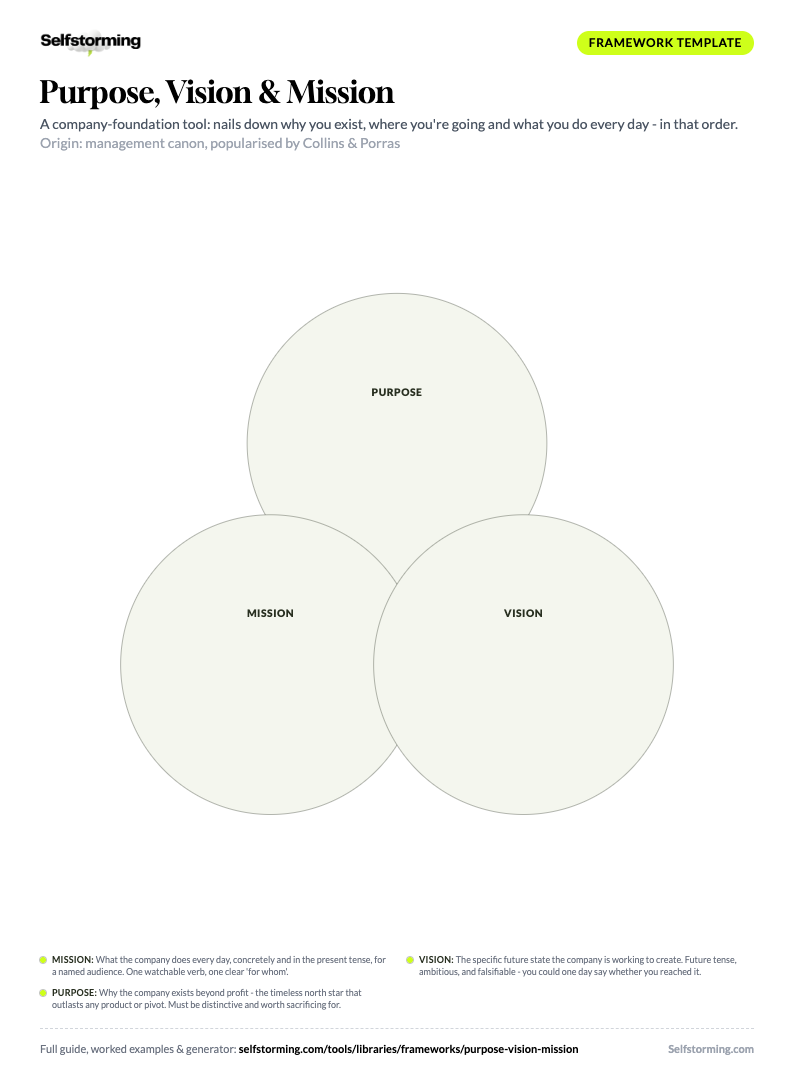
Print it. Fill it in.
The Purpose, Vision & Mission as a printable A4 worksheet - write straight into the framework, on paper or in any PDF app.
Download the PDF templateKnowledge Worth Paying For
A working library of brand strategy frameworks - with worked examples on real brands, sources, and decision criteria. Not vibes.
One good deck covers the subscription. The rest is profit.
Three tiers, narrowing to a point: Mission at the base (what we do every day, concretely, and for whom - present tense), Vision in the middle (the specific future state we're working to create - future tense), and Purpose at the apex (why we exist beyond profit - the north star that outlives any one product). The rule that makes it work: each tier must constrain real decisions. If your purpose, vision and mission could be swapped with a competitor's and nobody in the building would have to change a single plan, you've written three sentences, not a strategy. Use it to align an organisation, not to decorate a wall.
IKEA
Global flat-pack furniture and home retailer (Sweden, founded 1943)The cleanest example of all three tiers pulling in the same direction. IKEA's purpose ('a better everyday life for the many people') isn't decoration - it's the reason the furniture is flat-packed, the meatballs are cheap, and you assemble it yourself. Every famously frustrating IKEA decision becomes legible once you see the purpose, vision, and mission stacked above it. The stack doesn't describe the company; it explains it.

Dove
Mass-market personal care brand (Unilever, launched USA 1957, global)A purpose that stopped being a slogan the moment the brand started spending against it. Dove decided its reason for being wasn't soap but women's self-esteem, then built the Self-Esteem Project, a no-retouching pledge, and two decades of Real Beauty work to prove it meant it. The tell that the stack is real: the purpose costs Dove things a normal soap brand would never give up, like the airbrush.
Airbnb
Online marketplace for stays and experiences (USA, founded 2008)Shows how the three tiers separate a transactional what from an emotional why. The mission is concrete and bookable; the purpose ('belong anywhere') is the bigger idea that justified everything from the design of the product to the famously polarising rebrand. It also illustrates the risk: a lofty purpose about belonging sits uneasily next to the operational reality of a hospitality marketplace, which is exactly the tension a purpose statement has to keep earning.

IKEA, Dove, Airbnb - filled in, line by line. Unlock to read them.
IKEA (Global flat-pack furniture and home retailer (Sweden, founded 1943))
The cleanest example of all three tiers pulling in the same direction. IKEA's purpose ('a better everyday life for the many people') isn't decoration - it's the reason the furniture is flat-packed, the meatballs are cheap, and you assemble it yourself. Every famously frustrating IKEA decision becomes legible once you see the purpose, vision, and mission stacked above it. The stack doesn't describe the company; it explains it.
Mission: To offer a wide range of well-designed, functional home furnishing products at prices so low that as many people as possible can afford them - sold in a way (flat-pack, self-assembly, self-service) that keeps those prices low on purpose.
Vision: A future where good design and a comfortable home are not a luxury for the few but a normal expectation for the many - across as many countries and incomes as the model can reach.
Purpose: To create a better everyday life for the many people. The reason for being that survives even if IKEA sold something other than furniture - it's about democratising the good home, not about chipboard.
Dove (Mass-market personal care brand (Unilever, launched USA 1957, global))
A purpose that stopped being a slogan the moment the brand started spending against it. Dove decided its reason for being wasn't soap but women's self-esteem, then built the Self-Esteem Project, a no-retouching pledge, and two decades of Real Beauty work to prove it meant it. The tell that the stack is real: the purpose costs Dove things a normal soap brand would never give up, like the airbrush.
Mission: To make beauty a source of confidence, not anxiety - by selling skincare and personal care while showing real, undistorted women instead of the usual flawless models, and teaching body confidence through the Dove Self-Esteem Project.
Vision: A future where the next generation grows up with a positive relationship to the way they look - where 'real beauty' is the default the whole category is held to, not one brand's campaign.
Purpose: To exist so that beauty builds women up instead of grinding them down. The reason Dove pledges never to digitally distort an image and runs the world's largest youth self-esteem programme - the soap is just the thing that funds the mission.
Airbnb (Online marketplace for stays and experiences (USA, founded 2008))
Shows how the three tiers separate a transactional what from an emotional why. The mission is concrete and bookable; the purpose ('belong anywhere') is the bigger idea that justified everything from the design of the product to the famously polarising rebrand. It also illustrates the risk: a lofty purpose about belonging sits uneasily next to the operational reality of a hospitality marketplace, which is exactly the tension a purpose statement has to keep earning.
Mission: To help people book unique places to stay and things to do, hosted by locals - connecting travellers who want somewhere real with hosts who have space to share.
Vision: A world where travel means living in a place rather than passing through it - where a stranger's spare room is a normal, trusted way to belong somewhere new.
Purpose: To create a world where anyone can belong anywhere. The reason the company is about connection and belonging, not just nightly rates - the idea that justified the product, the brand, and the rebrand.
1. Mission
What do we actually do every day, concretely, and exactly who do we do it for?
The base of the pyramid and the most concrete tier. The Mission describes what the company does right now, in the present tense, for a named audience. It's the broadest, busiest layer because it's the closest to the work - the thing a new hire could read on Monday and understand what their job is in service of by Tuesday. A good Mission has a verb you can watch happen and a 'for whom' you could point at in a room. Get this wrong and Vision and Purpose float above an organisation that doesn't know what it's supposed to be doing all day.
Good answer: To organise the world's information and make it universally accessible and useful (Google's classic mission): a clear verb (organise), a clear scope (the world's information), and a clear job-to-be-done (accessible and useful). You can tell on any given Tuesday whether a project serves it.
Wrong answer: To deliver exceptional value to our customers, employees, and shareholders. No verb you can watch, no audience you can name, and a 'for whom' so wide it includes everyone and therefore no one. It describes the existence of a company, not the work of one.
2. Vision
If we succeed wildly, what does the future look like - and how would we know we got there?
The middle tier, and the one most teams quietly skip or merge into the others. The Vision is the specific future state the company is working to create - future tense, ambitious, and crucially falsifiable. It's the bridge between the daily Mission and the timeless Purpose: more concrete than 'why we exist', more aspirational than 'what we do'. The test of a real Vision is that you could stand at some future date and honestly say whether it came true. A Vision you can never fail to achieve isn't pointing anywhere - it's just optimism with a deadline removed.
Good answer: A personal computer on every desk and in every home (Microsoft's early vision): a picture of a changed world so specific you could measure it - and absurd enough at the time to be a genuine bet, not a safe platitude.
Wrong answer: To be the leading, most trusted, world-class provider in our space. 'Leading' by whose measure, 'world-class' by what test, 'trusted' compared to whom? It can never be falsified, never be reached, and never be failed - which means it can never guide a single choice.
3. Purpose
Why do we exist beyond making money - what would the world miss if we vanished?
The peak: the smallest, hardest, most permanent tier, and the north star the whole pyramid points toward. Purpose is why the company exists beyond profit - the reason that would still be true if the product, the market, and the business model all changed. It should outlast any single Vision (which gets achieved or abandoned) and any single Mission (which evolves with the work). The discipline of Purpose is restraint: it must be true, it must be distinctive enough that it couldn't belong to your nearest competitor, and it must be something the company would actually sacrifice profit to honour - otherwise it's just marketing wearing a philosophy costume.
Good answer: To create a better everyday life for the many people (IKEA): not 'sell furniture', not 'be the biggest', but a reason for being that explains the flat-pack, the meatballs, and the maddening allen key all at once - and would survive the company selling something else entirely.
Wrong answer: To empower people to achieve their potential and make the world a better place. True of a gym, a bank, a software firm, and a cult. A purpose that fits everyone fits no one - it's purpose-washing, a halo bolted onto a P&L that behaves exactly as it would without it.
Decide your starting point: A whiteboard offsite is not the only way in. You don't have to summon a purpose, vision and mission from a blank room - right here on Selfstorming you can find inspiration and directions, or generate a first-draft purpose, vision and mission in minutes. Treat that draft as a head start, then run it through the steps below to refine it and proof/research it against how the company actually behaves. Build-from-scratch and AI-draft-then-pressure-test are both valid; most teams move faster starting from a draft.
Audit what you already have, including the contradictions: Before writing a fresh stack, collect every purpose, vision, and mission statement scattered across your website, decks, careers page, and the founder's old keynote. Most companies find three different missions and a purpose nobody approved. Note where the words and the behaviour disagree - that gap is half the reason you're doing this.
Build the Mission first, because it's the most provable: Start at the base. Write what you do in the present tense, with a verb you can watch happen and a named audience you could point at. If a new hire couldn't read it and understand what their job serves, it's too abstract. Cut every word that would survive in a rival's mission unchanged.
Make the Vision falsifiable on purpose: Describe the future state you're working toward in a way you could one day fail. 'Be the leader' can never be failed and so guides nothing. 'X reality exists for Y people by Z' can be checked. If you can't imagine standing in the future and admitting you missed, the Vision is decoration.
Find the Purpose by subtraction, not addition: The apex is the smallest tier, so write it last and keep cutting. Ask 'why does this exist beyond the money?' and then ruthlessly delete anything that could also be true of your nearest competitor. What's left - if anything is - is your candidate purpose. If nothing is left, that's a finding, not a failure.
Run the swap test on all three tiers: Take a direct competitor's purpose, vision and mission and quietly drop them into your strategy. If nothing in your roadmap, hiring, or budget would have to change, your statements aren't doing strategic work. Rewrite until a swap would actually break something.
Pressure-test against three real decisions: Take three recent calls - a product you killed, a hire you made, a market you skipped. Trace each one up through Mission, Vision, and Purpose. If a decision doesn't connect to any tier, either the decision was off, the tier is wrong, or the tier is missing. All three are useful to know.
Distribute the stack, not the offsite deck: A finished purpose, vision and mission fits on a single card - three lines, sharpest at the top. Put it in onboarding, in the brief template, in the strategy review. The forty-slide journey that produced it can live in the drive. If a plan never references the stack, the plan is the problem, not the stack.
Best for: Aligning a whole organisation on what it does, where it's going, and why it exists - founding moments, strategic resets, leadership changes, or when staff give different answers to 'why are we here?'. / Generating creative ideas, campaign copy, or competitive positioning. The stack is the foundation everything sits on, not the work that sits on it.
Output: Three short, distinct statements on a single card - a concrete present-tense Mission, a falsifiable future-tense Vision, and a timeless Purpose at the peak, each constraining real decisions. / A single fuzzy paragraph, a tagline, or a values list. Those are different artifacts - the stack feeds them, it isn't them.
Time to complete: A focused workshop (a day or two) plus a week or so of refinement and pressure-testing against real decisions. The structure forces the hard distinctions quickly. / A five-minute fill-in-the-blanks exercise. If you draft it from gut feel and never run the swap or sacrifice tests, you've written three sentences, not a foundation.
vs Brand Onion: Use Purpose, Vision & Mission when the question is organisational ('why do we exist and where are we going?') and you need a stack the whole company shares, not just marketing. / The Brand Onion is a five-layer brand-identity tool (attributes to essence) built for creative briefing and brand expression. Use it when the question is 'how does the brand show up', not 'why does the company exist'.
vs Golden Circle: Use Purpose, Vision & Mission when you need three separate, distinct tiers - including a falsifiable Vision and a present-tense Mission - to align decisions, not just tell a story. / The Golden Circle (Sinek) has three rings (Why/How/What) optimised for narrative and pitch storytelling. Its 'Why' overlaps Purpose, but it has no real Vision tier and is built to inspire a room, not run an org.
vs Positioning Statement: Use the stack to set the internal foundation - the why and where that precede any market claim. It's upstream of competitive positioning. / A Positioning Statement is a market-facing, competitive claim (for X, we are the Y that does Z). Use it when you need to win a specific audience against named rivals, not to define why the company exists.
Purpose, Vision & Mission has no single inventor - it's the lingua franca of modern management, assembled over decades rather than authored in one paper. Mission and vision statements became standard strategic-planning tools through the management literature of the 1970s and 1980s, popularised by writers like Peter Drucker (whose 'what is our business?' question is the ancestor of the modern mission). The three-tier framing crystallised with James Collins and Jerry Porras in their 1994 book 'Built to Last' and their related Harvard Business Review article 'Building Your Company's Vision' (1996), which separated enduring core ideology (purpose and values) from an ambitious, time-bound 'BHAG' - a big hairy audacious goal that maps closely onto Vision. The 'Purpose' tier got a second, louder life through Simon Sinek's 2009 'Start With Why' and the broader purpose movement of the 2010s, which pushed 'why we exist beyond profit' from a footnote in the strategy deck to the headline. The framework spread because it gave leaders a shared, teachable vocabulary for three questions every organisation has to answer eventually - even if most answer them badly.
The honest critique of Purpose, Vision & Mission is that the statements are notoriously generic and almost universally ignored. Studies and surveys of corporate mission statements keep finding the same interchangeable vocabulary - value, leading, world-class, stakeholders - to the point that you could shuffle the statements of a hundred companies and few employees would spot their own. Critics like Lucy Kellaway built whole columns mocking the management-speak these statements generate, and the term 'purpose-washing' exists precisely because so many noble-sounding purposes are bolted onto businesses that behave exactly as they would without one. The deeper charge is that the framework rarely changes behaviour: a statement that never makes a decision easier, a 'no' clearer, or a sacrifice real is overhead dressed as strategy. The fair way to use it is as a working constraint you pressure-test against actual decisions - the swap test, the sacrifice test - not as a laminated artifact that proves the strategy is sound simply because it sounds noble.
What's the difference between purpose, vision and mission?
They answer three different questions in three different tenses. Mission is present tense - what you do every day, concretely, for whom (IKEA: affordable, well-designed furnishings for the many). Vision is future tense - the specific, falsifiable future you're working to create (a personal computer on every desk). Purpose is timeless - why you exist beyond profit, the north star that survives any pivot (a better everyday life for the many people). The simplest tell: if two of yours could swap places without anyone noticing, you've written one idea, not three.
Who created the Purpose, Vision & Mission framework?
There's no single inventor - it's assembled management craft. Mission and vision statements became standard through 1970s-80s strategy literature, with Peter Drucker's 'what is our business?' as the ancestor of the modern mission. The three-tier framing crystallised with James Collins and Jerry Porras in Built to Last (1994) and their HBR work separating core ideology from an ambitious 'BHAG'. The Purpose tier got its modern prominence from Simon Sinek's Start With Why (2009) and the 2010s purpose movement.
Why is Purpose at the top of the pyramid and not the bottom?
Because the pyramid narrows as it gets more permanent and more abstract. Mission sits at the base because it's the broadest, busiest, most concrete tier - the daily work. Purpose sits at the apex because it's the smallest, hardest, and most enduring - the single reason for being that outlasts every product, market, and Vision beneath it. You climb from what you do, through where you're going, to why you exist at all. The peak is the north star everything else points toward.
Do we really need all three, or can we just have a mission?
You can ship with fewer, but they do different jobs, so merging them usually means losing one. Mission keeps the daily work pointed somewhere. Vision gives that work a destination you can fail to reach. Purpose explains why any of it matters when the product inevitably changes. Small or early companies often live on a sharp Mission alone - that's fine - but the moment people start asking 'where is this going?' and 'why are we doing this?', the missing tiers are exactly what's missing.
How is this different from the Golden Circle?
They overlap at the top and diverge below. The Golden Circle's 'Why' is close kin to Purpose, and it's a brilliant storytelling structure for inspiring a room. But the Golden Circle has no real Vision tier - no falsifiable future state - and its 'What' is a product description rather than a present-tense mission with a named audience. Use the Golden Circle to tell the story from stage; use Purpose, Vision & Mission to give an organisation three distinct tiers that constrain actual decisions.
How often should we revisit our purpose, vision and mission?
On different clocks. Purpose should be stable for years - if it changes every planning cycle, you had a mood, not a reason for being. Vision deserves a real review on major moves (new market, leadership change, pivot), since it can genuinely be reached or rendered obsolete. Mission is allowed to evolve most often, because it tracks the actual work. The healthy pattern is a stable apex and an evolving base - not a fossil, not a fresh framework every quarter.
A company-foundation tool: nails down why you exist, where you're going and what you do every day - in that order.
The trouble is that this is the framework most likely to end up as a poster in a meeting room that contradicts the actual behaviour of the company underneath it. A purpose statement that says we exist to empower humanity while the org optimises for quarterly churn is not a north star - it's a horoscope. The honest test for all three tiers is the same: would anything in your roadmap, your hiring, or your next budget actually change if you swapped your statement for a competitor's? If not, you don't have a Purpose, Vision and Mission. You have wallpaper with serifs. This page walks through each tier, the question that unlocks it, and how to tell the working version from the laminated one.
Related Frameworks
Brand Onion
Five concentric layers from outer to inner: Attributes (provable product facts), Benefits (functional + emotional outcomes), Personality (ho
Brand Pyramid
Four levels, bottom to top: Salience (do people know you, and for what?), Meaning (what are you - performance facts plus imagery association
Brand Archetypes
Twelve characters drawn from Jungian psychology, grouped into four families by core human motivation: Independence & Fulfillment (Innocent,
Brand Ladder
The Brand Ladder is a five-rung model that climbs from Features (what it is) to Functional benefits (what it does for you) to Emotional bene