Brand Ladder
Climb From What It Is To Why Anyone Cares
Most brands describe themselves the way a fridge describes itself - litres, shelves, an ice maker. All true, all forgettable. Nobody lies awake wanting 28 litres of crisper drawer.
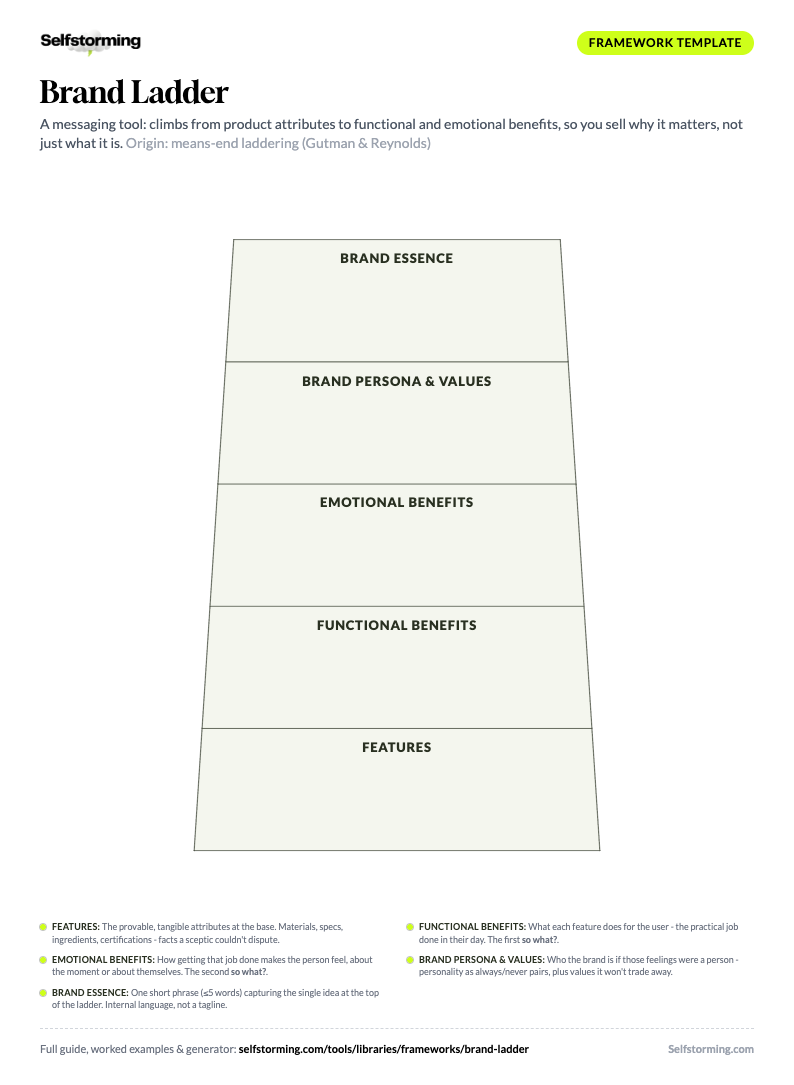
Print it. Fill it in.
The Brand Ladder as a printable A4 worksheet - write straight into the framework, on paper or in any PDF app.
Download the PDF templateKnowledge Worth Paying For
A working library of brand strategy frameworks - with worked examples on real brands, sources, and decision criteria. Not vibes.
One good deck covers the subscription. The rest is profit.
The Brand Ladder is a five-rung model that climbs from Features (what it is) to Functional benefits (what it does for you) to Emotional benefits (how it makes you feel) to Brand persona & values (who it is) to Brand essence (the single idea at the top). You build it bottom-up by asking so what? at every rung. It turns a spec sheet into a reason to care - and stops you from selling drill bits when people actually want holes.
Dove
Personal care / FMCGDove is the textbook climber. The features are almost aggressively ordinary - it's soap with moisturiser - yet the brand built one of the clearest emotional ladders in marketing by refusing to stop at "cleans skin". Every rung visibly leans into the one at the top, which is why "Real Beauty" outlived a dozen agency rosters.

Adidas
Global sportswear and footwear brand (Germany, founded 1949)Adidas is a ladder where the emotional rung does the climbing. The features (boost foam, three stripes, performance kit) are real but matched by rivals. What lifts the brand is the belief that sport is for everyone and that creativity belongs on the pitch - which is how a kit maker turns a running shoe into a statement about who gets to belong.

Heineken
Global lager brand (Netherlands, founded 1864)Heineken is a ladder that climbs past the liquid into a worldview. The functional story (a clean, consistent international lager) is commoditised, so the brand built its height on the idea that a beer is best shared across difference - turning 'open your world' from a tagline into the persona and essence the rungs all point toward.
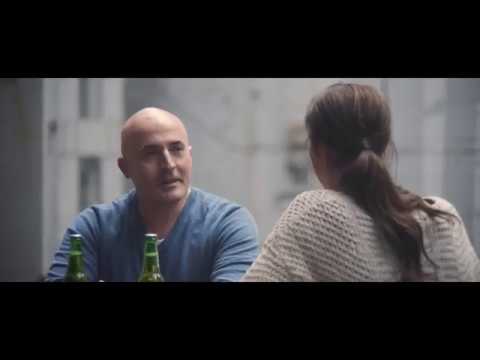
Dove, Adidas, Heineken - filled in, line by line. Unlock to read them.
Dove (Personal care / FMCG)
Dove is the textbook climber. The features are almost aggressively ordinary - it's soap with moisturiser - yet the brand built one of the clearest emotional ladders in marketing by refusing to stop at "cleans skin". Every rung visibly leans into the one at the top, which is why "Real Beauty" outlived a dozen agency rosters.
Features: A beauty bar with one-quarter moisturising cream, plus a body-care and haircare range. Dermatologically tested, sold in the mass aisle at a mainstream price.
Functional benefits: Cleans without the tight, stripped feeling ordinary soap leaves. Skin feels softer after, not drier. Practical, provable, and the original wedge that got Dove on the shelf.
Emotional benefits: Relief from the low-grade judgement the beauty aisle quietly sells. Feeling cared for rather than corrected - and a flicker of pride in a brand that doesn't make you feel worse to sell you more.
Brand persona & values: Casts women off the street, not off the agency's shortlist. Publishes the unretouched photo. Believes ordinary women are the point, not the before-photo.
Brand essence: Real beauty, no apology
Adidas (Global sportswear and footwear brand (Germany, founded 1949))
Adidas is a ladder where the emotional rung does the climbing. The features (boost foam, three stripes, performance kit) are real but matched by rivals. What lifts the brand is the belief that sport is for everyone and that creativity belongs on the pitch - which is how a kit maker turns a running shoe into a statement about who gets to belong.
Features: Three-stripe heritage performance gear, responsive cushioning, sport-specific kit, deep football and running pedigree, collaborations spanning athletes, designers and culture.
Functional benefits: Kit that holds up through real training and real matches, then carries straight onto the street. Performance you can trust and wear when you're not competing.
Emotional benefits: Feeling included in sport rather than judged by it - the belief that the game is yours too, whoever you are. Pride in a brand that treats creativity and inclusion as part of winning.
Brand persona & values: Signs the athlete nobody rated yet. Puts the community runner in the same ad as the champion. Believes sport changes lives and means it.
Brand essence: Through sport, we change lives
Heineken (Global lager brand (Netherlands, founded 1864))
Heineken is a ladder that climbs past the liquid into a worldview. The functional story (a clean, consistent international lager) is commoditised, so the brand built its height on the idea that a beer is best shared across difference - turning 'open your world' from a tagline into the persona and essence the rungs all point toward.
Features: Pale lager brewed with its proprietary A-yeast, the green bottle and red star, sold in nearly every country, long association with football, music and Formula 1.
Functional benefits: A crisp, consistent lager that tastes the same in Lagos as it does in Amsterdam - the reliable, sociable beer you reach for when you're out with people.
Emotional benefits: Feeling open, worldly and at ease with people unlike you. The small optimism of a drink that says differences are worth sharing a table over, not avoiding.
Brand persona & values: Sits two strangers at one bar and films what happens. Sponsors the match, then tells you to drink less. Believes openness beats your usual crowd.
Brand essence: Open your world
1. Features
What is it, factually? What are the attributes you could put on a spec sheet or a label without anyone arguing?
The provable, tangible base of the ladder. Ingredients, materials, specs, certifications, the count of things. This rung should be boring and true - it's the evidence the rest of the ladder stands on. Nobody buys here, but skip it and your emotional claims float with nothing holding them up.
Good answer: Made from recycled aluminium, 18-hour battery, 1mm hinge tolerance. Facts a sceptical engineer would sign off on. They don't sell anything yet - that's the point. They're the load-bearing floor, not the view.
Wrong answer: Premium, innovative, trusted. Those aren't features, they're conclusions you haven't earned yet. If you can't photograph it, weigh it, or read it off a label, it doesn't belong on the Features rung.
2. Functional benefits
So what? What does that feature actually do for the person using it - the practical job it gets done?
Translate each feature into a useful outcome. This is the first so what?. Recycled aluminium means it's lighter to carry; 18-hour battery means you stop hunting for plugs. Functional benefits are still rational and provable, but now they're about the customer's day instead of your factory. Most product marketing lives and dies here - which is exactly why it's forgettable on its own.
Good answer: You can leave the charger at home for a weekend. That's the 18-hour battery doing a job in someone's actual life. Concrete, testable, and it already sounds more like a reason than a number.
Wrong answer: Best-in-class performance. That's a feature in a trench coat, not a benefit. A functional benefit names the job done for the human, not the league table you'd win against rivals.
3. Emotional benefits
And so what? How does getting that job done make the person feel - about the moment, or about themselves?
Ask so what? again and you cross from the rational into the felt. Leaving the charger at home isn't really about the battery - it's about feeling free, unbothered, a little smug at the airport. This rung is where preference actually forms. It's also where most brands either get lazy ("feel confident") or get caught lying about a feeling the product can't deliver.
Good answer: The quiet confidence of never being the person frantically asking a café for a charging cable. Specific, slightly funny, and clearly traceable back to the battery feature two rungs down. You can feel it.
Wrong answer: Customers feel happy and confident. Every brand on earth claims happy and confident. Generic emotion is the same disease as generic features, just three rungs higher and harder to spot.
4. Brand persona & values
If those feelings were a person, who would they be? What would you watch this brand do at every touchpoint, and what would it refuse to trade away?
The emotional benefits add up to a character. This rung names it - personality (how the brand behaves, written as things it visibly does) and values (the beliefs it won't compromise even when it's expensive). Persona is the bridge between the feeling a customer gets and the consistent behaviour that earns it. Get this right and your tone of voice, your packaging, and your customer service stop contradicting each other.
Good answer: Answers a complaint in plain words, no script. Believes the customer is smarter than the category treats them. A persona with edges that predicts how the brand answers a complaint, writes an ad, and designs a box.
Wrong answer: Friendly, professional, approachable. That's not a persona, that's the minimum to not be sued. A real persona has a personality sharp enough that some people wouldn't like it.
5. Brand essence
If you climbed all the way up and could keep one single idea, what is the brand fundamentally about?
The top rung. One short phrase (ideally ≤5 words) that captures the single idea everything below it ladders into. It's internal language, not a tagline - the north star a new hire could read on day one and immediately know which decisions are on-brand. A good essence is decisive enough that it rules things out. If it could sit on top of a competitor's ladder unchanged, it isn't yours yet.
Good answer: Real beauty, no apology or Freedom from the plug. Short, specific, and you can feel every rung below it leaning into one idea. It predicts the next ten campaigns without naming a single one.
Wrong answer: Quality you can trust. The participation trophy of brand essences. It tops nothing, rules out nothing, and could be screwed onto any ladder in any category. An essence that fits everyone fits no one.
Start with a draft, not a blank page: You don't need a two-day offsite to begin. Pull your spec sheet, your last three ads, and your About page, then generate a first-draft brand ladder in minutes to react to. Arguing with a rough draft is faster than staring at five empty rungs - and it surfaces where your team secretly disagrees.
List every feature on the bottom rung first: Dump all the provable attributes onto slot-1 with zero editing. Materials, specs, certifications, the count of things. Keep only what an external sceptic couldn't dispute. This rung should feel almost insultingly boring - if it's exciting, you've smuggled a conclusion in early.
Climb to functional benefits with one question: For every feature ask so what does that do for the person? and write the practical outcome. One feature can spawn several benefits, and some features ladder up to nothing useful - cut those, they're vanity specs. You'll know you're at the right rung when the sentence is about the customer's day, not your factory.
Cross into emotion by asking so what again: Take each functional benefit and ask and how does that make them feel - about the moment or about themselves? This is the rung that separates a brand from a product page. Push past the first lazy emotion ("confident") to something specific and human. If the feeling could apply to a stapler, keep climbing.
Name the persona from the feelings: Read your emotional benefits as a group and ask if this were a person, who is it? Write personality as things the brand visibly does and values as trade-offs you'd actually make. The test: a value you'd never sacrifice money for isn't a value, it's a poster.
Compress everything into one essence: At the top, force the whole ladder into a single phrase of five words or fewer. Iterate out loud. The essence is right when a new hire could read it and correctly guess which ideas you'd reject. If it fits a competitor unchanged, it's not done.
Pressure-test top-down and bottom-up: Climb down from the essence and check every rung still supports it. Then take three recent real decisions - an ad, a feature, a price - and trace each one up the ladder. Anything that can't find a rung is either off-brand or a gap in your ladder. Both are useful to know.
Kill the rungs that don't connect: A ladder with a broken middle is worse than no ladder. If a feature doesn't ladder into a benefit, or a benefit into a feeling, sever the link honestly rather than inventing a connection. Fewer true rungs beat more fake ones.
Ship it as a one-page brief: A finished Brand Ladder fits on a single page, read bottom-to-top. Put it in the creative brief, the onboarding pack, and the wall behind whoever approves campaigns. The Ladder only pays off when people read off it before they write, not after.
Best for: Turning a feature-heavy product into a reason to care. Creative briefing, brand briefs, and onboarding teams who keep selling specs and wondering why nobody bites. / Competitive differentiation or audience definition. The Ladder tells you what you mean, not who you're for or who you're beating.
Output: A one-page, five-rung climb read bottom-to-top, each rung a short decisive line that earns the one above it. / A research deck, a perceptual map, or a full positioning doc. The Ladder is the meaning spine, not the whole strategy.
Time to complete: A focused half-day workshop, or minutes for a first AI draft you then argue with. The so what? chain moves fast once people commit. / Multi-month brand projects with primary consumer research. Different deliverable, different budget.
vs Brand Onion: Ladder is a directional climb - features at the bottom, essence at the top, every rung must earn the next. Better when you need to show cause and effect from fact to feeling. / Brand Onion is concentric and non-hierarchical, emphasising coherence between layers rather than a climb. Better for expression and DNA than for laddering benefits.
vs Brand Pyramid: Ladder is benefit-led and built bottom-up from your own features, ideal for product and FMCG brands rich in attributes. / Brand Pyramid (Keller's CBBE) is equity-led, climbing from salience through meaning and response to resonance - better for measuring and diagnosing brand strength over time.
vs Positioning Statement: Ladder builds the raw meaning - the feelings and essence a positioning statement later commits to. Use the Ladder first, while you're still discovering what you mean. / A Positioning Statement adds the missing pieces the Ladder ignores: target audience, competitive frame, and point of difference. Use it to turn ladder meaning into a market claim.
The Brand Ladder grew out of means-end laddering, a research technique from consumer psychology in the 1980s (associated with Jonathan Gutman, Thomas Reynolds, and others). The original idea was an interview method: ask a person why an attribute matters, then ask why that matters, and keep climbing until you hit a terminal value - the point where a buyer admits a car is really about feeling like a good parent. Jonathan Gutman set out the means-end chain model in a 1982 Journal of Marketing paper, and Reynolds and Gutman codified the interview technique itself in their 1988 'Laddering Theory, Method, Analysis, and Interpretation'. Agency planners borrowed the staircase and turned the interview into a brief. The features-to-benefits-to-values chain became a standard way to build positioning across FMCG and durables, where products are drowning in attributes and starved of meaning. The five-rung version - features, functional, emotional, persona, essence - is the practitioner's compression of that means-end chain into something a team can fill in a workshop instead of a research lab.
The honest objection is that laddering invents emotions that aren't there. Ask "so what?" enough times and a determined strategist will connect bin liners to self-actualisation - the technique provides no brake on fantasy. Critics point out that the emotional and persona rungs are where teams quietly fabricate, writing feelings the product never delivers and a customer never reported. A second charge: the rungs at the top drift generic exactly when specificity matters most, because "confidence", "freedom", and "trust" are the gravitational centre every ladder falls toward. Third, the model implies a neat one-feature-to-one-feeling causality that real brands rarely have, encouraging tidy fictions over messy truth. And finally, like most identity tools, it's mute on competition and audience - you can build a flawless ladder that's indistinguishable from three rivals'. The defence is the same as the critique: the Ladder is a thinking discipline, not a truth machine. Used with the swap test and a hard trace back to real features, it clarifies. Used to justify a feeling you already wanted to claim, it lies beautifully.
What is the Brand Ladder framework?
The Brand Ladder is a five-rung brand strategy model that climbs from Features (what it is) to Functional benefits (what it does for you), Emotional benefits (how it makes you feel), Brand persona & values (who it is), and finally Brand essence (the single idea at the top). You build it bottom-up by asking so what? at each rung, turning a spec sheet into a reason to care.
What's the difference between functional and emotional benefits?
A functional benefit is what the product does for you - the practical job, like "lasts a full day without a charger". An emotional benefit is how that makes you feel - "never the person frantically begging a café for a cable". Functional is rational and provable; emotional is felt and about the person, not the product. Mixing them up is the single most common Brand Ladder mistake.
Where does the Brand Ladder come from?
It descends from means-end laddering, a 1980s consumer-research technique (associated with Jonathan Gutman and Thomas Reynolds) that interviewed people by repeatedly asking why an attribute mattered until they reached a core value. Agency planners turned that interview into a one-page brief, and the five-rung features-to-essence version is the practitioner's compression of it.
Is the Brand Ladder the same as the Brand Pyramid?
No. The Brand Ladder is benefit-led and built bottom-up from your own product features, ending at a brand essence. The Brand Pyramid (Keller's CBBE) is equity-led, climbing from salience through meaning and response to resonance, and is built to measure and diagnose brand strength. Use the Ladder to find meaning; use the Pyramid to measure it.
How do I build a Brand Ladder?
Start by listing every provable feature at the base. For each one ask so what does it do for the person? to reach functional benefits, then so what does that make them feel? for emotional benefits. Read the feelings as a character to write the persona and values, then compress the whole climb into a single essence of five words or fewer. Finish by tracing real decisions up and down to check every rung holds.
Does the Brand Ladder work for B2B brands?
Yes, and it's badly needed there, because B2B brands are the worst offenders for stopping at features and integrations. The climb is the same - a SOC 2 certification (feature) means less audit anxiety (functional) means the buyer looks competent to their boss (emotional). B2B buying is full of personal feelings hiding behind procurement language, and the Ladder drags them into the open.
What makes a good brand essence at the top?
Short, specific, and decisive enough to rule things out. A good essence (≤5 words) predicts your next ten decisions and would feel wrong on a competitor's ladder. Run the swap test: if your essence could top a rival's ladder unchanged, like "quality you can trust", it isn't yours yet. "Real beauty, no apology" passes; "premium quality" does not.
Can the Brand Ladder replace a positioning statement?
No, they do different jobs. The Ladder builds meaning - the feelings and essence behind your brand - but says nothing about who your customer is or how you beat a competitor. A positioning statement adds exactly those missing pieces. Build the Ladder first while you're discovering what you mean, then write the positioning statement to turn that meaning into a market claim.
A messaging tool: climbs from product attributes to functional and emotional benefits, so you sell why it matters, not just what it is.
The Brand Ladder fixes the order of operations. It starts where you're comfortable (features, the provable stuff) and forces you to keep climbing - one so what? at a time - until you arrive somewhere a customer actually feels something. Features become functional benefits, functional benefits become emotional benefits, emotional benefits reveal a persona, and the persona points at a single idea sitting at the top.
The trick is that buyers shop near the top of the ladder and brands write near the bottom. You're proud of the titanium hinge. They want to feel like the kind of person who owns the titanium hinge. The Ladder is the staircase between those two facts.
It's older than most people think - it comes from means-end laddering, the technique researchers used to ask people "why does that matter?" over and over until a grown adult admits a razor is really about self-respect. We just turned the interview into a one-page brief.
Related Frameworks
Brand Onion
Five concentric layers from outer to inner: Attributes (provable product facts), Benefits (functional + emotional outcomes), Personality (ho
Brand Pyramid
Four levels, bottom to top: Salience (do people know you, and for what?), Meaning (what are you - performance facts plus imagery association
Brand Archetypes
Twelve characters drawn from Jungian psychology, grouped into four families by core human motivation: Independence & Fulfillment (Innocent,
Purpose, Vision & Mission
Three tiers, narrowing to a point: Mission at the base (what we do every day, concretely, and for whom - present tense), Vision in the middl