Brand Pyramid
How to Build a Brand From Awareness to Loyalty
The Brand Pyramid is Kevin Lane Keller's answer to a question every CMO eventually trips over: not 'what is our brand?' but 'how much brand do we actually have, and where is it leaking?' It's a four-level climb - Salience, Meaning, Response, Resonance - from being recognised at the bottom to being genuinely loved at the top. Each level is a question a customer silently asks before they'll let you up to the next one. Skip a level and the whole thing wobbles.
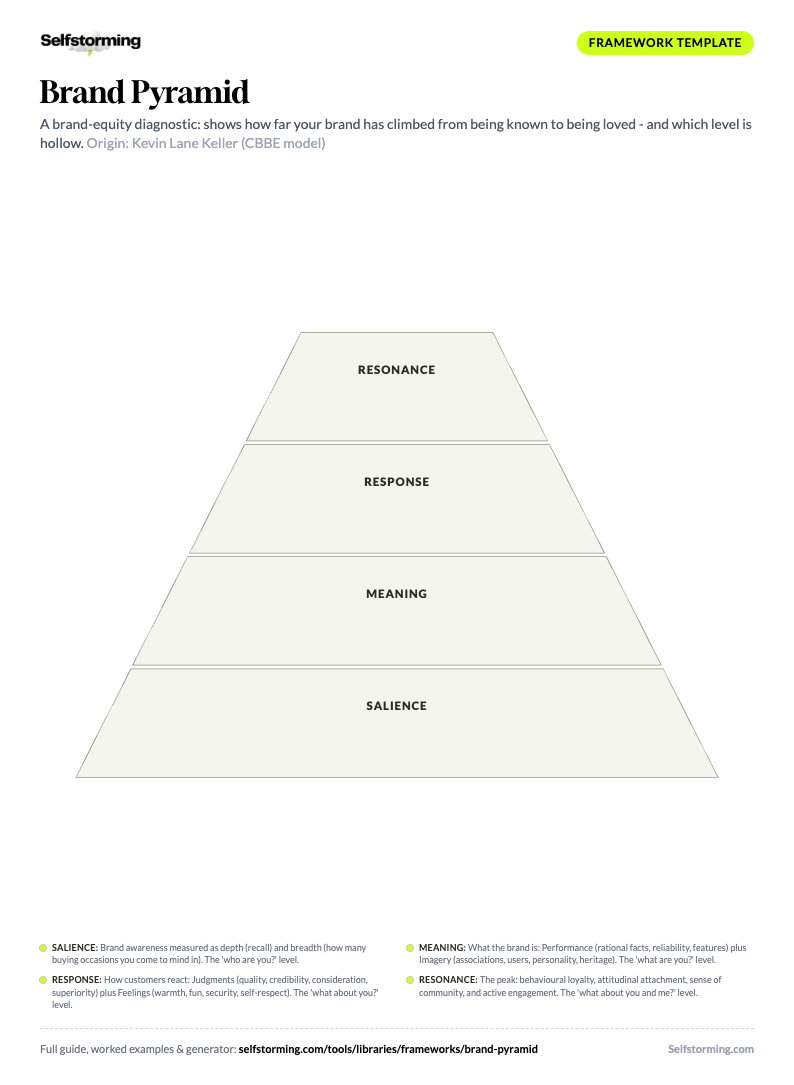
Print it. Fill it in.
The Brand Pyramid as a printable A4 worksheet - write straight into the framework, on paper or in any PDF app.
Download the PDF templateKnowledge Worth Paying For
A working library of brand strategy frameworks - with worked examples on real brands, sources, and decision criteria. Not vibes.
One good deck covers the subscription. The rest is profit.
Four levels, bottom to top: Salience (do people know you, and for what?), Meaning (what are you - performance facts plus imagery associations?), Response (what do people think and feel about you - judgments plus feelings?), and Resonance (the peak - loyalty, attachment, community, active engagement). Six building blocks sit inside those four levels. The rule that makes it work: you can't earn a higher level until the one beneath it is genuinely in place. Use it to diagnose where your brand equity is strong and where it's hollow, not to write copy.
Duolingo
Freemium language-learning app (USA, founded 2011)A textbook climb from Salience to Resonance. Duolingo turned a category nobody finishes (language apps) into a brand with genuine attachment by working every level - including the breadth of salience (the owl now lives in a dozen buying occasions) and the community engagement at the apex (people defend their streaks like family heirlooms).

Monzo
UK challenger bank / fintech (founded 2015)Shows the Pyramid working in a category built on inertia. Banks normally compete on Performance and Judgments alone (rates, fees, trust) and ignore the right pillar entirely. Monzo climbed by loading Imagery and Feelings - the coral card, the community forum - which is exactly how a startup out-resonated institutions a hundred times its size before it had a fraction of their balance sheets.

Volvo
Premium car maker (Sweden, founded 1927)Proof the Pyramid can be built on a single, owned meaning. Most car brands fight over Performance specs nobody remembers; Volvo planted one flag - safety - decades ago and let it climb. Because the Meaning layer is so unmistakable, the brand reaches a quiet Resonance most rivals buy their way toward and never get.

Duolingo, Monzo, Volvo - filled in, line by line. Unlock to read them.
Duolingo (Freemium language-learning app (USA, founded 2011))
A textbook climb from Salience to Resonance. Duolingo turned a category nobody finishes (language apps) into a brand with genuine attachment by working every level - including the breadth of salience (the owl now lives in a dozen buying occasions) and the community engagement at the apex (people defend their streaks like family heirlooms).
Salience: Depth: near-instant recall when anyone thinks 'learn a language.' Breadth: enters the room for boredom, guilt, the commute, kids' screen time, New Year resolutions, and TikTok comedy - far more entry points than any rival.
Meaning: Performance: bite-sized lessons, spaced repetition, a free tier that actually teaches. Imagery: the chaotic, slightly threatening green owl - a brand with the personality of a needy friend who is genuinely good for you.
Response: Judgments: credible enough to be a real first step (if not a substitute for fluency). Feelings: guilt, amusement, and the small daily pride of not breaking the streak.
Resonance: Streak-driven loyalty, not discounts. Memes, fan art, and genuine grief when a streak dies.
Monzo (UK challenger bank / fintech (founded 2015))
Shows the Pyramid working in a category built on inertia. Banks normally compete on Performance and Judgments alone (rates, fees, trust) and ignore the right pillar entirely. Monzo climbed by loading Imagery and Feelings - the coral card, the community forum - which is exactly how a startup out-resonated institutions a hundred times its size before it had a fraction of their balance sheets.
Salience: Depth: the hot-coral card became its own recall trigger ('the bright pink bank'). Breadth: top of mind for splitting bills, travel spending, budgeting, and 'a second account I won't be ashamed of' - many more occasions than a default high-street bank.
Meaning: Performance: instant notifications, fee-free spending abroad, budgeting pots, fast app. Imagery: the coral card as a status signal, a bank that feels built by people who also hate banks.
Response: Judgments: credible enough to trust with real money, helped by a banking licence and transparent comms. Feelings: relief, control, and the mild smugness of pulling out a card everyone recognises.
Resonance: Users evangelised it unpaid, queued for the card, and shaped the roadmap in a public forum.
Volvo (Premium car maker (Sweden, founded 1927))
Proof the Pyramid can be built on a single, owned meaning. Most car brands fight over Performance specs nobody remembers; Volvo planted one flag - safety - decades ago and let it climb. Because the Meaning layer is so unmistakable, the brand reaches a quiet Resonance most rivals buy their way toward and never get.
Salience: Depth: think 'safe car' and Volvo enters the room before anyone else. Breadth: family buying, new-parent buying, fleet and 'I want to grow old in this thing' occasions - fewer occasions than mass brands, but the ones that matter most are owned outright.
Meaning: Performance: the three-point seatbelt it invented and gave away, crash-test leadership, longevity people brag about. Imagery: understated Scandinavian design, the responsible-grown-up car, safety as a value rather than a feature.
Response: Judgments: 'these people genuinely care whether I survive the drive' - credibility earned over generations, not a campaign. Feelings: the calm of knowing your family is in the most protected box on the road.
Resonance: Owners pass cars down, hit 300,000 miles as a point of pride, and treat 'a Volvo saved my life' as a story worth telling strangers.
1. Resonance
What about you and me? Is there a real relationship here - one I'd defend, repeat, and bring other people into?
The peak, and the single building block almost no brand truly reaches. Resonance is the depth of the relationship: behavioural loyalty (genuine repeat, not discount-driven), attitudinal attachment ('I love this, not just buy it'), sense of community (these are my people), and active engagement (I'll invest time, talk about it, defend it, show up for it unpaid). This is the difference between a customer and a fan. Most brands mistake repeat purchase for resonance - but switching costs and habit aren't love. Real resonance is when people would be a little sad if you disappeared.
Good answer: Rapha: a clothing brand with physical clubhouses, group rides, and a membership people pay for to ride together. The product is good; the resonance is that members organise their weekends around it and would mourn the brand if it folded. That's the apex.
Wrong answer: Confusing a loyalty programme with loyalty. If the only reason people come back is points and a 10% code, you've bought repeat behaviour, not built resonance. Pull the discount and watch the 'loyalty' evaporate overnight.
2. Response
What about you? Having understood you, what do people conclude - and how do they feel about it?
How customers react once they understand you, again in two blocks. Judgments are the rational verdicts: quality, credibility, consideration ('would I shortlist them?'), superiority ('are they better than the alternatives?'). Feelings are the emotional responses the brand triggers - warmth, fun, excitement, security, social approval, self-respect. Judgments are the head, Feelings the heart. A brand that wins every spec comparison but stirs nothing gets respected and unbought. The opposite - all warm fuzzies, no credibility - gets liked and not trusted with money.
Good answer: Patagonia: the Judgment is 'these people make gear that genuinely lasts and they mean the environmental stuff.' The Feeling is the quiet self-respect of buying from a brand that told you to repair, not replace. Head and heart pulling the same direction.
Wrong answer: Manufacturing feelings before earning judgments. A brand floods the feed with emotional film while the product reviews say 'cheap and breaks.' Feelings without credible Judgments underneath read as manipulation, and customers can smell it.
3. Meaning
What are you? What do you do, how well do you do it, and what do you make people picture when they think of you?
The 'what are you' level, built from two blocks. Performance is the rational stuff - reliability, features, durability, service, price, how well the product does its job. Imagery is the softer, learned associations - who uses it, in what situations, what kind of person it makes you, the brand's personality and heritage. Performance is the left pillar, Imagery the right. Brands obsessed with spec sheets nail Performance and leave Imagery blank, which is exactly why their category looks like a row of interchangeable boxes.
Good answer: Aesop: Performance is genuinely good formulations and considered ingredients. But the Imagery - apothecary fonts, architect-designed stores, the smell of a friend with better taste than you - is what makes a hand wash cost what it costs. Both pillars, fully loaded.
Wrong answer: A wall of feature bullets and nothing else. Performance maxed, Imagery empty. The brand can tell you its load times and warranty terms but evokes no picture of who it's for or what it feels like to belong to it - so it competes on price forever.
4. Salience
Who are you? When a buying situation comes up, does this brand even enter the room - and for how many situations?
The foundation: brand awareness, but measured properly. Keller splits it into depth (how easily you're recalled and recognised) and breadth (how many buying situations, or category entry points, you come to mind in). The single building block here is Salience. A brand can be famous and still fail this level if it only springs to mind for one narrow occasion. Get this wrong and every level above it is built on sand - you can't be loved by people who never think of you.
Good answer: Duolingo: the owl shows up the moment anyone thinks 'I should learn a language' - and increasingly 'I should keep a streak going.' Deep recall AND broad entry points (commute, guilt, fun, bedtime). That's salience doing both jobs.
Wrong answer: 'Everyone knows us.' Famous for one thing, invisible for everything else. High depth, zero breadth - the brand only enters the room for a single occasion and loses every other buying moment to a competitor who came to mind first.
Decide your starting point: A workshop is not the only way in. You don't have to climb the Pyramid in a blank room - right here on Selfstorming you can find inspiration and directions, or generate a full first-draft Brand Pyramid in minutes. Treat that draft as a head start, then run it through the steps below to refine it and proof/research it against real customer data. Build-from-scratch and AI-draft-then-pressure-test are both valid; most teams move faster starting from a draft.
Diagnose before you build: The Pyramid is a ladder you climb from the bottom, so figure out which rung is hollow first. Pull whatever you have - aided/unaided awareness, brand tracking, review sentiment, NPS, repeat rates - and place each number on the level it belongs to. Most teams discover they're paying for the top while the base leaks.
Nail Salience as two numbers, not one: Write down depth (can people recall you unprompted?) and breadth (how many buying occasions do you come to mind in?). If you only score on depth, you're famous for one thing and invisible for the rest. List the category entry points you want to own, then check which ones you actually do.
Fill Meaning down both pillars: On the left, list the Performance facts that are genuinely distinctive (drop the table-stakes). On the right, write the Imagery - who uses you, in what situations, what personality and heritage you carry. If the right pillar is blank, that's your homework, not a rounding error.
Separate Response into head and heart: Under Judgments, write the rational verdicts customers actually reach (quality, credibility, would-they-shortlist-you, are-you-better). Under Feelings, name the specific emotion you trigger - warmth, fun, security, self-respect, social approval. 'Positive vibes' is not a feeling; name the exact one.
Stress-test Resonance honestly: Ask the brutal question - if you removed every discount, switching cost, and contract lock-in tomorrow, who would still choose you, talk about you, and miss you? That number is your real resonance. Everything above it is rented.
Find the weakest level and spend there: The Pyramid's whole point is that the lowest broken rung caps everything above it. Pouring resonance-building budget into a brand with a salience problem is like watering the top of a plant. Fix the base first, then climb.
Re-measure on the same axes next quarter: Equity moves slowly, so lock the metrics you placed on each level and re-read them on a schedule. The pattern you want is a base that holds steady while the middle and top thicken over time - not a fresh framework every planning cycle.
Best for: Diagnosing where brand equity is strong or hollow, connecting strategy to a brand-tracking dashboard, and arguing for spend at the right level (fix the base before funding the apex). / Generating creative ideas or copy. The Pyramid tells you the problem; it doesn't write the solution. It's a diagnostic, not a brief.
Output: A four-level diagram (six blocks) with each level scored against real metrics - awareness, consideration, sentiment, repeat, advocacy - and the weakest rung flagged. / A one-line essence, a tagline, or a campaign territory. Those are downstream deliverables this framework feeds, not what it produces.
Time to complete: A workshop plus data-gathering (a few days to a couple of weeks), since the value comes from placing real metrics on each level, not from guessing. / A five-minute napkin sketch. If you fill it from gut feel with no data, you've drawn a pyramid, not measured one.
vs Brand Onion: Use the Pyramid when you want a hierarchical ladder tied to measurable equity (do people know us, understand us, judge us worth it, love us?) - it's diagnostic and metric-friendly. / The Brand Onion is non-hierarchical and identity-focused (skin to soul). Better for fast internal alignment and creative briefing; weaker as a measurement tool.
vs Brand Key (Unilever): Use the Pyramid when the question is 'how strong is our equity and where does it leak?' It's built around customer perception and measurement. / The Brand Key has 8 sections including target, insight, RTB, and discriminator. Use it when you need consumer-target rigour and competitive positioning the Pyramid doesn't supply.
vs Golden Circle (Sinek): Use the Pyramid for a full equity ladder grounded in how customers actually perceive and respond, with hooks into real metrics at every level. / The Golden Circle has 3 rings (Why/How/What) optimised for purpose narrative and pitch storytelling. Better for a keynote or founder story than an equity audit.
The Brand Pyramid is the visual form of Kevin Lane Keller's Customer-Based Brand Equity (CBBE) model. Keller, a marketing professor at the Tuck School of Business at Dartmouth and co-author with Philip Kotler of the standard Marketing Management textbook, introduced the model in his 1990s work and crystallised it in the early 2000s - notably his 2001 paper 'Building Customer-Based Brand Equity: A Blueprint for Creating Strong Brands' (Marketing Science Institute) and his textbook Strategic Brand Management. The pyramid arranges four levels (Salience, Meaning, Response, Resonance) and six underlying building blocks (Salience; Performance and Imagery; Judgments and Feelings; Resonance), splitting each middle level into a rational left side and an emotional right side. Unlike the agency-craft Brand Onion, the Pyramid is an academic model with a clear lineage and a single, named author - which is exactly why it's the one taught in MBA programmes and the one consultancies reach for when they need a defensible measurement structure.
The honest critique of the Brand Pyramid is that it's descriptive, not prescriptive. It maps what strong brand equity looks like once you have it, but says remarkably little about how to actually create it - climb the levels in order, sure, but how? Practitioners point out that it's top-down and academic, built for the classroom more than the war room, and that operationalising it is genuinely hard: the right-hand side (Imagery, Feelings) and the apex (Resonance) resist clean measurement, so teams either fudge the numbers or quietly ignore those blocks. Resonance itself is reached by so few brands that critics argue the top of the pyramid is more aspiration than diagnosis for the average business. The fair way to use it: as a structured equity audit that tells you where you're weak, paired with a separate, more prescriptive tool to do something about it - not as proof that drawing the pyramid moved the equity.
Is the Brand Pyramid the same as the Brand Onion?
No, though both are 'one-diagram brand' tools. The Brand Pyramid (Keller's CBBE) is hierarchical and diagnostic - four levels you climb from awareness to loyalty, each tied to measurable equity. The Brand Onion is non-hierarchical and identity-focused - concentric layers from outer attributes to inner essence, built for fast internal alignment and creative briefing. Use the Pyramid to measure how strong your brand is; use the Onion to define what it is.
Who created the Brand Pyramid?
Kevin Lane Keller, a marketing professor at Dartmouth's Tuck School of Business and co-author of the Marketing Management textbook. He introduced the Customer-Based Brand Equity (CBBE) model in the 1990s and formalised the pyramid in his 2001 paper 'Building Customer-Based Brand Equity' and his textbook Strategic Brand Management. Unlike the Brand Onion, which is anonymous agency craft, the Pyramid has a single, named academic author - which is why it's the version taught in business schools.
What are the four levels of the Brand Pyramid?
Bottom to top: Salience ('who are you?' - awareness, depth and breadth), Meaning ('what are you?' - Performance plus Imagery), Response ('what about you?' - Judgments plus Feelings), and Resonance ('what about you and me?' - loyalty, attachment, community, engagement). Six building blocks sit across those four levels, with the middle two split into a rational left side and an emotional right side.
Does the Brand Pyramid work for B2B brands?
Yes, and it often exposes a useful blind spot. B2B brands tend to live entirely on the left side - Performance and Judgments, all spec sheets and credibility - and leave Imagery and Feelings blank, then wonder why every competitor looks the same. The Pyramid forces a B2B team to ask who the brand is for emotionally and what it makes buyers feel, which is exactly where defensible preference comes from in a category that thinks it's purely rational.
How is the Brand Pyramid different from the Brand Key?
The Pyramid (Keller) is a measurement ladder built around how customers perceive and respond to a brand - it answers 'how strong is our equity and where does it leak?' The Brand Key (Unilever) is a positioning template with eight sections including target, insight, reason-to-believe, and discriminator - it answers 'how do we position against competitors for a specific consumer?' Use the Pyramid to diagnose equity, the Brand Key to build a competitive positioning.
Can you actually measure Resonance and Feelings?
Partly, and this is the framework's honest weak spot. The left side (Performance, Judgments) maps neatly onto trackable metrics - awareness, quality ratings, consideration. The right side and the apex are harder: you can proxy Feelings with sentiment and emotion-coded survey items, and Resonance with repeat rate, advocacy, community size, and unpaid engagement - but none of it is as clean as a sales number. Treat those top blocks as directional, not precise, and don't let a team fudge a number just because the box demands one.
A brand-equity diagnostic: shows how far your brand has climbed from being known to being loved - and which level is hollow.
The catch is that the Pyramid is a diagnostic ladder, not a creative brief. It tells you, with uncomfortable honesty, that you can't buy your way to the apex with a clever tagline if nobody knows you exist at the base. Most brands are bottom-heavy and proud of it - lots of awareness, thin loyalty - and the Pyramid is the tool that makes that imbalance impossible to ignore. This page walks through each level, the question that unlocks it, and how to tell the difference between a brand that's climbing and one that's just renting the bottom shelf.
Related Frameworks
Brand Onion
Five concentric layers from outer to inner: Attributes (provable product facts), Benefits (functional + emotional outcomes), Personality (ho
Brand Archetypes
Twelve characters drawn from Jungian psychology, grouped into four families by core human motivation: Independence & Fulfillment (Innocent,
Brand Ladder
The Brand Ladder is a five-rung model that climbs from Features (what it is) to Functional benefits (what it does for you) to Emotional bene
Purpose, Vision & Mission
Three tiers, narrowing to a point: Mission at the base (what we do every day, concretely, and for whom - present tense), Vision in the middl