Brand Key
Unilever's 8-Part Positioning Model, Without the Box-Ticking
The Brand Key is what happens when a company that sells soap, ice cream, and deodorant in 190 countries decides to standardise how it argues about brands. Unilever built it so a marketer in São Paulo and a marketer in Surrey could fill in the same eight boxes and mean roughly the same thing. That's the genius of it and also the trap: a shared template makes alignment easy, and it makes box-ticking even easier.
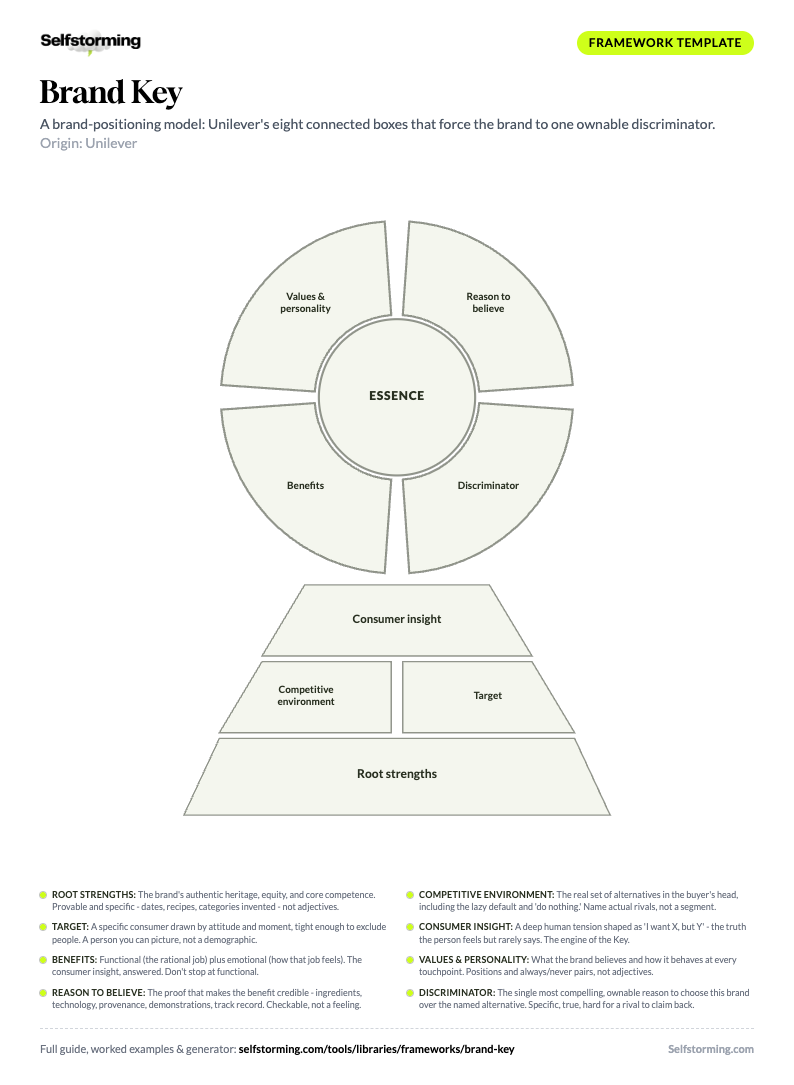
Print it. Fill it in.
The Brand Key as a printable A4 worksheet - write straight into the framework, on paper or in any PDF app.
Download the PDF templateKnowledge Worth Paying For
A working library of brand strategy frameworks - with worked examples on real brands, sources, and decision criteria. Not vibes.
One good deck covers the subscription. The rest is profit.
Eight sections, built outside-in: Root strengths (your heritage and core competence), Competitive environment (the real alternatives), Target (a specific human, not a demographic), Consumer insight (the tension you exploit), Benefits (functional + emotional), Values & personality (what you believe and how you behave), Reason to believe (the proof), and the Discriminator at the centre - the single most compelling reason to choose this brand over the alternative. The discriminator is the whole point; the other seven sections exist to earn it.
Heinz
Heritage FMCG condiment brand (founded USA 1869, global)The textbook Brand Key: deep root strengths and a discriminator carved straight out of a product trait everyone else treats as a flaw. Heinz turned 'our ketchup pours slowly' into the reason to choose it - a wedge a rival genuinely can't claim back without sounding like a copy. The other seven sections all earn that one line.
Over 150 years of tomato ketchup. The recipe people defend like an heirloom, the glass bottle and the '57' on the neck, and a manufacturing fact: it really does pour slowly because it's that thick.
Supermarket own-label ketchup at half the price, regional challenger brands, and the quiet threat of 'any ketchup is fine, they all taste the same.' The fight is as much against indifference as against rivals.
The home cook and parent who won't admit they have a 'ketchup brand' but absolutely refuses to put an unbranded bottle on the table when guests are over.
Lynx (Axe)
Mass-market men's grooming brand (Unilever, global; 'Axe' outside UK/Ireland)An honest example of the Brand Key built around a sharp consumer insight and a specific, almost uncomfortably narrow target. The whole brand for two decades ran on one tension - teenage male romantic anxiety - and a discriminator (the 'Lynx effect') that no rival deodorant could credibly own. It's also a Unilever brand, so it's a Key built on the model's home turf.
A Unilever fragrance and body-spray brand that turned cheap deodorant into a confidence ritual, with deep equity in scent variants and famously bold, funny advertising.
Other deodorants and body sprays, yes - but the real rival is the teenage boy's own crippling self-doubt, and the belief that no spray could possibly help with it.
The 16-year-old boy who is convinced everyone else is more confident than he is and is quietly hoping something - anything - will tip the odds in his favour.

Cadbury
Heritage chocolate brand (UK, founded Birmingham 1824, owned by Mondelez)A Brand Key where the root strengths and the emotional benefit do the heavy lifting. Chocolate is a generous, everyday treat, so Cadbury's wedge isn't 'more cocoa' - it's a 200-year heritage of glass-and-a-half warmth that own-label can buy the recipe of but never the feeling. The discriminator lives in what the bar means, not what's in it.
Founded by John Cadbury in Birmingham in 1824, with deep Quaker roots that built the model village of Bournville for its workers. Owns Dairy Milk (1905), the 'glass and a half' of milk promise, and the unmistakable Cadbury purple.
Supermarket own-label chocolate at a fraction of the price, premium challengers like Lindt and Green & Black's, and the easy alternative of any other sweet snack at the till. The fight is for the moment of generous, casual treating.
The everyday gift-giver and self-treater - the person who reaches for chocolate not as a luxury indulgence but as a small, warm act of kindness, to someone else or to themselves.

Heinz, Lynx (Axe), Cadbury - filled in, line by line. Unlock to read them.
Heinz (Heritage FMCG condiment brand (founded USA 1869, global))
The textbook Brand Key: deep root strengths and a discriminator carved straight out of a product trait everyone else treats as a flaw. Heinz turned 'our ketchup pours slowly' into the reason to choose it - a wedge a rival genuinely can't claim back without sounding like a copy. The other seven sections all earn that one line.
Root strengths: Over 150 years of tomato ketchup. The recipe people defend like an heirloom, the glass bottle and the '57' on the neck, and a manufacturing fact: it really does pour slowly because it's that thick.
Competitive environment: Supermarket own-label ketchup at half the price, regional challenger brands, and the quiet threat of 'any ketchup is fine, they all taste the same.' The fight is as much against indifference as against rivals.
Target: The home cook and parent who won't admit they have a 'ketchup brand' but absolutely refuses to put an unbranded bottle on the table when guests are over.
Consumer insight: I tell myself all ketchup is the same, but when it's my chips on my plate, only one brand actually tastes like ketchup is supposed to.
Benefits: Functional: a thicker, richer, unmistakably 'Heinz' taste that own-label can't match. Emotional: the small reassurance of serving the real thing, the taste of your own childhood handed down.
Values & personality: Lets the ketchup take its time rather than thin the recipe. Turns the bottle upside down before touching the sauce. Believes some things shouldn't be reinvented, just made properly.
Reason to believe: The grown, vine-ripened tomatoes per bottle, the protected recipe, and the literal viscosity - it's slow because it's thick, and you can watch it.
Discriminator: The ketchup so thick and slow it's worth the wait - the one that actually tastes like ketchup should.
Lynx (Axe) (Mass-market men's grooming brand (Unilever, global; 'Axe' outside UK/Ireland))
An honest example of the Brand Key built around a sharp consumer insight and a specific, almost uncomfortably narrow target. The whole brand for two decades ran on one tension - teenage male romantic anxiety - and a discriminator (the 'Lynx effect') that no rival deodorant could credibly own. It's also a Unilever brand, so it's a Key built on the model's home turf.
Root strengths: A Unilever fragrance and body-spray brand that turned cheap deodorant into a confidence ritual, with deep equity in scent variants and famously bold, funny advertising.
Competitive environment: Other deodorants and body sprays, yes - but the real rival is the teenage boy's own crippling self-doubt, and the belief that no spray could possibly help with it.
Target: The 16-year-old boy who is convinced everyone else is more confident than he is and is quietly hoping something - anything - will tip the odds in his favour.
Consumer insight: I desperately want to be noticed by the people I fancy, but I'm terrified of doing anything that risks making it worse.
Benefits: Functional: smells good and lasts the school day. Emotional: a hit of borrowed confidence - the feeling that you've evened the odds before you even walk in.
Values & personality: Puts the joke on the can. Casts the ordinary boy, not the model. Believes confidence can be funny and a teenage hope deserves a wink, not a lecture.
Reason to believe: A broad range of distinctive, long-lasting fragrances and a track record of advertising that made the brand a cultural shorthand for 'the spray that gets you noticed.'
Discriminator: The body spray with its own legend - the 'Lynx effect' that turns a nervous teenager into someone worth a second look.
Cadbury (Heritage chocolate brand (UK, founded Birmingham 1824, owned by Mondelez))
A Brand Key where the root strengths and the emotional benefit do the heavy lifting. Chocolate is a generous, everyday treat, so Cadbury's wedge isn't 'more cocoa' - it's a 200-year heritage of glass-and-a-half warmth that own-label can buy the recipe of but never the feeling. The discriminator lives in what the bar means, not what's in it.
Root strengths: Founded by John Cadbury in Birmingham in 1824, with deep Quaker roots that built the model village of Bournville for its workers. Owns Dairy Milk (1905), the 'glass and a half' of milk promise, and the unmistakable Cadbury purple.
Competitive environment: Supermarket own-label chocolate at a fraction of the price, premium challengers like Lindt and Green & Black's, and the easy alternative of any other sweet snack at the till. The fight is for the moment of generous, casual treating.
Target: The everyday gift-giver and self-treater - the person who reaches for chocolate not as a luxury indulgence but as a small, warm act of kindness, to someone else or to themselves.
Consumer insight: I want to give a little moment of joy - to my kid, my colleague, myself - but grand gestures feel like too much and an empty hand feels like too little.
Benefits: Functional: smooth, creamy, reliably comforting milk chocolate. Emotional: the warm glow of a generous little gesture - chocolate as the easiest way to say 'thinking of you' without making a fuss.
Values & personality: Films a kid buying his mum a bar with buttons and a ring. Sells the sharing, not the taste. Believes the best kindness is small, frequent and unfussy.
Reason to believe: Two centuries of British chocolate-making, the 'glass and a half' of fresh milk in every half pound of Dairy Milk, and the Bournville heritage of a company that built a town for its people.
Discriminator: The chocolate that means generosity - the everyday bar people reach for to share a little joy, soaked in two hundred years of warmth own-label can't reproduce.
1. Root strengths
What is this brand genuinely good at and known for - the heritage and competence nobody can take away?
The foundation. The brand's authentic history, equity, and core competence - the stuff that's earned, not claimed. Roots keep the rest of the Key honest: a discriminator that contradicts your roots is a promise you can't keep. Start here because everything above it has to be consistent with what the brand actually is.
Good answer: Heinz: 150 years of tomato ketchup, a recipe people defend like a religion, and 'the slowest ketchup' as a literal manufacturing fact. The roots are a moat, not a memory.
Wrong answer: 'Trusted heritage of quality and innovation.' A sentence with no specific fact in it. Roots have to be provable and particular - a date, a recipe, a category you actually invented - not adjectives a logo wears.
2. Competitive environment
Who and what are we really up against - the alternatives a buyer weighs at the moment of choice?
The market frame. Not a tidy category report - the actual set of choices in the buyer's head, including the lazy default and the 'do nothing' option. Naming the competition properly is what most one-page tools skip and what makes the Brand Key sharp: you can't have a discriminator if you haven't said discriminating from what.
Good answer: For a challenger energy drink: the real competition isn't only other energy drinks - it's coffee, the office kitchen, and the belief that you don't need a drink at all. Framing the fight that wide changes the whole Key.
Wrong answer: 'We compete in the premium beverage segment.' A segment is not a competitor. If you can't name the specific brand a customer would buy instead of you, you haven't done this section - you've drawn a market map and called it strategy.
3. Target
Who exactly is this for - and, more usefully, who is it pointedly not for?
A specific consumer, drawn tightly enough to exclude people. The Brand Key wants attitude and behaviour, not just age and income - the person's mindset at the moment they'd reach for you. A target you can picture in a room beats a demographic you can only put in a pie chart.
Good answer: 'The 17-year-old boy who is terrified of talking to girls and believes the right product might fix that.' Anxious, hopeful, specific. You can write a whole campaign to that boy and never get lost.
Wrong answer: 'Adults 18-45, ABC1, urban.' That's a media-buying spec, not a target. It describes a third of the country and inspires nothing. If the target doesn't exclude anyone, it isn't a target - it's a census.
4. Consumer insight
What deep, slightly uncomfortable truth about this person's life can the brand legitimately speak to?
The engine of the whole Key. A genuine insight names a tension the person feels but rarely says out loud - usually shaped like 'I want X, but Y.' It's the bridge between who they are and why they'd care. Get the insight right and the benefits and discriminator almost write themselves. Get it wrong and the rest is decoration.
Good answer: 'I want my house to look clean, but I judge other people by whether their whites are actually white.' A real, slightly petty human truth a detergent brand can own without flinching.
Wrong answer: 'Consumers are increasingly time-poor and seek convenience.' A trend report, not an insight. No tension, no person, no 'but.' If a competitor could lift the exact sentence into their deck, it isn't an insight - it's wallpaper.
5. Benefits
What does this brand actually do for the person - rationally, and then how does that feel?
Two layers, both required: functional (the rational job) and emotional (how that job makes them feel). Benefits are the consumer insight, answered. Most brands list the functional benefit, stop, and then wonder why the advertising is forgettable. The emotional benefit is where the choice actually gets made.
Good answer: Functional: removes stains in one wash. Emotional: the quiet, slightly smug pride of being the parent whose kid's kit is spotless. The second line is the one that sells.
Wrong answer: 'High quality and great value.' Two non-benefits doing the work of zero. No human is in the sentence and the emotional layer is missing entirely. Could be transplanted onto any product on the shelf without changing a word.
6. Values & personality
What does this brand believe, and if it were a person, what would you watch it do at every touchpoint?
The brand's character and convictions. Values are the beliefs it acts on even when it's costly; personality is how it shows up at every touchpoint. Best framed as positions and behaviours, not adjectives - what it stands for, and the things it visibly does that make creative legible. This is the section that keeps tone consistent when fifty people are writing copy.
Good answer: Puts the joke before the health claim. Writes the label like a note from a friend. Believes healthy can be funny and juice never needs a lecture. You can brief a junior writer off that and trust the result.
Wrong answer: 'Innovative, customer-centric, premium.' Three adjectives that survive any rewrite and tell a writer nothing. Personality should name something the brand does; 'premium' isn't a behaviour, it's a price.
7. Reason to believe
Why should anyone actually believe the benefit - what's the proof, not the promise?
The evidence that makes the benefit credible. Ingredients, technology, provenance, demonstrations, third-party proof, a track record. The RTB is what stops the benefit being a boast. If the benefit is the claim and the discriminator is the wedge, the RTB is the thing that lets a sceptical person say 'all right, fine, I buy it.'
Good answer: '52 tomatoes in every bottle' or a specific patented enzyme, or a demonstration you can watch. Concrete, checkable, and hard for a me-too brand to mimic without sounding like a copy.
Wrong answer: 'Because we're committed to excellence.' A feeling is not a reason to believe. If the proof can't be demonstrated, measured, or traced to something real, it's a mission statement wearing an evidence costume.
8. Discriminator
If a buyer could remember only one reason to choose this brand over the obvious alternative, what is it?
The heart of the Key - the single most compelling, ownable reason to pick this brand over the named competitor. Not a summary of the other seven sections; a wedge. The whole Key is built to earn this one line. A good discriminator is specific, true, and something a rival genuinely struggles to claim back. If yours could be pasted onto a competitor's Key unchanged, you don't have one yet.
Good answer: 'The ketchup so thick and slow it's worth the wait.' It's true, it's ownable (a rival can't credibly claim 'slow' now), and it turns a product flaw into the reason to buy.
Wrong answer: 'We care more about our customers.' Every brand believes this and none can prove it. A discriminator that any competitor could claim word-for-word is not a discriminator - it's the absence of one with confident punctuation.
Decide your starting point: You don't have to fill all eight boxes in a blank room. Right here on Selfstorming you can find inspiration and a head start, or generate a first-draft Brand Key in minutes. Treat the draft as scaffolding, then run it through the steps below to pressure-test it against the real market. Workshop-from-scratch and AI-draft-then-refine are both valid; most teams move faster from a draft.
Build outside-in, not heart-first: Resist the urge to write the discriminator before the rest. Start with root strengths and the competitive environment, then target, then insight. The discriminator is a conclusion, not a slogan - if you write it first, you'll spend the rest of the Key justifying a line you got attached to.
Make the competition real: List the actual alternatives in the buyer's head, including the lazy default and 'do nothing.' If you only name brands in your own category, you've probably drawn the fight too narrow. The discriminator only means something relative to a specific opponent.
Tighten the target until it excludes people: Write the target as a person with an attitude and a moment, not a demographic. If reading it doesn't make you slightly nervous about who you're leaving out, it's still too broad. Exclusion is the point.
Find the tension in the insight: A real insight has a 'but' in it - 'I want X, but Y.' If your insight is a statistic or a trend with no human and no contradiction, keep digging. The whole Key swings on this hinge.
Answer the insight with two benefits: For the functional benefit, ask 'what does it do?' For the emotional one, ask 'so how does that feel?' Stop at functional and your advertising will be forgettable. The emotional benefit is where the choice gets made.
Pin the reason to believe to something checkable: For the benefit you've claimed, ask 'why would a sceptic believe that?' If the answer is a feeling or a value, you don't have an RTB yet - you have a hope. Ingredients, demonstrations, provenance, track record: pick something a rival can't fake.
Stress-test the discriminator against the competitor: Write your discriminator, then paste it into your named competitor's imaginary Key. If it fits them just as well, it's generic - rewrite until it only fits you. A discriminator a rival can't claim back is the only kind worth having.
Distribute the one-pager, not the workshop: A finished Brand Key fits on a single page. Print it, put it in the brief, hand it to the agency. The deck of debate that produced it can stay in the drive where it belongs.
Best for: Full strategic positioning with consumer-target and competitive rigour - rebrands, brand relaunches, FMCG and DTC choice battles where you need to win against a specific alternative. / Quick campaign briefs, very early startups with one product, or internal vibe-alignment. Eight sections is too much machinery for those jobs.
Output: A one-page artifact with eight filled sections, built outside-in, culminating in a single ownable discriminator that names the reason to choose you. / A 30-slide positioning deck or a vague brand 'territory' moodboard. The Key is one decisive page, not a research dump.
Time to complete: A focused workshop or two (a day or so) plus a week of pressure-testing the insight and discriminator against real market evidence. / A 15-minute fill-in before a meeting. Rushed, the eight boxes turn into generic paragraphs and the discriminator collapses to 'we care more.'
vs Brand Onion: Use the Key when you need consumer-target and competitive rigour - it forces you to name a rival, a specific person, and a discriminator the Onion never asks for. / The Onion is faster, more visual, and better for internal identity alignment (skin to soul) when you don't need competitive or target depth.
vs Positioning Statement: Use the Key when you want the full eight-section workings - roots, insight, RTB, discriminator - and a structured argument, not just the conclusion. / A Positioning Statement is the tighter, market-facing distillation ('for X, brand is the Y that Z, because W'). Often the Key feeds straight into it.
vs Brand Pyramid (Keller's CBBE): Use the Key when the strategic question is 'why us over them?' - it's competitive and choice-focused, ending at a discriminator. / The Pyramid is hierarchical and equity-focused, climbing from salience to resonance. Better for measuring and building brand strength over time, not winning a single shelf choice.
The Brand Key (sometimes 'Brand Keys') is Unilever's proprietary positioning model, developed in the 1990s as an evolution of the earlier Unilever Brand Positioning Statement. Faced with thousands of brands across dozens of categories and markets, Unilever needed one shared template so a marketer anywhere could position a brand the same way - and so brand reviews didn't dissolve into arguments about what 'positioning' even meant. The Key formalised eight sections, placing the discriminator at the centre to force the question that matters most: why choose us over the alternative? It sits alongside the Brand Onion, Brand Pyramid, Brand Wheel, and Brand Ladder in the family of one-page brand tools that dominated agency and client-side planning through the 1990s and 2000s. The Key is the most explicitly competitive of them - the only one that hard-codes a target, a competitive frame, and a single discriminating reason to buy.
The fair criticism of the Brand Key is that eight sections is heavy and slow - and the standardised template that makes it scalable is exactly what invites box-ticking. Teams fill in all eight boxes to satisfy a process, not to make a decision, and end up with tidy paragraphs that change nothing. The most common failure is the discriminator itself: the one section the whole model is built around is the one most often fudged into a generic 'we care more' or 'superior quality' that any rival could claim word for word. Like every one-page tool, it can create an illusion of strategic control while drifting from how people actually choose. The honest way to use it is to treat the discriminator as the only section that has to survive contact with a competitor - and to pressure-test it ruthlessly against real behaviour, not committee comfort.
Who created the Brand Key, and is it really Unilever's?
Yes. The Brand Key is Unilever's proprietary positioning model, developed in the 1990s as an evolution of the earlier Unilever Brand Positioning Statement. Unlike the Brand Onion - an anonymous agency-craft tool with no single inventor - the Key has a clear corporate parent. Unilever built it to standardise how thousands of brands were positioned across markets, which is why it's more structured and more competitive than its cousins.
What's the difference between the Brand Key and the Brand Onion?
The Brand Onion is identity-first and internal: five concentric layers from attributes to essence, built for fast alignment on 'who we are.' The Brand Key is positioning-first and competitive: eight sections that force you to name a competitor, a specific target, and a discriminator the Onion never asks for. Use the Onion for quick internal identity alignment; use the Key when the question is 'why us over a specific rival?'
What exactly is the discriminator in the Brand Key?
The discriminator is the heart of the model - the single most compelling, ownable reason to choose this brand over the named alternative. It's not a summary of the other seven sections; it's a wedge. A good discriminator is specific, true, and something a competitor genuinely struggles to claim back. Heinz's 'so thick and slow it's worth the wait' is a discriminator. 'We care more' is the absence of one with confident punctuation.
Why does the Brand Key have eight sections when the Onion has five?
Because the Key is doing more work. It adds the three things the Onion skips: a competitive environment (who you're really up against), a specific target (a person, not a demographic), and a reason to believe (checkable proof). Those extra sections are why the Key is heavier and slower - and why it's the better choice when you need competitive and consumer-target rigour rather than just identity vocabulary.
How do I write a consumer insight that isn't just a trend report?
Force a tension into it - the 'I want X, but Y' shape. A real insight names something the person feels but rarely says out loud, with a contradiction inside it. 'Consumers want convenience' is a trend with no human and no 'but.' 'I want my house to look clean, but I judge people by whether their whites are actually white' is an insight a brand can own. If there's no 'but,' keep digging.
Does the Brand Key work for B2B and SaaS, or is it only for FMCG?
It was built for FMCG choice architecture, so it shines on the shelf - but the logic travels. B2B and SaaS brands benefit from the same discipline: name the real competitor (often the incumbent or 'do nothing'), pin down a specific buyer, and find a discriminator a rival can't copy. It can feel forced where the purchase isn't a quick comparative choice, so judge by the decision, not the category.
Should I build the Brand Key starting from the discriminator?
No - build it outside-in, from root strengths and competitive environment through to the insight, and let the discriminator be the conclusion. Writing the discriminator first means falling in love with a slogan and reverse-engineering seven sections to justify it. The discriminator should be the thing the rest of the Key forces you to say, not the premise you started from.
A brand-positioning model: Unilever's eight connected boxes that force the brand to one ownable discriminator.
Done well, the Brand Key is the most rigorous of the one-page brand tools - it's the only popular one that forces you to name your competition, your specific target, and the single discriminator that makes someone pick you over the obvious alternative. Done badly, it's eight tidy paragraphs that a committee approved on a Thursday, with a discriminator like 'we care more' that every brand on the shelf also believes.
This page walks the eight sections in build order - from root strengths up to the discriminator at the heart - with the question that unlocks each one and the difference between a Key that actually picks a fight and one that just fills the page.
Related Frameworks
Brand Onion
Five concentric layers from outer to inner: Attributes (provable product facts), Benefits (functional + emotional outcomes), Personality (ho
Brand Archetypes
Twelve characters drawn from Jungian psychology, grouped into four families by core human motivation: Independence & Fulfillment (Innocent,
Positioning Statement
One sentence built from five slots: Target (the specific person it's for), Need (the job or frustration they have), Frame of reference (the
Brand Identity Prism
Six facets on a prism, two per axis. Physique (tangible features and look) and Personality (character, as if a person) form the picture-of-s