Insight & Tension Statement
How To Find The Human Truth Worth Building An Idea On
An Insight & Tension Statement is three stacked layers that turn a flat observation into a creative spark. Observation (what you actually notice people doing), Tension (the contradiction or conflict they secretly feel about it), and Insight (the human truth that explains the tension and hands you an idea). Stacked, it often reads: I want X, but Y, which is why Z.
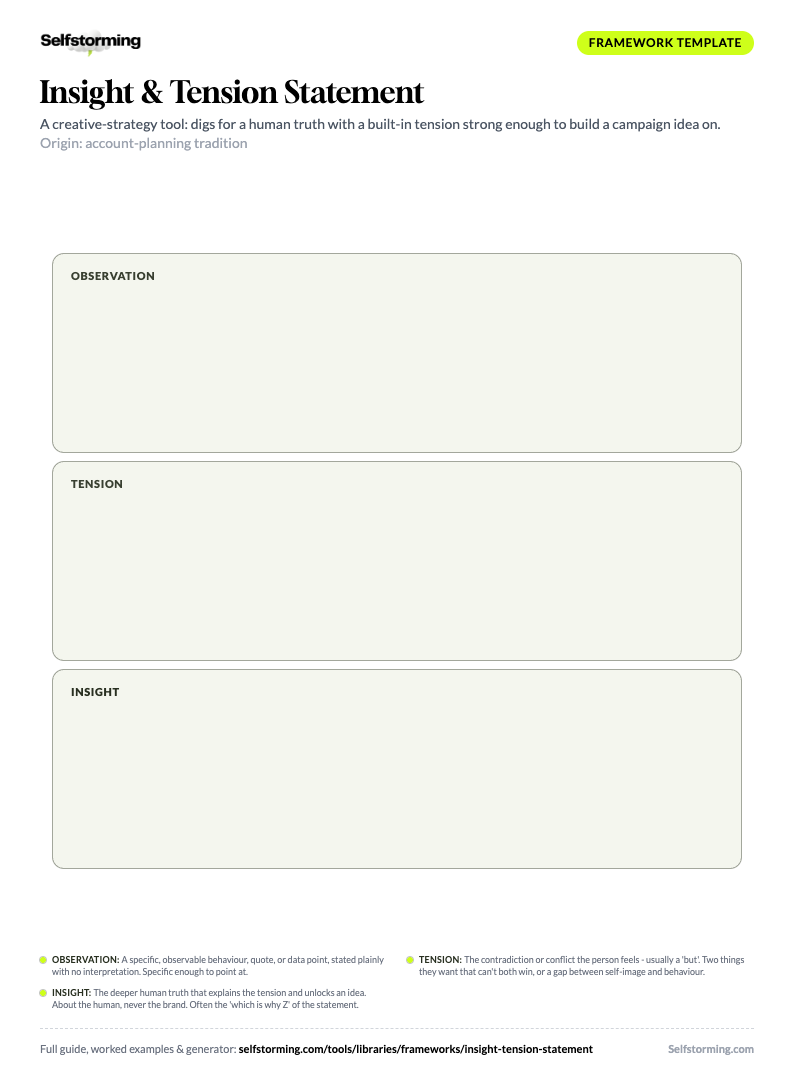
Print it. Fill it in.
The Insight & Tension Statement as a printable A4 worksheet - write straight into the framework, on paper or in any PDF app.
Download the PDF templateKnowledge Worth Paying For
A working library of brand strategy frameworks - with worked examples on real brands, sources, and decision criteria. Not vibes.
One good deck covers the subscription. The rest is profit.
Three stacked layers, bottom to top: Observation (the behaviour or data you can actually see), Tension (the contradiction the person feels - what they want versus what gets in the way), and Insight (the deeper human truth that explains the tension and unlocks an idea). The classic shape is 'I want X, but Y, which is why Z'. A real insight feels obvious only after you've heard it, and could not be lifted into a rival's brief without falling apart.
Patagonia
Outdoor apparel, sustainability-led (USA)A famous example of building a campaign on a genuine tension rather than a product claim. Patagonia noticed that environmentally-minded customers were still buying more gear than they needed, and named the contradiction out loud with 'Don't Buy This Jacket'. The insight - that people who care about the planet feel guilty about consumption yet keep consuming - turned an anti-sales ad into one of the most trust-building campaigns in retail.
Liquid Death
Canned water, irreverent DTC challenger (USA)A sharp insight about identity, not hydration. Liquid Death spotted that people at bars and gigs felt socially awkward holding a plain water bottle while everyone else had a beer. The tension between wanting to stay sober and not wanting to look like the boring one became the whole brand: water that looks like a tallboy of something dangerous, so you can drink nothing and still look like trouble.
Babbel
Language-learning app, subscription (Germany)An insight that separates a serious learner from a casual dabbler. Babbel observed that most people who download a language app quit within weeks, having collected streaks and badges but unable to hold a real conversation. The tension between wanting fluency and only chasing the dopamine of gamified progress led to a positioning built on actual conversational ability rather than addictive points.
Patagonia, Liquid Death, Babbel - filled in, line by line. Unlock to read them.
Patagonia (Outdoor apparel, sustainability-led (USA))
A famous example of building a campaign on a genuine tension rather than a product claim. Patagonia noticed that environmentally-minded customers were still buying more gear than they needed, and named the contradiction out loud with 'Don't Buy This Jacket'. The insight - that people who care about the planet feel guilty about consumption yet keep consuming - turned an anti-sales ad into one of the most trust-building campaigns in retail.
Observation: Outdoor enthusiasts who say they care deeply about the environment still buy new jackets every season and throw the old ones away.
Tension: They want to live by their environmental values, but the easiest way to feel like an outdoors person is to buy more outdoors gear - so their shopping quietly contradicts their beliefs.
Insight: For values-driven consumers, buying less is the real act of integrity, and a brand that gives them permission to consume less earns more trust than one that begs them to consume more.
Liquid Death (Canned water, irreverent DTC challenger (USA))
A sharp insight about identity, not hydration. Liquid Death spotted that people at bars and gigs felt socially awkward holding a plain water bottle while everyone else had a beer. The tension between wanting to stay sober and not wanting to look like the boring one became the whole brand: water that looks like a tallboy of something dangerous, so you can drink nothing and still look like trouble.
Observation: At parties, concerts and bars, people who aren't drinking still grab a beer can to hold, or feel self-conscious clutching a clear plastic water bottle.
Tension: They want to drink water and stay sharp, but they don't want to broadcast 'I'm the responsible one' and feel like the odd one out in the room.
Insight: Choosing not to drink is a social-identity problem before it's a hydration one - give people a way to opt out of alcohol that looks rebellious rather than boring, and you remove the real reason they reach for a drink.
Babbel (Language-learning app, subscription (Germany))
An insight that separates a serious learner from a casual dabbler. Babbel observed that most people who download a language app quit within weeks, having collected streaks and badges but unable to hold a real conversation. The tension between wanting fluency and only chasing the dopamine of gamified progress led to a positioning built on actual conversational ability rather than addictive points.
Observation: People download a language app full of ambition, rack up streaks and points for a few weeks, then quit - still unable to order a coffee in the language they were 'learning'.
Tension: They want to genuinely speak a new language, but the apps reward the feeling of progress over actual progress, so they get hooked on streaks while the real skill never arrives.
Insight: What people actually crave isn't points, it's the moment they're understood by a real human in another language - sell the conversation, not the streak, and you align the product with the reason they started.
1. Observation
What do people actually do, say, or show in the data - before you interpret any of it?
The ground floor. A specific, observable behaviour, quote, or data point, stated plainly with zero spin. This is what you can point at: the thing in the recording, the line in the interview, the number in the dashboard. The discipline here is to resist interpreting too early - capture the raw fact first, because a clean observation is what keeps the whole stack honest. Specific beats general every time.
Good answer: People buy gym memberships in January and stop going by mid-February, but they keep paying for months rather than cancelling. Concrete, observable, slightly odd - and it leaves you wanting to know why.
Wrong answer: Consumers value health and wellness. That's not an observation, it's a category platitude you could have written without leaving the office. If it isn't specific enough to point at, it can't carry an insight.
2. Tension
What does this person want that something else is getting in the way of - what's the contradiction they're living?
The middle floor, and the part everyone skips. A tension is a genuine conflict: two things the person wants that can't both win, or a gap between who they want to be and how they actually behave. It usually has a 'but' in it. This is where the energy comes from - no tension, no story, no idea. If you can't feel the squirm in it, you haven't found the tension yet, only restated the observation.
Good answer: They want to believe they're the kind of person who'll get fit, but cancelling the membership would mean admitting they're not - so they keep paying for a version of themselves they aren't. The 'but' is doing real work; you can feel the discomfort.
Wrong answer: People want to be healthy but they are busy. 'Busy' is the laziest tension in advertising - it's an excuse, not a contradiction. A real tension reveals something the person would be slightly embarrassed to admit, not a logistics problem.
3. Insight
What deeper human truth explains the tension - and does naming it unlock an idea?
The top floor. The insight is the truth that makes the tension make sense - the 'oh, of course' that reframes the whole thing and points straight at an idea. A real insight is portable to a human, not a category: it would feel true even to someone who's never heard of your product. The test isn't whether it sounds clever, it's whether it does two things at once: explains why the tension exists, and suggests what to do about it.
Good answer: For a lot of people the gym membership isn't a purchase, it's a penance - paying for the guilt is easier than facing the change, so the unused membership is a monthly receipt for good intentions. Explains the behaviour AND hands you a campaign idea.
Wrong answer: People should exercise more and our app makes it easy. That's a product claim wearing an insight's clothes. An insight is about the human, not the brand - the second your 'truth' mentions your solution, it has stopped being an insight.
Decide your starting point. You don't have to stare at a blank brief waiting for genius to strike - right here on Selfstorming you can find directions and raw material, or generate a first-draft Insight & Tension Statement in minutes. Treat that draft as a provocation, then dig past it using the steps below. A draft you interrogate beats a blank page you avoid.
Gather raw observations before you interpret anything. Pull real quotes, behaviours, and odd data points - the more specific and slightly weird, the better. Insights hide in the contradictions of real behaviour, not in survey averages, so collect the unvarnished material first.
Write the cleanest observation you can, with zero spin. State exactly what people do or say, specifically enough to point at. If it sounds like something true of the whole category, it's not specific enough yet - go narrower.
Hunt for the tension, and demand a 'but'. Ask what the person wants that something gets in the way of, or where their actions betray their self-image. If there's no contradiction, keep digging - a fact without friction will never become an idea.
Name the human truth that resolves the tension. Write the 'oh, of course' sentence that explains why the tension exists. Phrase the whole stack as 'I want X, but Y, which is why Z' to pressure-test that the three layers actually connect.
Run the competitor test. Could this insight appear, unchanged, in a rival's brief? If yes, you've written a category observation - push for the version only true of this specific human in this specific moment.
Check it unlocks an idea, not just nods. A real insight makes a creative person lean forward and start sketching. If the room agrees politely and nothing happens next, you have a true statement that isn't useful - which is its own kind of failure.
Pressure-test against being retro-fitted. Honestly ask whether you found this insight or reverse-engineered it to justify an idea you already loved. If you can't imagine it leading to a different idea, you may be describing your conclusion, not a truth.
Best for: Cracking open a creative brief - finding the single human tension and truth that gives an idea its energy and gives the team a shared target to aim at. / Defining brand architecture, sizing a market, or mapping an experience. The statement is a creative spark, not a strategy document or a research report.
Output: A tight three-layer statement - observation, tension, insight - that reads as 'I want X, but Y, which is why Z' and passes the competitor test by being true only of this specific human. / A research deck of stats relabelled as 'insights', or a poetic truth with no idea attached. A fact in a nice font and a beautiful dead-end are both failures.
Time to complete: A focused session once the raw material exists - an hour to draft, then real digging to push an observation into a tension and a tension into a truth. The thinking is the work, not the writing. / A multi-week research programme. The statement synthesises evidence you already have; if you have none, gather it first - this isn't the tool for primary research.
vs Jobs To Be Done: The Insight & Tension Statement digs into emotional and social contradiction - the 'why it feels conflicted'. Better for sparking creative work that resonates emotionally. / Jobs To Be Done focuses on the functional progress a customer is hiring you to make - the 'what are they trying to get done'. Better for product decisions and prioritising features than for a campaign hook.
vs Empathy Map: The Insight & Tension Statement distils everything into one sharp, idea-ready truth with a built-in contradiction. Better when you need a single creative springboard. / The empathy map spreads a user across says/thinks/does/feels quadrants to build broad understanding. Better as an upstream input that feeds the tension, not as the brief's final spark.
vs Get Who To By: The Insight & Tension Statement is about the human truth itself, independent of any specific objective. Better for finding the resonant emotional core. / Get Who To By is a goal-oriented brief structure (get whom, to do what, by means of what). Better when you already have the insight and need to turn it into a directive, action-focused brief.
The Insight & Tension Statement has no single inventor - it's a distillation of the account-planning tradition rather than one person's model. That discipline was founded in the UK in 1968 by Stanley Pollitt at Boase Massimi Pollitt (BMP) and Stephen King at J. Walter Thompson (JWT), with the term 'account planning' coined by JWT's Tony Stead. Both men argued, from slightly different angles, that the consumer's voice belonged at the centre of how advertising gets made: King brought analytical rigour through the T-Plan, while Pollitt insisted a trained researcher sit beside the account manager as an equal partner. Out of that lineage came the modern obsession with the 'consumer insight' - a fresh human truth, usually built on a tension - as the thing a creative brief lives or dies by. The 'I want X, but Y, which is why Z' shape and the tension-first brief are craft conventions that planners refined over decades; you'll find versions of it in agency planning handbooks and brief templates everywhere, attributed to the discipline rather than to one author.
The honest criticism comes from inside the discipline: 'insight' is widely called the most abused word in advertising. Practitioners note that most things labelled insights in award entries and briefs are just observations or research stats dressed up to sound profound - the grand, tension-unlocking revelation we're told an insight should be is rare, and a lot of great work demonstrably ran on none at all. The statement is also largely unfalsifiable (a confident human-truth sentence is hard to disprove) and easy to retro-fit, so a team can reverse-engineer a respectable insight to justify an idea they already wanted. The fair response is to treat the format as a discipline, not a guarantee: insist on a real tension, strip the brand out of the truth, run the competitor test, and judge the statement by whether it unlocks an idea - not by how deep it sounds.
What is an Insight & Tension Statement?
An Insight & Tension Statement is a three-layer tool for cracking a creative brief. You stack an Observation (what people actually do, stated plainly), a Tension (the contradiction they feel about it - what they want versus what gets in the way), and an Insight (the deeper human truth that explains the tension and unlocks an idea). It usually reads as 'I want X, but Y, which is why Z'. The point is to get past flat description to a truth specific enough to spark distinctive creative work.
Who created the Insight & Tension Statement?
There's no single inventor - it's a distillation of the account-planning tradition. That discipline was founded in the UK in 1968 by Stanley Pollitt at BMP and Stephen King at JWT, with the term coined by JWT's Tony Stead. Both put the consumer's voice at the heart of how advertising is made, and the modern fixation on a tension-based 'consumer insight' grew out of that lineage. The 'I want X, but Y, which is why Z' shape is a craft convention refined by planners over decades, attributed to the discipline rather than one author.
What's the difference between an observation and an insight?
An observation is what people do - a fact or behaviour you can point at. An insight is the human truth underneath that explains why, and it only earns the name if there's a tension in the middle. 'People keep paying for an unused gym membership' is an observation. 'The unused membership is a monthly receipt for good intentions' is an insight. If your statement has no contradiction and no new understanding, you've written an observation and called it an insight, which is the single most common mistake in briefs.
Why is the tension layer so important in the Insight & Tension Statement?
Because the tension is the engine. An observation with no contradiction is inert - true, but it goes nowhere. The tension names a real conflict the person feels (what they want versus what gets in the way, or who they want to be versus how they behave), and that friction is what a creative idea pushes against. No tension, no story, no idea. If your statement reads smoothly with no 'but' in it, you haven't found the tension yet - you've just restated the observation in a longer sentence.
How do I know if my insight is real or fake?
Run three tests. First, the tension test: is there a genuine contradiction, or just a stat? Second, the competitor test: could this exact sentence sit in a rival's brief unchanged? If yes, it's a category observation, not an insight about your human. Third, the idea test: does a creative person lean forward and start sketching, or just nod politely? A real insight feels obvious only after you hear it, is true of the human without mentioning your brand, and unlocks an idea.
Is 'people are busy' a good tension?
No - it's the laziest tension in advertising. 'People want X but they're busy' (or 'it's expensive', or 'it's hard') is a logistics excuse, not a human contradiction. A real tension lives in self-image and identity: the thing the person would be slightly embarrassed to admit, the gap between who they want to be and how they actually behave. If your tension is a scheduling problem, keep digging until you hit the emotional or social conflict underneath it.
Can the Insight & Tension Statement mention my product?
Not in the insight layer. The moment your 'truth' references the brand, the category, or what people 'should' do, it's a product claim wearing an insight's clothes. The insight has to be true of the human even to someone who's never heard of you - it should survive on its own. The product comes after: you take the human truth and ask what your brand can do about it. Keeping the brand out of the insight is what keeps it honest and portable.
Why is 'insight' called the most abused word in advertising?
Because the bar to call something an insight is high and the temptation to skip it is higher. Practitioners point out that most things labelled insights in briefs and award entries are really just observations or research stats relabelled to sound profound - and plenty of celebrated campaigns ran on no real insight at all. The Insight & Tension Statement doesn't fix that by itself; it just gives you the discipline to catch the fakes - demand a tension, strip out the brand, run the competitor test, and check it actually unlocks an idea.
A creative-strategy tool: digs for a human truth with a built-in tension strong enough to build a campaign idea on.
Done well, it's the difference between a brief that produces work and a brief that produces yawns. Done badly, it's the reason 'insight' is the most abused word in the building - a research stat in a nice font, a feeling everyone already had, dressed up to sound profound enough to justify the idea someone already wanted to make.
The statement is a discovery tool, not a decoration. Its whole job is to dig past what people say to the contradiction they're living, and then name the truth underneath it. If your insight could appear, unchanged, in a competitor's brief, you've written an observation. This page walks through each layer, the question that unlocks it, and how to tell a real insight from a stat wearing a costume.
Related Frameworks
Positioning Statement
One sentence built from five slots: Target (the specific person it's for), Need (the job or frustration they have), Frame of reference (the
Brand Ladder
The Brand Ladder is a five-rung model that climbs from Features (what it is) to Functional benefits (what it does for you) to Emotional bene
Brand Key
Eight sections, built outside-in: Root strengths (your heritage and core competence), Competitive environment (the real alternatives), Targe
Jobs To Be Done
Jobs To Be Done says customers hire products to make progress in a situation, not because of who they are demographically. The mechanism is