Jobs To Be Done
The Four Forces Behind Every Switch
People do not buy products. They hire them to make progress, and they fire whatever they were using before. Jobs To Be Done is the framework that takes that one sentence seriously - and once you do, half your demographic personas start to look like astrology for marketers.
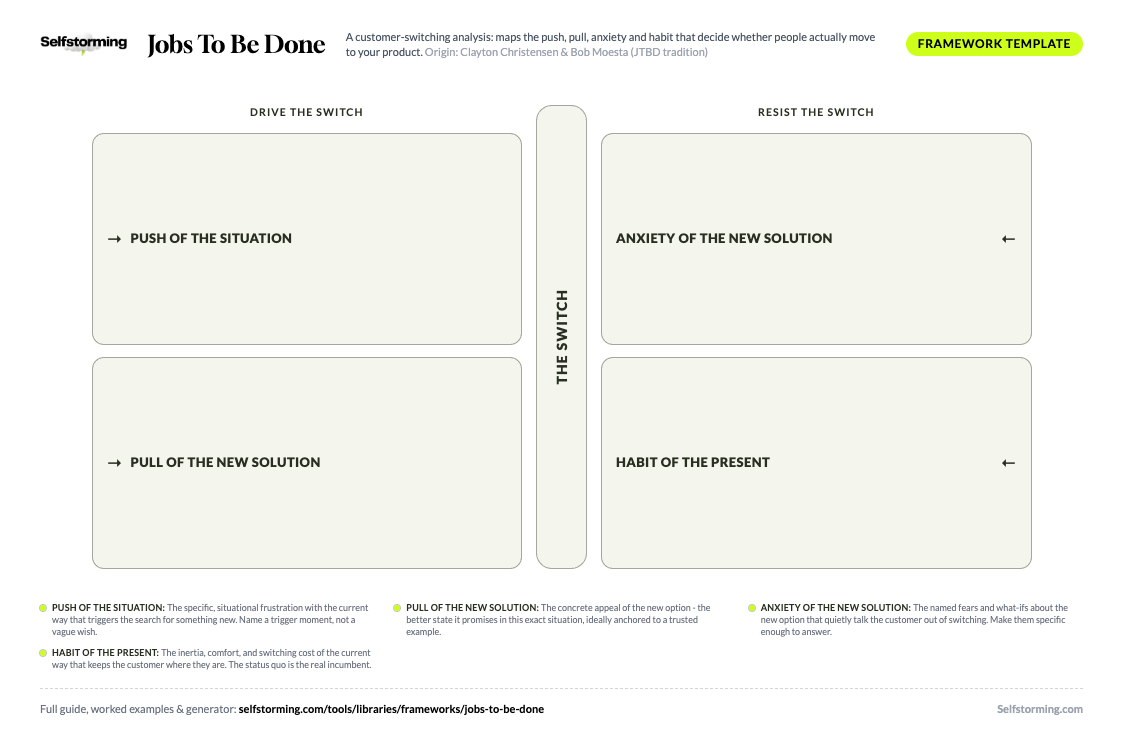
Print it. Fill it in.
The Jobs To Be Done as a printable A4 worksheet - write straight into the framework, on paper or in any PDF app.
Download the PDF templateKnowledge Worth Paying For
A working library of brand strategy frameworks - with worked examples on real brands, sources, and decision criteria. Not vibes.
One good deck covers the subscription. The rest is profit.
Jobs To Be Done says customers hire products to make progress in a situation, not because of who they are demographically. The mechanism is the four forces of progress: Push (what is wrong with today) and Pull (the appeal of the new) drive the switch, while Anxiety (fear of the new) and Habit (loyalty to the old) resist it. A switch happens only when Push + Pull beat Anxiety + Habit. Capture the job as "When [situation], I want to [motivation], so I can [expected outcome]" and check it covers functional, emotional, and social dimensions.
Notion
B2B SaaS workspace (founded 2016, USA)A clean case of competing against habit and a pile of incumbents at once. People do not wake up wanting 'a flexible workspace' - they switch because their docs, wikis, and trackers are scattered across five tools and onboarding a new hire takes a week. The four forces explain why Notion's templates and import tools matter as much as any feature.
Wise
Cross-border money transfer fintech (founded 2011, UK)The job is 'get my money to another country without getting quietly robbed on the exchange rate.' Wise wins not by being the flashiest app but by attacking anxiety (hidden fees, will it arrive) and the social/emotional job of feeling like a savvy, not a sucker. Banks were the habit; opacity was the push.
Whoop
Wearable fitness recovery band (founded 2012, USA)Whoop sells against the habit of an existing smartwatch and the anxiety of a subscription with no screen. The hired job is emotional and social as much as functional - 'help me train smart and prove I take recovery seriously' - which is why a screenless band with a monthly fee beats a cheaper watch for a specific job.
Notion, Wise, Whoop - filled in, line by line. Unlock to read them.
Notion (B2B SaaS workspace (founded 2016, USA))
A clean case of competing against habit and a pile of incumbents at once. People do not wake up wanting 'a flexible workspace' - they switch because their docs, wikis, and trackers are scattered across five tools and onboarding a new hire takes a week. The four forces explain why Notion's templates and import tools matter as much as any feature.
Push of the Situation: Our knowledge is scattered across a wiki, a docs tool, and three spreadsheets, and new hires take a week just to find anything.
Pull of the New Solution: I saw a startup run their entire company - docs, tasks, wiki - in one tidy place a new hire could navigate on day one.
Anxiety of the New Solution: If I move everything in and it gets messy or slow, I have made the chaos worse and it is on me.
Habit of the Present: The team already lives in the current tools and nobody wants to relearn how they take notes.
Wise (Cross-border money transfer fintech (founded 2011, UK))
The job is 'get my money to another country without getting quietly robbed on the exchange rate.' Wise wins not by being the flashiest app but by attacking anxiety (hidden fees, will it arrive) and the social/emotional job of feeling like a savvy, not a sucker. Banks were the habit; opacity was the push.
Push of the Situation: My bank took a chunk on the exchange rate and a fee, and the transfer to my family abroad arrived smaller than I promised them.
Pull of the New Solution: I want to see the real mid-market rate and the exact fee up front, so I know precisely what lands on the other side.
Anxiety of the New Solution: Sending money through a company I have not heard of feels risky - what if it vanishes or gets stuck?
Habit of the Present: My salary already lands in my bank and sending from there is one less app and one less password to manage.
Whoop (Wearable fitness recovery band (founded 2012, USA))
Whoop sells against the habit of an existing smartwatch and the anxiety of a subscription with no screen. The hired job is emotional and social as much as functional - 'help me train smart and prove I take recovery seriously' - which is why a screenless band with a monthly fee beats a cheaper watch for a specific job.
Push of the Situation: I keep overtraining and getting injured, and my current watch buries the one number I actually need under a hundred I do not.
Pull of the New Solution: I want a single, trustworthy recovery score each morning that tells me whether to push hard or back off today.
Anxiety of the New Solution: Paying a monthly fee for a band with no screen feels like a gimmick I will regret in three months.
Habit of the Present: I already wear a smartwatch that does steps and notifications, so adding a second device on my wrist feels like a lot.
1. Push of the Situation
What is going wrong in the customer's current situation that makes the old way feel intolerable enough to start looking?
The frustration with the present that kicks off the search. No push, no shopping. People do not switch because something better exists - they switch because something current broke, slipped, or finally got annoying enough. Push is the trigger event, not a vague dissatisfaction.
Good answer: Our spreadsheet broke again during the Monday finance review and I looked incompetent in front of the board. A specific, dated, emotionally loaded moment that started the hunt. That is a push.
Wrong answer: Customers want a more efficient solution. No situation, no trigger, no moment. That is a generic wish, and generic wishes never made anyone open their wallet on a Tuesday.
2. Pull of the New Solution
What is the specific appeal of the new option - the vision of the better life it promises in this exact situation?
The magnetic pull of the new way. This is the layer marketing usually over-invests in: features, demos, the shiny promise. Pull matters, but on its own it converts almost nobody - it has to be strong enough to overcome the two resisting forces sitting on the other side of the scale.
Good answer: I saw a peer close their books in two days with this tool and never touch a formula. A concrete picture of the better state, anchored to someone the buyer trusts. Pull with a face on it.
Wrong answer: It has the most powerful feature set on the market. A feature list is not a pull. People are pulled by the progress they imagine, not the spec sheet they skim and forget.
3. Anxiety of the New Solution
What fears, doubts, and what-ifs about the new option are quietly talking the customer out of switching?
Everything scary about the new thing: will it work, will I look foolish, will I lose my data, will migration be a nightmare. Anxiety is the force teams forget exists because it is invisible in a feature comparison. Reduce it and conversion climbs without adding a single feature.
Good answer: What if migration loses three years of records and it is my name on the rollout? A named, specific fear you can actually answer with a guarantee, a migration service, or a case study. That is workable anxiety.
Wrong answer: We assumed if the product was good enough, doubts would take care of themselves. They do not. Unaddressed anxiety does not disappear - it just becomes a deal that goes quiet and never comes back.
4. Habit of the Present
What inertia, loyalty, and comfort with the current way is keeping the customer exactly where they are?
The gravitational pull of the familiar. The old way is paid for, understood, and woven into how the team works. Habit is not laziness - it is rational risk-aversion. The status quo is the incumbent that beats most challengers, and it almost never shows up in your competitive deck.
Good answer: The whole team already knows the old system and switching means retraining nine people mid-quarter. A concrete cost of change you can shrink with onboarding, templates, or phased rollout. Nameable habit.
Wrong answer: Our only competitor is the other vendor in the category. Wrong. Your biggest competitor is the customer doing nothing, comfortably, forever. Ignore habit and you lose to inertia, not to a rival.
Decide your starting point: You do not need a month of interviews to begin. Right here on Selfstorming you can find inspiration and directions, or generate a first-draft Jobs To Be Done in minutes. Treat that draft as a hypothesis, then pressure-test it against real customer language using the steps below. Both interview-from-scratch and AI-draft-then-validate are valid - most teams move faster starting from a draft.
Find the switch moments first: Talk to people who recently bought (or cancelled). Anchor every interview to a specific, dated decision - 'walk me through the day you decided.' The story of the switch, not a satisfaction survey, is where the four forces live.
Map all four forces for each switch: For every story, write the Push (what broke), the Pull (what attracted), the Anxiety (what scared them), and the Habit (what nearly kept them put). If you can only fill two of the four, you have an opinion, not an interview.
Write the job statement: Compress the progress into 'When [situation], I want to [motivation], so I can [expected outcome].' No brand names, no features. The statement should be true even if your product never existed.
Check all three dimensions: For each job, name the functional task, the emotional payoff, and the social signal. Most teams nail functional and leave the emotional and social jobs on the table - which is exactly where the margin and the loyalty hide.
Audit your messaging against the forces: Lay your current homepage and sales deck over the four forces. Almost everyone over-indexes on Pull (features) and says nothing to reduce Anxiety or break Habit. That imbalance is usually your conversion leak.
Engineer the forces, do not just describe them: Grow Push and Pull in your copy; shrink Anxiety with guarantees, migration help, and proof; break Habit with switching incentives and onboarding. JTBD is only useful if it changes what you build and what you say.
Re-segment by job, not by demographic: Group customers by the job they hire you for. You will usually find two or three distinct jobs hiding inside one 'persona' - and they want different things, which is gold for positioning and roadmap.
Best for: Understanding why customers switch, finding unmet jobs, and re-segmenting a market around progress rather than demographics. Strong for product strategy and challenger positioning. / When you already know the job and need to size it, price it, or build the funnel. JTBD frames the why, not the how-much.
Output: A set of job statements plus a four-forces map per switch, showing what to grow (Push, Pull) and what to shrink (Anxiety, Habit). / A finished media plan, pricing model, or conversion funnel. Those are downstream of the job, not the job itself.
Time to complete: A focused round of 8-15 switch interviews plus synthesis - roughly two to three weeks to a confident job map. An AI first draft cuts the cold-start. / A multi-month outcome-driven innovation study with hundreds of survey respondents. That is Ulwick's quantified ODI, a heavier variant.
vs Value Proposition Canvas: JTBD discovers the job and the forces of switching - the diagnostic that comes first. Use it to understand the demand before you design the offer. / The Value Proposition Canvas takes a known job and maps your product's pain-relievers and gain-creators against it. Use the Canvas after JTBD, to build the fit.
vs Customer Persona: JTBD organises by situation and progress, so it catches buyers who share a job but nothing demographically. Better when 'who' has stopped predicting 'why.' / A Persona organises by attributes (age, role, goals) and is faster to brief a creative team with. Use Personas for shorthand, JTBD for causality.
vs Empathy Map: JTBD is causal and decision-focused - it explains the switch and gives you forces to engineer. Use it when you need to change conversion, not just understand mood. / An Empathy Map captures what a user thinks, feels, sees, and hears in the moment. Use it for a quick qualitative snapshot, not for explaining why they bought.
Jobs To Be Done has three overlapping lineages, which is both its strength and the source of its endless arguments. Harvard professor Clayton Christensen popularised the customer-progress framing in Marketing Malpractice (HBR, 2005) and the book Competing Against Luck (2016), with the famous milkshake study. In parallel, Tony Ulwick of Strategyn conceived the approach in 1990, named it Outcome-Driven Innovation in 1999, introduced it to Christensen, and codified the quantified version in What Customers Want (2005). The practical 'forces of progress' and the timeline-based switch interview were developed by Bob Moesta and Chris Spiek - the model this page uses, where Push and Pull drive a switch while Anxiety and Habit resist it.
The honest critique of Jobs To Be Done is definitional. The Christensen camp and the Ulwick camp use the same words for different things - one treats a 'job' as a high-level progress narrative, the other as a quantifiable list of outcome metrics - and the fragmentation means teams spend more time debating what JTBD is than using it. It is also hard to operationalise: 'find the job' sounds simple, but disciplined switch interviews are rare, and the word 'job' is elastic enough that a sloppy team can call anything a job and feel insightful while changing nothing. Used well it is a sharp diagnostic; used loosely it is a vocabulary that flatters the strategist and confuses the roadmap.
What is Jobs To Be Done?
Jobs To Be Done is a customer-insight framework built on one idea: people do not buy products, they hire them to make progress in a specific situation, and they fire whatever they used before. Instead of segmenting by demographics, you study the 'job' - the progress - and the four forces of progress that decide whether someone switches: Push and Pull pulling them toward the new, Anxiety and Habit dragging them back to the old.
Who created Jobs To Be Done?
There is no single inventor, which is why the camps argue. Tony Ulwick conceived the approach in 1990 and named Outcome-Driven Innovation in 1999. Clayton Christensen popularised the 'customers hire products to make progress' framing in HBR's Marketing Malpractice (2005) and Competing Against Luck (2016). Bob Moesta and Chris Spiek developed the four forces of progress and the switch interview that most practitioners use day to day.
What are the four forces in Jobs To Be Done?
The four forces of progress are Push (the frustration with the current situation that starts the search), Pull (the appeal of the new solution), Anxiety (fear and doubt about the new solution), and Habit (inertia and loyalty to the old way). Push and Pull drive the switch; Anxiety and Habit resist it. A customer only switches when Push plus Pull outweigh Anxiety plus Habit.
How do you write a Jobs To Be Done job statement?
Use the format When [situation], I want to [motivation], so I can [expected outcome]. For example: 'When my finance review breaks because the spreadsheet failed, I want to close the books without touching a formula, so I can look credible to the board.' The test: the statement must stay true even if your product never existed. If your brand name appears, you wrote a brief, not a job.
Is Jobs To Be Done the same as a customer persona?
No. A persona organises customers by attributes - age, role, goals, a stock photo. Jobs To Be Done organises by the progress they are trying to make in a situation, which is why two demographically opposite people can hire the same product for the same job. Personas are great shorthand for briefing creative; JTBD explains causality - why people actually switch. Use them together, not interchangeably.
Does Jobs To Be Done cover emotional and social needs, or just functional ones?
All three. Every job has a functional dimension (the practical task), an emotional dimension (how the customer wants to feel), and a social dimension (how they want to be seen). Most teams solve only the functional job and then lose to a 'worse' competitor that nailed the emotional and social ones. Those two dimensions are usually where loyalty and margin hide.
Why isn't my biggest competitor another company in Jobs To Be Done?
Because the customer's alternative is whatever else they could hire to get the job done - including doing nothing. The Habit force makes the status quo the strongest incumbent in most markets. Your real rival is often a spreadsheet, a manual workaround, or plain inertia, none of which appear in a competitive benchmark deck. JTBD forces you to compete against the job, not the logo.
Does Jobs To Be Done work for B2B?
Yes, and arguably harder, because B2B switches carry a heavy Anxiety force (career risk, migration risk) and a heavy Habit force (entrenched processes, retraining costs). The four forces are tailor-made for B2B: most B2B sales are lost not on features but on unaddressed fear of switching and the comfort of the incumbent. Map those two resisting forces and you usually find the stuck deals.
A customer-switching analysis: maps the push, pull, anxiety and habit that decide whether people actually move to your product.
The quietly radical bit is the unit of analysis. Not the customer, not the product, but the job: the progress someone is trying to make in a specific situation. A 55-year-old and a 19-year-old can hire the exact same milkshake for the exact same morning commute, and no amount of age-bracket targeting will ever surface that. The job will.
The engine inside JTBD is the model that explains why anyone switches at all - the four forces of progress. Two forces push people toward something new, two forces drag them back to the comfortable old thing, and a purchase only happens when the first pair beats the second. This page walks through those four forces, the job-statement format that keeps you honest, and how to spot the difference between a real job and a feature wish-list wearing a job costume.
Related Frameworks
Brand Onion
Five concentric layers from outer to inner: Attributes (provable product facts), Benefits (functional + emotional outcomes), Personality (ho
Brand Pyramid
Four levels, bottom to top: Salience (do people know you, and for what?), Meaning (what are you - performance facts plus imagery association
Brand Archetypes
Twelve characters drawn from Jungian psychology, grouped into four families by core human motivation: Independence & Fulfillment (Innocent,
Purpose, Vision & Mission
Three tiers, narrowing to a point: Mission at the base (what we do every day, concretely, and for whom - present tense), Vision in the middl