Message Map
One Brand Truth, Told Differently To Every Audience
Most messaging dies the moment it tries to please everyone at once. You write one line, polish it for a fortnight, and it lands on three different audiences like a slightly damp handshake - technically fine, memorable to nobody. The Message Map fixes the wrong assumption underneath that: it assumes everyone needs the same words to reach the same conclusion. They don't.
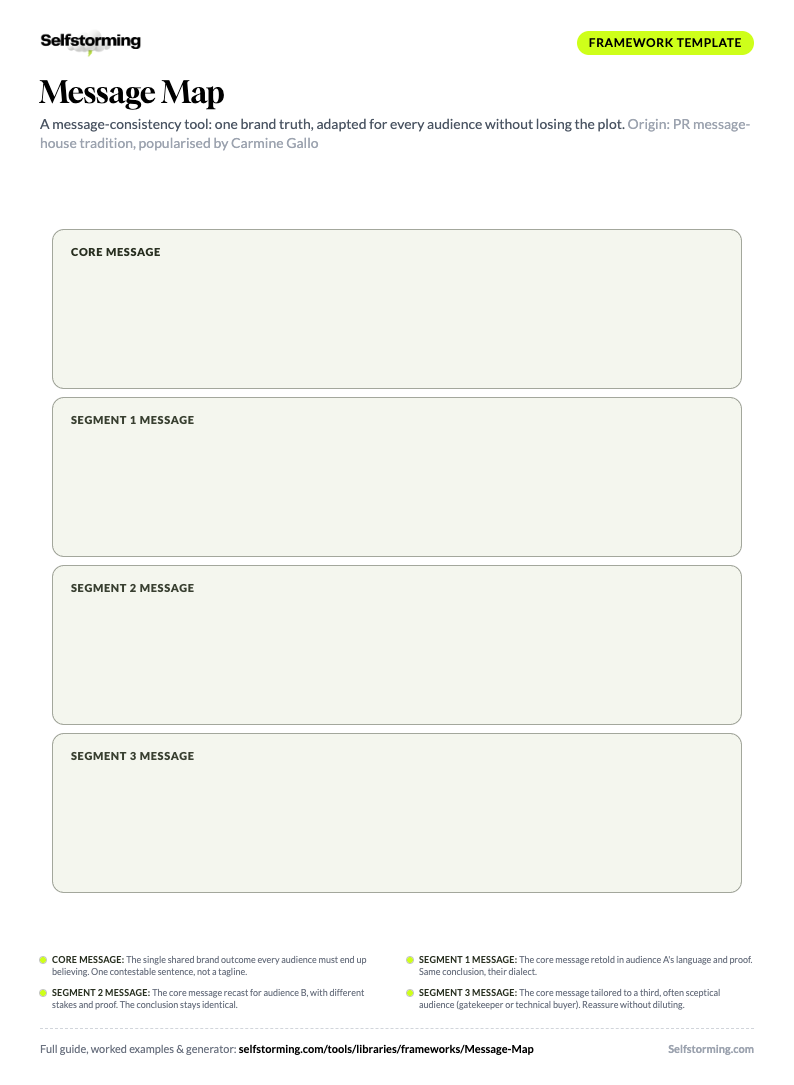
Print it. Fill it in.
The Message Map as a printable A4 worksheet - write straight into the framework, on paper or in any PDF app.
Download the PDF templateKnowledge Worth Paying For
A working library of brand strategy frameworks - with worked examples on real brands, sources, and decision criteria. Not vibes.
One good deck covers the subscription. The rest is profit.
A Message Map has one Core Message (the single brand outcome every audience must end up believing) and then the same idea retold as distinct segment messages for three different audiences. The rule that makes it work: every segment message has to ladder back to the one core, or you've built a copy deck, not a map. Use it when one message genuinely won't cut it across audiences - rebrands, multi-segment launches, repositioning - not for single-message performance campaigns.
Nike
Global sportswear brand (USA, founded 1964)One core belief - winning silences the people who told you that you couldn't - retold for very different women without ever splitting the brand. The basketball rookie, the sprinter, and the gymnast each get their own sentence, and all three ladder to the same defiant conclusion.

Spotify
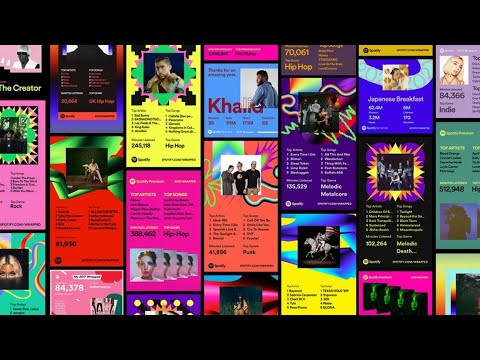
Music & audio streaming platform (Sweden, founded 2006)The cleanest proof that a message map can scale to hundreds of millions. There is one core message - your year in music, made personal - translated into an individual, shareable version for every single listener. Same idea, hundreds of millions of dialects, all in their own data.
Monzo
UK digital challenger bank (founded 2015)An example where the core outcome is emotional - banking that doesn't feel like a punishment - and each segment translates it into concrete proof. The everyday spender, the freelancer, and the anxious saver hear different sentences and reach the same belief.

Nike, Spotify, Monzo - filled in, line by line. Unlock to read them.
Nike (Global sportswear brand (USA, founded 1964))
One core belief - winning silences the people who told you that you couldn't - retold for very different women without ever splitting the brand. The basketball rookie, the sprinter, and the gymnast each get their own sentence, and all three ladder to the same defiant conclusion.
Core Message: Whatever they say you can't be, win - and let the winning be the argument.
Segment 1 Message: For the doubted rookie (Caitlin Clark's lane): they'll call you arrogant for wanting it all - so don't shrink, dominate, and let the scoreboard answer back.
Segment 2 Message: For the policed sprinter (Sha'Carri Richardson's lane): they'll judge how loud, how fast, how much you celebrate - so be exactly that much, and then more.
Segment 3 Message: For the held-back champion (the gymnast and team-sport stars): they'll say you're too emotional, too demanding, too 'much' - so be relentless, and win anyway.
Spotify (Music & audio streaming platform (Sweden, founded 2006))
The cleanest proof that a message map can scale to hundreds of millions. There is one core message - your year in music, made personal - translated into an individual, shareable version for every single listener. Same idea, hundreds of millions of dialects, all in their own data.
Core Message: Your year in music is uniquely yours - here it is, made personal enough to share.
Segment 1 Message: For the super-fan: you streamed one artist more than almost anyone on Earth - here's your badge, your minutes, your bragging rights.
Segment 2 Message: For the genre-hopper: your taste refused to sit still this year - here's the strange, specific map of where it wandered.
Segment 3 Message: For the casual listener: even a quiet year of listening tells a story - here's the song that was secretly the soundtrack to yours.
Monzo (UK digital challenger bank (founded 2015))
An example where the core outcome is emotional - banking that doesn't feel like a punishment - and each segment translates it into concrete proof. The everyday spender, the freelancer, and the anxious saver hear different sentences and reach the same belief.
Core Message: Banking you can actually see and control, instead of a black box that surprises you at the worst moment.
Segment 1 Message: For the everyday spender: instant notifications and budgets that tell you where your money went before the month-end shock does.
Segment 2 Message: For the freelancer: separate pots for tax and expenses, so the money you owe HMRC isn't quietly the money you already spent.
Segment 3 Message: For the anxious saver: round-ups, locked savings pots, and gambling blocks that put the brakes on for you when willpower runs out.
1. Core Message
What is the one thing we need every single audience to end up believing, no matter which door they walked in through?
The single shared brand outcome that sits above everything. Not a tagline, not a value prop for one buyer - the conclusion all segments must arrive at. Everything below it is just a different road to this same destination. If it's vague enough to fit any competitor, it can't anchor anything beneath it.
Good answer: Switching to us costs less than staying where you are. Sharp, contestable, and every segment below can ladder to it without sounding like the same memo - the CFO, the operator, and the IT lead each reach this belief by a different route.
Wrong answer: We help businesses grow and succeed. A core message so broad it survives any rewrite and commits to nothing. Segment messages laddering to this would be laddering to fog.
2. Segment 1 Message
If audience A only ever read one sentence from us, which version of the core message would actually move them?
The core idea retold in the exact language, proof, and priority of your first audience. Same conclusion, their dialect. The job here is fidelity to the core plus specificity to the segment - the words change, the destination doesn't.
Good answer: For the finance lead: cut your monthly tooling spend 30% in the first quarter, no migration downtime. Numbers, time horizon, and the one fear (downtime) named directly - all laddering to the core that switching costs less than staying.
Wrong answer: For the finance lead: our innovative platform drives efficiency. Generic enough to paste under any segment. No number, no fear named, no reason this audience specifically should care - it's the core message in a worse outfit.
3. Segment 2 Message
What does audience B actually care about day to day, and how does the core message show up inside that reality?
The same core outcome, recast for a second audience with different stakes and a different vocabulary. The discipline is keeping the conclusion identical while the framing shifts entirely - this is where most maps either prove themselves or start drifting.
Good answer: For the daily operator: set up in an afternoon, keyboard shortcuts for everything, no tickets to raise. Speaks to the operator's lived friction, still ladders cleanly to the core - their version of 'switching costs less' is measured in saved hours, not saved euros.
Wrong answer: For the daily operator: we're a market-leading solution trusted by thousands. A credential, not a message. It tells the operator nothing about their afternoon and quietly stops laddering to the core at all.
4. Segment 3 Message
Where is the third audience standing, what are they afraid of, and what's the smallest true sentence that gets them to the core belief?
The core message tailored to a third, often more sceptical audience - the gatekeeper, the technical buyer, the one who can veto. Hardest to write because it must reassure without diluting. Get this one right and the whole map holds; fudge it and you've got a copy deck with one honest line and two polite ones.
Good answer: For IT/security: SOC 2 Type II, SSO on every tier, your data stays in-region. Reassurance as proof, not adjectives - the sceptic's route to 'switching costs less than staying' runs straight through 'and it won't blow up on my watch.'
Wrong answer: For IT/security: enterprise-grade security you can trust. The exact phrase a sceptic has learned to ignore. No standard named, no specific reassurance - it asks for trust instead of earning it, and breaks the ladder to the core.
Decide your starting point: You don't have to draft a Message Map in a blank document. Right here on Selfstorming you can pull inspiration and directions, or generate a first-draft Message Map in minutes. Treat the draft as a head start, then run it through the steps below to sharpen the core and pressure-test each segment against the real audience. Workshop-from-scratch and AI-draft-then-refine are both valid - most teams move faster starting from a draft.
Write the Core Message first, and only the Core Message: Before you touch a single segment, force the team to agree on the one outcome every audience must reach. If you can't write it as one contestable sentence, you don't have a core yet - you have a hope. Everything downstream inherits the sharpness or the fog of this line.
Name your three audiences by their stakes, not their job titles: 'CFO' is a label. 'The person who gets fired if this migration breaks' is a stake. Segments defined by what they fear and want produce far sharper messages than segments defined by a row in the CRM.
Translate, don't multiply: For each segment, ask what's the core message in this audience's exact language? The conclusion stays identical; the words, the proof, and the priority change. If a segment message reaches a different conclusion, it's a different strategy - take it off the map.
Swap the proof, not just the adjectives: Each segment gets evidence that audience actually weighs - a number for finance, a saved hour for the operator, a compliance standard for security. If you find yourself changing only the tone and keeping the same generic proof, you're decorating, not mapping.
Run the ladder test on every segment line: Read each segment message, then ask does this lead a reasonable person back to the core? If the path is unclear, the segment message is drifting. Rewrite it until the ladder is obvious, or cut it.
Stress-test for contradiction across segments: Put all three segment messages side by side. If audience A's promise quietly undercuts audience C's (e.g. 'cheapest' vs 'most secure premium choice'), the brand is splitting. Reconcile them against the core or pick a different core that can honestly hold both.
Distribute the map, not the workshop: A finished Message Map fits on one page - one core, three segment lines, the proof under each. Put it in briefs, sales enablement, and the next campaign kickoff. The deck explaining how you got there can stay in Drive.
Best for: Multi-segment launches, rebrands, and repositioning where one message genuinely won't reach every audience. Keeping sales, comms, and creative on the same core while each speaks its audience's language. / Single-message performance campaigns, one-audience products, or tactical asks where speed beats segmentation. A Message Map is overhead when there's only one person to convince.
Output: A one-page map: one core message at the top, three segment messages beneath it, with the specific proof under each. Everything ladders to the core. / A sprawling deck of audience personas, mood, and unlinked taglines. That's a content library, not a Message Map.
Time to complete: A focused session (2-4 hours) to lock the core and draft three segment lines, plus a round of proof-swapping and laddering. The structure forces decisions, so it moves fast. / Multi-week messaging projects with full segmentation research and stakeholder sign-off cycles. Different, heavier deliverable.
vs Idea Cascade: Message Map spreads one idea sideways across audiences - same core, many segment translations. Use it when the challenge is reaching different people. / Idea Cascade drives one idea downward through tiers (Idea to Message to Execution). Use it when the challenge is turning a single idea into finished creative work.
vs Get Who To By: Message Map handles many audiences at once and keeps them coherent under one core. Better when you're juggling several segments and fear them drifting apart. / Get Who To By sharpens a single brief - one target, one behaviour change, one route. Better for a focused campaign aimed at one audience.
vs Positioning Statement: Message Map turns settled positioning into audience-specific messages. It assumes you already know where you stand and now need to say it three ways. / A Positioning Statement decides where you stand in the market in the first place - the upstream input. Use it before the Message Map, not instead of it.
The Message Map is the Selfstorming-named version of a tool we previously called the Inception Spinner. The underlying practice is much older and well-established: message-mapping and the message house (a roof = umbrella message, supporting pillars, foundation = proof points) have been standard in corporate communications and PR since at least the 1990s, used to keep messaging consistent across functions, regions, and audiences during launches and issues management. The presentation-craft lineage runs through Carmine Gallo, who popularised the term 'message map' in Talk Like TED (one headline supported by three key messages and proof), and Tim Pollard, whose The Compelling Communicator formalised audience-first message design. Selfstorming's contribution is the segmentation angle: one shared core retold per audience, with a hard laddering rule. We're being honest about both halves - the name is ours, the craft is borrowed and credited.
The fair critique of any message-mapping approach is that it can fragment the brand instead of focusing it. If the core message isn't genuinely shared, the segment messages drift until the brand promises different things to different people and means nothing to anyone. The second critique is that a Message Map quietly becomes a copy deck - a set of nicely-worded variations dressed up as strategy, written to justify lines someone already loved rather than to force a real decision about what the brand stands for. Both are real risks. The honest way to use it is to treat the core as a hard test every segment line must pass, and to pressure-test the whole map against real audience behaviour - not as proof the messaging is working.
What is a Message Map?
A Message Map is a one-page tool that starts with a single Core Message - the one outcome every audience must end up believing - and then retells that same idea as distinct messages for different audience segments. The CFO, the end user, and the gatekeeper hear different sentences and different proof, but reach the same conclusion. The rule that makes it a map and not a copy deck: every segment message has to ladder back to the one core.
Who created the Message Map?
Message Map is the Selfstorming-named version of a tool we previously called the Inception Spinner, so the name and segmentation logic are ours. The underlying craft is much older: the message house structure has been standard in corporate comms and PR since the 1990s, and the term 'message map' was popularised by Carmine Gallo in Talk Like TED and built on by Tim Pollard in The Compelling Communicator. We didn't invent message-mapping - we adapted it for one-core-many-audiences brand work and credit the lineage openly.
How is the Message Map different from a message house?
They're close cousins. A message house has a roof (umbrella message), three supporting pillars, and a foundation of proof points - it's built mainly to keep one organisation's messaging disciplined. The Message Map, as Selfstorming uses it, leans the structure sideways: one core message retold per audience segment, with a hard rule that every segment line must ladder back to the core. Same family, but the Message Map is organised by audience, not by message pillar.
Does the Message Map work for B2B brands?
Yes, and it arguably works hardest there. B2B sales almost always involve multiple audiences - the economic buyer, the daily user, and the technical or security gatekeeper - who care about completely different proof. The Message Map lets you sell one thing to all three without collapsing into generic 'all-in-one platform' soup, because each gets their own language and evidence while laddering to the same core belief.
When does a Message Map turn into a copy deck?
The moment the segment messages stop laddering to a shared core. If you can read all three lines and they point to three different conclusions, you don't have a Message Map - you have three taglines in a tidy grid. The other tell is reverse-engineering: if the map was written to justify copy someone already loved, it's documentation pretending to be strategy. The fix is to lock the core first and run the ladder test on every segment line.
How many audience segments should a Message Map have?
Usually three - and rarely more than four. The Selfstorming Message Map is built around one core plus three segment messages on purpose: enough to cover the audiences who actually buy or block, few enough that each message stays sharp. Add a fifth and sixth audience and the messages thin out until none of them does real work. If a fourth audience genuinely needs its own line, it often deserves its own map.
What's the difference between a Message Map and a Positioning Statement?
A Positioning Statement decides where the brand stands in the market - it's the upstream input. The Message Map assumes that's settled and turns it into audience-specific messages. Write the positioning first, then use the Message Map to say it three ways without drifting. Using the Message Map to figure out your position is doing the steps in the wrong order.
Can the Core Message just be our tagline?
Usually no. A tagline optimises for memorability in public; the Core Message optimises for being the belief every segment ladders to internally. They can rhyme, but they're not the same artifact. The Core Message needs to be contestable enough that a competitor could honestly disagree with it - most taglines are too polished and too broad to do that work. Keep the tagline for the billboard and the core for the map.
A message-consistency tool: one brand truth, adapted for every audience without losing the plot.
The Message Map starts with one shared brand outcome - the single thing you want every audience to end up believing - and then tells that one idea in the specific language each segment actually responds to. The CFO, the end user, and the procurement lead can hear three very different sentences and still walk away agreeing on the same point. That's not fragmentation. That's translation.
The trap, and we'll be honest about it, is that a Message Map can quietly become a copy deck - four nicely-worded variations with no shared spine underneath, drifting apart campaign by campaign until the brand means four different things. This page walks through the one core message, the three segment messages that ladder to it, and how to tell a real Message Map from a tidy-looking pile of taglines.
Generate this for your brief - or grab the template
Generate a ready Message Map from your brief straight into editable slides, or start from the free template.