Venn Diagram
Strategy: Find The One Message That Lives In The Overlap
The Venn Diagram is the most honest two-circle drawing in strategy. One circle is what your brand can genuinely own. The other is what your audience actually cares about. The message you're after isn't in either circle - it's in the sliver where they overlap. Everything outside that sliver is true but irrelevant, or relevant but unbelievable. The overlap is the only place a claim is both.
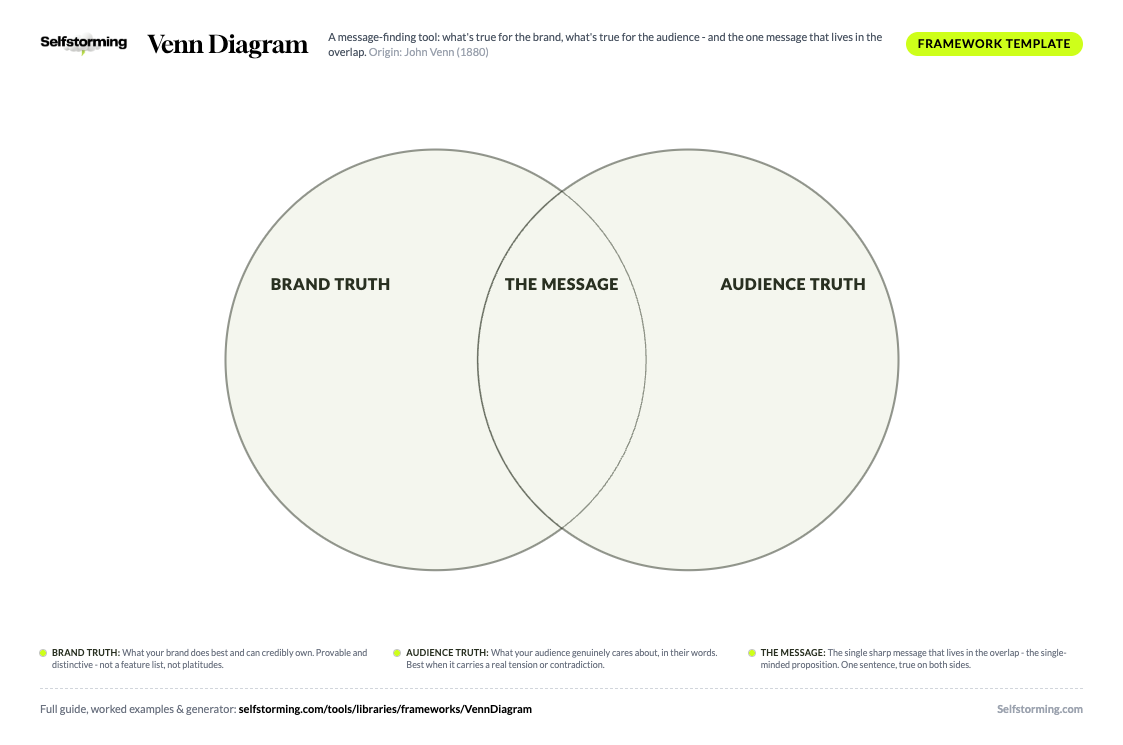
Print it. Fill it in.
The Venn Diagram as a printable A4 worksheet - write straight into the framework, on paper or in any PDF app.
Download the PDF templateKnowledge Worth Paying For
A working library of brand strategy frameworks - with worked examples on real brands, sources, and decision criteria. Not vibes.
One good deck covers the subscription. The rest is profit.
Two circles, one overlap. Left: what your brand does best and can credibly own. Right: what your audience genuinely cares about. Overlap: the single sharp message that is true on both sides - your single-minded proposition. The rule that makes it work: anything outside the overlap gets cut, no matter how much you love it. It's a focusing tool for messaging, not a positioning audit and not a feature list.
Heinz
Heritage ketchup & condiments brand (USA, founded 1869)A textbook overlap that took Heinz 150 years to finally draw. Brand truth: a taste so specific that fans treat substitutes as fraud. Audience truth: people are irrationally, almost embarrassingly loyal to it. The message sits exactly where 'we taste like no one else' meets 'I will smuggle this into a steakhouse'.

Liquid Death
Canned water challenger (USA, founded 2019)The overlap is the whole brand. Brand truth: water in a tallboy can with heavy-metal styling. Audience truth: young drinkers find bottled-water branding boring and plastic embarrassing. The message lives precisely where 'it's just water' meets 'make hydration feel like a statement'.

Nike
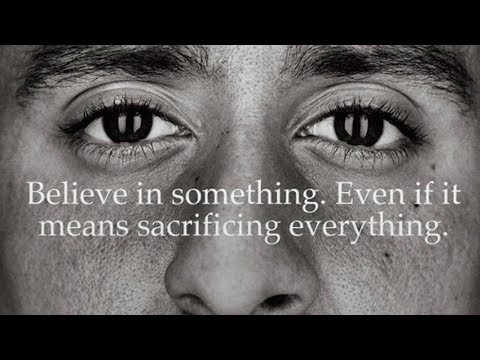
Global sportswear brand (USA, founded 1964)A famous overlap that looked like a business risk until you read both circles. Brand truth: Nike backs athletes who push against the limits, including the social ones. Audience truth: young sports fans want a brand with the spine to stand for something, not just sell shoes. 'Believe in something, even if it means sacrificing everything' only works in the intersection of conviction and courage.
Heinz, Liquid Death, Nike - filled in, line by line. Unlock to read them.
Heinz (Heritage ketchup & condiments brand (USA, founded 1869))
A textbook overlap that took Heinz 150 years to finally draw. Brand truth: a taste so specific that fans treat substitutes as fraud. Audience truth: people are irrationally, almost embarrassingly loyal to it. The message sits exactly where 'we taste like no one else' meets 'I will smuggle this into a steakhouse'.
Brand Truth: A ketchup with a taste profile so distinctive that imitators and store-brands never quite land it - the original people grew up on.
Audience Truth: I'm weirdly devoted to Heinz - I'll bring my own bottle, refuse the diner's no-name stuff, and feel genuinely betrayed by a different ketchup.
The Message: It has to be Heinz - because for the people who love it, nothing else will do.
Liquid Death (Canned water challenger (USA, founded 2019))
The overlap is the whole brand. Brand truth: water in a tallboy can with heavy-metal styling. Audience truth: young drinkers find bottled-water branding boring and plastic embarrassing. The message lives precisely where 'it's just water' meets 'make hydration feel like a statement'.
Brand Truth: Plain water and tea in a tallboy aluminium can with horror-metal branding and zero wellness vocabulary.
Audience Truth: I want to drink water at the party but I don't want to look like the boring one holding a plastic bottle.
The Message: Murder your thirst - hydration you'd actually be seen holding.
Nike (Global sportswear brand (USA, founded 1964))
A famous overlap that looked like a business risk until you read both circles. Brand truth: Nike backs athletes who push against the limits, including the social ones. Audience truth: young sports fans want a brand with the spine to stand for something, not just sell shoes. 'Believe in something, even if it means sacrificing everything' only works in the intersection of conviction and courage.
Brand Truth: A brand that has always sided with athletes who defy the rules - and was willing to put Colin Kaepernick, a divisive figure, at the centre of its 30th 'Just Do It' anniversary.
Audience Truth: I want my heroes - and the brands behind them - to actually stand for something, even when it's unpopular, instead of playing it safe.
The Message: Believe in something, even if it means sacrificing everything.
1. Brand Truth
What can this brand do better than anyone, and prove, that the audience would believe coming from us?
The left circle: what your brand does best and can credibly own. Not the full feature list - the part that is both distinctive and defensible. Drop anything a competitor could claim verbatim, and anything you can't back up. The brand circle is the half people forget to make honest.
Good answer: We refurbish each phone through 70 manual checks and resell it with a one-year warranty. Specific, provable, hard for a marketplace reseller to copy with a straight face.
Wrong answer: We're passionate about quality and customer-first. Every brand says this. It's not a truth, it's wallpaper - and it fills the circle with air.
2. Audience Truth
What does the audience genuinely care about, worry about, or want - in their words, not ours?
The right circle: what your audience genuinely cares about. The tension, desire, or cultural mood that already lives in their head before they meet your brand. Written from inside their life, not from inside your marketing plan. The sharper and more specific, the better the overlap can get.
Good answer: I want a newer phone but I feel stupid paying flagship prices and guilty about the e-waste. A real human tension with a contradiction inside it - exactly what good messaging resolves.
Wrong answer: Consumers seek value and convenience. True of literally everyone, resolves nothing, and could be pasted onto any category on Earth. A platitude is not an insight.
3. The Message
What is the one sentence that is true for the brand AND true for the audience at the same time?
The intersection: the single sharp message that lives in the overlap of both circles - the single-minded proposition. It has to be believable coming from the brand AND resonant for the audience, or it's only half a message. One sentence. If you need two, you have two diagrams, not one.
Good answer: A like-new phone without the new-phone guilt. The brand truth (rigorous refurb) and the audience truth (want-new-but-guilty) collapse into one line that does both jobs.
Wrong answer: The smart choice for modern consumers. A sentence that touches neither circle honestly - too vague to be a brand truth, too generic to be an audience truth. The overlap of nothing and nothing.
Decide your starting point: You don't need a blank wall and a week. Right here on Selfstorming you can find inspiration and directions, or generate a first-draft Venn Diagram in minutes. Treat the draft as a head start, then run it through the steps below to sharpen both circles and pressure-test the overlap against the real market. Workshop-from-scratch and AI-draft-then-refine are both valid - most teams move faster from a draft.
Fill the brand circle with provable truths only: List what the brand does well, then strike every line a competitor could copy word-for-word and every line you can't back up with evidence. What survives is the honest brand circle. If it's down to one or two items, good - that's distinctiveness.
Fill the audience circle in their language: Write what the audience actually cares about as if you overheard it, not as a demographic. Use their words, their worry, their contradiction. The best audience truths have a tension inside them, because tension is what a message gets to resolve.
Resist matching the circles too early: Don't reverse-engineer the audience circle to flatter the brand. Build both honestly and separately first. A circle written to make the overlap easy is a circle that will lie to you later.
Find the genuine intersection: Look for the one place where a brand truth and an audience truth are effectively the same statement. That's the overlap. If you can't find one, the problem is real - either the brand truth is weak or you don't understand the audience yet.
Compress the overlap into one single-minded proposition: Write the intersection as a single sharp sentence a stranger could repeat. A like-new phone without the new-phone guilt works. Quality refurbished devices for value-conscious buyers doesn't - it's a category description wearing a message costume.
Stress-test it from both sides: Ask twice. Is this believable coming from us? and does this actually matter to them? If either answer is soft, you're outside the overlap and the message will quietly underperform. Move the line until both are yes.
Brief from the overlap, ship nothing outside it: The single-minded proposition becomes the spine of the campaign. Every execution traces back to it. The moment a headline starts selling a feature that isn't in the overlap, you're back to two monologues - cut it.
Best for: Finding the one message a campaign should be built on. Cutting a brief down to a single-minded proposition that is both believable and resonant. / Mapping competitive position, auditing your full brand identity, or planning media. The Venn Diagram is a message-focusing tool, not a positioning system.
Output: A two-circle diagram with one sharp overlap: a single-minded proposition that is true for the brand and true for the audience. / A list of features, a multi-page strategy deck, or three 'pillar messages'. That's a content plan, not a Venn Diagram.
Time to complete: A focused session - an hour or two with sharp inputs to draw both circles, plus refinement to compress the overlap into one line. / Multi-week research projects with quantitative segmentation studies. The Venn Diagram assumes you've already got an audience truth worth using.
vs Get Who To By: Use the Venn Diagram to find the message - the single idea that lives in the overlap. It answers 'what do we say?' / Get Who To By turns that message into an action-shaped brief (get WHO to do WHAT by saying WHICH). Use it after the Venn Diagram, not instead of it.
vs Positioning Statement: Use the Venn Diagram for the single creative message that cuts through and makes people care. / A Positioning Statement fixes your place in the market against competitors (for X, brand is the Y that Z). Use it for category strategy; use the Venn Diagram for the campaign line.
vs Value Proposition Canvas: Use the Venn Diagram when you need one sharp message fast, written for cut-through, not completeness. / The Value Proposition Canvas (Osterwalder) maps jobs, pains, and gains against products in detail. Use the Canvas for product-market fit work; use the Venn Diagram for the message.
The two-circle diagram itself is genuinely old: the mathematician John Venn introduced it in 1880 in his paper On the Diagrammatic and Mechanical Representation of Propositions and Reasonings, as a tool for logic and set theory. Its use in brand and creative strategy is a much later borrowing - planners adopted the overlap as a picture of the sweet spot or single-minded proposition, the idea that the strongest message sits where what the brand can own meets what the audience cares about. That tradition runs through agency planning lineages like BBH's when the world zigs, zag and the IPA effectiveness school (Binet and Field). So: the diagram has a named inventor, but the strategy application is shared craft, not a single author's model. Selfstorming renamed its version from Crossover to Venn Diagram in 2026 because that's what everyone already calls the drawing in their head.
The fair criticism is that a Venn diagram can manufacture false confidence. Two circles drawn loosely will always appear to overlap somewhere, and a team can talk itself into a 'sweet spot' that is really just two vague statements touching. Strategists like Martin Weigel have made the broader point that neat planning diagrams often distance teams from how people actually behave. The honest defence is the same as the honest use: keep both circles provable and specific, keep the overlap uncomfortably small, and treat the diagram as a way to cut options - not as evidence the message is right. The diagram focuses thinking; it doesn't replace it.
What is a Venn Diagram in brand strategy?
In strategy, the Venn Diagram is a two-circle tool for finding one message. One circle is what your brand can credibly own; the other is what your audience genuinely cares about. The message you want lives in the overlap - the single-minded proposition that is true on both sides. It borrows the mathematician's diagram as a picture of the 'sweet spot', but here the goal is a sharp campaign message, not set theory.
Who created the Venn Diagram?
The diagram itself was introduced by the British mathematician and logician John Venn in 1880, for logic and set theory. Its use in brand and creative strategy has no single author - it's shared agency-planning craft, where the overlap stands for the 'sweet spot' or single-minded proposition. So the drawing has a famous inventor, but applying it to messaging is a tradition, not one person's model. Selfstorming renamed its own version from Crossover to Venn Diagram in 2026.
How is the Venn Diagram different from a Positioning Statement?
Different jobs. A Positioning Statement fixes where you sit in the market against competitors ('for X, brand is the Y that Z') - it's category strategy. The Venn Diagram finds the single creative message that makes people care, by overlapping a brand truth with an audience truth. Positioning is about your place; the Venn Diagram is about your line. Most teams do positioning first, then use the Venn Diagram to find the campaign message.
Does the Venn Diagram work for B2B?
Yes, and it earns its keep there. B2B messaging drifts into feature lists and 'trusted partner' soup faster than almost any category. The Venn Diagram forces a B2B team to name one provable brand truth and one real buyer tension - and a buyer's tension is usually about career risk, internal politics, or time, not just specs. The overlap of those two is where a B2B message stops sounding like every other vendor.
How small should the overlap be?
Uncomfortably small. If most of your ideas fit inside the overlap, your circles are too vague and they're not cutting anything. A healthy Venn diagram leaves most candidate messages outside the intersection - that's the whole value. The overlap should hold one sharp idea, the single-minded proposition. If it comfortably holds three, you haven't finished.
Is the Venn Diagram the same as a single-minded proposition?
Closely related. The single-minded proposition is the output; the Venn Diagram is how you find it. The overlap of the brand circle and the audience circle, compressed to one sentence, is your single-minded proposition. The diagram is the working; the SMP is the answer. You can have an SMP without drawing the circles, but the circles are the fastest way to check it's honest on both sides.
When should I not use the Venn Diagram?
Skip it for pure price or performance propositions where the 'message' is a number and there's no tension to resolve, and for full brand-identity work where you need attributes-to-essence depth (use a Brand Onion). It also can't tell you where to compete - that's a Positioning Statement question. And it's only as good as your audience insight: with no real audience truth, the right circle is just a guess and the overlap is fiction.
A message-finding tool: what's true for the brand, what's true for the audience - and the one message that lives in the overlap.
Most teams draw the two circles and then quietly cheat: they make the brand circle a list of features nobody asked about, and the audience circle a focus-group platitude. Two big circles, a tiny honest overlap, and a slide that says passionate about quality. That's not a Venn diagram. That's two monologues pretending to be a conversation.
Used properly, the Venn Diagram forces a single decision - what is the one thing we can say that is true for us AND true for them - and kills the seventeen other things you were tempted to also mention. This page walks through both circles, the overlap that matters, and how to tell a real intersection from a wishful one.
Generate this for your brief - or grab the template
Generate a ready Venn Diagram from your brief straight into editable slides, or start from the free template.