36 Months: 36 Months
The advocacy group 36 Months tasked FINCH with addressing the escalating teen mental health crisis caused by social media. They needed to mobilize parents, experts, and policymakers to drive legislative change, specifically aiming to raise Australia's social media access age from 13 to 16.
Creative Idea
It leveraged collective parent voices and media pressure to force legislative action on social media age.
The campaign mobilized parents, experts, and celebrities through strategic media and political engagement to create an unignorable chorus of voices, successfully pressuring politicians to pass legislation raising the social media access age from 13 to 16 by offering a clear, singular policy objective.
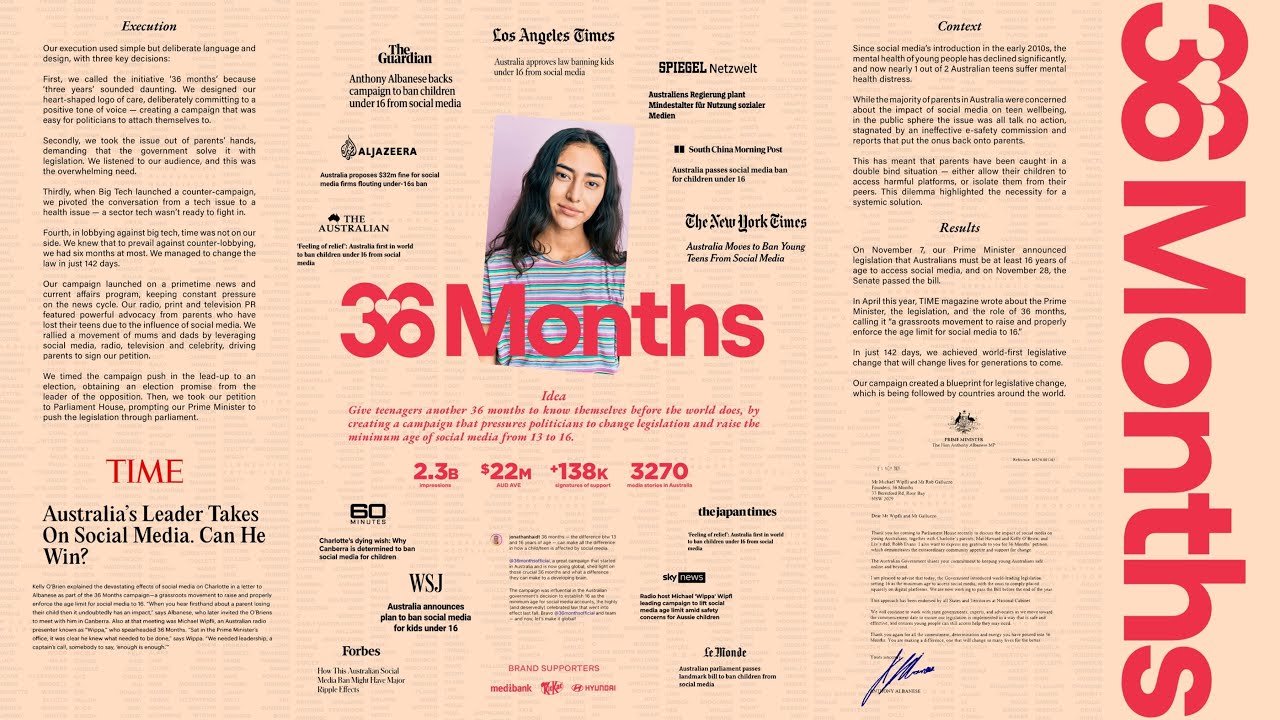
The 142 Day Sprint to Change the Law
36 Months vs Three Years
The campaign name was a deliberate psychological choice. The team discovered that "three years" felt like an eternity to the public, whereas 36 Months felt like a manageable, critical developmental window. This framing allowed the movement to focus on the biological necessity of protecting a child's brain during a specific period of growth. Co-founder Michael "Wippa" Wipfli was driven by a personal ultimatum, stating that if he didn't act on this issue after seeing similar legislation in Florida, he would never feel justified in advocating for anything again.
Political Back-Channeling and Unignorable Voices
Strategist Simone Gupta designed a "political back-channeling" strategy that bypassed traditional lobbying. By combining emotional storytelling from grieving parents with the clinical expertise of Jonathan Haidt and Maggie Dent, the campaign made it politically impossible for lawmakers to ignore the movement in an election year. This resulted in rare bipartisan support from both Prime Minister Anthony Albanese and Opposition Leader Peter Dutton. Director Greg Attwells captured this through "unignorable voices," focusing on medical experts and high-profile supporters like Hamish Blake and Zoë Foster-Blake.
From Ban to Best Summer Ever
When the legislation passed in November 2024, the team immediately pivoted to "The First Best Summer Ever." This phase reframed the December 10 effective date not as a restrictive ban, but as a positive invitation for teens to rediscover an offline life. KitKat joined as a founding partner, cleverly aligning their "Have a Break" positioning with the legislative pause. The campaign's success was so absolute that by 2025, the founders were advising the UN General Assembly on a global blueprint for social media reform.
Creative Strategy Deconstructed
Company
An advocacy platform that could unite diverse stakeholders around a clear legislative goal to protect adolescent mental health.
Category
The category often relied on outdated U.S. standards and placed responsibility solely on parents, lacking unified legislative action.
Customer
Parents and Gen Z felt deep concern about social media's mental health harms, wanting stricter regulation and legislative protection for youth.
Culture
A growing global conversation and public anxiety about adolescent mental health, coupled with a desire for government accountability, created fertile ground.
Company
An advocacy platform that could unite diverse stakeholders around a clear legislative goal to protect adolescent mental health.
Category
The category often relied on outdated U.S. standards and placed responsibility solely on parents, lacking unified legislative action.
Strategy:
Mobilize public concern into a focused legislative demand to shift responsibility from individuals to government.
Customer
Parents and Gen Z felt deep concern about social media's mental health harms, wanting stricter regulation and legislative protection for youth.
Culture
A growing global conversation and public anxiety about adolescent mental health, coupled with a desire for government accountability, created fertile ground.
Strategy:
Mobilize public concern into a focused legislative demand to shift responsibility from individuals to government.
Strategy Technique
Turn the Brand Into a Movement
By mobilizing parents, experts, and policymakers around a singular, actionable objective, the campaign transformed into a powerful advocacy movement. It leveraged collective public concern to drive legislative change, making it bigger than just an ad.
Explore Technique
Creative Technique
Apply Social Pressure
The campaign directly mobilized over 100,000 parents to sign a petition, creating a powerful physical symbol of public demand. This collective action generated immense social and political pressure, making the legislative change undeniable.
Explore Technique