2026BOBATH Memorial HospitalHealthcareCase video
BOBATH Memorial Hospital: A.I.ways Call
BOBATH Memorial Hospital asked Daehong Communications to address the severe emotional strain placed on families caring for dementia patients. The challenge was to mitigate the exhaustion caused by repetitive, anxiety-driven phone calls while maintaining the patient's sense of connection. The goal was to develop a sustainable, non-pharmacological solution that improved the quality of life for both patients and their caregivers.
Creative Idea
AI clones family voices to comfort dementia patients, replacing caregiver stress with meaningful connection.
BOBATH Memorial Hospital developed an AI-powered phone system that mimics family members' voices to reassure dementia patients during repetitive calls. This technology reduces patient anxiety while providing caregivers with summaries, effectively healing relationships through empathetic, tech-driven communication.
From Hospital Renovation to AI Innovation
An Unlikely Origin Story
The project began when Daehong Communications was originally contracted for a physical space and brand renovation at Bobath Memorial Hospital. While observing daily hospital operations, the creative team noticed the intense emotional toll of repetitive, anxiety-driven phone calls on both patients and their families. This observation shifted the agency's focus from interior design to a social-impact technology solution, leading them to partner directly with Dr. Na Hae-ri, the hospital’s director and a specialist in neurology and dementia care.
Designing for Analog Memory
A critical production decision was the choice of an analog telephone interface rather than a modern, complex chatbot. Because the target demographic belongs to an older generation, the team prioritized procedural memory. As cognitive abilities decline, patients often struggle with new digital interfaces, but the physical act of picking up a phone remains deeply ingrained. This design choice ensured the technology felt intuitive and comforting rather than alienating.
Validated Clinical Impact
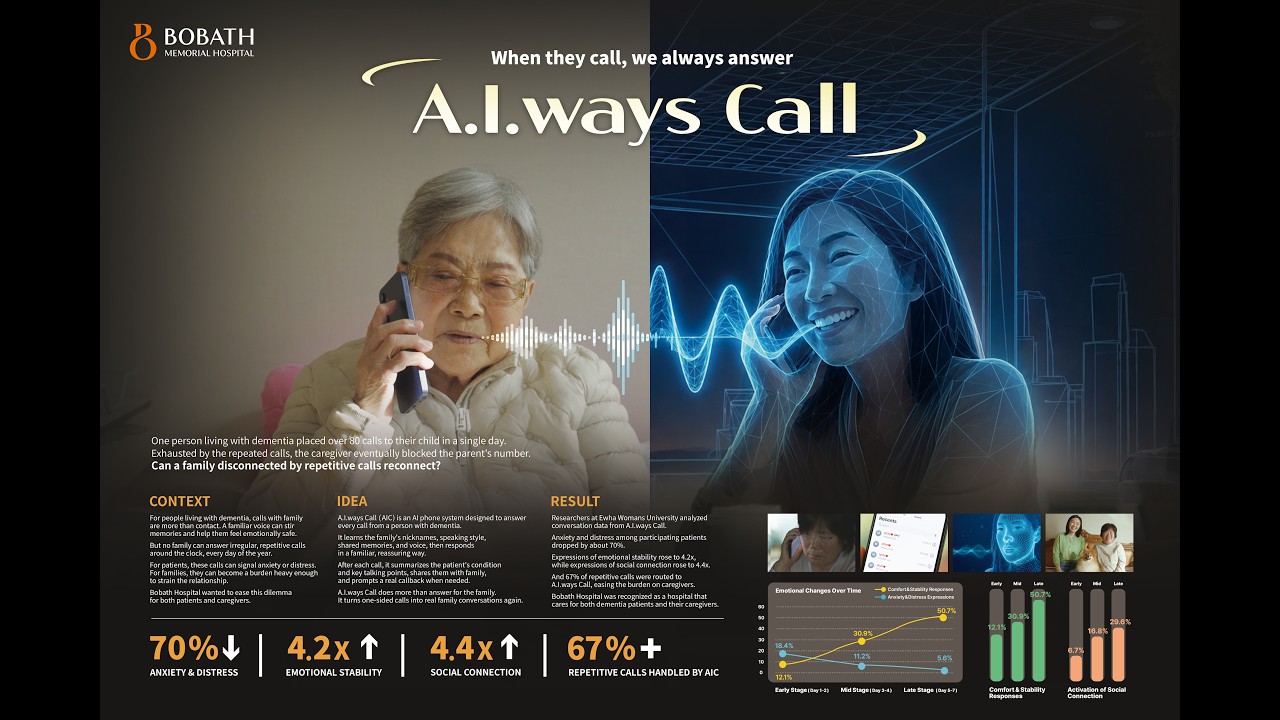
The service underwent rigorous pilot testing validated by Ewha Womans University, led by Professor Kang Ji-young. The data revealed a 70% reduction in expressions of patient anxiety and a 4.2x increase in emotional stability. Furthermore, 67% of repetitive, anxiety-induced calls were successfully pacified by the AI. To ensure transparency, the system explicitly informs users it is an AI assistant and is not a medical device for diagnosis or treatment. The campaign also features voice narration by Kim Young-ok, a renowned veteran actress often referred to as "The Nation's Grandmother," who donated her voice to the project's official case film.
4C Framework deconstruction
Company
BOBATH Memorial Hospital leveraged its clinical expertise in dementia care to integrate generative AI into patient-family communication.
Category
Dementia care typically focuses on medical treatment or physical monitoring, often neglecting the emotional toll of constant, repetitive communication.
Customer
Caregivers felt overwhelmed by guilt and exhaustion, while patients suffered from severe separation anxiety and a desperate need for connection.
Culture
The rise of generative AI combined with South Korea's rapidly aging population created a demand for tech-enabled, compassionate care solutions.
Company
BOBATH Memorial Hospital leveraged its clinical expertise in dementia care to integrate generative AI into patient-family communication.
Category
Dementia care typically focuses on medical treatment or physical monitoring, often neglecting the emotional toll of constant, repetitive communication.
Strategy:
Use technology to bridge emotional gaps by automating repetitive interactions that cause human caregiver burnout.
Customer
Caregivers felt overwhelmed by guilt and exhaustion, while patients suffered from severe separation anxiety and a desperate need for connection.
Culture
The rise of generative AI combined with South Korea's rapidly aging population created a demand for tech-enabled, compassionate care solutions.
Strategy:
Use technology to bridge emotional gaps by automating repetitive interactions that cause human caregiver burnout.
Results
The 'A.I.ways Call' campaign demonstrated significant clinical and emotional impact for dementia patients and their family caregivers: - Expressions of anxiety and distress decreased by about 70%. - Emotionally stable responses rose to approximately 4.2x. - Feeling of social connection rose to approximately 4.4x. - 67% of repeated calls were routed to AIC, easing the caregiver's burden.
-70%
anxiety and distress expressions
4.2x
increase in emotionally stable responses
67%
repeated calls routed to AIC
Strategy Technique
Solve a Daily Annoyance
The campaign identifies the exhausting cycle of repetitive dementia-related phone calls as a critical pain point. By automating the response, it solves the caregiver's burnout while simultaneously improving the patient's emotional state.
Explore Technique
Creative Technique
Unexpected Utility
The campaign transforms a frustrating daily pain point into a functional, comforting tool. By repurposing AI technology as a surrogate for emotional support, it provides a practical solution to a complex psychological problem.
Explore Technique
Craft Breakdown
This campaign elevates human-centered AI by synthesizing artificial voice cloning with empathetic psychological care for dementia patients and caregivers. The combination of sophisticated Digital Craft and thoughtful Technology turns a distressing medical reality into a seamless connection tool.
The AI integration seamlessly clones voice tones, detects patient emotional states, and generates clear summaries for caregivers in real time.
Developing a custom telephony and voice synthesis system tailored specifically for dementia interaction offers a breakthrough functional solution.
Reframing repetitive calls from 'an obsession' to 'a sign of anxiety' shifts caregiver perspective with deep empathy.
Designing an end-to-end communication experience that bridges patient reassurance and caregiver relief without intruding on daily routine.
“The innovation relies on merging cutting-edge generative AI voice technology with nuanced psychological insight to solve a sensitive real-world healthcare burden.”