Brand Strategy
What it is, how to build one in seven steps, and what 1,955 award-winning campaigns tell us about the strategies that actually win. Less theory, more evidence, and a generator for the part where you have to fill it in.
What is brand strategy?
Brand strategy is the long-term plan for what a brand stands for, who it is for and why people should choose it over the alternatives. It sets the positioning, promise, identity and messaging that every campaign, product and touchpoint then follows, so the brand builds memory over time instead of starting from zero with each campaign.
That is the polite definition. The useful one: brand strategy is a short list of decisions you make once and then defend for years, mostly against your own team, who will get bored of it long before customers notice it exists.
It is not the logo, which is brand identity. It is not this quarter's media plan, which is marketing strategy. And it is not a campaign, which is one expression of the strategy that should still make sense when the campaign is long gone. When the strategy works, people end up with a clear brand image and the brand comes to mind when they buy - what Ehrenberg-Bass calls mental availability.
The six parts of a brand strategy
Different agencies draw them as onions, pyramids or keys. Underneath, they all answer the same six questions.
Purpose and promise
Why the brand exists beyond making money, and the one thing it commits to deliver every single time. The promise matters more than the purpose: customers check promises, nobody checks mission statements.
Audience and insight
Who buys the category, not just who you wish bought it, and the human truth that makes them choose. Most brands grow by reaching more people, so the audience is usually wider than the persona deck says.
Positioning
The place you want to hold in people's heads, relative to the alternatives they actually consider. Not a tagline. A choice of what you will be known for, and therefore what you will stop talking about.
Identity and distinctive assets
The personality, voice and the recognisable bits - colours, shapes, characters, sounds - that let people spot you in two seconds without reading the logo. This is where strategy becomes something people can see.
Architecture
How the master brand, sub-brands and products relate. One name on everything, a family of separate brands, or something in between. It decides whether a new product borrows trust or has to earn it from scratch.
Messaging
What you say, to whom, in what order, and the single thought every brief should push. The part that turns a strategy document into something a copywriter can actually use on Monday.
How to build a brand strategy in 7 steps
Each step comes with the tool we would reach for. You do not need all of them. You do need to finish each step before the next one, which is the part most strategy decks skip.
- 1
Start with the business problem, not the brand
Write down what the business needs in numbers - more buyers, higher price, a new category - and which buyer behaviour has to change to get there. A brand strategy that cannot point at a business objective is a mood board with a budget.
- 2
Understand who buys and why
Talk to buyers, read the reviews, sit in the store. You are looking for the job people hire the category to do and the tension they feel while doing it. The insight is rarely what the client brief says it is.
- 3
Map the territory
Put the company, the category, the customer and the culture side by side. Where they overlap is where a brand can say something true that nobody else in the category is saying.
Use4C framework - 4
Choose a position and say it in one sentence
For whom, against what, and why believe it. If the sentence would fit your biggest competitor just as well, it is not a position yet. Ladder it from product features up to the emotional payoff so it survives contact with a sales team.
- 5
Define the core
Values, personality and the essence in two or three words. Keep it short enough that people in the company can repeat it without opening a PDF. If nobody can, it does not exist.
- 6
Make it recognisable
Pick the few assets you will use everywhere and for years: a colour, a shape, a character, a sound. Consistency is boring for the marketing team and exactly what makes a brand easy to remember for everyone else.
- 7
Turn it into messages and a strategic idea
Translate the position into a message hierarchy, then choose how the brand will show up in the world - a utility, a fight, a borrowed icon. The data below shows which of those routes the best campaigns took.
Skip the blank page
Describe your brand in a few sentences and the generator fills in a Brand Onion, Positioning Statement or Golden Circle for it. Then you edit, which is the fun part.
What 1,955 award-winning campaigns say about brand strategy
Every campaign in our campaign library is tagged with the strategic move behind it, from a set of 65 creative strategy techniques. Cannes Lions, D&AD, Effies, Golden Drum and the classics that came before them. Four things stand out.
1. Five moves make up 38% of everything
There are 65 ways to approach a brand problem in our set, and the industry keeps reaching for the same five. The leader by a distance is building a utility instead of an ad - a service, a tool or a product that does something useful and gets talked about because of it. Good news if you want a proven route. Bad news if you want to stand out at an awards show.
Share of campaigns, top 10 techniques
2. Brands stopped exaggerating and started being useful
Before 2010, the most common move was exaggerating to reveal a truth - 23.9% of campaigns. That is the classic advertising trick: take a product benefit and blow it up until it is funny. By 2016-2020, utility had taken over at 21.3%. The best brand strategies moved from saying things to doing things.
Share of campaigns by era
Before 2010 (184 campaigns)
2010-2015 (414 campaigns)
2016-2020 (478 campaigns)
2021 onwards (809 campaigns)
3. The Grand Prix goes to brands that pick a fight
Across the library, 6.5% of campaigns won a Grand Prix. Some moves do far better: making the brand the hero of a bigger fight, turning brand values into action, attacking a cultural blind spot. All of them put the brand on the side of something larger than the product. At the bottom sit exaggeration, brand myths and flipping conventional wisdom - clever, popular, and almost never the top prize.
A fair warning: juries love purpose, and awards are not sales. Use this to understand what the industry rewards, then check it against what your brand actually needs to grow.
4. Every industry has its favourite move
Healthcare brands build tools. Charities make invisible problems visible. Car brands dramatise benefits you cannot see on a spec sheet. Knowing your category's default is useful in two ways: it shows what works, and it shows the move everyone in your category will expect from you.
| Industry | Most used technique | Share |
|---|---|---|
| Consumer Goods (558) | Build a Utility, Not an Ad | 9.9% |
| Travel, Leisure, Retail & Restaurants (356) | Build a Utility, Not an Ad | 14.6% |
| Not-for-Profit & Government (336) | Make the Invisible Visible | 18.8% |
| Media & Entertainment (303) | Exaggerate to Reveal the Truth | 12.9% |
| Consumer Services & B2B (198) | Build a Utility, Not an Ad | 19.7% |
| Automotive (124) | Dramatize the Invisible Benefit | 14.5% |
| Healthcare (79) | Build a Utility, Not an Ad | 36.7% |
How we got these numbers
Base: 1,955 published campaigns in the Selfstorming campaign library with a strategy technique assigned. Each campaign was classified into one of 65 creative strategy techniques by an AI model reading the case, the brief and the idea, so treat single labels as a well-informed opinion, not gospel.
Award data is recorded for 617 of the campaigns, so Grand Prix rates are a lower bound. Eras are by launch year. Numbers update automatically as the library grows; last refreshed 2026-11-14.
Brand strategy examples from Grand Prix winners
Six recent winners, six different strategic moves. Each page has the full case video and a breakdown of the strategy behind it.

Heineken: The Pub That Refused to Die
Cannes Lions 2026 Grand Prix

The Ordinary: The Periodic Fable
Cannes Lions 2026 Grand Prix

Club Deportivo Municipal: The Thousand Sponsors of Muni
Cannes Lions 2026 Grand Prix

CeraVe - Michael CeraVe
Cannes Lions 2024 Grand Prix
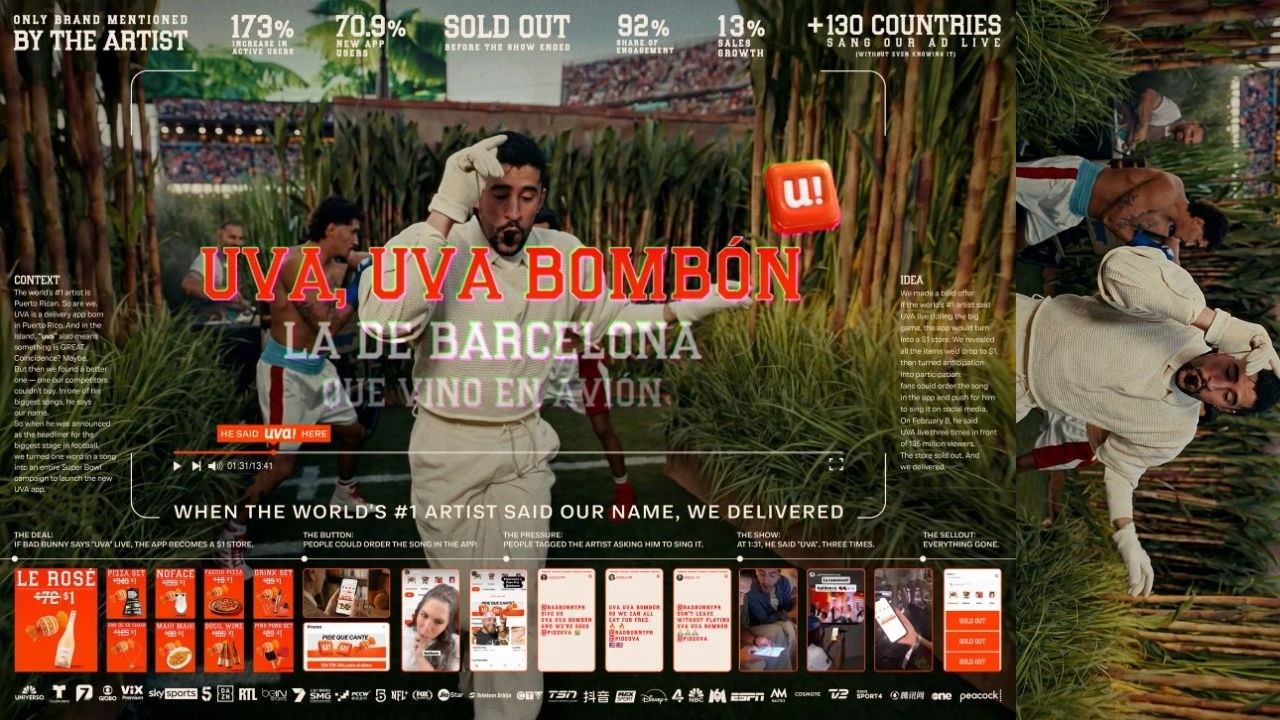
Uva App: Uva Uva Bombón
Cannes Lions 2026 Grand Prix

Absolut Vodka & TABASCO: Absolut Tabasco
Golden Drum 2026 Grand Prix
The 4 types of brand strategy
When people ask for "the four brand strategies", they usually mean Kotler's options for growing a brand into new products. They are really decisions about brand architecture.
Line extension
Same brand, new variant in the same category: a flavour, a size, a format. Cheap and low risk, and the most common way brands grow their range.
Brand extension
Same brand, new category. It borrows trust you already built, and works when the new product fits what people already believe about you.
Multibrand
Several separate brands in one category, each aimed at a different need or price point. More shelf space and more choice, at the cost of splitting the budget.
New brand
A fresh name when the existing brand would hurt the new product or the new product would hurt the brand. The most expensive option, so it needs a real reason.
Five ways brand strategies fail
Mistaking the logo for the strategy
Identity is the visible output. The strategy is the decision about what to be known for and for whom. Redesigning the first without the second is redecorating a house with no foundations.
Targeting too narrowly
Brands grow mostly by winning more buyers, many of them light and occasional (Sharp, How Brands Grow). A persona of one 34-year-old yoga teacher is a creative device, not a media plan.
Chasing difference instead of distinctiveness
Being meaningfully different matters less than being easy to recognise and easy to think of when buying. Distinctive assets do more work than a clever differentiator nobody remembers.
Changing it every year
Brand effects build over years (Binet & Field, The Long and the Short of It). A new strategy with every new marketing director resets the memory you paid for.
Purpose as a slogan
Purpose wins when the brand does something about it. In our data, turning values into action wins Grand Prix far more often than building a brand myth.
Where to go from here
- Brand strategy frameworks - the Brand Onion, Pyramid, Key, Prism and the rest, with live diagrams and worked examples.
- 50 Shapes of Strategy - our ebook with 50 frameworks and printable templates.
- Creative strategy techniques - every move from the data above, with the campaigns that used it.
- Campaign library - 1,955 campaigns, each broken down with the 4C framework.