Distinctive Brand Assets
The Non-Logo Codes That Make You Findable
Here's an uncomfortable truth from the Ehrenberg-Bass Institute: most of the time, people don't choose your brand. They notice it, or they don't. The vast majority of buying happens on autopilot, in three seconds, by someone who isn't thinking about you at all until the moment they're standing in front of the shelf or scrolling past the ad. Distinctive Brand Assets are the shortcut that makes you get noticed and correctly tagged in that three seconds - the colour, the character, the sound, the shape that triggers oh, that's them before anyone reads a single word.
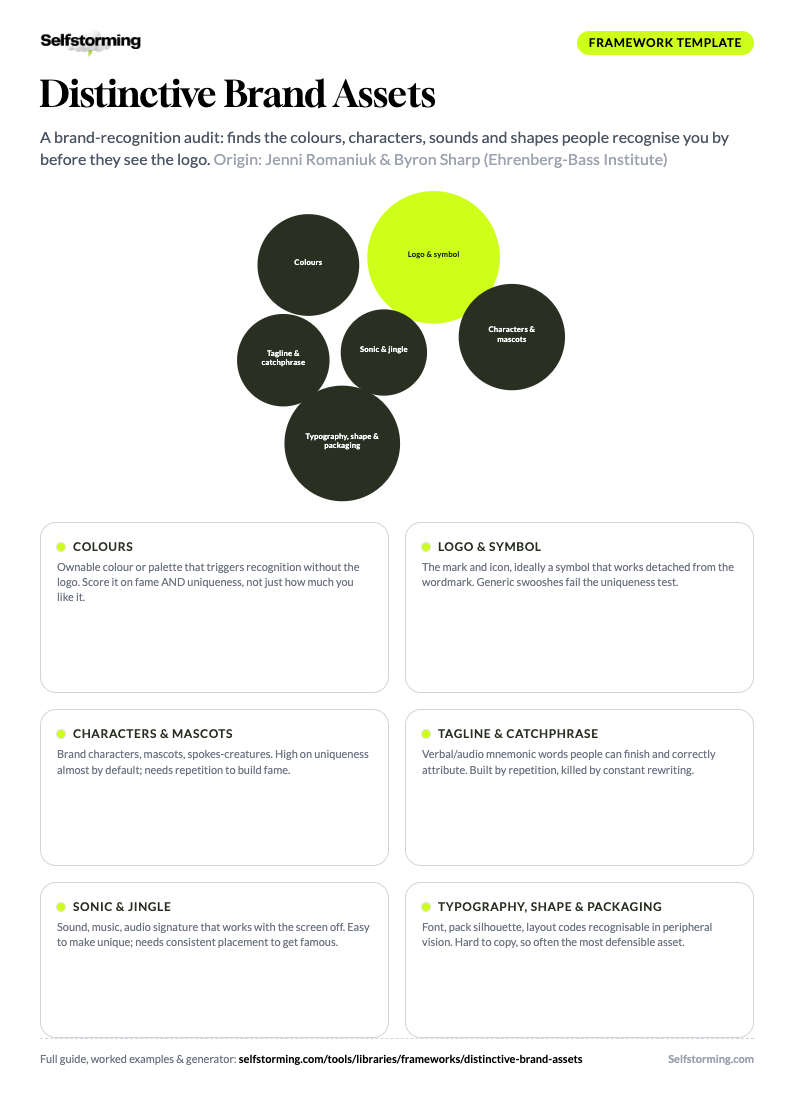
Print it. Fill it in.
The Distinctive Brand Assets as a printable A4 worksheet - write straight into the framework, on paper or in any PDF app.
Download the PDF templateKnowledge Worth Paying For
A working library of brand strategy frameworks - with worked examples on real brands, sources, and decision criteria. Not vibes.
One good deck covers the subscription. The rest is profit.
Distinctive Brand Assets are the non-logo codes - colour, logo/symbol, characters, tagline, sound, typography/shape/packaging - that let people identify your brand fast, without reading the name. The rule that decides everything: an asset is only worth investing in if it scores high on both fame (how many people link it to you) and uniqueness (how few other brands they link it to). High on one and low on the other is a liability. Build assets to drive mental availability, use them with boring consistency, and stop "refreshing" the ones that work.
Cadbury
Confectionery / FMCG (UK, founded 1824, owned by Mondelez)The textbook case for treating colour, character, and a hero idea as defensible infrastructure rather than decoration. Cadbury's purple is so distinctive the brand spent years in court trying to trademark the shade outright, and its most famous ad (a gorilla playing drums to Phil Collins) sold nothing rationally while doing enormous work for mental availability. It's a masterclass in fame times uniqueness across multiple asset types.
Cadbury Dairy Milk purple (Pantone 2685C) - so high on both fame and uniqueness that Cadbury fought a multi-year legal battle to trademark it. Cover the logo and the colour alone says Cadbury.
The flowing handwritten 'Cadbury' wordmark, based on a founder's signature - high uniqueness because cursive scripts are hard to mistake for a rival, consistently used across the whole range.
The drumming gorilla and, longer-running, the 'glass and a half' visual mnemonic - characters/symbols that carry the brand emotionally without needing the name.

Specsavers
Optical retail chain (UK / Channel Islands, founded 1984)Proof that a single verbal asset, repeated with iron discipline, can outgrow the entire category. 'Should've gone to Specsavers' escaped advertising and became everyday language for any avoidable mistake - which is the rarest, highest-value thing a distinctive asset can do. The brand name is baked into the catchphrase, so every use is free attribution. It scores near the top on both fame and uniqueness despite an otherwise unglamorous category.
Bold green-and-white retail identity - consistent across stores and ads, doing the recognition work at the high-street level.
The clean Specsavers wordmark inside the green block - simple, stable, and never 'refreshed' into obscurity.
Recurring comedic everyman scenarios (the person who clearly didn't go to Specsavers) - a repeatable narrative device rather than a single mascot.
Mailchimp
Marketing SaaS (USA, founded 2001, acquired by Intuit 2021)The B2B/SaaS counter-argument to 'distinctive assets are an FMCG thing.' In a category drowning in blue logos and stock-photo dashboards, Mailchimp leaned into a winking chimp mascot, an ownable Cavendish-yellow, and a deliberately odd hand-drawn illustration style. Freddie the chimp scores high on uniqueness almost by definition - nobody else has him - and the brand's commitment to weird, consistent codes made it findable in a sea of sameness.
Cavendish yellow - a genuinely ownable colour in a category that defaults to corporate blue, high on uniqueness because rivals won't go there.
Freddie the chimp's winking head, which works as a standalone symbol detached from the wordmark - a rare feat for a SaaS mark.
Freddie the chimp himself plus a cast of strange hand-drawn creatures - flexible, story-friendly, and impossible for competitors to copy without looking like thieves.
Cadbury, Specsavers, Mailchimp - filled in, line by line. Unlock to read them.
Cadbury (Confectionery / FMCG (UK, founded 1824, owned by Mondelez))
The textbook case for treating colour, character, and a hero idea as defensible infrastructure rather than decoration. Cadbury's purple is so distinctive the brand spent years in court trying to trademark the shade outright, and its most famous ad (a gorilla playing drums to Phil Collins) sold nothing rationally while doing enormous work for mental availability. It's a masterclass in fame times uniqueness across multiple asset types.
Colours: Cadbury Dairy Milk purple (Pantone 2685C) - so high on both fame and uniqueness that Cadbury fought a multi-year legal battle to trademark it. Cover the logo and the colour alone says Cadbury.
Logo & symbol: The flowing handwritten 'Cadbury' wordmark, based on a founder's signature - high uniqueness because cursive scripts are hard to mistake for a rival, consistently used across the whole range.
Characters & mascots: The drumming gorilla and, longer-running, the 'glass and a half' visual mnemonic - characters/symbols that carry the brand emotionally without needing the name.
Tagline & catchphrase: 'A glass and a half in everyone' - a verbal-plus-visual code unique to Cadbury, tied to the literal milk content, repeated for generations.
Sonic & jingle: The Phil Collins 'In The Air Tonight' drum fill became borrowed-but-ownable through the gorilla spot - and Cadbury's later use of distinctive, joyful music beds.
Typography, shape & packaging: The chunky Dairy Milk bar shape and purple foil packaging silhouette - a pack code recognisable in peripheral vision at the till.
Specsavers (Optical retail chain (UK / Channel Islands, founded 1984))
Proof that a single verbal asset, repeated with iron discipline, can outgrow the entire category. 'Should've gone to Specsavers' escaped advertising and became everyday language for any avoidable mistake - which is the rarest, highest-value thing a distinctive asset can do. The brand name is baked into the catchphrase, so every use is free attribution. It scores near the top on both fame and uniqueness despite an otherwise unglamorous category.
Colours: Bold green-and-white retail identity - consistent across stores and ads, doing the recognition work at the high-street level.
Logo & symbol: The clean Specsavers wordmark inside the green block - simple, stable, and never 'refreshed' into obscurity.
Characters & mascots: Recurring comedic everyman scenarios (the person who clearly didn't go to Specsavers) - a repeatable narrative device rather than a single mascot.
Tagline & catchphrase: 'Should've gone to Specsavers' - the crown jewel. High fame, total uniqueness, brand name inside the line, used in real conversation about any mistake.
Sonic & jingle: Consistent comedic timing and a recognisable ad structure (setup, blunder, punchline-tag) that functions as an audio-narrative signature.
Typography, shape & packaging: The blocky green panel layout and consistent ad composition - a structural code that reads as Specsavers before the joke even lands.
Mailchimp (Marketing SaaS (USA, founded 2001, acquired by Intuit 2021))
The B2B/SaaS counter-argument to 'distinctive assets are an FMCG thing.' In a category drowning in blue logos and stock-photo dashboards, Mailchimp leaned into a winking chimp mascot, an ownable Cavendish-yellow, and a deliberately odd hand-drawn illustration style. Freddie the chimp scores high on uniqueness almost by definition - nobody else has him - and the brand's commitment to weird, consistent codes made it findable in a sea of sameness.
Colours: Cavendish yellow - a genuinely ownable colour in a category that defaults to corporate blue, high on uniqueness because rivals won't go there.
Logo & symbol: Freddie the chimp's winking head, which works as a standalone symbol detached from the wordmark - a rare feat for a SaaS mark.
Characters & mascots: Freddie the chimp himself plus a cast of strange hand-drawn creatures - flexible, story-friendly, and impossible for competitors to copy without looking like thieves.
Tagline & catchphrase: Distinctive, plain-spoken voice and naming ('Mailchimp,' the cheeky tone) rather than a single slogan - a verbal code built on personality and repetition.
Sonic & jingle: Quirky audio identity in brand films and the 'MailKimp' mispronunciation moment - playful sound cues that reinforce the off-kilter character.
Typography, shape & packaging: Cooper Light display type and a deliberately hand-drawn, imperfect illustration system - a structural style recognisable before you read a word.
1. Colours
Is there a colour or palette people link to us specifically - and would they still know it's us with the logo removed?
An ownable colour or colour pairing that triggers recognition before any name is read. The strongest colour assets are defended in court, used on everything, and survive the test where you cover the logo and people still know who it is. Score it on both axes: a colour can be famous for your brand yet shared with five competitors, which makes it pretty wallpaper, not an asset.
Good answer: Cadbury's purple (Pantone 2685C), so distinctive Cadbury fought a multi-year legal battle to trademark it. Tiffany blue. Both are high fame AND high uniqueness - cover the logo and the colour alone does the identifying.
Wrong answer: We use blue because we're trustworthy. So does every bank, airline, and SaaS on Earth. High recognition, zero ownership - you're spending budget reminding people the category exists, not that you do.
2. Logo & symbol
Does our mark or icon work on its own, stripped of the wordmark - and could a competitor's symbol be mistaken for ours?
The mark and the icon that can detach from the name and still carry it. The valuable version is the symbol that works alone - the swoosh, the bitten apple, the bird - because a standalone symbol is the highest-leverage shortcut a brand can own. Most logos fail the uniqueness test: generic abstract swooshes and gradient circles are famous to nobody and shared by everybody.
Good answer: McDonald's Golden Arches - an "M" so distinctive it functions as a roadside beacon with no words attached. High fame, near-total uniqueness. People navigate by it.
Wrong answer: A friendly abstract swoosh in a circle. Indistinguishable from four hundred other tech logos. Redrawing it every three years guarantees it never accumulates enough fame to matter on either axis.
3. Characters & mascots
Do we have a character, creature, or face that carries the brand on its own - and is it unmistakably ours, not a generic category prop?
Brand characters, mascots, and spokes-creatures - the most flexible distinctive asset, because a character can move across formats, tell stories, and age without you. Romaniuk rates strong characters highly: they're hard for competitors to copy and they score on uniqueness almost by definition, because nobody else has your exact creature. The risk is fame - a character only an internal team recognises is an expensive in-joke.
Good answer: Compare the Market's meerkats (Aleksandr Orlov). A whole cast that became more famous than the price-comparison category itself - high fame, total uniqueness, and they made an unsexy product memorable for a decade.
Wrong answer: A generic smiling cartoon person who appears once on the homepage. No story, no repetition, no recognition. A mascot used twice a year never crosses the fame threshold and might as well not exist.
4. Tagline & catchphrase
Is there a verbal mnemonic people can finish for us - and would they attribute it to us, not to a rival?
The words and verbal/audio mnemonics people can complete on their own. The asset isn't the slogan's cleverness - it's whether the phrase has been repeated long enough to become a fill-in-the-blank that people correctly attribute to you. A catchphrase scores high on uniqueness when the wording is yours alone, and high on fame only after years of disciplined repetition most brands abandon too early.
Good answer: Specsavers' "Should've gone to Specsavers." A catchphrase so embedded that people use it in everyday conversation about any mistake - high fame, and the brand name is baked into the line itself, so attribution is automatic.
Wrong answer: Changing the tagline with every campaign. A line gets famous through repetition; swapping it annually resets the counter to zero and the verbal asset never compounds into anything anyone can finish.
5. Sonic & jingle
Do we have a sound, jingle, or audio signature people recognise with their eyes shut - and is it ours alone?
Sound, music, and audio signatures - the asset that works when nobody is looking at the screen, which is most of the time in audio and video. A few notes can do what a logo can't: trigger recognition through earbuds, smart speakers, and skippable pre-roll. Sonic assets often score very high on uniqueness (a melody is easy to make distinctively yours) but require consistent placement to build the fame that makes them worth the studio time.
Good answer: Intel's five-note bong ("Intel Inside"). Three seconds of sound that identifies a component buried inside a laptop you can't even see. High fame, total uniqueness, recognisable with the screen off.
Wrong answer: Licensing a different trending track for every ad. You rent recognition you never get to keep. The borrowed song gets famous; your brand gets nothing on either axis when the licence expires.
6. Typography, shape & packaging
Could someone identify us from the font, the pack silhouette, or the layout alone - before reading a word?
Typography, packaging shape, and layout codes - the quiet structural assets that do enormous work at the shelf and in the feed. A pack silhouette, a custom typeface, or a repeatable layout grid can be recognised in peripheral vision. These score well on uniqueness when the shape or type is genuinely proprietary, and they're often the most defensible assets a brand owns because they're physically hard to copy without looking like a knock-off.
Good answer: Aldi's deliberately unbranded, blocky pack-and-shelf system - the cardboard-box-on-pallet look is so consistent it's instantly "Aldi" before you read anything. The structural code does the identifying. The Toblerone triangular bar is the same logic in physical form.
Wrong answer: A different Google Font on every channel. Shared by ten thousand sites, owned by none. Typography only becomes an asset when it's distinctive and used everywhere long enough to register - not when it's whatever the latest deck template shipped with.
Decide your starting point: You don't need a research budget to begin. Right here on Selfstorming you can generate a first-draft distinctive assets audit in minutes - a structured list of your candidate assets across all six types, ready to pressure-test. Treat that draft as the inventory, then run it through the steps below to score it and validate it against the real market.
List every candidate asset across the six types: Walk your packaging, ads, website, app, social, and out-of-home. Write down every colour, symbol, character, catchphrase, sound, font, and shape you currently use. Most teams are shocked to find they have nine half-used codes and no idea which ones anyone recognises.
Score each candidate on fame AND uniqueness: For every asset ask two separate questions. Fame: what share of category buyers link this to us? Uniqueness: of those who recognise it, how many link it to us and only us? Plot them. Ideally use real prompted-recognition tracking; if you have none, get rough proxy reads from customer interviews, sales staff, and a brutally honest team session - and flag that you're estimating.
Sort the grid into invest, build, fix, or drop: High fame + high uniqueness = protect and use relentlessly, never touch it. Low fame + high uniqueness = invest, it has room to grow. High fame + low uniqueness (shared with the category) = fix or replace, it's leaking budget to rivals. Low + low = drop, it's clutter pretending to be branding.
Invest in the strong few, not the weak many: Distinctive assets are built through repetition over years, so concentration beats spread. Pick the one or two assets with the best fame-uniqueness trajectory and over-invest in them rather than thinly maintaining six mediocre ones. A brand can own a colour and a character; it cannot own everything at once.
Lock a usage standard and defend it: For each asset you're keeping, write the non-negotiable rules - the exact colour values, the mandatory placements, the protected wording. Distinctiveness dies by a thousand well-meaning tweaks, so the audit's real output is a short list of things nobody is allowed to redesign without proving the recognition data has changed.
Use them consistently, everywhere, for longer than feels comfortable: The single biggest source of wasted asset value is abandoning a working code before it has compounded. Repeat across every touchpoint, resist the internal boredom that screams "refresh," and re-measure fame and uniqueness annually rather than restyling annually.
Re-audit, don't re-brand: Once a year, re-score the assets against fresh recognition data. Promote the climbers, retire the ones that never gained fame, and otherwise leave the winners alone. The healthy pattern is stable assets and evolving campaigns - not the reverse.
Best for: Auditing and building the non-logo codes that make a brand recognisable fast - colour, character, sound, shape - to grow mental availability. Strongest when distribution and quality are already sorted and the problem is 'nobody notices us.' / Defining what the brand means, where it competes, or what it should say. The asset audit assumes you already know who you are - it just makes you findable.
Output: A scored inventory of candidate assets across six types, each plotted on a fame-by-uniqueness grid, sorted into invest / build / fix / drop, plus a locked usage standard for the winners. / A mood board of pretty visuals or a 'brand world' deck. Distinctive assets are about measured recognition, not aesthetic ambition.
Time to complete: A first inventory and rough scoring in a day or two; a credible audit in a few weeks if you commission real recognition tracking. The build phase, by contrast, takes years of consistent use. / Anything promising overnight distinctiveness. Assets compound slowly - the framework is fast to apply but the payoff is patient.
vs Brand Onion: Distinctive Brand Assets is outward and behavioural - it asks 'can buyers identify us in three seconds?' Use it to make the brand findable in the real, distracted world. / The Brand Onion is inward and definitional - it asks 'what is this brand, from skin to soul?' Use the Onion first to decide who you are, then the asset audit to make that identity recognisable.
vs Brand Archetypes: Distinctive Brand Assets cares only about recognition and ownership - fame and uniqueness, measured. It's agnostic about personality narrative. / Brand Archetypes gives the personality a story (Hero, Jester, Outlaw) that can inspire which character or tone to build - an input to your assets, not a measure of whether they work.
vs Positioning Statement: Distinctive Brand Assets is about being noticed and correctly attributed - the recognition layer. It deliberately ignores the argument. / A Positioning Statement is about being preferred - the meaning and choice layer. The two are complementary: assets get you into the consideration set, positioning earns the pick.
Distinctive Brand Assets were codified by Jenni Romaniuk and Byron Sharp at the Ehrenberg-Bass Institute for Marketing Science (University of South Australia). The concept grew out of Sharp's How Brands Grow (2010), which argued that brand growth depends on physical availability and mental availability - the propensity of a brand to be noticed and thought of in buying situations - far more than on persuasion or claimed differentiation. Romaniuk developed the idea into a working method in Building Distinctive Brand Assets (2018), introducing the dual metric of fame (the share of category buyers who correctly link the asset to the brand) and uniqueness (how exclusively they link it to that brand and no other), plotted on a grid that tells brands which assets to invest in, build, fix, or drop. The institute's empirical, behaviour-first stance - that buyers are light, distracted, and choosing on autopilot - is what separates this from earlier, more aspirational identity models.
The biggest practical critique is that the fame-times-uniqueness grid demands real prompted-recognition tracking data that most brands simply don't have - so the method often gets applied on gut feel, producing a confident-looking chart with no evidence underneath. The deeper critique is philosophical: by optimising relentlessly for recognition, teams risk treating distinctive assets as a substitute for meaning rather than a vehicle for it. A brand can become famously identifiable and stand for nothing anyone wants to buy. Critics also note the framework deliberately says little about message, positioning, or where to compete - which is fine if you remember it's a recognition tool, and dangerous if you mistake 'we are recognisable' for 'we have a strategy.' Used honestly - measured where possible, paired with real meaning, and applied to a brand that already knows who it is - the pushback mostly evaporates.
What are distinctive brand assets?
Distinctive brand assets are the non-logo brand codes - colours, symbols, characters, taglines, sounds, typography, and pack shapes - that let people identify a brand quickly, often without reading the name. The concept comes from Jenni Romaniuk and Byron Sharp at the Ehrenberg-Bass Institute. Their purpose is to build mental availability: making the brand easy to notice and recall in the split-second, autopilot moments when most buying decisions actually happen.
What's the difference between distinctive and differentiated?
Distinctive means recognisable - people can tell it's you. Differentiated means meaningfully better or different in what you offer. Ehrenberg-Bass research argues that distinctiveness drives growth far more reliably than claimed differentiation, because most buyers don't perceive or care about the fine differences brands obsess over - but they do reward being easy to recognise and recall. You want both, but if you have to choose where to start, make yourself findable before you make yourself special.
How do I measure fame and uniqueness?
Fame is the share of category buyers who link an asset to your brand when prompted. Uniqueness is, among those who recognise it, how exclusively they attribute it to you versus competitors. Ideally you measure both with prompted-recognition surveys among real buyers and plot them on a grid. If you have no budget for tracking, triangulate with customer interviews, frontline staff, and blind logo-off tests - and be honest that the scores are estimates, not evidence.
Which is the most powerful distinctive brand asset?
There's no single winner - it depends on your category and media - but Romaniuk's research consistently rates characters and standalone symbols highly, because they're flexible, hard for rivals to copy, and score on uniqueness almost by definition. Colours and sonic assets are powerful too, especially in cluttered or screen-off environments. The real answer is whichever asset you can make both famous and unique, then commit to for years.
How is Distinctive Brand Assets different from a Brand Onion?
The Brand Onion is inward-facing - it defines what the brand is, from outer attributes down to inner essence. Distinctive Brand Assets is outward-facing - it asks whether buyers can recognise you in three seconds in the real world. Use the Onion first to decide who you are, then the asset audit to make that identity findable. One is about meaning; the other is about memory.
Can distinctive brand assets work for B2B and SaaS brands?
Yes, and the upside is often bigger because B2B categories are visually identical - endless blue logos and stock-photo dashboards. A brand like Mailchimp, with its yellow, its chimp, and its weird hand-drawn style, became instantly recognisable precisely because rivals played it safe. The mechanics are the same: build codes that score on fame and uniqueness, then repeat them everywhere for longer than feels comfortable.
How long does it take to build a distinctive brand asset?
Auditing existing assets takes days to a few weeks. Building a new one into genuine fame takes years of consistent use - distinctiveness compounds through repetition, the same way a tagline only becomes a fill-in-the-blank after you've heard it a hundred times. This is why the framework's most important rule is also its least exciting: pick your codes, then resist the urge to change them.
Why shouldn't I refresh my logo and colours regularly?
Because every refresh resets the recognition you've spent years and money building. Distinctive Brand Assets argues that consistency is the asset - the value lives in the accumulated link between the code and your brand in buyers' memories. Internal boredom is not a strategic reason to rebrand. The honest test is the data: re-measure fame and uniqueness, and only change a working asset if the numbers say it has stopped working.
A brand-recognition audit: finds the colours, characters, sounds and shapes people recognise you by before they see the logo.
Jenni Romaniuk's contribution, building on Byron Sharp's How Brands Grow, was to stop treating these codes as decoration and start treating them as measurable infrastructure. The test is brutal and simple. An asset is worth money only if it scores high on two things at once: fame (how many people link it to your brand) and uniqueness (how few other brands they link it to). A famous asset that everyone else also owns is wallpaper. A unique asset nobody recognises is a private joke. You need both, and most brands have neither - they have a logo they keep shrinking and a palette they keep "refreshing" every time a new CMO arrives.
This page walks through the six asset types worth auditing, the fame-and-uniqueness logic that decides which ones deserve your budget, and how to stop accidentally throwing away the few codes you actually own.
Related Frameworks
Brand Onion
Five concentric layers from outer to inner: Attributes (provable product facts), Benefits (functional + emotional outcomes), Personality (ho
Brand Pyramid
Four levels, bottom to top: Salience (do people know you, and for what?), Meaning (what are you - performance facts plus imagery association
Brand Archetypes
Twelve characters drawn from Jungian psychology, grouped into four families by core human motivation: Independence & Fulfillment (Innocent,
Brand Ladder
The Brand Ladder is a five-rung model that climbs from Features (what it is) to Functional benefits (what it does for you) to Emotional bene