Playing to Win
How to Make Five Strategic Choices That Actually Cohere
Most strategy decks are a wish dressed up as a plan. They list goals, add a few initiatives, sprinkle in a mission statement, and call it strategy. Playing to Win calls that bluff. It argues that strategy is not a document or a vision - it's a set of choices, and choices, by definition, mean you said no to something. If your strategy could be true for your three biggest competitors at the same time, you don't have one. You have a brochure.
Print it. Fill it in.
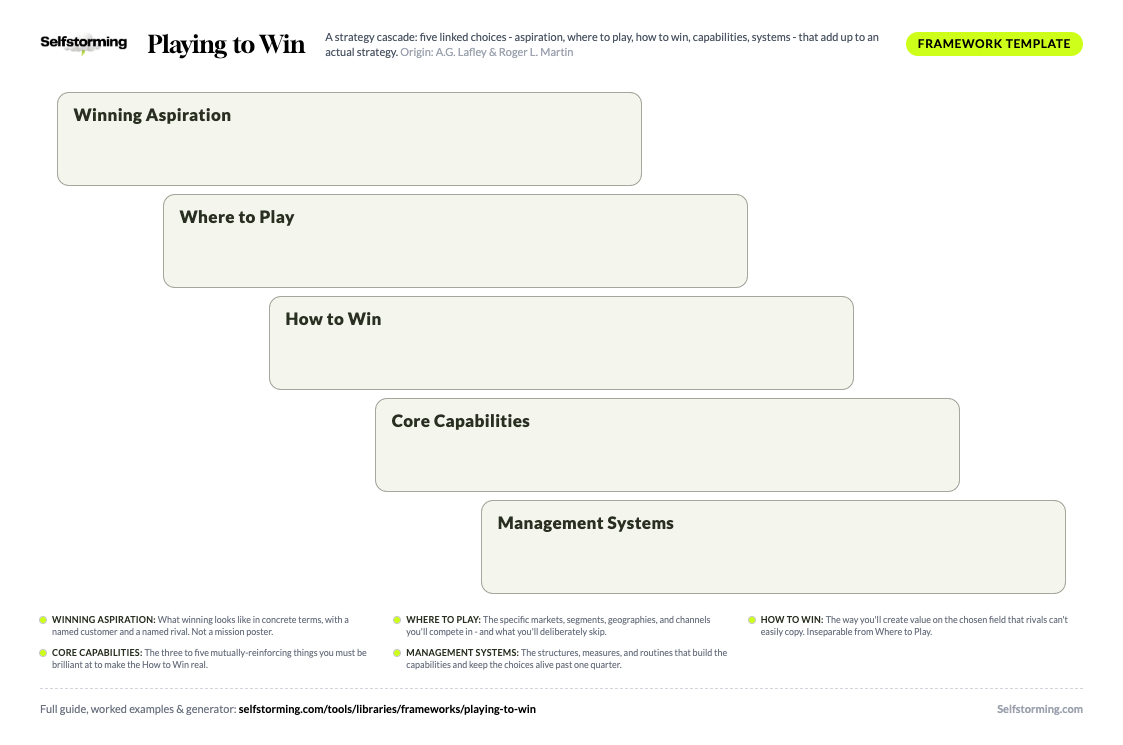
The Playing to Win as a printable A4 worksheet - write straight into the framework, on paper or in any PDF app.
Download the PDF templatePLAYING TO WIN
A strategy cascade: five linked choices - aspiration, where to play, how to win, capabilities, systems - that add up to an actual strategy.
The framework, from A.G. Lafley and Roger L. Martin, is built as a cascade of five linked questions. Each answer constrains the next, so the whole thing has to hang together or it falls apart. The discipline isn't in answering the questions - any team can do that in an afternoon. The discipline is in making the answers cohere, and in being honest enough to admit when where you want to play and how you think you'll win are quietly contradicting each other. This page walks through each of the five choices, the question that unlocks it, and how to tell a real cascade from a confident-sounding one.
What is Playing to Win?
Five linked choices, top to bottom: Winning Aspiration (what winning looks like, for whom), Where to Play (the specific market, segment, geography, channel you'll compete in), How to Win (the way you'll create value there that rivals can't easily copy), Core Capabilities (the handful of activities you must be brilliant at), and Management Systems (the structures and measures that keep the choices alive). The rule that makes it work: every choice must reinforce the one above and below it. A cascade where Where-to-Play and How-to-Win don't fit each other isn't a strategy - it's two strategies arguing.
Worked Examples
Three real brands. Different categories, different sizes. Same framework, filled in.
Procter & Gamble (Olay)
FMCG skincare turnaround (the origin case behind the book, early 2000s)The case Lafley and Martin built the framework on. Olay was a dying 'oil of old ladies' brand; the team chose a precise field (the 'masstige' gap between drugstore and department-store skincare) and a precise way to win (prestige-grade efficacy at a mass-accessible $18.99 price), then rebuilt capabilities and systems to match. It became a multi-billion-dollar brand.
On (On Running)
Swiss performance footwear challenger (founded 2010, IPO 2021)A textbook narrow Where-to-Play / How-to-Win pairing. On didn't try to out-spend the footwear giants everywhere. It chose the premium performance-running niche and a patented cushioning system as its way to win, then expanded outward only once the cascade was proven - the disciplined opposite of 'compete with everyone.'
Whoop
Wearable recovery-tracking subscription (founded 2012, fitness-tech)A cascade that bet everything on one inseparable Where-to-Play / How-to-Win choice: serious athletes who care about recovery, won via a screenless, subscription-only band. Removing the screen and charging a membership instead of a device price are choices most hardware rivals literally can't make without breaking their own model.
The 5 Layers, One By One
Each one answers a specific question - here is how to fill it in, and how to tell a sharp answer from a lazy one.
1. Winning Aspiration
What does winning actually look like for us, and who specifically are we beating to get there?
The purpose of the enterprise and what winning means in concrete terms. Not a mission poster - a definition of victory specific enough that you'd know whether you achieved it. Frame it around real customers won and real rivals beaten, not abstract leadership.
Be the default running shoe of the sub-3-hour marathon crowd before the legacy giants notice the niche exists (the kind of aspiration On built early on). Specific buyer, specific rival, specific finish line.
To be the leading innovative player in our space. Leading by what measure? Beating whom? An aspiration that fits every company in the category is an aspiration that constrains nothing below it.
2. Where to Play
In which specific markets, segments, geographies, channels, and stages of the value chain will we compete - and which will we deliberately ignore?
The playing field. The set of choices about where you will and won't compete. Its power is in the exclusions - the segments you walk past on purpose are what make the chosen field defensible.
Premium oat-based coffee drinks, sold through independent baristas first, in cities before supermarkets (Oatly's early field). The narrowness is the point - it concentrates force where rivals aren't looking.
The global wellness market. A field that big isn't a choice, it's a fantasy. If you haven't named what you're skipping, you haven't chosen where to play - you've described the economy.
3. How to Win
Within the field we chose, how will we create value for customers in a way that competitors can't easily copy or won't want to match?
The way you'll win on the chosen field - cost leadership, differentiation, or a sharp combination. This is the choice Martin himself flags as the hardest and the most often faked. It must be inseparable from Where to Play: change the field and the winning logic changes with it.
Win on speed and craft obsession that bigger, slower incumbents structurally can't match (Linear vs legacy issue trackers). The advantage is built into how they operate, not bolted on as a feature.
By delivering superior quality and great customer service. Everyone claims this, nobody is uniquely positioned to deliver it, and it survives no rival's counter-move. A list of nice initiatives is not a way to win.
4. Core Capabilities
What handful of things must we be genuinely brilliant at - reinforcing each other - to make our How to Win real?
The set of activities and competencies that must be in place and work together to win the chosen way. A short, mutually-reinforcing list, not an inventory. If a capability doesn't directly serve the How to Win, it doesn't belong here.
Direct-to-consumer storytelling, fast iterative product release, and a fanatical community-building muscle - three capabilities that compound rather than just coexist. Pull one and the win logic wobbles.
Operational excellence, talent, technology, and customer focus. Every company would list these. A capability is only 'core' if a competitor would struggle to replicate it and it's directly tied to how you win - otherwise it's just a department.
5. Management Systems
What structures, measures, and routines do we need so these choices survive contact with quarterly reality?
The systems that build, support, and measure the capabilities - hiring, planning, metrics, incentives, review cadences. The unglamorous layer that determines whether the strategy lives in the org or dies in the deck. Skip it and the cascade reverts to business-as-usual within two quarters.
A weekly community-health metric reviewed by leadership, hiring scorecards built around the three core capabilities, and a planning cycle that funds the chosen field first. The systems make the choices unavoidable, not optional.
We'll track it in the usual quarterly review. The usual review measures the usual things, which are exactly the things the new strategy was supposed to change. If your measurement didn't change, your strategy didn't either.
Origin & Lineage
Playing to Win was published by Harvard Business Review Press in 2013, written by A.G. Lafley, the former Chairman and CEO of Procter & Gamble, and Roger L. Martin, then Dean of the Rotman School of Management at the University of Toronto. Martin has written that the underlying Strategy Choice Cascade was not invented for the book - he traces its first rudimentary version to a 1987 Monitor Company assignment for Eaton Corporation's truck-axle business, then refined it over the next decade, first drawing the five-question cascade around 1995-96 during work with P&G. The book codified the approach into five linked choices and grounded it in the P&G turnaround Lafley led from 2000 to 2009. It won the Thinkers50 Best Book Award for 2012-2013 and became one of the best-selling strategy books ever published.
Critics
The fairest criticism comes partly from Roger Martin himself: the five questions look simple, but the How-to-Win choice is the one teams answer worst, often filling it with a list of initiatives that fails the basic test of strategy. The cascade can also feel top-down and executive-led - it describes the choices a leadership team must make but says comparatively little about how to involve the wider organisation, or about execution speed and sequencing once the choices are set. Used honestly, it's a tool for forcing real choices and then pressure-testing whether they cohere - not a guarantee that the choices are correct. The framework picks the battlefield; it doesn't fight the battle for you.
How To Build It
A workshop flow that produces a usable v1 in a day - with the right people in the room, or just you and a Selfstorming strategy session right here.
Decide your starting point
You don't need a blank whiteboard and a two-day offsite to begin. Right here on Selfstorming you can find inspiration and directions, or generate a first-draft Playing to Win in minutes. Treat that draft as a head start, then run it through the steps below to pressure-test the choices against the real market. Workshop-from-scratch and AI-draft-then-stress-test are both valid; most teams move faster starting from a draft.
Write down the strategy you're already running
Before you choose anything new, reverse-engineer your current cascade from where the money and people actually go. Most teams discover their real Where-to-Play is three times broader than the slide claims, and their How-to-Win is just 'work harder.' Naming the implicit strategy is half the battle.
Define winning before defining anything else
Force the team to write a Winning Aspiration with a named rival and a named customer. If you can't say who you're beating and for whom, stop here. Everything downstream inherits the vagueness of this line.
Choose Where to Play and How to Win together, never in sequence
This is the cascade's hard centre. Draft three or four field-plus-win pairs side by side and reject any pair where the field and the winning logic don't reinforce each other. A great How-to-Win on the wrong field still loses.
Stress-test each pair with the can't-be-true-for-rivals check
Take your leading Where-to-Play / How-to-Win pair and ask whether your two biggest competitors could write the exact same sentence. If they could, it isn't a strategy yet - it's an industry description. Sharpen until it's uniquely yours.
Reduce capabilities to a mutually-reinforcing few
List every capability the win seems to need, then cut to the three to five that directly serve the How to Win and strengthen each other. If pulling one wouldn't break the strategy, it isn't core - move it off the list.
Design the management systems that make the choices stick
For each core capability, name the hiring, metric, and review routine that will build and protect it. Then check your incentives - if bonuses still reward the old behaviour, the cascade is already dead, it just doesn't know it.
Run the whole cascade top-to-bottom and bottom-to-top
Read it down (does each choice constrain the next?) and up (do the systems and capabilities actually deliver the win on the chosen field?). Any seam that doesn't hold is your most useful finding - fix the choice, not the slide.
How This Framework Compares
| Aspect | When It Works | When It Doesn't |
|---|---|---|
| Best for | Setting or resetting whole-company or whole-business-unit strategy - deciding where to compete and how to win there. Founders, boards, and leadership teams making the big where/how choices. | Quarterly goal-setting, team execution tracking, or internal brand-identity work. The cascade chooses the battlefield; it doesn't run the daily campaign. |
| Output | A one-page cascade of five linked choices, each constraining the next, that you can read top-down and bottom-up without finding a contradiction. | A quarterly scorecard of objectives and metrics, or a SWOT grid of lists. Those describe conditions or targets; the cascade makes choices. |
| Time to complete | One to a few focused leadership sessions plus market validation - days to a couple of weeks. The five questions are fast; reconciling the answers is the work. | A 15-minute fill-in-the-blanks exercise. Speed-running the cascade is exactly how you end up with five contradictory boxes. |
| vs SWOT | Playing to Win forces integrated choices that exclude options. Use it when you need to decide and commit, not just survey the landscape. | SWOT is a four-quadrant inventory of strengths, weaknesses, opportunities, threats - a useful input, but it makes no choices. Use SWOT to gather raw material, then feed it into the cascade. |
| vs Porter's Five Forces | Playing to Win is the choice-making layer: given the industry, what will WE do. Use it to define your specific Where-to-Play and How-to-Win. | Porter's Five Forces is industry-structure analysis (rivalry, buyers, suppliers, entrants, substitutes). It diagnoses how attractive a market is, not how you'll win in it. Run it before the cascade as an input. |
| vs OKRs | Playing to Win sets the strategic choices - the why and the where/how. Use it to decide the direction before anyone sets a single goal. | OKRs are quarterly goal-setting and execution tracking. They move you toward a destination but never choose the destination. The cascade picks the battlefield; OKRs measure progress across it. |
Frequently Asked Questions
What is Playing to Win?
Playing to Win is a business strategy framework from A.G. Lafley and Roger L. Martin, set out in their 2013 book of the same name. It defines strategy as an integrated set of five linked choices - Winning Aspiration, Where to Play, How to Win, Core Capabilities, and Management Systems - arranged as a cascade where each choice constrains and reinforces the others. Its core claim is that strategy is choice, not planning: if your strategy doesn't rule anything out, it isn't a strategy.
Who created Playing to Win?
The book was co-authored by A.G. Lafley, former Chairman and CEO of Procter & Gamble, and Roger L. Martin, former Dean of the Rotman School of Management. Martin developed the underlying Strategy Choice Cascade through consulting work starting in the late 1980s; Lafley applied and proved it during the P&G turnaround he led from 2000-2009. They published Playing to Win with Harvard Business Review Press in 2013.
What are the five questions in Playing to Win?
What is our winning aspiration? Where will we play? How will we win? What capabilities must we have? What management systems do we need? They run as a cascade - each answer constrains the next, and the whole set has to cohere. Lafley and Martin stress that Where to Play and How to Win are the heart of the cascade and should be decided together, not in sequence.
Is Playing to Win the same as OKRs?
No. Playing to Win sets the strategic choices - where you compete and how you win - while OKRs are a quarterly goal-setting system for tracking progress toward a destination. The cascade picks the battlefield; OKRs measure how far you've advanced across it. They're complementary: run Playing to Win first to choose direction, then use OKRs to make the chosen capabilities and field measurable each quarter.
How is Playing to Win different from SWOT?
SWOT is an inventory - four quadrants of strengths, weaknesses, opportunities, and threats. It surveys the situation but makes no choices. Playing to Win is the opposite: it forces a team to choose where to play and how to win, deliberately excluding options. The honest way to use them together is to treat SWOT as raw material that feeds the Where-to-Play and How-to-Win decisions in the cascade.
Why is the How to Win box the hardest part of Playing to Win?
Because a real How-to-Win is a genuine source of advantage a rival can't easily copy, and most teams instead write a list of nice initiatives ('improve quality, invest in tech'). Roger Martin has openly said this box gets the lowest grade across most cascades. The test is simple: if your two biggest competitors could write the exact same sentence, you don't have a way to win - you have an industry description.
Does Playing to Win work for startups, or only big companies like P&G?
It works for both. The framework was proven at P&G's scale, but the logic - choose a narrow field, choose a defensible way to win there, build the few capabilities that serve it - is arguably even more important for a startup with limited resources. Challengers like On and Whoop effectively ran tight cascades by picking a precise niche and a hard-to-copy way to win before expanding outward.
How often should we revisit our Playing to Win cascade?
Review it annually as a sanity check, and deeply whenever something material shifts - a new competitor changes the field, a technology shift changes how you can win, or you enter a new market. The choices shouldn't churn every quarter; if your Where-to-Play and How-to-Win change that often, you never really committed to them. Stable core choices with adapting capabilities is the healthy pattern.
Sources & Further Reading
Related Frameworks
Marketing Funnel
Five stages from widest to narrowest: Awareness (people learn you exist), Consideration (they weigh you against alternatives), Conversion (t
OKRs
One Objective (qualitative, ambitious, memorable - the hill worth taking) plus three Key Results (numeric, measurable, with zero grey area -
SWOT Analysis
Four boxes, two axes: Strengths and Weaknesses are internal and controllable, Opportunities and Threats are external and mostly not. Left si
Eisenhower Matrix
Score every task on two axes: important (does it matter to your goals?) and urgent (does it need attention now?). That gives four boxes. Do