Porter's Five Forces
How to Read Where the Profit Actually Goes
Porter's Five Forces is the framework people quote to sound strategic and almost never use to make a decision. Done well, it answers one ruthless question - why is this industry profitable, or why isn't it? - and points you at the one or two forces actually draining the money. Done badly, it's a five-box template filled with everything you already knew, printed, and never opened again.
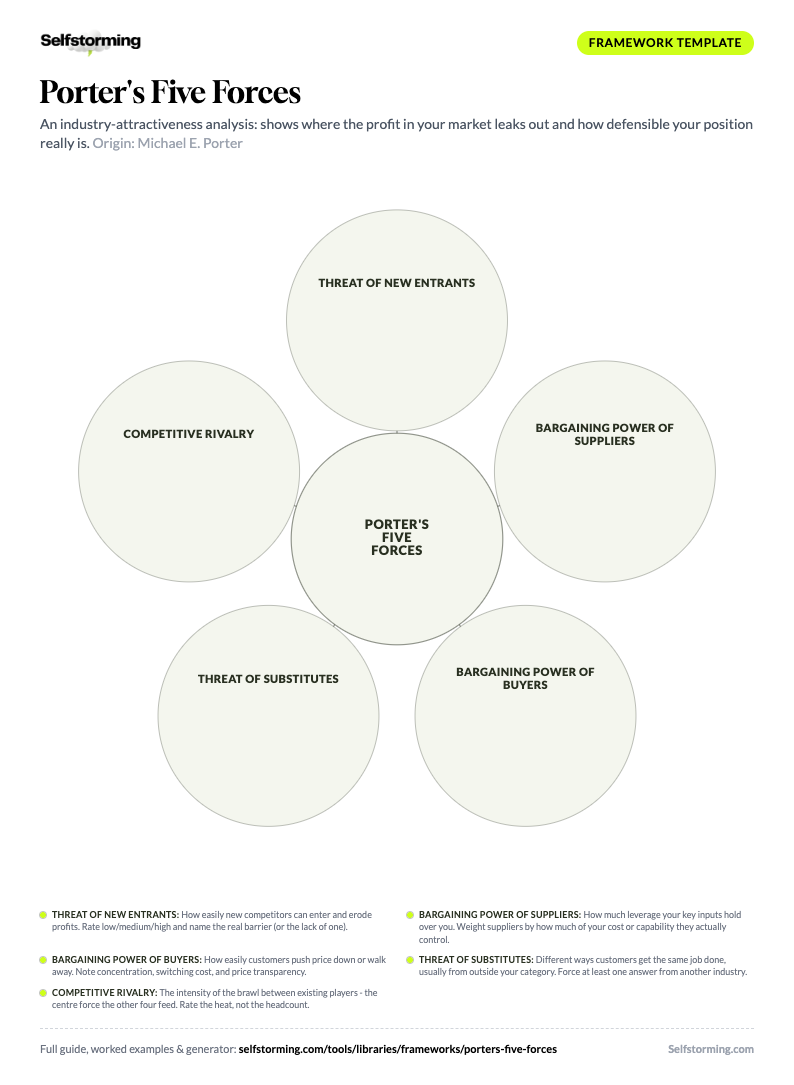
Print it. Fill it in.
The Porter's Five Forces as a printable A4 worksheet - write straight into the framework, on paper or in any PDF app.
Download the PDF templateKnowledge Worth Paying For
A working library of brand strategy frameworks - with worked examples on real brands, sources, and decision criteria. Not vibes.
One good deck covers the subscription. The rest is profit.
Five forces decide an industry's long-run profitability: Threat of New Entrants (how easy is it to copy you), Bargaining Power of Suppliers (who you depend on), Bargaining Power of Buyers (how easily customers push back on price), Threat of Substitutes (different ways to get the same job done), and Competitive Rivalry (the brawl in the middle). Strong forces drain profit out of the industry; weak ones leave it on the table. The point is to find the one or two forces that actually constrain you, then build strategy around moving them.
Spotify
Music streaming platform (Sweden, founded 2006)A near-perfect case of one force dominating all others. Spotify can have hundreds of millions of users and still run thin margins, because supplier power - the record labels - sits like a tax on the whole industry. Five Forces explains the puzzle that a huge, beloved product can be a structurally hard business.
Shein
Ultra-fast-fashion e-commerce (founded China, global since ~2017)Shows Five Forces used to explain a winner rather than diagnose a loser. Shein's edge isn't a single product - it's an on-demand supply chain that flips two forces (suppliers and entrants) in its favour. Reading the forces explains why incumbents struggled to copy it even after they saw exactly what it was doing.
Canva
Web-based design platform (Australia, founded 2012)A case where the framework's blind spot becomes the headline. Canva's most useful Five Forces reading is the threat that classic Porter underweights - substitutes and platform entrants powered by generative AI. It illustrates why you run the model and then deliberately stress-test the force the model tends to miss.
Spotify, Shein, Canva - filled in, line by line. Unlock to read them.
Spotify (Music streaming platform (Sweden, founded 2006))
A near-perfect case of one force dominating all others. Spotify can have hundreds of millions of users and still run thin margins, because supplier power - the record labels - sits like a tax on the whole industry. Five Forces explains the puzzle that a huge, beloved product can be a structurally hard business.
Threat of New Entrants: Medium. Catalogue licensing and capital make a from-scratch rival hard, but Apple, Amazon, and Google entered easily by bundling streaming into ecosystems they already owned.
Bargaining Power of Suppliers: Very high - the binding constraint. Three major labels control most of the music people actually want, take the majority of revenue as royalties, and could pull catalogue. The margin is set upstream.
Bargaining Power of Buyers: High. Switching costs are low (playlists aside), free tiers anchor willingness to pay, and price increases risk churn to a cheaper bundled rival.
Threat of Substitutes: Medium-high. YouTube, short-form video, podcasts, and just listening to the radio all compete for the same ears without paying for a subscription.
Competitive Rivalry: High. Differentiation is mostly UX and exclusives because everyone licenses the same catalogue, so competition collapses toward price and feature parity.
Shein (Ultra-fast-fashion e-commerce (founded China, global since ~2017))
Shows Five Forces used to explain a winner rather than diagnose a loser. Shein's edge isn't a single product - it's an on-demand supply chain that flips two forces (suppliers and entrants) in its favour. Reading the forces explains why incumbents struggled to copy it even after they saw exactly what it was doing.
Threat of New Entrants: Was low, now medium. The barrier turned out to be the real-time test-and-repeat supply network, not the website - which is why imitators copied the storefront but not the economics.
Bargaining Power of Suppliers: Low - the engineered advantage. A vast pool of small factories on micro-batch orders gives Shein the leverage; no single supplier can dictate terms.
Bargaining Power of Buyers: High. Price-sensitive young shoppers with zero switching cost and infinite choice - loyalty lasts until the next cheaper feed.
Threat of Substitutes: High. Resale, other ultra-cheap marketplaces, and the growing "buy less" sentiment all sit one tap away.
Competitive Rivalry: Very high. A crowded, undifferentiated, price-led category where speed and assortment are the only durable weapons.
Canva (Web-based design platform (Australia, founded 2012))
A case where the framework's blind spot becomes the headline. Canva's most useful Five Forces reading is the threat that classic Porter underweights - substitutes and platform entrants powered by generative AI. It illustrates why you run the model and then deliberately stress-test the force the model tends to miss.
Threat of New Entrants: Medium-high and rising. Generative-AI design tools and the big platforms (Adobe, Microsoft, Google) can bolt "design" onto products millions already use.
Bargaining Power of Suppliers: Medium. Dependence on cloud infrastructure and, increasingly, third-party AI model providers whose pricing Canva doesn't control.
Bargaining Power of Buyers: Medium. Strong template lock-in and team workflows raise switching costs, which is exactly the buyer-power moat the others on this list lack.
Threat of Substitutes: High - the real threat. "Just ask an AI to make it" is a substitute that does the job a completely different way, capping how much any design tool can charge.
Competitive Rivalry: High. A crowded design-tool market plus an incumbent (Adobe) with deep pockets and an installed base.
1. Threat of New Entrants
If our margins look attractive from the outside, how hard is it for a well-funded newcomer to copy what we do and take share?
How easily new competitors can enter and erode profits. High barriers (capital, regulation, brand, switching costs, network effects) protect incumbents. Low barriers mean any good quarter is an invitation for someone to copy you. The question isn't whether anyone has entered - it's how fast they could.
Good answer: Commercial aircraft manufacturing: the threat is near-zero. Building a certified jet needs decades of capital, regulatory approval, and a global service network. Boeing and Airbus split a duopoly precisely because the entrance fee is brutal.
Wrong answer: "Our brand protects us." Written as a vague comfort blanket, not a tested barrier. If a venture-backed challenger could replicate your offer in eighteen months, your brand is a hope, not a moat.
2. Bargaining Power of Suppliers
Who do we depend on that we can't easily replace - and how much of our margin can they quietly take before we'd switch?
How much leverage your inputs hold over you. Suppliers gain power when they're concentrated, when their product is unique, when switching is costly, or when they could plausibly move downstream into your business. Labour, platforms, and data are suppliers too, even when no invoice says so.
Good answer: Nvidia over AI startups: when one supplier makes the chips your entire product depends on and demand outstrips supply, that supplier sets the terms. The margin doesn't sit with the model company - it sits one layer up.
Wrong answer: "We have multiple vendors." Listing vendors without weighting them. If 80% of your cost or capability comes from one of them, you have one supplier and four backups you've never load-tested.
3. Bargaining Power of Buyers
How easily can our customers push our price down, demand more, or walk to someone else - and do a few big buyers control most of our revenue?
How much leverage customers hold over price and terms. Buyers gain power when they're concentrated, when they buy in volume, when products are undifferentiated, when switching is cheap, and when they can see and compare prices instantly. The internet handed buyers a lot of this power for free.
Good answer: Supermarket chains over food producers: a handful of retailers control shelf access to millions of shoppers, so they dictate price, packaging, and payment terms. The producer making the actual product often keeps the thinnest slice.
Wrong answer: "Customers love us." Affection is not switching cost. If a buyer can move to a competitor over a weekend with no real pain, their love lasts exactly until someone undercuts you by 10%.
4. Threat of Substitutes
What completely different thing could a customer do to get the same job done - and would they switch if our price crept up?
The risk that customers solve their problem a different way entirely. Substitutes come from outside your category, which is exactly why teams miss them. They cap how much you can charge: the moment your price exceeds the value of the alternative, demand quietly migrates somewhere you weren't watching.
Good answer: Video calls vs business travel: the substitute for a flight to a meeting was never another airline - it was not flying at all. The threat lived in a different industry until it suddenly capped the whole category's pricing power.
Wrong answer: Only listing direct competitors as substitutes. A rival product is rivalry, not substitution. If your substitutes box just repeats your competitor box, you've missed the force entirely - the dangerous substitute never shows up at your industry conference.
5. Competitive Rivalry
Among the players already here, is competition a polite truce or a knife fight - and what's it being fought on, price or genuine differentiation?
The intensity of the brawl between existing players - the force at the centre, because the other four feed into it. Rivalry runs hot when competitors are numerous and similar, growth is slow, fixed costs are high, products are undifferentiated, and exit barriers trap people in. Price-based rivalry is the most value-destroying kind because anyone can copy a discount.
Good answer: Airlines on identical routes: near-identical product, high fixed costs, perishable inventory, and a price-comparison engine for every seat. The result is rivalry so intense the whole industry struggles to earn its cost of capital for decades.
Wrong answer: Counting competitors and stopping there. "There are six players" tells you nothing. Six in a fast-growing, differentiated market is calm; two in a stagnant commodity market is a bloodbath. Rate the heat, not the headcount.
Decide your starting point: A blank five-box grid is the slowest way in. Right here on Selfstorming you can pull market context and a structured first pass, or generate a first-draft Porter's Five Forces in minutes. Treat that draft as a head start, then pressure-test every force against real evidence using the steps below. Workshop-from-scratch and AI-draft-then-verify are both valid; most teams move faster starting from a draft.
Define the industry boundary before anything else: Five Forces only works if you're clear on what industry you're analysing - and at what level. "Transport" and "short-haul European flights" produce completely different verdicts. Draw the boundary too wide and every force looks weak; too narrow and you miss the substitute that matters. Name the specific market, geography, and segment first.
Score each force, don't just describe it: For every force, rate it low / medium / high as a threat to profitability, and write one sentence of evidence behind the score. A force with no rating is a paragraph; a rated force is an input to a decision.
Hunt substitutes outside your category on purpose: Spend dedicated time asking what else solves this job? Force the team off the competitor list and into adjacent industries, DIY alternatives, and "just not doing it." The substitute that kills you almost never appears in your own market map.
Find the binding constraint: Industries are rarely constrained by all five forces equally. Identify the one or two forces actually capping profitability - that's where your strategy has to do work. The polite, medium-rated forces are context, not the battle.
Trace the money, not the noise: For each strong force, ask who keeps the margin this force creates? If suppliers are powerful, the profit sits upstream. If buyers are, it sits with customers. Five Forces is a map of who captures the value, so follow it to the wallet.
Turn the diagnosis into moves: A force is only useful if it changes what you'd do - raise switching costs against buyers, build a second supplier, lock a complementor, pick a less-contested segment. If reading the five boxes wouldn't change a single decision, you analysed for decoration.
Date it and set a re-run trigger: Write the date on the analysis and name the event that would invalidate it - a new platform, a regulation, an AI shift. Structure changes; a Five Forces from three years ago can be confidently, expensively wrong.
Best for: Judging the long-run attractiveness of an industry, deciding whether to enter or exit a market, and finding which structural force is capping profitability. / Internal capability assessment, brand or messaging work, or fast tactical campaign decisions. Five Forces looks outward at structure, not inward at execution.
Output: A rated read of five forces (low/medium/high) with the binding constraint identified and a clear verdict on where profit leaks - and what to do about it. / A symmetrical five-box poster with a balanced paragraph in each box and no decision attached. That's a template, not an analysis.
Time to complete: A focused half-day for a first read, plus a week of evidence-gathering to defend the scores. The structure makes it move fast. / Multi-month strategy programmes with primary research and scenario modelling. Five Forces is a lens within those, not the whole project.
vs SWOT: Five Forces is rigorous and external - it explains why an industry is profitable using economic structure. Better when you need a defensible read of the market itself. / SWOT is broader and includes internal strengths and weaknesses, but it's ad hoc and easy to fill with wishful thinking. Use SWOT to combine the external read with your own capabilities.
vs Playing to Win: Five Forces diagnoses the battlefield - where leverage and profit sit. Better for understanding the structure before you commit. / Playing to Win (Lafley & Martin) forces actual choices - where to play and how to win. Use it after Five Forces to turn the diagnosis into a strategic bet.
vs Blue Ocean Strategy: Five Forces helps you compete inside an existing industry by reading its structure honestly. Better when the market is a given and you must win in it. / Blue Ocean (Kim & Mauborgne) is for escaping a brutal structure entirely by creating uncontested space. Use it when Five Forces says the industry is structurally ugly and the smarter move is to stop competing there.
Porter's Five Forces was created by Michael E. Porter, then a young associate professor at Harvard Business School, in his 1979 Harvard Business Review article "How Competitive Forces Shape Strategy" (HBR, March-April 1979). He expanded the model into a full theory of competitive analysis in his 1980 book Competitive Strategy: Techniques for Analyzing Industries and Competitors. The framework grew out of Porter's frustration with SWOT, which he saw as analytically loose, and brought industrial-organisation economics to bear on the question of why some industries are structurally more profitable than others. Porter revisited and updated the model in a 2008 HBR article, "The Five Competitive Forces That Shape Strategy," sharpening the definitions and addressing common misuses. It went on to become one of the most taught frameworks in business education.
The most-cited criticisms are that Five Forces is a static snapshot in markets that move fast, that it ignores complements and ecosystems (Adam Brandenburger and Barry Nalebuff added "complementors" as a sixth force using game theory in their 1996 book on co-opetition), that it assumes a clear industry boundary that barely exists in platform and multi-sided markets, and that it's weak for digital and network-effect businesses where buyers and suppliers blur into sides of one platform. Coyne and Subramaniam also argued the model leans on assumptions - that buyers and suppliers don't collude and that uncertainty is low - that often don't hold. The honest way to use it: as a rigorous structural read you date, stress-test against ecosystem dynamics, and pair with a choice-making tool - not as proof you've understood a market for all time.
What is Porter's Five Forces?
Porter's Five Forces is a framework for analysing the structure and long-run profitability of an industry. It examines five competitive forces - threat of new entrants, bargaining power of suppliers, bargaining power of buyers, threat of substitutes, and competitive rivalry - to explain why some industries are structurally more profitable than others. The goal isn't to fill five boxes evenly; it's to find which one or two forces actually constrain profitability and build strategy around them.
Who created Porter's Five Forces?
It was created by Michael E. Porter, a professor at Harvard Business School, in his 1979 Harvard Business Review article "How Competitive Forces Shape Strategy," and expanded in his 1980 book Competitive Strategy. Porter built it partly as a more rigorous answer to SWOT, drawing on industrial-organisation economics. He published an updated version in HBR in 2008.
What is the difference between Porter's Five Forces and SWOT?
Porter's Five Forces is an external, structural analysis - it explains why an industry is profitable using economic forces. SWOT is broader and partly internal, covering your own strengths and weaknesses alongside market opportunities and threats. Five Forces is more rigorous but narrower; SWOT is more flexible but easier to fill with wishful thinking. The two work well together: use Five Forces for the disciplined market read, then feed it into the opportunities and threats side of a SWOT.
What is the most important of the five forces?
There's no universally most important force - it depends on the industry. Competitive rivalry sits at the centre because the other four feed into it, but in any specific market one or two forces usually dominate. In music streaming it's supplier power; in airlines it's rivalry and buyer power; in many software categories it's the threat of substitutes. The whole point of running Porter's Five Forces is to find the binding constraint, not to assume one in advance.
Does Porter's Five Forces work for digital and platform businesses?
Partly, and with care. The framework was built for traditional industries with a clear boundary, so it strains in platform and multi-sided markets where buyers, suppliers, and rivals blur into sides of one network. Its biggest blind spot is complements - in ecosystem businesses a complementor can matter more than any of the five forces, which is why Brandenburger and Nalebuff added it as a "sixth force." For digital businesses, run Porter's Five Forces and then explicitly stress-test for network effects and complementors.
What is the "sixth force" in Porter's Five Forces?
The "sixth force" is complementors - companies whose products make yours more valuable, like apps to a phone or games to a console. It was proposed by Adam Brandenburger and Barry Nalebuff in their 1996 book on co-opetition, using game theory to extend Porter's model. Porter himself never folded complements into the five, but in ecosystem and platform businesses they're often the most important relationship of all, so many strategists add the check explicitly.
How often should you redo a Porter's Five Forces analysis?
Treat it as a dated snapshot, not a constant. Re-run it whenever a structural shift could change who holds the leverage - a new platform, a major technology like generative AI, a regulatory change, or a wave of consolidation. As a baseline, revisit it annually and any time you're making a real entry, exit, or major investment decision. A Five Forces from a few years ago quoted as current truth is how teams walk confidently into a market that no longer exists the way they think.
An industry-attractiveness analysis: shows where the profit in your market leaks out and how defensible your position really is.
The model is a structural X-ray, not a competitor checklist. It looks past the rival in your face and asks who really holds the leverage: the supplier you can't switch away from, the buyer who can walk in a click, the substitute nobody on your slide deck mentioned. Most industries are constrained by one dominant force, not five balanced ones. The job isn't to fill all five boxes evenly - it's to find which box is eating your margin and decide what you'll do about it. This page walks through each force, the question that exposes it, and how to tell a Five Forces that does work from one that just decorates a strategy offsite.
Related Frameworks
Playing to Win
Five linked choices, top to bottom: Winning Aspiration (what winning looks like, for whom), Where to Play (the specific market, segment, geo
OKRs
One Objective (qualitative, ambitious, memorable - the hill worth taking) plus three Key Results (numeric, measurable, with zero grey area -
SWOT Analysis
Four boxes, two axes: Strengths and Weaknesses are internal and controllable, Opportunities and Threats are external and mostly not. Left si
Eisenhower Matrix
Score every task on two axes: important (does it matter to your goals?) and urgent (does it need attention now?). That gives four boxes. Do