Eisenhower Matrix
Sort What Matters From What's Merely Loud
Most to-do lists are sorted by volume. The loudest task wins - the Slack ping, the "quick call," the thing with a red exclamation mark - while the work that actually moves your life forward sits quietly at the bottom, undone, for the third week running.
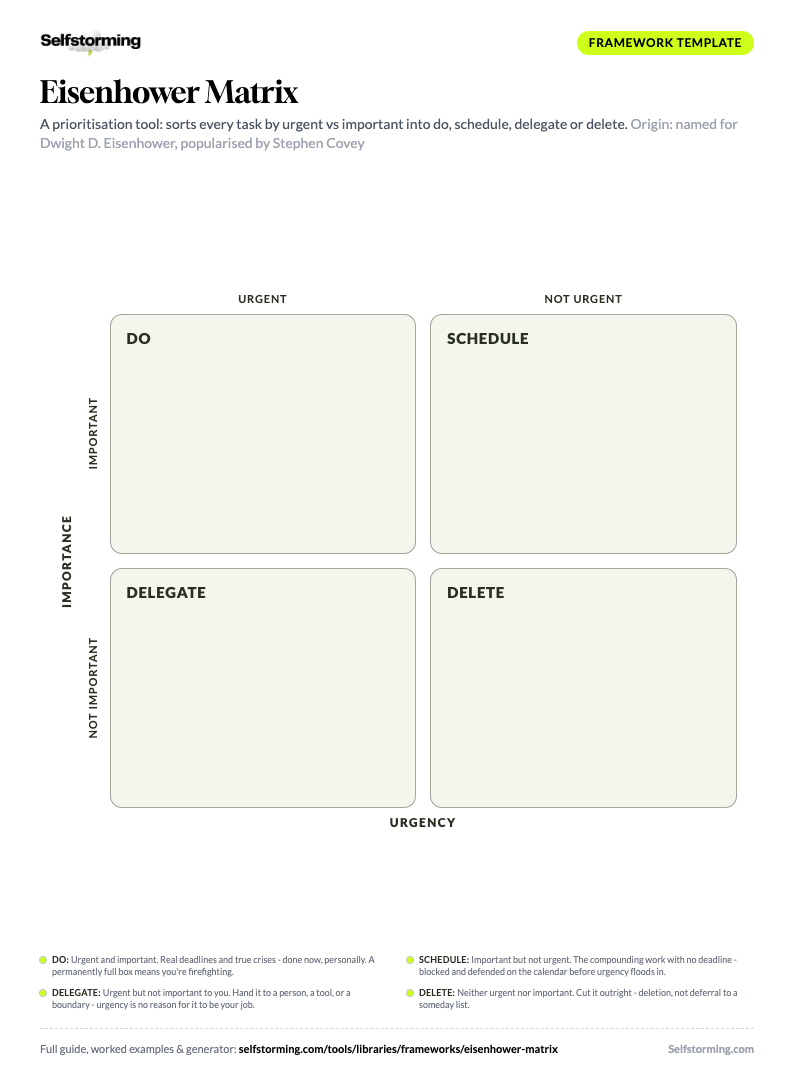
Print it. Fill it in.
The Eisenhower Matrix as a printable A4 worksheet - write straight into the framework, on paper or in any PDF app.
Download the PDF templateKnowledge Worth Paying For
A working library of brand strategy frameworks - with worked examples on real brands, sources, and decision criteria. Not vibes.
One good deck covers the subscription. The rest is profit.
Score every task on two axes: important (does it matter to your goals?) and urgent (does it need attention now?). That gives four boxes. Do urgent and important tasks immediately. Schedule important but not urgent ones - this is the box that builds your future. Delegate urgent but unimportant ones to someone else. Delete tasks that are neither. The core insight: urgency is about time, importance is about consequences, and most people let the first hijack the second.
Basecamp
Project management software (USA, founded 1999)A company that essentially runs on Quadrant 2 discipline. Basecamp's founders are famous for protecting deep, important-but-not-urgent work (six-week cycles, no fake deadlines, calm-by-design) while aggressively deleting the urgent-but-unimportant rituals - status meetings, real-time pings - that most teams mistake for productivity.
Shopify
E-commerce platform (Canada, founded 2006)A clear case of using the Delete quadrant as a strategic act. Shopify publicly cancelled thousands of recurring meetings to claw back time for important, non-urgent work - an explicit company-wide decision that the urgent-but-low-value meeting habit had been quietly eating the calendar.
Calendly
Scheduling software (USA, founded 2013)A product that is essentially Quadrant 3 (delegate and automate) turned into a business. The back-and-forth of booking a meeting is urgent-feeling but unimportant admin; Calendly's whole pitch is to delegate that task to software so the human time goes back to important work - the Eisenhower logic embodied as a feature.
Basecamp, Shopify, Calendly - filled in, line by line. Unlock to read them.
Basecamp (Project management software (USA, founded 1999))
A company that essentially runs on Quadrant 2 discipline. Basecamp's founders are famous for protecting deep, important-but-not-urgent work (six-week cycles, no fake deadlines, calm-by-design) while aggressively deleting the urgent-but-unimportant rituals - status meetings, real-time pings - that most teams mistake for productivity.
Do: A live outage affecting paying customers; a security incident; a contractual deliverable due today.
Schedule: Six-week product cycles, deep design work, writing internal docs, long-term hiring and culture decisions - all blocked and defended.
Delegate: Routine support triage, recurring reports, vendor admin - handed to owners or systems rather than absorbed by founders.
Delete: Standing status meetings, real-time notification expectations, busywork rituals - cut on principle to protect focus.
Shopify (E-commerce platform (Canada, founded 2006))
A clear case of using the Delete quadrant as a strategic act. Shopify publicly cancelled thousands of recurring meetings to claw back time for important, non-urgent work - an explicit company-wide decision that the urgent-but-low-value meeting habit had been quietly eating the calendar.
Do: Black Friday infrastructure scaling; merchant-facing payment failures; critical platform reliability issues.
Schedule: Platform architecture bets, new merchant tooling, developer-ecosystem investment - the compounding work with no deadline.
Delegate: Internal status reporting, low-stakes approvals, routine coordination - pushed to owners and automation.
Delete: Thousands of recurring calendar meetings cancelled outright to reclaim focus time across the company.
Calendly (Scheduling software (USA, founded 2013))
A product that is essentially Quadrant 3 (delegate and automate) turned into a business. The back-and-forth of booking a meeting is urgent-feeling but unimportant admin; Calendly's whole pitch is to delegate that task to software so the human time goes back to important work - the Eisenhower logic embodied as a feature.
Do: A live booking or payments bug blocking customers from scheduling; an enterprise security review on deadline.
Schedule: Enterprise product roadmap, integrations strategy, brand positioning as competitors crowd in.
Delegate: Meeting-scheduling itself - automated away for users; internal ops handled by tools and owners.
Delete: Manual email tag for booking times; redundant internal meetings the product itself makes unnecessary.
1. Do
Does this matter to my goals, and does it genuinely need me to act now?
Urgent and important. Real deadlines, true crises, problems that cost something if ignored today - a production outage, a client deliverable due tonight, a health issue. These get done first, personally, no delegation. But beware: a quadrant that's permanently full is a warning sign, not a badge of honour. A life lived entirely in Quadrant 1 is firefighting, and it usually means Quadrant 2 got starved.
Good answer: A payment outage blocking every customer checkout, right now. Important (revenue and trust on the line) and genuinely urgent (every minute costs money). Drop everything; this is the box working as intended.
Wrong answer: Every email marked high-priority by the sender. Someone else's urgency dressed up as your crisis. If it's important it can be scheduled, and if it's not, it shouldn't be here at all.
2. Schedule
Will this matter enormously in six months even though absolutely nothing forces me to do it today?
Important but not urgent. Strategy, learning, relationships, health, the deep work that compounds - none of it has a deadline, which is exactly why it never happens. This is the box that builds your future and the box that gets robbed every time something urgent walks in. The discipline isn't doing these tasks; it's defending the time for them on the calendar before the urgent stuff fills the day.
Good answer: Two hours a week designing next year's positioning, blocked and protected like a meeting you can't move. No deadline forces it, so you create one - because this is where the compounding actually happens.
Wrong answer: "I'll get to the strategy work once things calm down." Things never calm down. Treating Quadrant 2 as a leftover-time activity guarantees it stays permanently empty.
3. Delegate
Does this need doing soon - but does it actually need to be done by me?
Urgent but not important (to you). The classic productivity trap: tasks that feel productive because they're urgent, but don't move your goals - routine requests, certain meetings, status updates, interruptions. The instinct is to just knock them out. The better move is to get them off your plate entirely: delegate to a person, automate with a tool, or set a boundary. Urgency is not a reason for it to be your job.
Good answer: A recurring weekly report someone else can run from a template, or a tool can generate automatically. Urgent on Friday, but nothing about it requires your specific brain. Hand it off and reclaim the slot.
Wrong answer: Personally answering every routine support question to feel responsive. It's urgent and it feels helpful, but doing it yourself just converts your important time into someone else's convenience.
4. Delete
If I never did this at all, would anything I care about actually be worse?
Neither urgent nor important. The time-sink box: aimless scrolling, meetings that exist out of habit, busywork that survives because nobody questioned it, reports nobody reads. The honest move here is deletion, not deferral. These tasks don't need a better time slot; they need to stop existing. The hardest part is admitting how much of a normal week quietly lives in this quadrant.
Good answer: A standing status meeting nobody prepares for and nobody remembers afterwards - cancelled, replaced by a two-line message. The clearest win the matrix offers: time recovered from a thing that was never earning it.
Wrong answer: Filing these under "low priority" instead of deleting them. A low-priority list is just a graveyard where unimportant tasks wait to ambush you on a slow afternoon. Cut them properly.
Dump every open task before you sort: You can't prioritise what you can't see. Empty your head, your inbox flags, and your sticky notes into one raw list first - sorting comes after capture, never during. If staring at a blank grid stalls you, right here on Selfstorming you can find a head start, or generate a first-draft Eisenhower Matrix in minutes and edit from there.
Score importance first, urgency second: Importance is the harder, more honest question, so ask it before urgency clouds your judgement. For each task ask does this move a goal I actually care about? Only once you've answered that do you ask whether it needs attention now. Doing it in this order stops loud-but-trivial tasks from sneaking into the important boxes.
Define urgent and important out loud before you start: Vague axes produce a useless grid. Write down what "important" means for this week (tied to a specific goal or outcome) and what "urgent" means (a real deadline, not a feeling). The clearer the definitions, the less the matrix becomes a mirror of your current panic.
Place each task in exactly one quadrant: No fence-sitting. If a task feels like it belongs in two boxes, you haven't been honest about importance yet - usually it's urgent-and-unimportant masquerading as urgent-and-important. Force a single placement; the forcing is where the clarity comes from.
Protect Quadrant 2 on the calendar first: The important-but-not-urgent box only happens if you book it before the urgent stuff floods in. Block recurring, defended time for it at the start of the week, and treat that block as immovable as a client meeting. Everything else fills in around it.
Action each remaining quadrant deliberately: Quadrant 1 gets done now and personally. Quadrant 3 gets a named owner, a tool, or a boundary - decide which for each item. Quadrant 4 gets deleted outright, not demoted to a someday list. A quadrant with no action attached was never sorted, just labelled.
Watch for a permanently overflowing Quadrant 1: If everything keeps landing in urgent-and-important, you're firefighting, and the root cause is almost always a starved Quadrant 2. Treat a crowded Do box as a diagnosis: too little scheduled important work upstream is generating the crises downstream.
Re-sort on a fixed rhythm, not when you panic: Urgency moves - today's Schedule item is next week's Do item. Re-run the matrix on a set cadence (a Monday reset works well) rather than in the middle of a stressful afternoon, when everything feels urgent and the sort becomes worthless.
Best for: Personal and team prioritisation - cutting a bloated task list down to what actually matters, and separating real work from borrowed urgency. / Setting goals or strategy in the first place. The matrix sorts tasks against goals; it can't tell you what the goals should be.
Output: A four-quadrant sort with a clear action per box: do now, schedule, delegate, or delete. Fast, lightweight, decision-oriented. / A sequenced plan, a project timeline, or anything accounting for effort and dependencies. It prioritises; it doesn't schedule the work for you.
Time to complete: Minutes. Two questions per task and a quick weekly re-sort. The whole appeal is how little overhead it carries. / Quarterly planning cycles or multi-month roadmapping. Reaching for the matrix there is like sorting a warehouse with a kitchen drawer.
vs OKRs: The Eisenhower Matrix sorts the tasks already in front of you by urgency and importance - it's tactical, daily, reactive-by-design. / OKRs set the ambitious goals and measurable outcomes in the first place. Use OKRs to decide what matters; use the matrix to defend the time for it day to day.
vs SWOT: The matrix is about time and attention - what to do with your hours. It assumes you already know your situation. / SWOT is about your competitive and strategic position - strengths, weaknesses, opportunities, threats. Different question entirely: position, not prioritisation.
vs Playing to Win: The Eisenhower Matrix operates inside an existing strategy, triaging the work that strategy generates. / Playing to Win defines the strategy itself (Where to Play, How to Win). The matrix can't make those choices - it just helps you protect time for them.
The Eisenhower Matrix is named after Dwight D. Eisenhower, but he never drew a matrix in his life. The naming traces to a line from a 1954 speech in which he quoted an unnamed former college president: "I have two kinds of problems, the urgent and the important. The urgent are not important, and the important are never urgent." Eisenhower himself attributed the distinction to someone else - so even the founding quote is borrowed. The two-by-two grid everyone now calls the Eisenhower Matrix was actually built decades later by Stephen Covey, who turned the urgent-versus-important idea into his "time-management matrix" in The 7 Habits of Highly Effective People (1989) and expanded it in First Things First. Covey supplied the diagram and the famous emphasis on Quadrant 2; Eisenhower supplied the quote and the name. The conflation of the two is a post-1989 invention, which makes "Eisenhower Matrix" one of strategy's more charming misattributions.
The matrix's critics make a fair point: the framework assumes the hard part is already done. Deciding whether a task is important is precisely the judgement most people struggle with, and the matrix offers no help with it - it just gives you boxes to put your existing biases into. Productivity writers note that in the real world the urgent/not-urgent and important/not-important lines are far blurrier than the clean grid implies, so tasks get shoved into quadrants by gut feel rather than analysis. It's also blind to energy and context: a task can be objectively important and urgent and still be the wrong thing to attempt when you're depleted, and the matrix has nothing to say about that. And it ignores effort and dependencies entirely, so it can sort tasks but can't sequence them into a workable plan. The honest verdict: it's a genuinely useful sorting question, not a complete operating system. Its lasting value is forcing the urgent-versus-important distinction into the open - the part everyone quietly skips.
What is the Eisenhower Matrix?
The Eisenhower Matrix is a prioritisation tool that sorts tasks on two axes - important (does it affect your goals?) and urgent (does it need attention now?) - into four quadrants. You Do the urgent-and-important, Schedule the important-but-not-urgent, Delegate the urgent-but-unimportant, and Delete the rest. Its core insight is that urgency and importance are different questions, and most people let the first hijack the second.
Who created the Eisenhower Matrix?
The name comes from Dwight D. Eisenhower, who in a 1954 speech quoted an unnamed college president: "the urgent are not important, and the important are never urgent." But Eisenhower never drew a grid. The actual two-by-two matrix was created by Stephen Covey in The 7 Habits of Highly Effective People (1989) as his "time-management matrix." Covey built the diagram; Eisenhower supplied the quote and, retroactively, the name.
What are the four quadrants of the Eisenhower Matrix?
Quadrant 1, Do: urgent and important - act now, personally (crises, hard deadlines). Quadrant 2, Schedule: important but not urgent - block calendar time (strategy, learning, health). Quadrant 3, Delegate: urgent but not important - hand to a person, tool, or boundary (routine requests, some meetings). Quadrant 4, Delete: neither - cut it entirely (busywork, aimless scrolling).
What's the difference between urgent and important in the Eisenhower Matrix?
Urgent is about time - it demands attention now, usually because of a deadline or someone else's pressure. Important is about consequences - it materially affects the goals you care about, whether or not there's a deadline. A ringing phone is urgent but rarely important; designing next year's strategy is important but never urgent. The entire value of the matrix is making you feel the difference.
Why is Quadrant 2 the most important box in the Eisenhower Matrix?
Quadrant 2 (important but not urgent) is where the compounding work lives - strategy, deep skills, relationships, health - and because none of it has a deadline, it's the first thing sacrificed whenever something urgent appears. Covey argued this box is where effective people actually spend their time. The discipline is to schedule and defend Quadrant 2 before the urgent tasks flood the day, otherwise it stays permanently empty.
What are the main criticisms of the Eisenhower Matrix?
Three big ones. First, judging importance is the genuinely hard part, and the matrix offers no help - it just holds your existing biases. Second, real tasks rarely split cleanly into urgent/not and important/not, so placements become gut feel. Third, it ignores energy, context, effort, and dependencies, so it can sort tasks but can't build a realistic plan. It's a sorting question, not a full system.
How is the Eisenhower Matrix different from a regular to-do list?
A regular to-do list is usually sorted by volume or recency - the loudest, newest task floats to the top. The Eisenhower Matrix forces a second question, does this actually matter?, before the urgency question. That single addition is what stops other people's deadlines from quietly setting your priorities, and it legitimises deleting and delegating rather than grinding through everything.
Does the Eisenhower Matrix work for teams or just individuals?
Both, though the team version needs a shared definition of "important" - usually tied to a goal or an OKR - or everyone sorts by their own bias. Run as a recurring team triage, it's powerful for cutting meeting bloat and reclaiming focus time: companies have used the Delete quadrant to cancel thousands of standing meetings. The trap is the same as for individuals: the Delegate and Delete boxes only work if you actually act on them.
A prioritisation tool: sorts every task by urgent vs important into do, schedule, delegate or delete.
The Eisenhower Matrix fixes that with one rude little question per task: is this important, and is it urgent? Two yes-or-no answers, four boxes. Do the urgent-and-important now. Schedule the important-but-not-urgent, which is where your actual future lives. Delegate the urgent-but-unimportant, because urgency is not a reason for it to be your problem. And delete the rest, guilt-free.
The whole framework rests on a distinction we constantly blur: urgent is about time, important is about consequences. A ringing phone is urgent. It is almost never important. Once you can feel the difference between those two words, you stop letting other people's urgency set your priorities - which is, more or less, the entire point.
Related Frameworks
Playing to Win
Five linked choices, top to bottom: Winning Aspiration (what winning looks like, for whom), Where to Play (the specific market, segment, geo
OKRs
One Objective (qualitative, ambitious, memorable - the hill worth taking) plus three Key Results (numeric, measurable, with zero grey area -
SWOT Analysis
Four boxes, two axes: Strengths and Weaknesses are internal and controllable, Opportunities and Threats are external and mostly not. Left si
Porter's Five Forces
Five forces decide an industry's long-run profitability: Threat of New Entrants (how easy is it to copy you), Bargaining Power of Suppliers