OKRs
How to Set Goals That Actually Move Something
OKRs are the most copied and least understood goal-setting system in tech. The shape is trivial - one ambitious Objective, three measurable Key Results - which is exactly why so many teams get it wrong. They write a vague Objective, attach three numbers they were going to hit anyway, and congratulate themselves on doing strategy. That isn't OKRs. That's a to-do list wearing a tracksuit.
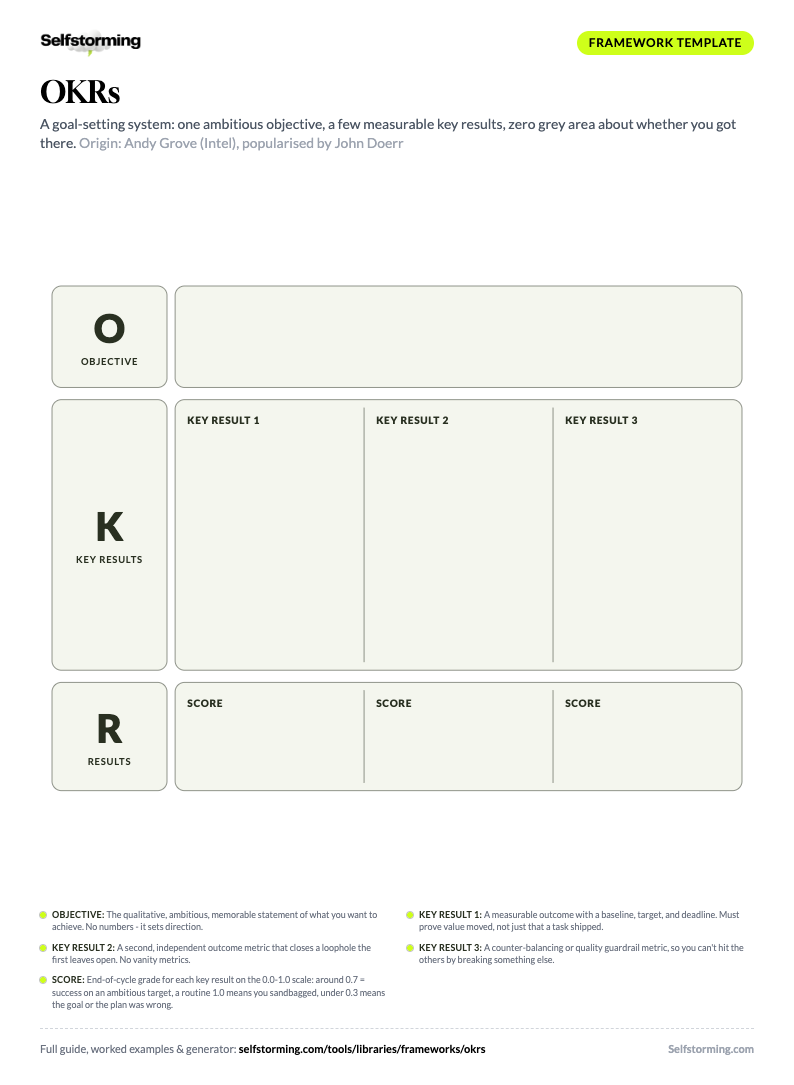
Print it. Fill it in.
The OKRs as a printable A4 worksheet - write straight into the framework, on paper or in any PDF app.
Download the PDF templateKnowledge Worth Paying For
A working library of brand strategy frameworks - with worked examples on real brands, sources, and decision criteria. Not vibes.
One good deck covers the subscription. The rest is profit.
One Objective (qualitative, ambitious, memorable - the hill worth taking) plus three Key Results (numeric, measurable, with zero grey area - proof you took it). The Objective answers 'where do we want to go?'; each Key Result answers 'how will we know we got there?'. The rule that separates real OKRs from theatre: Key Results measure outcomes (the number that proves value moved), not outputs (the task you completed). 'Launch the newsletter' is an output. 'Grow active subscribers from 2k to 10k' is an outcome. At the end of the cycle, grade every key result 0.0-1.0 - around 0.7 means the target was ambitious and you still moved it; a routine 1.0 means you aimed too low.
The reference example for the whole framework. John Doerr brought OKRs from Intel to a tiny Google in 1999, and the company ran on them as it scaled. The often-cited Chrome browser goal shows the pattern: an inspiring Objective ('build the best browser') paired with a single brutally clear outcome number - 7-day active users - that nobody could fudge.
Notion
Productivity SaaS (workspace/docs, scaled via product-led growth)A clean product-led-growth OKR. The Objective is qualitative and human; the Key Results are all outcomes (activation, team conversion, retention) rather than 'ship feature' outputs, with a satisfaction guardrail so the team can't win by nagging users into clicking.
Monzo
UK challenger bank (fintech, mobile-first current accounts)An OKR for a regulated, trust-sensitive business, which is exactly where guardrails earn their keep. Growth and engagement KRs sit alongside a hard quality metric, so the team can't chase deposits by cutting corners on the support and trust that a bank lives or dies on.
Google, Notion, Monzo - filled in, line by line. Unlock to read them.
Google (Search/tech giant (the case that made OKRs famous, OKRs adopted 1999))
The reference example for the whole framework. John Doerr brought OKRs from Intel to a tiny Google in 1999, and the company ran on them as it scaled. The often-cited Chrome browser goal shows the pattern: an inspiring Objective ('build the best browser') paired with a single brutally clear outcome number - 7-day active users - that nobody could fudge.
Objective: Build the best browser on the planet and get the world onto it.
Key Result 1: Grow Chrome's 7-day active users from 0 to 20 million within the first year.
Key Result 2: Increase the share of users who set Chrome as their default browser quarter over quarter.
Key Result 3: Hold median page-load and JavaScript benchmark speeds in the top tier versus competing browsers.
Notion (Productivity SaaS (workspace/docs, scaled via product-led growth))
A clean product-led-growth OKR. The Objective is qualitative and human; the Key Results are all outcomes (activation, team conversion, retention) rather than 'ship feature' outputs, with a satisfaction guardrail so the team can't win by nagging users into clicking.
Objective: Make a brand-new team productive in Notion before they ever consider leaving.
Key Result 1: Lift new-workspace activation (created a doc and invited a teammate in week one) from 38% to 55%.
Key Result 2: Increase free-to-paid team conversion within 30 days from 6% to 10%.
Key Result 3: Keep new-user CSAT at or above 4.4/5 while the activation and conversion numbers climb.
Monzo (UK challenger bank (fintech, mobile-first current accounts))
An OKR for a regulated, trust-sensitive business, which is exactly where guardrails earn their keep. Growth and engagement KRs sit alongside a hard quality metric, so the team can't chase deposits by cutting corners on the support and trust that a bank lives or dies on.
Objective: Make Monzo the account people actually pay their salary into, not their spare-change app.
Key Result 1: Increase the share of active users with a salary or recurring deposit from 28% to 45%.
Key Result 2: Raise the proportion of users with 5+ transactions per week from 41% to 55%.
Key Result 3: Keep median in-app support response time under 3 minutes and complaint rate flat while volume grows.
1. Objective
What is the single most important, ambitious thing we want to achieve this quarter - stated so plainly anyone could repeat it?
The qualitative, memorable statement of intent. It should be inspiring, significant, and a little uncomfortable - the hill worth taking. No numbers live here; the Objective sets direction, the Key Results provide the proof.
Good answer: Make new users fall in love in their first session. Concrete enough to picture, ambitious enough to stretch, plain enough that a new hire could repeat it back without the slide.
Wrong answer: Improve overall user engagement and satisfaction. Bland, immeasurable, and true of every product on Earth. An Objective nobody could disagree with is an Objective that points nowhere.
2. Key Result 1
What is the first hard number that, if it moves, proves we actually achieved the Objective rather than just felt busy?
A measurable, time-bound result with a clear starting point and target. It must describe an outcome - value that moved - not a task you completed. If you could mark it done by shipping something rather than changing a metric, it's an output in disguise.
Good answer: Increase day-1-to-day-7 retention of new signups from 22% to 40%. A from-to number, no grey area, and you can't claim it by 'launching' anything - the metric either moved or it didn't.
Wrong answer: Launch the new onboarding flow. That's an output - a thing you ship, not a result you achieve. You can launch a flow that nobody finishes and tick the box while the Objective dies.
3. Key Result 2
What second, independent metric closes a loophole the first Key Result leaves open?
A second outcome measure that approaches the Objective from a different angle, so the team can't win on a technicality. Good KR sets are mutually reinforcing - hitting one shouldn't let you quietly fail the goal.
Good answer: Raise the share of new users who complete the core action within 24 hours from 35% to 60%. Pairs with retention so you can't juice one number while the real experience stays broken.
Wrong answer: Increase total signups by 20%. A vanity metric that can rise while the Objective (users falling in love) gets worse. More signups who churn instantly is the opposite of the goal.
4. Key Result 3
What third metric guards quality, so we don't hit the first two by breaking something else?
A counter-balancing or quality result that keeps the team honest - often a health, satisfaction, or guardrail metric. It stops the classic failure where a team smashes its targets by quietly degrading something that wasn't measured.
Good answer: Keep new-user support tickets per 100 signups flat or lower while the above metrics climb. A guardrail - it proves the gains came from a better experience, not from confusing people into clicking.
Wrong answer: Hold weekly onboarding review meetings. An activity, not a result, and a guardrail that guards nothing. Counting meetings tells you the team was busy, never whether quality held.
5. Score
How did each key result actually land at the end of the cycle - and what does that teach the next one?
The grading step most teams skip - and the reason OKRs stay honest. At the end of the cycle each key result gets a score from 0.0 to 1.0, the convention John Doerr brought from Intel to Google. The sweet spot is 0.6-0.7: it means the target was ambitious and you still moved it. A wall of 1.0s doesn't mean a great quarter - it means the targets were too safe. Under 0.3 means the goal or the plan was wrong, which is information, not shame. Scores exist to calibrate the next cycle's targets.
Good answer: Google: KRs graded 0.0-1.0 each quarter, with 0.7 treated as success on a stretch target - and a routine 1.0 read as sandbagging, triggering harder targets next quarter, not applause.
Wrong answer: Wiring scores into performance reviews or bonuses. The moment a score pays out, everyone sandbags their key results and the whole system collapses into theatre.
Decide your starting point: You don't have to draft OKRs from a blank doc. Right here on Selfstorming you can find inspiration and directions, or generate a first-draft OKRs in minutes. Treat that draft as a head start, then run it through the steps below to sharpen the Objective and pressure-test that the Key Results measure outcomes, not busywork. Draft-from-scratch and AI-draft-then-refine are both valid; most teams move faster starting from a draft.
List the change you actually want, then cut to a few: Write down everything you'd love to achieve this quarter, then ruthlessly cut to one to three Objectives. OKRs are for the change that matters, not for cataloguing the day job. If sales already has a quota, it doesn't need an OKR restating it.
Write the Objective with no numbers and a clear hill: Make it qualitative, memorable, and a little uncomfortable. Test it: could a new hire repeat it back without the slide? If it needs a metric to make sense, you've smuggled a Key Result into the Objective.
Draft Key Results as from-to numbers: Each KR needs a baseline, a target, and a deadline - 'from 22% to 40% by end of Q3.' No baseline means you can't tell if you moved. No grey area allowed: a KR you could argue you 'sort of' hit is written wrong.
Run the output-vs-outcome test on every Key Result: Ask 'could I mark this done by shipping something rather than changing a metric?' If yes, it's an output - rewrite it as the outcome that shipping was supposed to produce. 'Launch X' becomes 'X drives metric Y from A to B.'
Add a guardrail Key Result: Include at least one counter-balancing metric so the team can't hit its targets by quietly breaking quality, speed, or cost. The classic failure is smashing a growth number while support tickets or churn quietly explode.
Set the ambition level and decouple it from pay: Calibrate stretch OKRs so ~70% is a great result, and make it explicit that compensation does NOT depend on the score. The moment a bonus rides on the number, people sandbag - they set goals they already know they'll hit.
Score, review, and reset on a cadence: Check in mid-cycle, score at the end (typically 0.0-1.0), and treat low scores as information, not punishment. A consistent run of 1.0s means you're aiming too low. Then write the next set - OKRs are a rhythm, not a one-off.
Best for: Quarterly goal-setting and execution focus - turning a chosen direction into a few measurable, ambitious outcomes and tracking progress toward them across teams. / Choosing the strategy itself (where to compete, how to win), brand identity work, or business-as-usual operations that already have their own KPIs.
Output: A short list of Objectives, each with about three numeric Key Results - a from-to target and deadline per result, scored 0.0-1.0 at the end of the cycle. / A strategy cascade, a SWOT grid, or a brand artifact. OKRs measure progress; they don't decide the destination or define identity.
Time to complete: A focused drafting session plus refinement - hours to a few days per cycle - then a recurring weekly check-in. It's a quarterly rhythm, not a one-off. / A multi-week strategy project or a one-time exercise you never revisit. OKRs that aren't part of a cadence quietly become decoration.
vs Playing to Win: OKRs track progress toward a destination each quarter. Use them once the direction is set, to make the chosen field and capabilities measurable. / Playing to Win chooses the destination - where to play and how to win. It makes the strategic choices; OKRs never do. Run Playing to Win first, then set OKRs to execute it.
vs SWOT: OKRs are forward-looking, numeric goals you commit to and score. Use them to drive and measure change over a defined period. / SWOT is a static inventory of strengths, weaknesses, opportunities, and threats - a situational snapshot, not a goal or a metric. Use SWOT to inform what your OKRs should target.
vs AARRR (Pirate Metrics): OKRs are a general goal-setting system for any function and any kind of Objective, with a guardrail-driven, change-focused mindset. / AARRR is a specific funnel of growth metrics (Acquisition, Activation, Retention, Referral, Revenue). It's a metric framework you can draw Key Results from, not a goal-setting system in itself.
OKRs were created by Andy Grove at Intel in the 1970s as an evolution of Peter Drucker's Management by Objectives - Grove initially called it 'iMBO,' Intel Management by Objectives - and documented the approach in his 1983 book High Output Management. The framework left Intel through John Doerr, who learned it in Grove's internal course in 1975, later joined the venture firm Kleiner Perkins, and introduced OKRs to a tiny Google in 1999. Google ran on OKRs as it scaled, and the system spread from there to companies like LinkedIn, Uber, and GitLab. Doerr codified the playbook for a wider audience in his 2018 book Measure What Matters, which paired the Google story with case studies from Bono and the Gates Foundation and turned OKRs into the default goal-setting language of modern tech.
The honest criticism of OKRs is that the format is easy to copy and hard to do well. Teams confuse outputs ('ship the feature') with outcomes ('move the metric'), so OKRs quietly degrade into a task list. Sandbagging is endemic, especially when scores are tied to pay - people set targets they already know they'll hit, killing the stretch the system was designed to create. Vanity metrics sneak in as Key Results, rising while the real Objective gets worse, and over-eager organisations cascade dozens of rigid OKRs that restate business-as-usual and add pure bureaucracy. The fix is discipline, not the framework: outcome-based Key Results, a guardrail metric, fewer goals, and a firm wall between OKR scores and compensation.
What are OKRs?
OKRs (Objectives and Key Results) are a goal-setting method built from two parts: one Objective - a qualitative, ambitious statement of what you want to achieve - and around three Key Results - numeric, measurable outcomes that prove you achieved it, each with a baseline, target, and deadline. The Objective answers 'where do we want to go?' and the Key Results answer 'how will we know we got there?' with no grey area.
Who created OKRs?
OKRs were created by Andy Grove at Intel in the 1970s, evolving Peter Drucker's Management by Objectives into what Grove first called 'iMBO,' documented in his 1983 book High Output Management. John Doerr learned the method in Grove's course, brought it to Google in 1999 while at Kleiner Perkins, and later popularised it worldwide in his 2018 book Measure What Matters.
What's the difference between an Objective and a Key Result in OKRs?
The Objective is qualitative and inspiring - what you want to achieve, stated with no numbers. A Key Result is quantitative and verifiable - how you'll know you achieved it, written as a from-to number with a deadline. One Objective typically carries about three Key Results. The trap to avoid: a Key Result must measure an outcome (value that moved), not an output (a task you completed).
How many OKRs should a team have?
Fewer than you think. Most guidance lands on one to three Objectives per team per cycle, each with roughly three Key Results. The discipline is the point: OKRs are for the few changes that matter, not for cataloguing the day job. If a team already has stable KPIs or a sales quota, those don't need to be restated as OKRs - leave them off the list.
Should OKRs be tied to compensation or performance reviews?
Generally no, and this is one of the most important rules. The moment a bonus or rating depends on the OKR score, people sandbag - they set safe targets they already know they'll hit, and the stretch the system was designed to create disappears. Keep OKRs as an ambition and alignment tool, and assess performance through a separate, broader conversation.
What does it mean if we hit 100% of our OKRs?
It usually means you aimed too low. Stretch OKRs are deliberately calibrated so that scoring around 0.7 is a strong result - the goals are meant to be a little out of reach. A consistent run of perfect 1.0s is a red flag that the team is under-reaching or sandbagging. Treat scores as information for the next cycle, not a pass/fail grade.
What's the difference between an output and an outcome in OKRs?
An output is something you produce or ship ('launch the onboarding flow'); an outcome is the change in the world that producing it was supposed to cause ('lift week-one activation from 38% to 55%'). The classic OKR failure is writing outputs as Key Results - you tick every box while the Objective stays exactly where it was. Always rewrite an output KR as the outcome it's meant to drive.
Do OKRs replace strategy?
No - and treating them as strategy is a common mistake. OKRs are an execution and goal-setting system: they help you move toward a destination, but they never choose the destination. Deciding where to compete and how to win is the job of a strategy framework like Playing to Win. Set the strategy first, then use OKRs to make it measurable each quarter.
A goal-setting system: one ambitious objective, a few measurable key results, zero grey area about whether you got there.
The whole point of an OKR is the tension between the two halves. The Objective is qualitative and a little bit terrifying - the thing you'd be proud to achieve. The Key Results are the cold, numeric proof that you actually did it, written so there's no grey area. Done right, the format does two jobs at once: it points everyone at the same hill, and it makes self-delusion impossible, because either the number moved or it didn't. This page walks through the four pieces (the Objective and its three Key Results), the trap of confusing outputs with outcomes, and how to write KRs you can't quietly sandbag.
Related Frameworks
Playing to Win
Five linked choices, top to bottom: Winning Aspiration (what winning looks like, for whom), Where to Play (the specific market, segment, geo
SWOT Analysis
Four boxes, two axes: Strengths and Weaknesses are internal and controllable, Opportunities and Threats are external and mostly not. Left si
Eisenhower Matrix
Score every task on two axes: important (does it matter to your goals?) and urgent (does it need attention now?). That gives four boxes. Do
Porter's Five Forces
Five forces decide an industry's long-run profitability: Threat of New Entrants (how easy is it to copy you), Bargaining Power of Suppliers