SWOT Analysis
How to Run One That Actually Changes a Decision
SWOT is the most-completed and least-used framework in the building. Almost every team has filled one in. Almost none can point to a decision it changed. That's the SWOT problem in one sentence: it's a four-box list that feels like strategy and rarely becomes one.
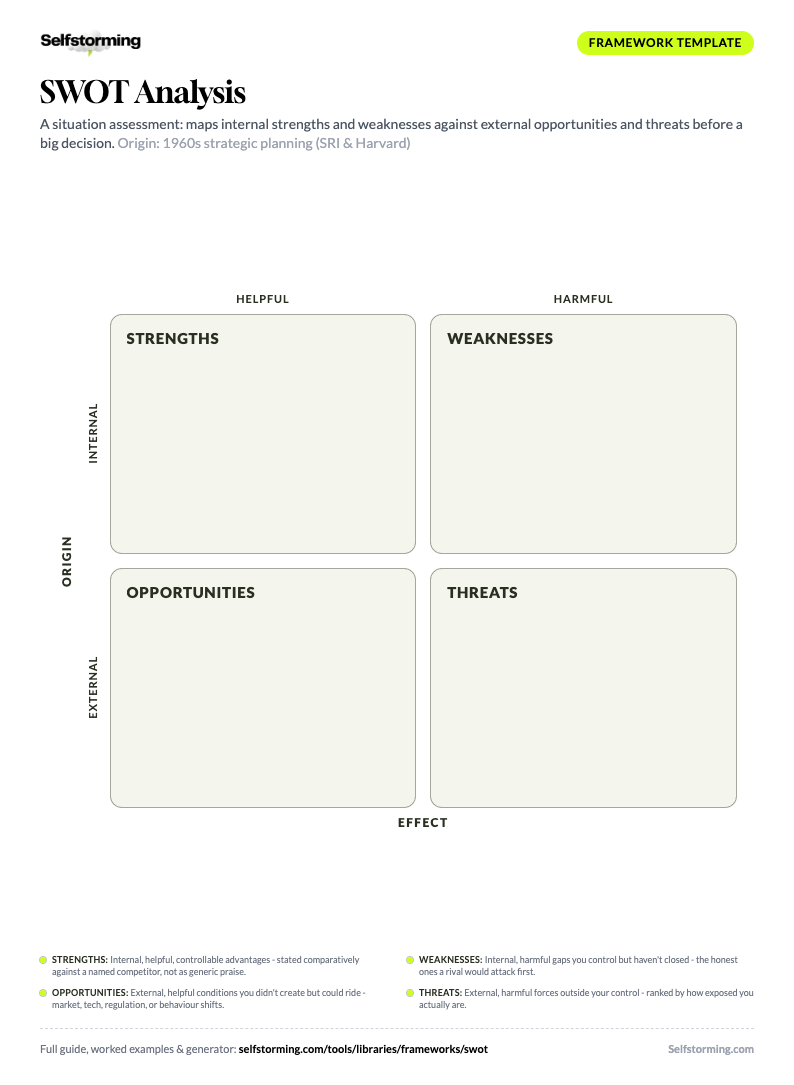
Print it. Fill it in.
The SWOT Analysis as a printable A4 worksheet - write straight into the framework, on paper or in any PDF app.
Download the PDF templateKnowledge Worth Paying For
A working library of brand strategy frameworks - with worked examples on real brands, sources, and decision criteria. Not vibes.
One good deck covers the subscription. The rest is profit.
Four boxes, two axes: Strengths and Weaknesses are internal and controllable, Opportunities and Threats are external and mostly not. Left side helps you, right side hurts you. The output isn't the grid - it's the pairings: match a strength to an opportunity to find a move, expose a weakness to a threat to find a risk. If you don't pair the cells and turn them into decisions, you've made a list, not a strategy.
Notion
Productivity software (USA, founded 2013)A clean case of pairing strengths to opportunities instead of just listing them. Notion's flexible all-in-one canvas (a strength) met the remote-work documentation boom (an opportunity), and the pairing - not the list - drove a bottom-up land-and-expand motion that turned individual users into company-wide rollouts.
Oatly
Plant-based dairy alternative (Sweden, founded 1990s, scaled 2010s)Shows the Weakness-meets-Threat fire and the Strength-meets-Opportunity move on the same page. Oatly's distinctive irreverent brand (a strength) rode the sustainability and dairy-alternative wave (an opportunity), while thin supply capacity (a weakness) collided with surging demand and copycats (a threat) - a pairing that explained their growth pains better than any single box could.
Duolingo
Language-learning app (USA, founded 2011)A textbook offensive pairing: a strength (addictive gamified habit loop) crossed with an opportunity (cheap mobile distribution and a free model nobody could undercut) produced the strategy - own the top of the funnel for free, monetise the committed. Listing those boxes separately would have hidden the move that pairing them revealed.
Notion, Oatly, Duolingo - filled in, line by line. Unlock to read them.
Notion (Productivity software (USA, founded 2013))
A clean case of pairing strengths to opportunities instead of just listing them. Notion's flexible all-in-one canvas (a strength) met the remote-work documentation boom (an opportunity), and the pairing - not the list - drove a bottom-up land-and-expand motion that turned individual users into company-wide rollouts.
Strengths: Genuinely flexible all-in-one workspace; passionate template-building community; strong design-led brand among creators and startups.
Weaknesses: Steep first-hour learning curve scares off casual users; historically thin offline and performance story; "does everything" can mean "nails nothing" for buyers wanting a focused tool.
Opportunities: Remote work normalising shared docs; teams consolidating five point tools into one; AI features as a new wedge into the workspace.
Threats: Incumbents (Microsoft, Google, Atlassian) bundling similar features for free; new AI-native note tools attacking the core use case; switching costs that cut both ways.
Oatly (Plant-based dairy alternative (Sweden, founded 1990s, scaled 2010s))
Shows the Weakness-meets-Threat fire and the Strength-meets-Opportunity move on the same page. Oatly's distinctive irreverent brand (a strength) rode the sustainability and dairy-alternative wave (an opportunity), while thin supply capacity (a weakness) collided with surging demand and copycats (a threat) - a pairing that explained their growth pains better than any single box could.
Strengths: Unmistakable, opinionated brand voice; first-mover credibility in oat milk; barista-grade product that won coffee shops.
Weaknesses: Persistent supply and production capacity constraints; high cost base; reliance on a single category narrative.
Opportunities: Mainstreaming of plant-based diets; sustainability-conscious consumers; foodservice and retail expansion across new regions.
Threats: Big dairy and private-label launching cheaper oat milk; greenwashing scrutiny; commoditisation as the category fills with copycats.
Duolingo (Language-learning app (USA, founded 2011))
A textbook offensive pairing: a strength (addictive gamified habit loop) crossed with an opportunity (cheap mobile distribution and a free model nobody could undercut) produced the strategy - own the top of the funnel for free, monetise the committed. Listing those boxes separately would have hidden the move that pairing them revealed.
Strengths: Best-in-class gamification and streak mechanics; enormous free user base; instantly recognisable brand mascot and tone.
Weaknesses: Free-heavy base with modest conversion; questions over depth for serious fluency; engagement loops that critics call manipulative.
Opportunities: Global smartphone access expanding the addressable market; AI tutoring lowering content costs; adjacent subjects (math, music) to extend the habit.
Threats: AI assistants offering free conversational practice; well-funded edtech entrants; novelty fatigue if the game loop stops feeling fresh.
1. Strengths
What do we do measurably better than the people we compete with, and can we prove it?
Internal and helpful. The advantages you actually control - capabilities, assets, distinctive positions, things rivals can't easily copy. The test is comparative: a strength only counts if it beats a named competitor. "We care about customers" is table stakes; everyone claims it. A real strength predicts who you beat and why.
Good answer: The fastest claims payout in the category - 3 minutes, fully automated, while incumbents take 3 weeks. Specific, provable, and it directly maps to an opportunity (winning impatient first-time buyers).
Wrong answer: Strong brand, great culture, passionate team. Three phrases that fit every company on earth, prove nothing, and beat no one. That's a self-esteem exercise, not a strength.
2. Weaknesses
Where would a competitor attack us first, and what are we quietly hoping nobody notices?
Internal and harmful. The gaps you control but haven't closed - thin capabilities, missing assets, structural disadvantages. This box dies of politeness. Teams list cosmetic flaws to look self-aware while protecting the real ones. The useful weaknesses are the ones somebody in the room would rather not say out loud.
Good answer: We have no mobile product in a category that is now 70% mobile-first signups. Honest, measurable, and clearly the thing a competitor exploits next quarter.
Wrong answer: We're maybe a little too ambitious sometimes. The humble-brag weakness. It's a strength wearing a disguise, and it lets the team skip the conversation that actually matters.
3. Opportunities
What is changing out there - market, tech, regulation, behaviour - that we could ride if we moved now?
External and helpful. Conditions in the world you didn't create but could exploit: a shifting market, a new channel, a regulation that hurts incumbents, a behaviour change. The discipline is that opportunities are external. The moment you write "launch a new product" you've written an action, not an opportunity. Opportunities are conditions; what you do about them is strategy.
Good answer: New EU rules force competitors to disclose pricing by 2027, and our model is already transparent. A genuine external shift we can ride, paired straight to a strength.
Wrong answer: Improve our marketing. That's an internal action you fully control, parked in the external box. If you can just decide to do it, it isn't an opportunity.
4. Threats
What outside force could erode our position whether we act or not, and how fast is it moving?
External and harmful. Forces outside your control that could shrink the board: new entrants, substitutes, platform shifts, economic conditions, a rival's roadmap. The point of this box is priority, not paranoia. A threat that meets a weakness is the first fire to fight. A threat that meets a strength is one you can absorb. Rank them by how exposed you actually are.
Good answer: A platform we depend on for 60% of traffic is launching a competing feature. External, specific, and it lands directly on a known dependency - so it goes to the top of the list.
Wrong answer: The economy might get worse. True for everyone, actionable for no one. A threat you can't size and can't respond to is just background anxiety on a sticky note.
Pick the one decision this SWOT serves: A SWOT with no question behind it becomes a wall of adjectives. Before you draw a single box, write the decision you're actually trying to make - enter a market, kill a product, pick a position. You don't have to start from a blank grid either: right here on Selfstorming you can find inspiration and a head start, or generate a first-draft SWOT analysis in minutes, then pressure-test it against reality.
Sort by the two axes before you brainstorm: Draw the cross first. Left column helpful, right column harmful; top row internal (Strengths, Weaknesses), bottom row external (Opportunities, Threats). Agreeing the axes up front stops the classic mess where actions land in the Opportunities box and self-esteem lands in Strengths.
Make every entry comparative and specific: For each item ask compared to whom, and how do we know? "Good support" gets cut. "Median first-response under 4 minutes vs the category's 2 days" stays. If you can't name a competitor or a number, it isn't earning its sticky note.
Quarantine internal and external rigorously: If you can change it by deciding to, it's a Strength or Weakness. If it would be true whether or not you existed, it's an Opportunity or Threat. Move every misfiled item now - this single discipline is what separates a SWOT from a vibe board.
Rank inside each box, don't just list: A box with twelve equal items is noise. Force a top three per quadrant. The act of ranking surfaces the disagreements that actually matter and stops the loudest person from setting the priorities by default.
Pair the cells - this is the actual analysis: Cross Strengths with Opportunities (offensive moves), Weaknesses with Threats (defensive priorities), Strengths with Threats (what you can absorb), Weaknesses with Opportunities (what's blocking you from the upside). The four-box list was just the setup; the pairings are the punchline.
Convert each pairing into a sentence that starts with "so we will": A pairing that doesn't produce a commitment is trivia. So we will use our 3-minute payout (S) to target first-time buyers leaving slow incumbents (O). If a quadrant can't generate one of these, the items in it weren't real.
Distribute the decisions, not the grid: Nobody reopens a four-box diagram in March. Pull the three to five "so we will" commitments into your plan, assign owners, and let the grid itself go in a drawer. The SWOT was scaffolding; the commitments are the building.
Best for: A fast shared snapshot of your position before a decision - entering a market, picking a fight, briefing a team, or warming up before a deeper strategy tool. / Actually choosing a strategy, sizing a market, or modelling competitive dynamics. SWOT shows the board; it doesn't pick the square.
Output: A two-by-two grid plus, crucially, a short list of "so we will" commitments drawn from pairing the cells. The pairings are the deliverable. / A precise strategy, a financial model, or a prioritised roadmap. If you need numbers and trade-offs, SWOT runs out of road fast.
Time to complete: One short session - 60 to 90 minutes to fill and pair the grid with the right people in the room. The structure moves quickly on purpose. / Multi-week strategy projects with research and modelling. SWOT is a warm-up, not the main event - don't stretch it into one.
vs Porter's Five Forces: SWOT is broad and internal-plus-external in one view, fast to run, good for a first read across the whole picture. / Five Forces goes deep on industry structure and profitability (rivalry, entrants, substitutes, buyer and supplier power). Use it when the question is "is this industry even worth competing in?"
vs Playing to Win: SWOT surfaces raw inputs - what you've got and what's out there - before you've committed to anything. / Playing to Win forces actual choices (Where to Play, How to Win). As Roger Martin argues, a strength only means something once you've made those choices - so use Playing to Win to decide, SWOT to feed it.
vs Ansoff Matrix: SWOT diagnoses your current position across four open boxes with no preset direction. / The Ansoff Matrix is specifically about growth direction (existing vs new products, existing vs new markets). Reach for Ansoff when the question is narrowly "which way do we grow?"
SWOT has a famously contested origin, and the honest answer is that no single person invented it. Two parallel streams converged in the mid-1960s. At the Stanford Research Institute, a team including Robert F. Stewart, Otis Benepe and Albert Humphrey developed a four-part corporate-planning tool originally called SOFT (Satisfactory, Opportunities, Faults, Threats). In parallel, Harvard Business School professors - Edmund Learned, C. Roland Christensen, Kenneth Andrews and William Guth - were teaching the same internal-versus-external logic in their Business Policy course, stating the idea without ever coining an acronym. The popular story that consultant Albert Humphrey single-handedly created SWOT (and that the F in SOFT was swapped to W at a 1964 Zurich seminar) is widely repeated but disputed by later historians, who note Humphrey's account surfaced decades after the fact and that the recognisable 2x2 matrix only appeared in John Argenti's 1974 work. The fair summary: SWOT is agency-and-academy craft from the 1960s strategy boom, not the invention of one named author.
SWOT's critics are loud and, frankly, often right. Strategy thinker Roger Martin argues the tool is fundamentally backwards: a strength is only a strength relative to a specific Where-to-Play / How-to-Win choice, so listing strengths before you've chosen a strategy produces vague, generic inventory rather than insight. He reports that across years of audiences, not one person could name a real insight a SWOT had given them. The broader pushback is that SWOT collapses into a brainstorm dump: four boxes of unranked adjectives that feel like progress while committing the team to nothing. It's static (last year's strength is this year's table stakes), it invites self-flattery in the strengths box and politeness in the weaknesses box, and it has no built-in mechanism to turn the lists into a decision. The defence is narrow but real: as a fast, structured first pass that feeds a sharper tool, SWOT earns its keep - as long as you pair the cells and refuse to stop at the grid.
What is a SWOT analysis?
A SWOT analysis is a strategic planning tool that sorts factors into four boxes across two axes: Strengths and Weaknesses (internal, controllable) and Opportunities and Threats (external, mostly not). The left side is helpful to you, the right side is harmful. Its real purpose isn't the grid - it's pairing the cells (a strength with an opportunity becomes a move; a weakness with a threat becomes a priority risk) and turning those pairings into decisions.
Who created the SWOT analysis?
There's no single inventor, and the history is genuinely contested. In the mid-1960s a Stanford Research Institute team (Robert Stewart, Otis Benepe, Arnold Mitchell) built a tool called SOFT, while Harvard Business School professors (Learned, Christensen, Andrews, Guth) taught the same internal-versus-external logic without an acronym. The common claim that consultant Albert Humphrey created SWOT is widely repeated but disputed by later historians. The honest answer: it's 1960s strategy craft, not one person's invention.
What is the difference between SWOT and the SOFT analysis?
SOFT came first. Developed at the Stanford Research Institute, it stood for Satisfactory, Opportunities, Faults, Threats. The story goes that the framework was reworked into SWOT - Strengths, Weaknesses, Opportunities, Threats - to sharpen the internal-versus-external structure. The acronym changed; the underlying idea (controllable internal factors versus external conditions) is the same one Harvard was teaching in parallel.
How do you actually use a SWOT analysis to make a decision?
Stop at the grid and you've made a list, not an analysis. The move is to pair the cells: cross Strengths with Opportunities for offensive plays, Weaknesses with Threats for defensive priorities, then convert each pairing into a commitment that starts with "so we will...". If a quadrant can't generate one of those sentences, the items in it weren't decision-relevant to begin with.
What's the difference between Strengths/Weaknesses and Opportunities/Threats?
The axis is control. Strengths and Weaknesses are internal - things your company owns and can change by deciding to. Opportunities and Threats are external - conditions in the market, technology, regulation or competitor behaviour that exist whether you act or not. The single most common SWOT error is filing an internal action ("improve our marketing") in the external boxes. If you can just decide to do it, it isn't an opportunity.
Is SWOT analysis still useful, given the criticism?
Yes, but only in a narrow lane. Critics like Roger Martin are right that SWOT isn't a strategy and that listing strengths before choosing a direction produces vague inventory. Where it still earns its place is as a fast structured first pass that surfaces what a team half-knows and feeds a sharper tool like Playing to Win or Porter's Five Forces. Use it as a warm-up, not the main event, and always pair the cells.
How many items should go in each SWOT box?
Fewer than you think. A box with fifteen unranked items is noise; cap each quadrant at a top three or four, ranked by decision relevance. The act of cutting is where the real prioritisation argument happens. If everything is a strength, nothing is - and the loudest voice in the room ends up setting the list by default.
Does SWOT analysis work for small businesses and startups?
It works for any size, because the friction is low and the structure is universal. For a startup the most valuable boxes are usually Weaknesses (the gaps a funded competitor will attack) and Opportunities (the market shift you're betting exists). The same discipline applies: be comparative, keep it external where it should be external, and turn the grid into three or four concrete moves rather than a reassuring slide.
A situation assessment: maps internal strengths and weaknesses against external opportunities and threats before a big decision.
The boxes themselves are fine. Strengths and Weaknesses are internal and (mostly) within your control. Opportunities and Threats are external and mostly aren't. Top row helpful, bottom row harmful, or whichever orientation your workshop facilitator prefers - the layout matters less than what you do after the sticky notes come down.
The trick isn't filling the grid. It's pairing the cells. A strength that meets an opportunity is a move. A weakness exposed to a threat is a fire. If your SWOT ends as four tidy columns and nobody pairs anything, you've made a brainstorm dump, not an analysis. Used well, it's a fast way to see your board before you pick a square. Used badly, it's a frame around a wall of adjectives.
Related Frameworks
Playing to Win
Five linked choices, top to bottom: Winning Aspiration (what winning looks like, for whom), Where to Play (the specific market, segment, geo
OKRs
One Objective (qualitative, ambitious, memorable - the hill worth taking) plus three Key Results (numeric, measurable, with zero grey area -
Eisenhower Matrix
Score every task on two axes: important (does it matter to your goals?) and urgent (does it need attention now?). That gives four boxes. Do
Porter's Five Forces
Five forces decide an industry's long-run profitability: Threat of New Entrants (how easy is it to copy you), Bargaining Power of Suppliers