Ansoff Matrix
The Four Ways a Company Can Grow, Ranked by Risk
The Ansoff Matrix is the oldest growth-strategy tool still in daily use, and it survives for one reason: it asks the only two questions that actually narrow the field. Are you selling something old or something new? And are you selling it to people you already serve or to people you don't? Cross those two axes and you get four boxes - and a quietly brutal truth printed across the diagonal: the further you move from what you already know, the more ways there are to be wrong.
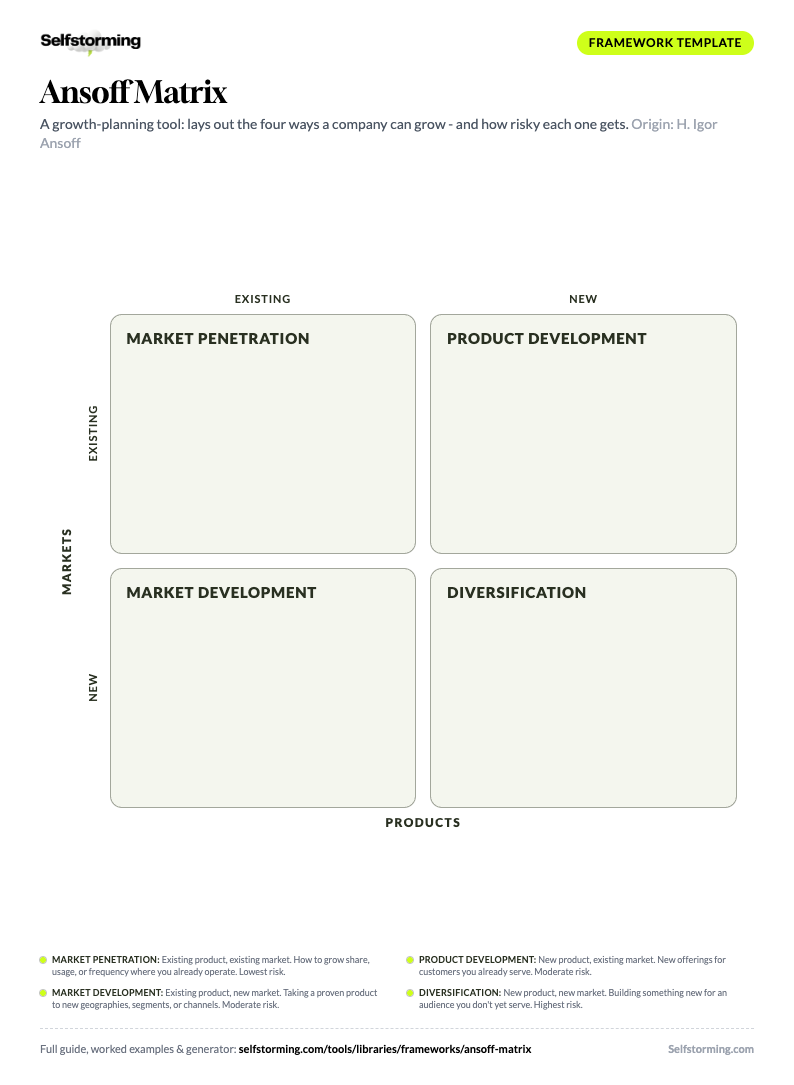
Print it. Fill it in.
The Ansoff Matrix as a printable A4 worksheet - write straight into the framework, on paper or in any PDF app.
Download the PDF templateKnowledge Worth Paying For
A working library of brand strategy frameworks - with worked examples on real brands, sources, and decision criteria. Not vibes.
One good deck covers the subscription. The rest is profit.
Two axes, four growth options. Market Penetration (existing product, existing market - sell more to who you already have, lowest risk), Product Development (new product, existing market - build something new for your current customers), Market Development (existing product, new market - take what works somewhere new), and Diversification (new product, new market - the moonshot, highest risk). Risk rises as you move away from the familiar top-left corner. Use it to compare growth bets, not to design the execution.
Netflix
Streaming and entertainment company (USA, founded 1997)A rare company that has lived in all four quadrants in sequence - the cleanest illustration of using the Ansoff Matrix as a growth ladder rather than a one-time choice. Each move funded the next and raised the risk one notch.
Airbnb
Travel and hospitality marketplace (USA, founded 2008)Shows the matrix used to weigh adjacent growth against a true leap. Airbnb's safe moves (more bookings, Experiences for existing travellers) are clearly separable from its riskier diversification, which makes the risk gradient legible.
LEGO
Toy and entertainment company (Denmark, founded 1932)A case where diversification nearly sank the company before disciplined penetration and licensed product development saved it - a vivid lesson that the safe quadrants are not the boring ones, and the risky corner deserves its reputation.
Netflix, Airbnb, LEGO - filled in, line by line. Unlock to read them.
Netflix (Streaming and entertainment company (USA, founded 1997))
A rare company that has lived in all four quadrants in sequence - the cleanest illustration of using the Ansoff Matrix as a growth ladder rather than a one-time choice. Each move funded the next and raised the risk one notch.
Market Penetration: Pushing existing US DVD-by-mail and later streaming subscribers to watch more and churn less - personalisation, autoplay, and pricing tiers to deepen share of an existing market.
Product Development: Building Netflix Originals (House of Cards onward) for its existing subscriber base - a new product, same audience, reducing reliance on licensed catalogue.
Market Development: Taking the existing streaming product into 190+ new countries, adapting payment, language, and pricing for markets it didn't previously serve.
Diversification: Moving into mobile gaming and live events - new products for partly new audiences - the riskiest leap, still unproven relative to the core streaming business.
Airbnb (Travel and hospitality marketplace (USA, founded 2008))
Shows the matrix used to weigh adjacent growth against a true leap. Airbnb's safe moves (more bookings, Experiences for existing travellers) are clearly separable from its riskier diversification, which makes the risk gradient legible.
Market Penetration: Driving more bookings from existing hosts and guests in established markets - reviews, search ranking, and superhost incentives to lift frequency and trust.
Product Development: Launching Experiences and Airbnb-branded services for its existing traveller base - new products for customers it already had.
Market Development: Expanding the existing stays product into new regions and into business-travel and longer-stay segments it didn't originally serve.
Diversification: Earlier bets like building its own end-to-end travel and transport offerings - new products for new use cases - the highest-risk direction it has scaled back from.
LEGO (Toy and entertainment company (Denmark, founded 1932))
A case where diversification nearly sank the company before disciplined penetration and licensed product development saved it - a vivid lesson that the safe quadrants are not the boring ones, and the risky corner deserves its reputation.
Market Penetration: Selling more core brick sets to existing fans and families - seasonal ranges, collector sets, and AFOL (adult fan) lines to deepen an existing market.
Product Development: Licensed themes (Star Wars, Harry Potter) and LEGO Ideas sets - new products for the existing fan base, leaning on a relationship it already had.
Market Development: Pushing into new geographies like China and new age segments such as adults with LEGO Botanicals and Architecture lines.
Diversification: Earlier ventures into theme parks, video games, and clothing - new products for new markets - the over-extension that triggered a near-bankruptcy and a hard refocus on the brick.
1. Market Penetration
How do we sell more of our existing products to the customers and markets we already serve?
Existing product, existing market. The lowest-risk quadrant: grow by winning more share, increasing usage, or stealing customers from rivals in a market you already understand. The default first move because you're betting on execution, not on the unknown.
Good answer: Costco drives penetration through its membership model - the annual fee plus the treasure-hunt layout pushes existing members to shop more often and spend more per visit, all inside the markets it already operates.
Wrong answer: We'll grow by being in a new country next year. That isn't penetration, it's market development wearing the wrong label. Mislabelling the quadrant hides the real risk you're taking on.
2. Product Development
What new products or services can we create for the customers and markets we already serve?
New product, existing market. Grow by building something new for people who already trust you. Moderate risk: you know the customer, so the bet is on whether you can build the right thing, not on whether anyone is there to buy it.
Good answer: Slack added Huddles and Canvas for its existing workplace users - new products, same audience, leaning on a relationship it had already earned rather than chasing strangers.
Wrong answer: Let's build it and a brand-new audience will surely show up. If the new product needs a new kind of customer, you've quietly slipped into diversification - the riskiest box - while telling yourself it's a safe extension.
3. Market Development
Which new markets, segments, or geographies could buy the products we already make?
Existing product, new market. Grow by taking what already works to people who can't yet buy it - new geographies, new segments, new channels. Moderate risk: the product is proven, but the new market may behave nothing like the one you know.
Good answer: Notion expanded from individual power users into enterprise teams - same core product, a new market segment with new needs around security and admin, opening a far larger pool of buyers.
Wrong answer: It sold well at home, so it'll sell everywhere. Assuming a proven product travels unchanged ignores that the new market has its own competitors, habits, and price expectations the matrix won't warn you about.
4. Diversification
What entirely new products could we offer to entirely new markets, and is the leap worth the risk?
New product, new market. The highest-risk quadrant: you're learning two unfamiliar things at once with no existing relationship to fall back on. Sometimes it's the only path to real growth - and sometimes it's where confident companies go to discover their limits.
Good answer: Amazon's move into cloud computing with AWS was true diversification - a new product (infrastructure-as-a-service) for a new market (developers and enterprises) that became more profitable than the retail business it grew out of.
Wrong answer: We're a strong brand, so a new product in a new market is a safe bet for us. Brand strength rarely transfers across both axes at once. Diversification fails most often when leadership underestimates how little their reputation buys them in unfamiliar territory.
Decide your starting point. You don't have to brainstorm four growth boxes from a blank page - right here on Selfstorming you can find inspiration and directions, or generate a first-draft Ansoff Matrix in minutes. Treat that draft as a head start, then pressure-test it with the steps below. Workshop-from-scratch and AI-draft-then-validate are both valid - most teams move faster from a draft.
Define your two axes honestly before you fill anything in. Be strict about what counts as a genuinely new product versus a tweak, and a genuinely new market versus an adjacent segment. Loose definitions are how a risky bet gets miscategorised as a safe one.
Populate all four quadrants, not just your favourite. The point of the matrix is comparison. Force at least one real option into each box, including the moonshot diagonal you'd normally avoid - you can't weigh a bet you never wrote down.
Read the risk gradient as information, not instruction. Risk rises from Market Penetration toward Diversification, but high risk is not a veto. The matrix tells you the size of the bet; your appetite, runway, and ambition decide whether to take it.
Add the competition column the matrix forgets. For each quadrant, note who already owns that space and how hard they'll defend it. Ansoff's most documented flaw is that it ignores rivals entirely - so add them by hand before you decide.
Stress-test each option against capability and cash. A great-looking diversification you can neither build nor fund is not a strategy, it's a daydream. Mark which quadrants you have the resources and skills to actually execute.
Sequence rather than pick one. Most durable growth stacks the boxes: penetrate hard to fund product development, use that to open new markets, and only diversify once the core is strong. Decide the order, not just the destination.
Revisit after every major move. A market you've entered is now an existing market; a launched product is now an existing product. The matrix shifts under you as you grow, so redraw it whenever the board you started from is out of date.
Best for: Framing and prioritising growth options early in strategic planning - comparing safe bets against ambitious ones on a single risk-graded picture. / Execution planning, competitive strategy, or portfolio resource allocation. The Ansoff Matrix names the direction, not the route or the rivals.
Output: A 2x2 with one or more concrete growth options in each quadrant, read against a risk gradient that rises toward diversification. / A detailed go-to-market plan, financial model, or competitor analysis. Those are the next steps the matrix points you toward, not what it produces.
Time to complete: A short session (1-2 hours) to populate all four quadrants, then validation of the shortlisted options against real numbers and competition. / Multi-month strategy projects with deep market research. The matrix is the framing step at the front of that work, not the work itself.
vs BCG Matrix: Ansoff is forward-looking and about choosing growth direction - where to expand next across product and market. / The BCG Matrix is portfolio-looking and about managing what you already have - which existing products to invest in, milk, or kill by market share and growth rate.
vs SWOT: Ansoff is a decision tool that hands you four specific, comparable growth options with a built-in risk read. / SWOT is a situational audit that organises strengths, weaknesses, opportunities, and threats but recommends no action. Use SWOT to understand the context, Ansoff to choose the move.
vs Playing to Win: Ansoff answers 'which direction do we grow in?' with four risk-ranked options and no view on how to win there. / Playing to Win answers 'where will we play and how will we win?' with explicit competitive choices and capabilities. Use Ansoff to shortlist, Playing to Win to build the winning logic.
The Ansoff Matrix was created by H. Igor Ansoff, a Russian-American applied mathematician and business manager often called the father of strategic management. He introduced the product-market growth grid in his 1957 Harvard Business Review article Strategies for Diversification, and later developed the ideas further in his 1965 book Corporate Strategy. The matrix gave executives one of the first structured ways to think about growth as a set of distinct, comparable choices rather than a single vague ambition. It endured because the two questions at its heart - new or existing product, new or existing market - turned out to be the simplest honest way to frame where growth could come from and how risky each path was.
The Ansoff Matrix draws steady criticism for oversimplifying risk - it reduces a complex, uncertain decision to four boxes and assumes the product and market axes are independent and stable, which they rarely are in dynamic, competitive markets. Critics also note it ignores competition and execution entirely: it has no place for rivals, no guidance on resources or operations, and treats 'newness' so loosely that the same move can be classed as product development or diversification depending on who is drawing it. The fair reading: it's a great framing tool and a poor decision-maker. Use it to surface and compare growth options, then add the competition, capability, and execution context it deliberately leaves out.
What is the Ansoff Matrix?
The Ansoff Matrix is a strategic planning tool that maps four growth options on two axes - product (existing vs new) and market (existing vs new). The four quadrants are Market Penetration (existing product, existing market), Product Development (new product, existing market), Market Development (existing product, new market), and Diversification (new product, new market). Risk rises as you move away from market penetration, so it lets a leadership team compare growth bets and their risk on one picture.
Who created the Ansoff Matrix?
It was created by H. Igor Ansoff, a Russian-American applied mathematician and business manager known as the father of strategic management. He introduced the product-market growth grid in his 1957 Harvard Business Review article Strategies for Diversification and expanded on it in his 1965 book Corporate Strategy.
What are the four quadrants of the Ansoff Matrix?
Market Penetration (sell more existing product to your existing market - lowest risk), Product Development (build a new product for your existing market), Market Development (take your existing product to a new market), and Diversification (a new product for a new market - highest risk, because you're learning two unfamiliar things at once).
Which Ansoff Matrix strategy is the riskiest?
Diversification - a new product for a new market - is the riskiest quadrant. You have no existing relationship to lean on and you're betting on two unknowns at the same time: whether you can build the product and whether the new market wants it. The risk gradient in the Ansoff Matrix rises from Market Penetration in the safe corner toward Diversification in the far one.
What is the difference between the Ansoff Matrix and the BCG Matrix?
The Ansoff Matrix is forward-looking and about choosing a growth direction - where to expand next across product and market. The BCG Matrix is portfolio-looking and about managing what you already have - classifying existing products as stars, cash cows, question marks, or dogs by market share and growth rate. Use Ansoff to decide where to grow, the BCG Matrix to decide where to invest in the current lineup.
What are the main criticisms of the Ansoff Matrix?
It oversimplifies risk into four boxes and assumes product and market are independent and stable; it ignores competition entirely, with no place for rivals who often decide the outcome; and it offers no guidance on execution or resources. Its 'newness' axes are also fuzzy, so the same move can be labelled product development or diversification depending on the drawer. The fix is to add competition, capability, and execution context the matrix leaves out.
Does the Ansoff Matrix work for startups?
Yes, as a fast framing tool. It helps a small team see that growth has more than one direction and weigh a safe bet against an ambitious one before committing scarce runway. But because the Ansoff Matrix ignores competition and resources, a startup should pair it with an honest capability and cash check - and for very early stage, a tool like the Lean Canvas or Business Model Canvas usually does more practical work.
Can a company use more than one Ansoff Matrix quadrant at once?
Yes, and the strongest growth strategies usually sequence the quadrants rather than picking one. A common pattern is to penetrate hard to generate cash, use it to fund product development, expand into new markets off that base, and only diversify once the core is strong. The matrix is best read as a ladder of bets over time, not a single either-or choice.
A growth-planning tool: lays out the four ways a company can grow - and how risky each one gets.
Market Penetration sits in the safe corner, selling more of what you have to people who already buy it. Diversification sits in the far corner, new product and new market at once, where most ambitious failures live. The matrix doesn't tell you which box to pick - it tells you what you're really betting and roughly how much it costs to be wrong. This page walks through each quadrant, the growth question behind it, and how to use the risk gradient without letting it scare you into doing nothing.
Related Frameworks
Marketing Funnel
Five stages from widest to narrowest: Awareness (people learn you exist), Consideration (they weigh you against alternatives), Conversion (t
Playing to Win
Five linked choices, top to bottom: Winning Aspiration (what winning looks like, for whom), Where to Play (the specific market, segment, geo
OKRs
One Objective (qualitative, ambitious, memorable - the hill worth taking) plus three Key Results (numeric, measurable, with zero grey area -
SWOT Analysis
Four boxes, two axes: Strengths and Weaknesses are internal and controllable, Opportunities and Threats are external and mostly not. Left si