BCG Matrix
How to Decide Which Products to Feed and Which to Kill
The BCG Matrix is the framework everyone half-remembers from a slide deck: four boxes, two of them with animal names, and a vague sense that something should be milked. That reputation does it a disservice. Strip away the cartoon and what you have is a brutally simple cash-flow question - which of our products earns the money, and which of them spends it?
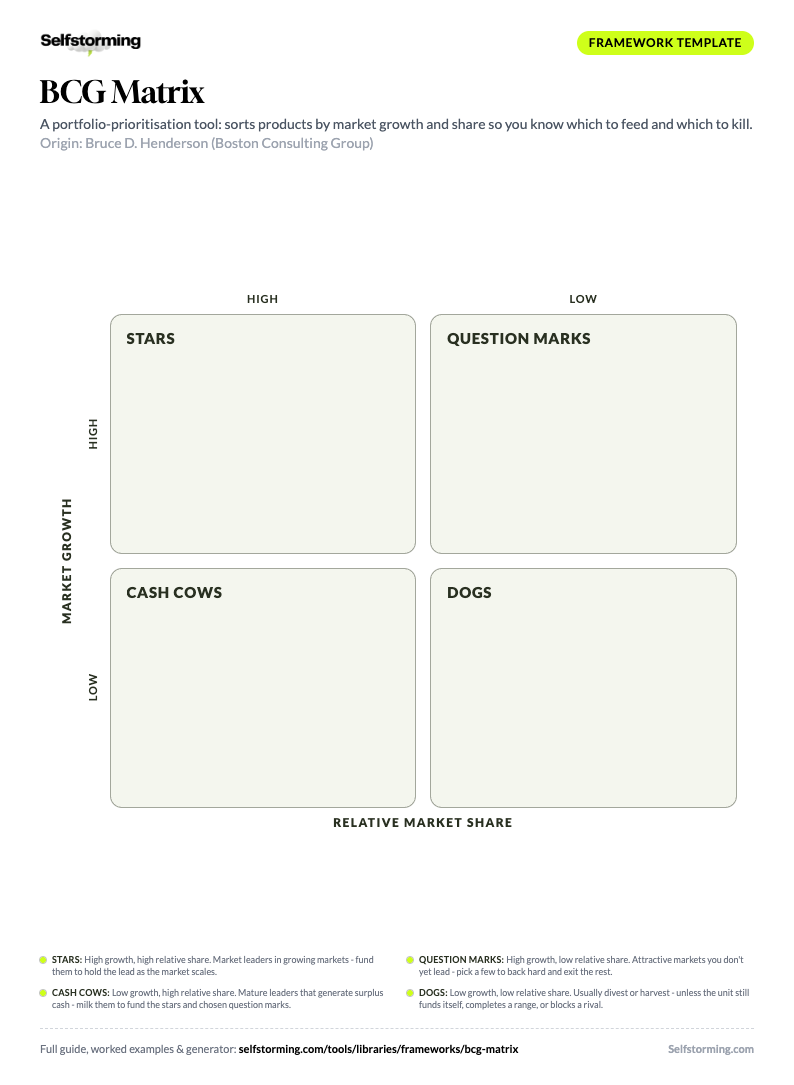
Print it. Fill it in.
The BCG Matrix as a printable A4 worksheet - write straight into the framework, on paper or in any PDF app.
Download the PDF templateKnowledge Worth Paying For
A working library of brand strategy frameworks - with worked examples on real brands, sources, and decision criteria. Not vibes.
One good deck covers the subscription. The rest is profit.
Plot products on two axes - market growth (high/low) and relative market share (high/low) - and four quadrants appear. Stars: high growth, high share, fund them. Question Marks: high growth, low share, pick a few and double down or drop. Cash Cows: low growth, high share, milk them to fund everything else. Dogs: low growth, low share, divest unless they serve a strategic purpose. The whole tool is a cash-routing diagram: cows pay, stars grow, you bet on the best question marks, and you stop feeding dogs.
Netflix
Streaming and content company (USA, founded 1997)A clean illustration of products moving between quadrants over time. The legacy DVD-by-mail business slid from Cash Cow to Dog as its market shrank, streaming became the Star, and newer bets like ad-supported tiers and gaming sit as Question Marks demanding investment in fast-growing but contested spaces.
Samsung Electronics
Diversified electronics conglomerate (South Korea, founded 1969)A portfolio broad enough to span all four quadrants at once, which is exactly the situation the matrix was built for: routing cash from mature dominant lines into newer high-growth bets while pruning categories that have gone flat.
Nestlé
Global food and beverage company (Switzerland, founded 1866)A sprawling brand house that lives or dies on portfolio discipline. The matrix maps neatly onto how the company shifts investment from declining legacy lines toward fast-growing health and premium-coffee categories.
Netflix, Samsung Electronics, Nestlé - filled in, line by line. Unlock to read them.
Netflix (Streaming and content company (USA, founded 1997))
A clean illustration of products moving between quadrants over time. The legacy DVD-by-mail business slid from Cash Cow to Dog as its market shrank, streaming became the Star, and newer bets like ad-supported tiers and gaming sit as Question Marks demanding investment in fast-growing but contested spaces.
Stars: Ad-free streaming subscriptions - the dominant share of a still-growing global streaming market, generating cash while requiring relentless content investment to hold the lead.
Question Marks: Netflix Games and the live-events push - low share in fast-growing categories Netflix doesn't yet own. Clear bets that need heavy, deliberate funding or an honest exit.
Cash Cows: The mature, saturated subscription base in North America - slow growth, high share, dependable cash that funds the riskier global and format bets.
Dogs: The wound-down DVD-by-mail business - low share of a market that effectively disappeared. Correctly harvested and then exited rather than propped up.
Samsung Electronics (Diversified electronics conglomerate (South Korea, founded 1969))
A portfolio broad enough to span all four quadrants at once, which is exactly the situation the matrix was built for: routing cash from mature dominant lines into newer high-growth bets while pruning categories that have gone flat.
Stars: Foldable smartphones - Samsung leads a still-expanding premium category, earning well but spending heavily on R&D and marketing to defend the lead.
Question Marks: Galaxy XR and ambient-computing devices - low share in a nascent, fast-growing market where the outcome is genuinely uncertain and the bet must be sized deliberately.
Cash Cows: Memory chips and home appliances - mature, slow-growing categories with strong share that throw off the cash funding the hungrier divisions.
Dogs: Standalone digital cameras and feature-phone lines - low share of markets that stopped growing, candidates to harvest or exit rather than chase.
Nestlé (Global food and beverage company (Switzerland, founded 1866))
A sprawling brand house that lives or dies on portfolio discipline. The matrix maps neatly onto how the company shifts investment from declining legacy lines toward fast-growing health and premium-coffee categories.
Stars: Nespresso and premium coffee systems - a leading share of a category still growing globally, generating cash while needing continued investment in machines, capsules, and retail.
Question Marks: Plant-based and health-science nutrition lines - fast-growing markets where Nestlé is not the clear leader, demanding a real invest-or-exit decision per brand.
Cash Cows: Maggi and instant coffee staples in mature markets - slow growth, dominant share, steady cash that funds the growth bets elsewhere.
Dogs: Underperforming frozen and confectionery lines in flat markets - low share, low growth, regularly divested as the portfolio is pruned.
1. Stars
Which products lead a fast-growing market - and will need cash to keep that lead as it scales?
High market growth, high relative market share. The market leaders in markets that are still expanding. They generate a lot of cash but also consume a lot to defend their position. Today's Stars are tomorrow's Cash Cows if growth eventually flattens while you hold the lead - which is the whole reason to protect them.
Good answer: Nintendo's Switch line at its peak. A clear leader in a hybrid console category that was still growing fast - throwing off cash while demanding constant content and hardware investment to stay ahead.
Wrong answer: Treating a Star like a Cash Cow too early. Cutting investment while the market is still growing hands the lead to a competitor, and a Star you stopped feeding quietly slides into a Dog.
2. Question Marks
Which products sit in fast-growing markets where we are NOT yet the leader - and could we realistically become one?
High market growth, low relative market share. Also called Problem Children. The market is attractive, but you do not own it. They burn cash and the outcome is genuinely uncertain: invest hard and a few become Stars, or starve them and they become Dogs. The discipline is choosing the few worth backing, not funding all of them politely.
Good answer: Disney+ in its early launch years. A late entrant into fast-growing streaming with low share against the incumbent - a clear bet that demanded heavy, deliberate investment to push toward Star territory.
Wrong answer: Spreading investment across every Question Mark equally. Hedging your bets across all of them guarantees none get enough fuel to win, and you fund a litter of future Dogs.
3. Cash Cows
Which products dominate a mature, slow-growing market and quietly generate more cash than they consume?
Low market growth, high relative market share. The reliable earners. Market growth has slowed, so they need little reinvestment, yet their dominant share keeps the cash flowing. Cows are the engine that funds Stars and the chosen Question Marks. The job is to defend the position cheaply and route the surplus to where growth still lives.
Good answer: Gillette razors inside Procter & Gamble. A dominant share of a mature, slow-growing category that throws off dependable cash used to fund newer, hungrier bets across the portfolio.
Wrong answer: Either over-investing in a flat market chasing growth that isn't there, or milking so aggressively the leader erodes. Both ends ruin the cow - one wastes the cash, the other kills the source.
4. Dogs
Which products hold low share in a market that is barely growing - and are we keeping them out of habit?
Low market growth, low relative market share. The classic candidates for divestment. They neither lead nor ride a wave, so they tend to tie up cash and attention for little return. The honest move is usually to harvest or exit - but not always. Some Dogs still generate cash, complete a range, or block a competitor, which is a strategic reason to keep them.
Good answer: BlackBerry's handset business in its final years. Low share of a market that had stopped growing for it - a textbook case where the strategic answer was to exit hardware and redeploy, which the company eventually did.
Wrong answer: Killing a Dog on the label alone. A unit can score 'Dog' on the chart yet still fund itself, defend a flank, or anchor a portfolio - the matrix flags it, it doesn't sentence it.
Decide your starting point: You don't need a finance team and a quarter of data to begin. Right here on Selfstorming you can sketch a first-pass portfolio and pressure-test the logic, or generate a first-draft BCG Matrix in minutes. Treat that draft as a head start, then run it through the steps below to ground it in real numbers and real market definitions.
Define the market before you plot anything: The same product is a Star or a Dog depending on how narrowly you draw the market. A craft soda is a Dog in 'beverages' and a Star in 'premium functional soda'. Pick the market definition you can defend, write it down, and use the same one for every product.
Get relative market share right, not just market share: Relative share is your share divided by your largest competitor's share, not your raw percentage. A 20% share is a leader if the next player has 10%, and an also-ran if the next player has 40%. Use the relative number on the x-axis or the matrix lies to you.
Set honest axis thresholds: Decide what counts as 'high' growth (often the market's own growth rate, or a 10% line) and where the share midpoint sits (relative share of 1.0). Don't fudge the lines to put a favourite product in a flattering box.
Plot bubbles sized by revenue: Draw each product as a bubble whose size reflects its revenue or contribution. A tiny Dog and a giant Cash Cow are very different problems, and equal-sized dots hide that. The picture should make the stakes obvious at a glance.
Route the cash explicitly: For every Cash Cow, name where its surplus goes - which Star it defends, which Question Mark it funds. The matrix is only useful if it ends in a money-movement decision, not a colourful chart.
Make a call on every Question Mark: For each one, decide invest hard or exit. The expensive failure mode is the polite middle - funding all of them a little. Pick the few with a real path to leadership and starve the rest deliberately.
Stress-test the share-equals-profit assumption: Before you milk a cow or shoot a dog, confirm the product's share actually translates to cash and cost advantage. Where it doesn't, ignore the box and follow the money - the matrix is the prompt, the P&L is the verdict.
Best for: Multi-product or multi-business portfolios where you must route limited cash between mature earners and growth bets. Big-picture investment and divestment decisions. / Single-product companies, early-stage startups with one bet, or any decision where margin and capability fit matter more than share and growth.
Output: A two-by-two bubble chart placing every product by market growth and relative share, ending in explicit cash-routing and invest/divest calls. / A nuanced competitive analysis, a financial model, or a customer-insight synthesis. The matrix is a routing diagram, not a forecast.
Time to complete: A focused session once you have share and growth data - the structure forces decisions fast, often inside a single planning workshop. / Deep multi-month strategy projects with scenario modelling and competitive war-gaming. Different deliverable, different rigour.
vs Ansoff Matrix: BCG Matrix asks where to allocate cash across an existing portfolio - which products to feed, milk, or cut, based on share and growth. / Ansoff Matrix asks where future growth comes from - existing vs new products against existing vs new markets. Use Ansoff to pick growth directions, BCG to fund them.
vs SWOT: BCG Matrix is quantitative and portfolio-level, forcing concrete cash decisions from two measurable axes. / SWOT is qualitative and single-unit, surfacing strengths, weaknesses, opportunities, and threats. Use SWOT to understand one business, BCG to compare many.
vs Playing to Win: BCG Matrix tells you which products earn and which spend, a portfolio cash map for the products you already have. / Playing to Win asks the prior strategic questions - where to play and how to win - that decide which products should exist at all. Use Playing to Win to set the field, BCG to manage what's on it.
The BCG Matrix, formally the growth-share matrix, came out of the Boston Consulting Group between 1968 and 1970. Bruce D. Henderson, who founded BCG in 1963, popularised it in a one-page essay titled The Product Portfolio in BCG's Perspectives series in 1970, building on the firm's earlier work on the experience curve. The initial sketch is often credited to BCG's Alan Zakon, refined collaboratively across the firm. The idea was deceptively simple: a company is a portfolio of products, cash should flow from mature leaders to growing bets, and a single two-by-two could make that flow visible. By the early 1980s roughly half the Fortune 500 used some version of it in planning, and it became the template for nearly every two-by-two strategy diagram that followed.
The honest objections are well documented. The matrix has only two axes, so it ignores margin, capability fit, competitive intensity, and brand strength - factors that often matter more than share or growth. It assumes relative market share equals lower cost and more cash, which is not always true, especially in categories where scale doesn't drive profit. The 'Dog' label invites lazy divestment of units that quietly fund themselves or guard a flank, and it treats products as independent, ignoring the synergies and shared costs that link them. Academic work has been sceptical too: a 1992 study by Slater and Zwirlein in the Journal of Management, covering 129 multi-business firms, found that following portfolio-planning models like this one was associated with lower shareholder returns rather than higher. The fair reading is that the matrix is a useful first prompt, not a verdict - it tells you where to look, while the P&L and the market tell you what to do.
What is the BCG Matrix?
The BCG Matrix is a portfolio-strategy tool that plots a company's products or business units on two axes - market growth and relative market share - to produce four quadrants: Stars, Question Marks, Cash Cows, and Dogs. Its purpose is to show which products generate cash and which consume it, so you can route money from mature leaders to growth bets and stop funding what won't pay back.
Who created the BCG Matrix?
It came out of the Boston Consulting Group between 1968 and 1970. The firm's founder, Bruce D. Henderson, popularised it in his 1970 essay The Product Portfolio in BCG's Perspectives series, building on the firm's experience-curve work. The initial sketch is commonly credited to BCG's Alan Zakon, then refined across the firm. So it's a BCG house tool with Henderson as its public face, not a single-author academic model.
What do the four quadrants of the BCG Matrix mean?
Stars (high growth, high share) are leaders in growing markets you fund to keep the lead. Question Marks (high growth, low share) are attractive markets you don't yet lead - back a few hard or exit. Cash Cows (low growth, high share) are mature leaders you milk for cash. Dogs (low growth, low share) are usually divested. The arrows of cash run from cows to stars and the chosen question marks.
Why is relative market share used instead of normal market share in the BCG Matrix?
Because leadership is relative. A 20% share looks strong until you notice a rival holds 40%. Relative market share - your share divided by your largest competitor's - tells you whether you actually lead, with a value above 1.0 meaning you do. Plotting raw percentages on the x-axis is the most common way teams put followers in the leader column and break the whole cash logic.
Is the BCG Matrix outdated?
It's old, not useless. The criticisms are real - only two axes, share isn't always profit, and it ignores synergies - and its formal use has declined. But as a fast first prompt for portfolio cash decisions it still earns its place, especially in multi-product companies. Treat the BCG Matrix as the question that gets the right debate started, then let the P&L and the market deliver the verdict.
What is the difference between the BCG Matrix and the Ansoff Matrix?
Different jobs. The BCG Matrix manages the products you already have - which to feed, milk, or cut based on share and growth. The Ansoff Matrix decides where future growth should come from, mapping existing vs new products against existing vs new markets. Use Ansoff to choose growth directions, then the BCG Matrix to fund them from the portfolio's cash.
Should you always divest a Dog in the BCG Matrix?
No - and this is where the labels do the most damage. A unit can land in the Dog quadrant yet still generate cash, complete a product range customers expect, share costs with a Cash Cow, or block a competitor's flank. The matrix flags a Dog for investigation; it doesn't sentence it. Divest for a strategic reason you can name, not because of the cartoon.
Does the BCG Matrix work for a single-product startup?
Not really, and that's fine - it's the wrong tool. The BCG Matrix routes cash across a portfolio, so with one product there's nothing to route. A single-product startup is better served by where-to-play tools like Playing to Win or growth-direction tools like the Ansoff Matrix. Reach for the BCG Matrix once you have several lines competing for the same budget.
A portfolio-prioritisation tool: sorts products by market growth and share so you know which to feed and which to kill.
Plot every product or business unit on two axes: how fast its market is growing, and how big a share of that market you hold. Four quadrants fall out. Stars (high growth, high share), Question Marks (high growth, low share), Cash Cows (low growth, high share), and Dogs (low growth, low share). The point was never the labels. The point is that money has to flow from the cows to the stars and the better question marks, and that you stop quietly funding things that will never pay you back. This page walks through what each box actually means, where the model lies to you, and how to use it without milking the wrong cow.
Related Frameworks
Playing to Win
Five linked choices, top to bottom: Winning Aspiration (what winning looks like, for whom), Where to Play (the specific market, segment, geo
OKRs
One Objective (qualitative, ambitious, memorable - the hill worth taking) plus three Key Results (numeric, measurable, with zero grey area -
SWOT Analysis
Four boxes, two axes: Strengths and Weaknesses are internal and controllable, Opportunities and Threats are external and mostly not. Left si
Eisenhower Matrix
Score every task on two axes: important (does it matter to your goals?) and urgent (does it need attention now?). That gives four boxes. Do