Marketing Funnel
From Stranger To Superfan in 5 Stages
The Marketing Funnel is the diagram every marketer can draw blindfolded and almost nobody uses honestly. Five stages, wide at the top, pinched at the bottom: Awareness, Consideration, Conversion, Retention, Advocacy. The promise is seductive - pour strangers in the top, collect customers out the bottom, optimise the leaky bits in between.
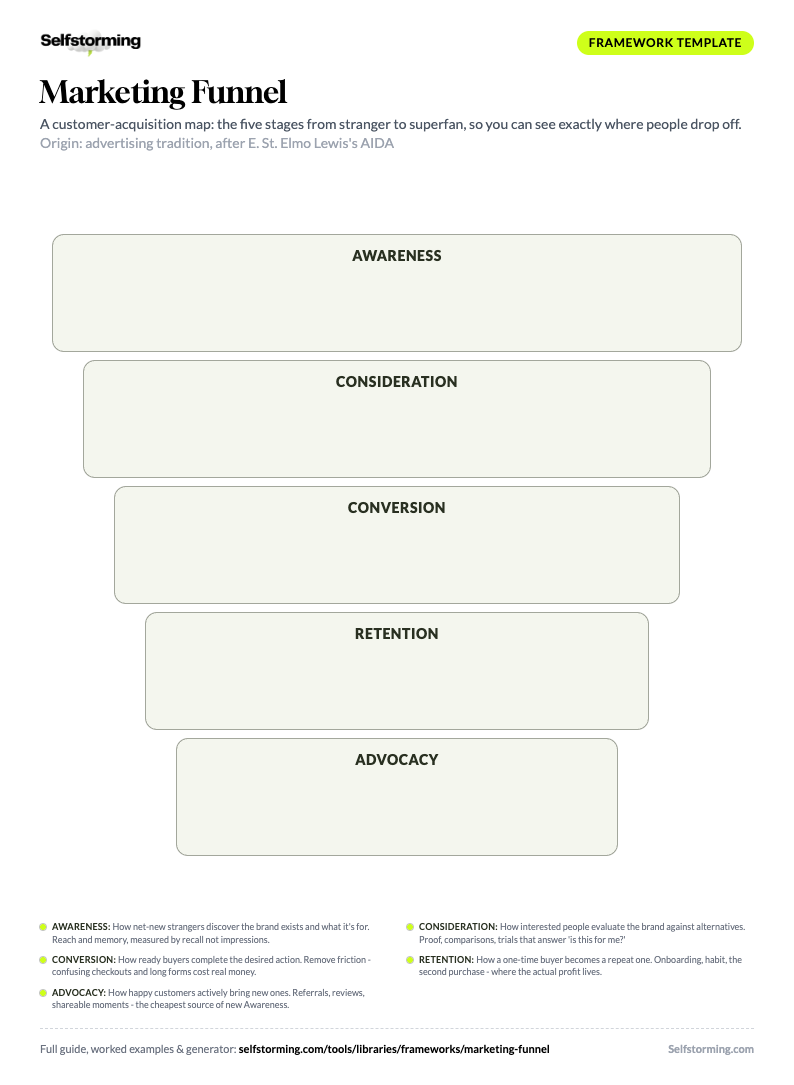
Print it. Fill it in.
The Marketing Funnel as a printable A4 worksheet - write straight into the framework, on paper or in any PDF app.
Download the PDF templateKnowledge Worth Paying For
A working library of brand strategy frameworks - with worked examples on real brands, sources, and decision criteria. Not vibes.
One good deck covers the subscription. The rest is profit.
Five stages from widest to narrowest: Awareness (people learn you exist), Consideration (they weigh you against alternatives), Conversion (they buy or sign up), Retention (they stick around and buy again), Advocacy (they tell other people). The trap: treating it as one-directional and last-click-only. The fix: read it as a loop where Retention and Advocacy refill Awareness, and balance brand demand-generation at the top with performance harvesting at the bottom.
Spotify
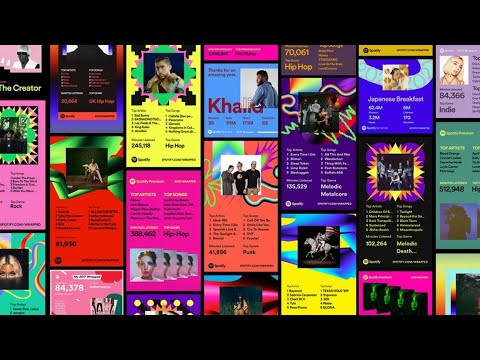
Freemium music streaming (Sweden, global, founded 2006)A near-perfect full-funnel machine: a free tier is the conversion-to-retention bridge, Wrapped is an advocacy engine that refills awareness every December, and the product itself does the retention work. Most companies treat the five stages as separate teams - Spotify treats them as one loop.
HelloFresh
DTC meal-kit subscription (Germany, scaled globally)A textbook performance-heavy funnel that learned the expensive lesson the hard way: acquisition was cheap and aggressive, but the first-box discount funnel only paid off once Retention got serious. A clean example of why the bottom two stages decide whether the top two were worth it.
Airbnb
Two-sided travel marketplace (USA, founded 2008)A funnel complicated by having two of them - guests and hosts - that feed each other. It shows the loop nature of the model clearly: a great guest stay produces a review, which produces awareness, which produces the next guest. Linear funnel thinking would miss the flywheel entirely.
Spotify, HelloFresh, Airbnb - filled in, line by line. Unlock to read them.
Spotify (Freemium music streaming (Sweden, global, founded 2006))
A near-perfect full-funnel machine: a free tier is the conversion-to-retention bridge, Wrapped is an advocacy engine that refills awareness every December, and the product itself does the retention work. Most companies treat the five stages as separate teams - Spotify treats them as one loop.
Awareness: Wrapped flooding every social feed each December; ubiquitous free tier so the brand is already on most phones; playlist branding that travels wherever the music does.
Consideration: Free vs Premium comparison made painless; the free tier IS the trial, so evaluation happens inside the product instead of on a pricing page.
Conversion: Frictionless upgrade to Premium triggered by the right annoyance at the right time (ads, offline, skips); student and family pricing to lower the leap.
Retention: Personalised playlists (Discover Weekly, Daily Mix) and saved libraries make leaving feel like losing your taste; the app earns a daily habit.
Advocacy: Wrapped is engineered to be shared - users do the marketing for free; collaborative playlists and shareable links turn every listener into a recruiter.
HelloFresh (DTC meal-kit subscription (Germany, scaled globally))
A textbook performance-heavy funnel that learned the expensive lesson the hard way: acquisition was cheap and aggressive, but the first-box discount funnel only paid off once Retention got serious. A clean example of why the bottom two stages decide whether the top two were worth it.
Awareness: Heavy podcast and influencer sponsorships with discount codes; YouTube pre-roll showing the box being unpacked so the product is understood before the click.
Consideration: Aggressive first-box discounts that lower the risk of trying; menu previews and dietary filters that answer "will this actually fit my life?"
Conversion: Simple plan picker and a discounted first order that makes the first signup feel almost free; the hard part is making the second box convert at full price.
Retention: Recipe variety, skip-a-week flexibility, and reminders to keep the subscription from feeling like a chore - the stage that decides if the discount was an investment or a loss.
Advocacy: Refer-a-friend credit and shareable recipe results; happy customers posting plated meals become low-cost top-of-funnel proof.
Airbnb (Two-sided travel marketplace (USA, founded 2008))
A funnel complicated by having two of them - guests and hosts - that feed each other. It shows the loop nature of the model clearly: a great guest stay produces a review, which produces awareness, which produces the next guest. Linear funnel thinking would miss the flywheel entirely.
Awareness: SEO on millions of location pages, PR around unique stays, and the simple cultural fact that travellers now say "find an Airbnb" the way they once said other category verbs.
Consideration: Reviews, photos, Superhost badges and transparent pricing that let a nervous traveller trust a stranger's spare room over a hotel they know.
Conversion: Streamlined booking with instant confirmation and clear cancellation terms; removing the fear of "what if it's not as pictured" is the real conversion lever.
Retention: Saved wishlists, trip history, and a steadily widening catalogue (Experiences, longer stays) that give a reason to open the app for the next trip too.
Advocacy: Post-stay reviews that become other travellers' Awareness, plus referral credit - the guest who had a great stay literally writes the marketing for the next one.
1. Awareness
Of the people who could ever buy this, how many even know we exist - and for what?
The widest stage. People who don't yet know you, learning that you're a thing and roughly what you're for. This is brand and demand-generation territory: reach, memory, and category association. It's the hardest to measure cleanly and the easiest to underfund, because its payoff lands months later in the stages below it.
In practice: Liquid Death's horror-trailer ads and tallboy cans made a water brand impossible to ignore in a category nobody thought about. Awareness done right buys you a place in memory before anyone is ready to buy.
Common mistake: Counting impressions and calling it growth. Ten million views of an ad nobody remembers is not awareness - it's a receipt. Awareness means people can recall who you are and what you're for, unprompted, later.
2. Consideration
When someone is weighing options, do we make their shortlist - and give them a reason to lean our way?
The stage where interest becomes evaluation. People compare you against alternatives, read reviews, lurk on your site, ask a colleague. The job here is to be on the shortlist and to remove friction and doubt: proof, demos, comparisons, free trials, the answer to the question they're too polite to ask.
In practice: Notion's template gallery and public docs let people picture their own work inside the product before paying a cent. Good consideration content answers "is this for me?" faster than a sales call could.
Common mistake: Talking about yourself instead of their decision. Feature dumps don't help someone choose. A buyer in consideration wants to know what changes for them and why you beat the obvious alternative, not your release notes.
3. Conversion
Of the people ready to act, how many actually complete the thing we want - and what's stopping the rest?
The pinch point where intent becomes action: a purchase, a signup, a booked demo. Small frictions cost real money here - a confusing checkout, a form with too many fields, a price revealed too late. This is also the stage performance marketers obsess over, often to the point of starving the stages that feed it.
In practice: A one-field signup that drops you straight into a working product converts because it removes every reason to hesitate. The best conversion design makes the next step feel smaller than not taking it.
Common mistake: Optimising the button while ignoring the doubt. You can A/B-test the checkout for a year, but if Consideration didn't do its job, you're polishing the exit of a room nobody wanted to enter. Conversion rate is a symptom, not always the disease.
4. Retention
After they buy, do they come back, stay, and use the thing enough to keep paying?
The stage where a transaction becomes a relationship. Onboarding, habit formation, customer success, the second purchase. For subscription and repeat-purchase businesses this is where the actual profit lives, because acquiring the customer rarely pays for itself on the first sale. Skipped by teams who think the funnel ends at checkout.
In practice: Duolingo's streaks and nagging owl turn a free app into a daily habit, which is why people stay long enough to convert to Super and recommend it. Retention is a product job dressed as a marketing one.
Common mistake: Pouring the entire budget into acquisition while churn quietly drains the tank. Buying new customers to replace ones you failed to keep is the most expensive growth strategy there is, and it never shows up in a top-of-funnel dashboard.
5. Advocacy
Do our happiest customers actively bring us new ones - and have we made it easy for them to?
The narrowest stage and the one that secretly refills the widest. Customers who are happy enough to recommend you, leave reviews, post screenshots, drag friends in. This is where the funnel stops being a line and becomes a loop: advocacy is the cheapest, most credible source of new Awareness you will ever have.
In practice: Monzo's "Golden Ticket" referrals and the bright coral card that started conversations on every table turned customers into a sales force. The best advocacy is a product detail people can't help mentioning.
Common mistake: Waiting for word-of-mouth instead of designing for it. Advocacy rarely happens by accident at scale. If you've never given a happy customer an easy, obvious way to bring a friend, you're leaving your cheapest channel switched off.
Decide your starting point: You don't have to map the funnel on a blank whiteboard. Right here on Selfstorming you can pull inspiration and a structure, or generate a first-draft marketing funnel in minutes. Treat that draft as a head start, then run it through the steps below to ground each stage in your own numbers and reality. Map-from-scratch and draft-then-pressure-test are both fine; most teams move faster from a draft.
Inventory what you already run, stage by stage: Before redesigning anything, list every current activity - ads, content, emails, onboarding, referral nudges - and sort each into one of the five stages. Most teams discover four things crammed into Conversion and absolutely nothing in Retention or Advocacy. That imbalance is the first finding.
Attach one honest metric per stage: Awareness = reach or aided recall, Consideration = qualified leads or trial starts, Conversion = conversion rate, Retention = retention or repeat rate, Advocacy = referral or review rate. If a stage has no metric, you're flying blind there. If it only has vanity counts, you're lying to yourself there.
Find the narrowest leak, not the loudest one: Walk the numbers top to bottom and look for the biggest drop relative to benchmark. The instinct is to fix the stage you can see (usually Conversion). The leverage is usually in the stage you've ignored. Fix the actual bottleneck, not the convenient one.
Balance brand and performance deliberately: Decide your split between top-of-funnel demand generation (Awareness, Consideration) and bottom-of-funnel harvesting (Conversion). Pure performance starves the top; pure brand never cashes in. Name the ratio out loud so it's a decision, not a default.
Treat Retention and Advocacy as a channel, not a chore: Design the post-purchase journey with the same care as the ad. What's the second action, the habit, the moment a customer would naturally recommend you? A funnel that ends at checkout is half a funnel.
Close the loop on attribution before you judge a stage: Avoid grading Awareness on last-click - it will always look worthless because the credit landed on Conversion. Use a model that gives upper-funnel work partial credit, or at minimum read the stages together. A click is the end of a story the top of the funnel started.
Pressure-test against the messy middle: Pick three real recent customers and trace how they actually arrived. You'll find loops, skips, and re-entries the neat diagram doesn't show. Use the funnel as a coverage checklist - "are we present at every stage?" - not as a claim that everyone travels it in order.
Best for: Mapping the end-to-end customer journey, finding the leakiest stage, and aligning a team on where the next hour of effort should go. Strong for diagnosing coverage gaps across acquisition AND retention. / Modelling non-linear, looping real-world journeys in fine detail, or deep brand-identity work. The funnel is a coverage map, not a behavioural simulation.
Output: A five-stage diagram with one decision-grade metric per stage and a named owner, showing exactly where intent leaks out between Awareness and Advocacy. / A dashboard of impressions and follower counts with no stage ownership. That's a vanity report, not a marketing funnel.
Time to complete: A focused half-day to map stages, attach metrics, and spot the biggest leak. The structure forces decisions, so the first useful version comes fast. / A multi-month customer-research programme with journey interviews and segmentation. Different, deeper deliverable - the funnel is the napkin, not the study.
vs AIDA: The Marketing Funnel extends AIDA past the sale - it includes Retention and Advocacy, where the actual profit and word-of-mouth live. Better when repeat business and referrals matter. / AIDA (Attention, Interest, Desire, Action) is tighter and copy-focused, ending at the purchase. Better for writing a single ad or page, not for running a whole growth operation.
vs AARRR: The Marketing Funnel leads with brand and Awareness, which suits businesses where demand has to be created before it can be captured. Stronger top-of-funnel framing. / AARRR (Acquisition, Activation, Retention, Referral, Revenue) is product-led and metric-native, built for startups instrumenting a digital product. Better when the whole journey happens inside an app.
vs Customer Journey Map: The funnel is faster, quantitative, and stage-by-stage - good for spotting where numbers leak. Use it when you need a metric-driven diagnosis quickly. / A Customer Journey Map captures emotions, touchpoints, and the messy non-linear reality the funnel flattens. Use the map when you need empathy and experience detail, not just conversion math.
The Marketing Funnel descends from AIDA - Attention, Interest, Desire, Action - a sales-and-advertising model usually traced to E. St. Elmo Lewis around 1898. The funnel shape came later: in 1924 William W. Townsend drew AIDA as a literal funnel in his book Bond Salesmanship, and through the mid-20th century practitioners refined the idea of customers progressing through measurable stages of purchase readiness. Modern digital marketing widened it into the now-standard full-funnel view - often shorthanded as TOFU, MOFU, BOFU (top, middle, bottom of funnel) - and crucially extended it past the sale to include Retention and Advocacy, recognising that repeat business and word-of-mouth are where most profit actually hides. The model spread because it gave teams a teachable, measurable structure for the otherwise invisible journey from stranger to customer.
The funnel is a famously leaky metaphor, and the critics have a point. Google's own research describes a non-linear "Messy Middle" where buyers loop endlessly between exploration and evaluation rather than marching down tidy stages. Behavioural marketers note the model over-credits the last click - the action gets the glory while the brand work that created the demand gets the blame for being unmeasurable. It also says nothing about brand-versus-performance balance, so teams optimise the harvestable bottom until the top quietly runs dry. The honest way to use it is as internal scaffolding - a coverage checklist you pressure-test against how people actually behave - not as proof that anyone travels it in the order you drew.
What is the marketing funnel?
The marketing funnel is a model of the customer journey drawn as a shape that's wide at the top and narrow at the bottom, with five stages: Awareness (people learn you exist), Consideration (they weigh you against alternatives), Conversion (they buy or sign up), Retention (they stay and buy again), and Advocacy (they tell other people). It's a coverage checklist for making sure you're investing across the whole journey, not just the stage that's easiest to measure.
What are TOFU, MOFU, and BOFU?
They're shorthand for the three broad zones of the funnel. TOFU (top of funnel) is Awareness and early Consideration - broad reach and education. MOFU (middle of funnel) is deeper Consideration - comparisons, proof, nurturing leads who are evaluating you. BOFU (bottom of funnel) is Conversion - the buyers ready to act. The Marketing Funnel adds Retention and Advocacy below BOFU, which the three-letter shorthand often forgets.
Is the Marketing Funnel the same as AIDA?
They're closely related but not identical. AIDA (Attention, Interest, Desire, Action) is the ancestor and stops at the sale. The Marketing Funnel keeps AIDA's logic but extends past the purchase to include Retention and Advocacy - the stages where repeat revenue and word-of-mouth live. Use AIDA to structure a single ad or page; use the Marketing Funnel to run a whole growth operation.
Is the Marketing Funnel outdated because journeys aren't linear?
The criticism is fair but the tool still earns its keep. Real buyers loop, skip, and re-enter - Google calls it the "Messy Middle." That doesn't make the funnel useless; it makes it a coverage checklist rather than a literal path. Read it as "are we present and measured at every stage?" instead of "everyone walks down these steps in order," and it stays useful.
How do I measure each stage of the Marketing Funnel?
Attach one decision-grade metric per stage: Awareness = reach or aided recall, Consideration = qualified leads or trial starts, Conversion = conversion rate, Retention = retention or repeat-purchase rate, Advocacy = referral or review rate. The rule is that a metric only belongs on the funnel if it would actually change a decision - impressions and follower counts rarely do.
Why do teams ignore Retention and Advocacy?
Because they sit after the sale, and most marketing dashboards and incentives stop at the conversion. That's a costly habit - keeping a customer is far cheaper than acquiring one, and an advocate is your most credible source of new Awareness. The Marketing Funnel's whole value for many teams is making those two neglected stages visible and assigning them an owner.
Does the Marketing Funnel work for B2B?
Yes, and arguably it works harder, because B2B journeys are long, involve buying committees, and loop heavily through the Consideration stage. The funnel gives a B2B team a shared language for where a deal is and what's stalling it, as long as you accept that several stakeholders travel the stages at different speeds and the path is anything but tidy.
How is the Marketing Funnel different from a Customer Journey Map?
The Marketing Funnel is fast, quantitative, and stage-by-stage - it's built to spot where numbers leak. A Customer Journey Map is qualitative and captures emotions, touchpoints, and the non-linear reality the funnel flattens. Use the funnel for a quick metric-driven diagnosis; use the journey map when you need empathy and experience detail. They complement each other rather than compete.
A customer-acquisition map: the five stages from stranger to superfan, so you can see exactly where people drop off.
The reality is messier, and that's the whole point of this page. A funnel done well is a shared map of where attention turns into trust and trust turns into money - and, crucially, what happens after the sale, where most teams stop drawing. A funnel done badly is a spreadsheet of vanity metrics that flatters the last click, ignores the brand work that filled the top, and quietly forgets that the cheapest customer you'll ever get is the one you already have.
This page walks each stage, the question that unlocks it, the metric that actually matters, and the specific way teams fool themselves at every level. Treat it as a thinking tool for deciding where your next hour of effort goes - not as proof the machine is working.
Related Frameworks
AIDA
Four stages a prospect moves through, top to bottom: Attention (get noticed in a hostile, distracted environment), Interest (earn a few more
Playing to Win
Five linked choices, top to bottom: Winning Aspiration (what winning looks like, for whom), Where to Play (the specific market, segment, geo
Ansoff Matrix
Two axes, four growth options. Market Penetration (existing product, existing market - sell more to who you already have, lowest risk), Prod