Customer Journey Map
How Your Customer Actually Gets From Stranger To Fan
A customer journey map is a five-stage picture of what a person does, thinks and feels on the way to becoming a customer - and, if you do it right, on the way to becoming a fan who tells other people. Awareness, Consideration, Decision, Onboarding & Service, Loyalty & Advocacy. Five stages, one timeline, the whole emotional rollercoaster on a single page.
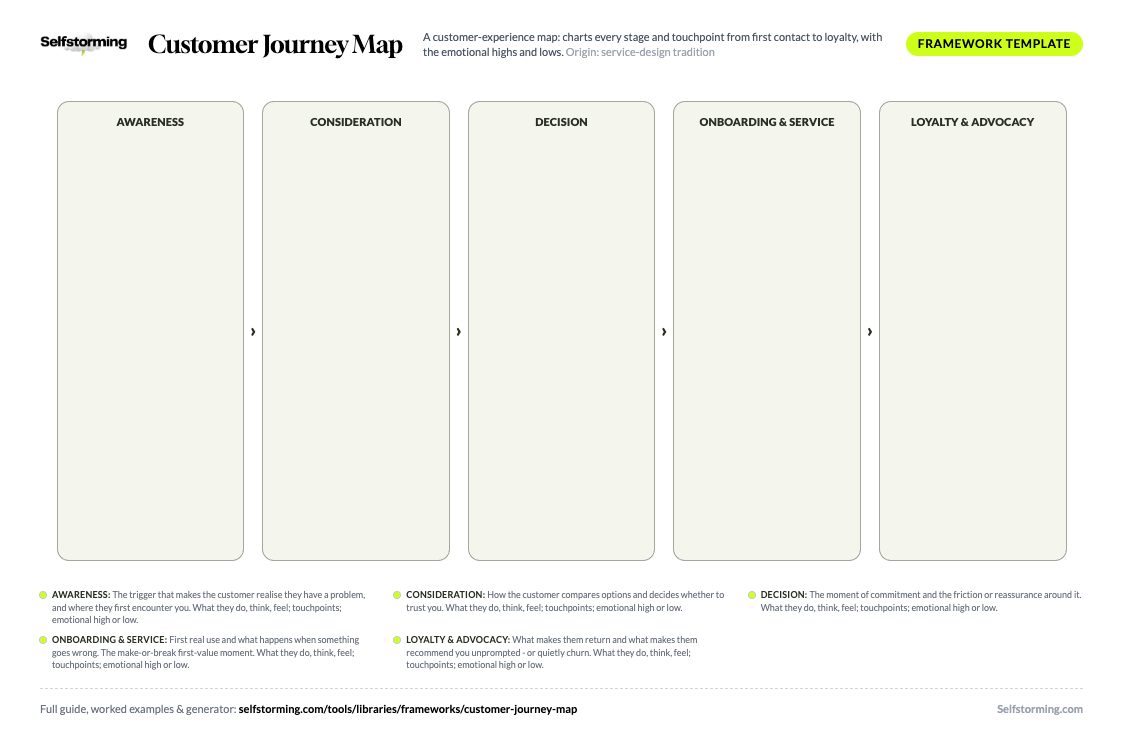
Print it. Fill it in.
The Customer Journey Map as a printable A4 worksheet - write straight into the framework, on paper or in any PDF app.
Download the PDF templateKnowledge Worth Paying For
A working library of brand strategy frameworks - with worked examples on real brands, sources, and decision criteria. Not vibes.
One good deck covers the subscription. The rest is profit.
Five stages across one timeline: Awareness (the trigger, first contact), Consideration (comparing options, weighing trust), Decision (the moment of commitment and the friction around it), Onboarding & Service (first use, support, the make-or-break first value), and Loyalty & Advocacy (repeat use, recommendation, churn risk). For each stage you capture what the customer does, what they think and feel, the touchpoints involved, and the emotional high or low. Use it to find broken moments, not to redraw your funnel.
Monzo
UK digital bank (challenger fintech, founded 2015)A textbook case of winning on the neglected stages. Most banks pour everything into Awareness and the account-open, then abandon the customer to a call centre. Monzo mapped the emotional dips of switching banks and getting paid, and engineered first-value moments - instant spending notifications, fee-free travel spend - that turned nervous switchers into vocal advocates.
Oura Ring
Sleep and health wearable (hardware + subscription, Finland)A journey where the make-or-break stage is firmly Onboarding & Service. The purchase is exciting, but the product only earns its subscription if the customer survives the first few nights of data and reaches a genuine 'I learned something about my body' moment. Mapping that early-value window is the whole game for any hardware-plus-subscription product.
Tony's Chocolonely
Mission-led chocolate brand (FMCG, Netherlands)An FMCG journey proving the map doesn't end at the till. The unequal chocolate chunks and the slavery-free mission turn a one-off impulse buy into a values-based relationship. Mapping the post-purchase moment - reading the wrapper, learning the story - is what converts a snack into a cause people repeat-buy and gift.
Monzo, Oura Ring, Tony's Chocolonely - filled in, line by line. Unlock to read them.
Monzo (UK digital bank (challenger fintech, founded 2015))
A textbook case of winning on the neglected stages. Most banks pour everything into Awareness and the account-open, then abandon the customer to a call centre. Monzo mapped the emotional dips of switching banks and getting paid, and engineered first-value moments - instant spending notifications, fee-free travel spend - that turned nervous switchers into vocal advocates.
Awareness: Trigger: frustration with a legacy bank's hidden fees or a friend's coral card spotted in the wild. Touchpoint: word of mouth, the distinctive card itself. Feeling: curious but wary of trusting money to an app.
Consideration: Compares against the high-street bank and other challengers. Reads Reddit threads about whether it's a 'real' bank. Touchpoint: reviews, FSCS protection messaging. Feeling: tempted, but anxious about safety.
Decision: Opens an account in minutes from the sofa, no branch visit. The low-friction signup is the conversion. Feeling: a small disbelief that it was that easy.
Onboarding & Service: First instant notification when they buy a coffee lands the 'oh, this is different' moment. Fee-free spending abroad on a first trip seals it. Feeling: relief turning into delight.
Loyalty & Advocacy: Shows the card to friends, posts about a budgeting feature, switches their salary over. Feeling: this is just my bank now. Advocacy happens unprompted, in pubs and group chats.
Oura Ring (Sleep and health wearable (hardware + subscription, Finland))
A journey where the make-or-break stage is firmly Onboarding & Service. The purchase is exciting, but the product only earns its subscription if the customer survives the first few nights of data and reaches a genuine 'I learned something about my body' moment. Mapping that early-value window is the whole game for any hardware-plus-subscription product.
Awareness: Trigger: chronic tiredness plus a podcast guest raving about their sleep score. Touchpoint: influencer mention, a colleague's ring. Feeling: intrigued, slightly skeptical of wellness hype.
Consideration: Weighs it against a smartwatch and a cheaper band. Worries about the monthly subscription on top of the hardware. Touchpoint: comparison reviews, accuracy studies. Feeling: interested but cost-conscious.
Decision: Buys after a sizing kit reduces the fear of ordering the wrong fit. The sizing step is the friction-remover. Feeling: committed, with a flicker of did-I-just-overspend.
Onboarding & Service: First week of readings is noisy and confusing - the danger zone. The 'aha' arrives when a late dinner visibly wrecks the sleep score and the data finally feels personal. Feeling: from confusion to fascination.
Loyalty & Advocacy: Checks the score every morning as a ritual, recommends it to a tired friend, renews the subscription without thinking. Feeling: it's part of my routine. Churn risk is anyone who never hit the first insight.
Tony's Chocolonely (Mission-led chocolate brand (FMCG, Netherlands))
An FMCG journey proving the map doesn't end at the till. The unequal chocolate chunks and the slavery-free mission turn a one-off impulse buy into a values-based relationship. Mapping the post-purchase moment - reading the wrapper, learning the story - is what converts a snack into a cause people repeat-buy and gift.
Awareness: Trigger: a loud, colourful wrapper in the checkout queue or a friend's gift. Touchpoint: shelf, supermarket impulse zone, word of mouth. Feeling: curiosity at the unusual look and price.
Consideration: Notices it costs more than the bar next to it, reads the slavery-free claim on the front. Touchpoint: packaging copy, the deliberately unequal chunks. Feeling: a tug between cost and conscience.
Decision: Pays the premium, partly for the taste, partly to feel good about the choice. The mission is the tie-breaker. Feeling: small virtuous satisfaction.
Onboarding & Service: Breaks the bar, finds the famously uneven pieces, reads the inside-wrapper story about why. The 'service' is the education moment. Feeling: surprise, then deeper buy-in.
Loyalty & Advocacy: Becomes the person who gifts it and explains the mission, buys it on principle, seeks out new flavours. Feeling: I support what they stand for. Advocacy is built into the wrapper itself.
1. Awareness
What is the trigger that makes this person realise they have a problem, and where do they first bump into you?
The opening scene. Something pushes the customer from not-thinking-about-you to looking for an answer - a frustration, a recommendation, a scroll-stopping ad. Capture what they do (search, ask a friend, ignore the problem a bit longer), what they think and feel (curious, skeptical, overwhelmed by options), the touchpoints (search results, social, word of mouth), and the emotional level: usually a low (the problem itself) tipping into hope.
Good answer: A freelance designer's invoicing keeps slipping and a late-payment finally stings enough that she Googles 'get paid faster freelance' at 11pm. The trigger is the pain, the touchpoint is search, the feeling is mild panic plus relief that tools might exist.
Wrong answer: Awareness: customer becomes aware of our brand. Circular and useless. It describes your goal, not their trigger. If the stage doesn't name what was happening in the customer's life the second before they found you, it's empty.
2. Consideration
Once they know options exist, how do they compare them, and what makes them trust or distrust you?
The shopping-around stage, and where most real journeys get gloriously messy. The customer is weighing you against alternatives, reading reviews, lurking, asking around. Capture what they do (compare pricing pages, watch a demo, screenshot a competitor), what they think and feel (cautiously optimistic, suspicious of hype, afraid of choosing wrong), the touchpoints (reviews, comparison pages, sales calls, a friend's offhand opinion), and the emotional level: a jittery middle of hope and doubt.
Good answer: She opens six tabs, finds two tools with near-identical features, and picks the one whose pricing page doesn't make her feel stupid. The deciding touchpoint wasn't the feature list - it was the trust signal of clear pricing.
Wrong answer: Consideration: customer evaluates our key differentiators. They are not evaluating your differentiators. They are evaluating whether you'll waste their time. Map the trust question they're really asking, not the value prop you wish they cared about.
3. Decision
At the moment of commitment, what friction or reassurance tips them over the line - or scares them off?
The hinge of the whole map. The customer is ready to commit, and now every tiny bit of friction is amplified. Capture what they do (start a trial, fill the form, abandon the cart, come back twice), what they think and feel (a spike of resolve, then last-second doubt), the touchpoints (signup flow, checkout, the credit-card field, a confirmation email), and the emotional level: a sharp high of decision followed by a dangerous dip if anything goes wrong.
Good answer: She clicks sign up, hits a form demanding her company VAT number she doesn't have as a sole trader, and almost quits - until a 'skip for now' link saves the conversion. One optional field was the difference between a customer and a bounce.
Wrong answer: Decision: customer purchases. Treating the sale as a clean single event hides the actual drama. The friction lives in the seconds around the click - the surprise fee, the forced account, the loading spinner. Map the wobble, not the win.
4. Onboarding & Service
After they commit, how fast do they reach real value, and what happens when something goes wrong?
The most neglected and most important stage. The customer now has to actually use the thing, and your real reputation is forged here. Capture what they do (set up, hit a wall, contact support, look for a tutorial), what they think and feel (was this a mistake? oh, that's clever, finally), the touchpoints (welcome email, empty-state screens, help docs, the support reply time), and the emotional level: a roller-coaster from buyer's-remorse low to first-win high.
Good answer: She finishes setup, sends her first invoice in four minutes, gets paid two days later, and feels the small private thrill of a problem actually solved. That first-value moment, not the ad, is what turns a trial into a habit.
Wrong answer: Onboarding & Service: customer is activated. 'Activated' is a metric, not an experience. The map should show the wall they hit, the help they couldn't find, and the moment relief arrived - because that's where churn is quietly decided.
5. Loyalty & Advocacy
What makes them come back, and what would make them put their own reputation on the line to recommend you?
The payoff stage, and the one most maps treat as a hopeful afterthought. The customer either drifts away, quietly renews, or becomes the rarest thing - a person who recommends you unprompted. Capture what they do (renew, upgrade, refer a friend, post about it, or silently churn), what they think and feel (this is just part of how I work now, or I forgot why I'm paying for this), the touchpoints (renewal notices, referral prompts, a delightful surprise, a billing email), and the emotional level: a steady high if you earned it, a slow leak if you didn't.
Good answer: Six months in, she recommends the tool to a fellow freelancer mid-conversation, without being asked, because it genuinely changed her cash flow. Unprompted advocacy is the only marketing metric that compounds for free.
Wrong answer: Loyalty & Advocacy: customer becomes a brand ambassador. Nobody wakes up wanting to be your ambassador. They recommend things that made their own life visibly better. Map the specific win worth bragging about, not the loyalty you're hoping to extract.
Decide your starting point. You don't have to map the journey in a blank meeting room from memory - right here on Selfstorming you can find directions and a head start, or generate a first-draft Customer Journey Map in minutes. Treat that draft as a hypothesis, then pressure-test it against real customers using the steps below. A draft you challenge beats a blank canvas you stall on.
Pick one specific persona and one specific goal. 'All our customers' produces a map so generic it's useless. Map the freelance designer trying to get paid, not 'users'. One person, one job, one journey at a time.
Get real evidence before you fill a single box. Pull support tickets, session recordings, sales-call notes, reviews, and three actual customer interviews. The map is only as honest as the inputs - assumptions in, assumptions out.
Lay out the five stages and fill in what the customer DOES first. Just the actions, stage by stage, before any interpretation. The behavioural spine keeps the map anchored to reality instead of wishful thinking.
Add the thinks-and-feels layer and plot the emotional line. For each stage, write the inner monologue and mark the high or low. The shape of that emotional curve is where the insights hide.
Mark every touchpoint and name an owner for each. Search ad, pricing page, signup form, support inbox - and who is responsible for it. Orphaned touchpoints are where journeys quietly break.
Circle the worst dip and pick ONE moment to fix. Resist mapping forever. Find the sharpest emotional drop with the clearest owner and ship a fix. A map that changes one thing has earned its keep.
Revisit after the fix and after the product changes. A journey map is a snapshot, not a monument. Re-run it when you ship a major change, enter a new segment, or every couple of quarters - whichever comes first.
Best for: Diagnosing where real customers drop, doubt, or disappear across the full lifecycle, and aligning marketing, product, and support around one shared picture of the experience. / Defining brand identity, writing positioning, or running quick A/B tweaks. The journey map is a diagnostic of experience, not a strategy statement or a conversion hack.
Output: A horizontal five-stage timeline with actions, thoughts and feelings, touchpoints, and an emotional curve - anchored in real customer research and pointing at specific fixes. / A laminated poster of five tidy boxes describing the idealised journey, mapped from assumptions and never acted on. That's wall art, not a journey map.
Time to complete: A few days to a couple of weeks: most of the effort is gathering real evidence (tickets, recordings, interviews), then a focused workshop to plot stages and emotions. / A one-hour whiteboard sketch from memory. You can draw the boxes fast, but a map without research is just your assumptions in a nicer layout.
vs Marketing Funnel: The journey map is customer-centric, emotional, and runs past the sale into service and loyalty. Better when you care about the whole lived experience, not just conversion. / The marketing funnel is brand-centric and stops at purchase, optimised for volume and conversion rate. Better for media planning and top-of-funnel maths than for fixing the post-sale experience.
vs AARRR (Pirate Metrics): The journey map captures qualitative feelings and the why behind behaviour across touchpoints. Better for understanding the human experience and spotting emotional friction. / AARRR (Acquisition, Activation, Retention, Referral, Revenue) is a quantitative metrics funnel for growth tracking. Better when you need numbers and conversion rates between stages, not narrative and emotion.
vs Empathy Map: The journey map is a timeline across multiple stages and touchpoints, showing how experience changes over the whole lifecycle. Better for finding where in the journey things break. / The empathy map is a single snapshot of one moment - what a user says, thinks, does, and feels right now. Better as a quick persona-deepening input that feeds into the journey map, not as the full lifecycle view.
The customer journey map has no single inventor - it's a tool that grew up out of service design and modern CX/UX practice rather than springing from one paper. Its clearest ancestor is service blueprinting, introduced by G. Lynn Shostack, a bank executive, in the 1984 Harvard Business Review article 'Designing Services That Deliver'. Shostack was frustrated that services were managed with none of the structural rigour applied to physical products, so she diagrammed the service process from the customer's point of view, line of visibility and all. A service blueprint contains the core elements of a journey map and then goes deeper into back-stage processes, so a journey map is essentially the customer-facing slice of that lineage. The term 'customer journey mapping' itself was popularised much later, around 2006 to 2008, as design thinking, experience design, and CX measurement converged and reinforced each other. The honest summary: many hands, no founder - which is fitting for a tool whose whole point is to assemble many perspectives into one shared story.
The sharpest criticism is that journey maps quietly become fiction. Mapped from a meeting room rather than real research, they launder a team's assumptions into an official-looking artifact and then get laminated to a wall, admired, and ignored. The deeper objection is the tidy line itself: Google's research into the 'messy middle' shows people loop endlessly between exploration and evaluation rather than marching through neat stages, and a McKinsey finding that most consumers add new brands late in the journey makes the single straight path look like wishful geometry. The fair response is to treat the five stages as a story spine, not a law - map loop-backs and detours explicitly, build from real evidence, and judge the map by the one broken moment it actually fixes, not by how good it looks on the wall.
What is a customer journey map?
A customer journey map is a visual, stage-by-stage story of what a specific customer does, thinks, and feels as they move from first becoming aware of you through to becoming a loyal advocate. It plots five stages - Awareness, Consideration, Decision, Onboarding & Service, and Loyalty & Advocacy - across one timeline, marking the touchpoints involved and the emotional highs and lows at each step. Its job is to surface the gap between the experience you think you deliver and the one customers actually have, so you can find and fix the moments that break.
Who created the customer journey map?
There's no single inventor. The customer journey map grew out of service design and CX/UX practice rather than one paper. Its clearest ancestor is service blueprinting, introduced by G. Lynn Shostack in a 1984 Harvard Business Review article, 'Designing Services That Deliver'. The specific term 'customer journey mapping' was popularised much later, roughly 2006 to 2008, as design thinking and experience measurement converged. It's a discipline-craft tool with many contributors, not a branded model with one author.
What is the difference between a customer journey map and a service blueprint?
A customer journey map shows the experience from the customer's side - what they do, think, feel, and which touchpoints they hit. A service blueprint takes that same journey and extends it downward to include everything behind the line of visibility: the staff actions, systems, and back-stage processes that make each touchpoint happen. Put simply, the journey map is the front-of-house story; the blueprint adds the kitchen. Many teams map the journey first, then blueprint the stages that are breaking.
How many stages should a customer journey map have?
This template uses five - Awareness, Consideration, Decision, Onboarding & Service, and Loyalty & Advocacy - because they cover the full lifecycle including the post-sale stages most maps forget. There's nothing sacred about five; some teams use three, others split onboarding and support into separate stages. The rule that matters is that the stages reflect how your customer actually experiences the journey, and that you don't stop the map at the sale, which is exactly where churn is decided.
Isn't a customer journey map just a marketing funnel?
No, and confusing the two is a common mistake. A marketing funnel is brand-centric, optimised for conversion, and usually stops at purchase. A customer journey map is customer-centric, includes thoughts and emotions, and runs well past the sale into service and loyalty. The funnel tells you how many people convert; the journey map tells you what it felt like to be one of them, and why some of them quietly left afterwards.
How do I avoid my customer journey map being pure fiction?
Refuse to fill a single box from memory. Build it from real evidence: customer interviews, support tickets, session recordings, reviews, and sales-call notes, at least a few sources per stage. Keep any genuine assumptions in a separate colour and treat them as things to test, not facts. The fastest way to a fictional map is a closed meeting room; the fastest way to a useful one is letting actual customer behaviour overrule the team's confident guesses.
Does a customer journey map work if buying isn't linear?
Yes, as long as you don't pretend the line is straight. Real journeys loop and skip - Google's 'messy middle' research shows people bounce between exploring and evaluating many times before they commit. Treat the five stages as the spine of the story, not a one-way street: add loop-back arrows, note the common detours and re-entries, and accept that a customer can hit Advocacy for one product while still in Consideration for the next. The map stays useful; you just stop lying about the shape.
How often should I update my customer journey map?
Treat it as a living snapshot, not a monument. Revisit the map whenever you ship a major change to a mapped flow, enter a new segment, or notice the emotional pattern shifting - and at minimum every couple of quarters. The fastest way to waste the effort is to laminate version one and let the real journey drift away from it. A good rule: every mapping session ends with one fix shipped and a date set to check the map again.
A customer-experience map: charts every stage and touchpoint from first contact to loyalty, with the emotional highs and lows.
Done well, it's the most honest mirror a team can hold up to itself. It shows the exact moment your beautifully designed checkout asks for a phone number nobody wanted to give. Done badly, it's a laminated poster of five tidy boxes that describe the journey you wish people took, mapped from the inside of a meeting room where no actual customer has ever set foot.
The map is a research artifact, not an org chart of your funnel. Its job is to surface the gaps between what you think happens and what actually happens - the emotional dip nobody owns, the touchpoint everyone assumed someone else was handling. This page walks through each stage, the questions that unlock it, and how to tell a map that does work from a map that just looks busy.
Related Frameworks
Value Proposition Canvas
Two halves, one rule. The customer profile (a circle) maps Customer Jobs (what they're trying to get done), Pains (what gets in the way), an
Jobs To Be Done
Jobs To Be Done says customers hire products to make progress in a situation, not because of who they are demographically. The mechanism is
Bullseye Customer
The Bullseye Customer is three concentric rings of audience. The core is your sharpest, single best-fit early customer - the beachhead you w
Empathy Map Canvas
One person, one situation, six sections. Four sectors around their head: Think & Feel (what occupies their mind and the emotions attached),