AARRR
(Pirate Metrics): The 5-Stage Growth Funnel, Honestly
AARRR is the framework people quote in a board meeting and then quietly ignore when they actually run growth. The idea is gorgeous in its simplicity: take the entire life of a customer and break it into five things you can count - Acquisition, Activation, Retention, Referral, Revenue. Say the initials out loud and you sound like a pirate, which is the whole joke and also why it stuck for two decades.
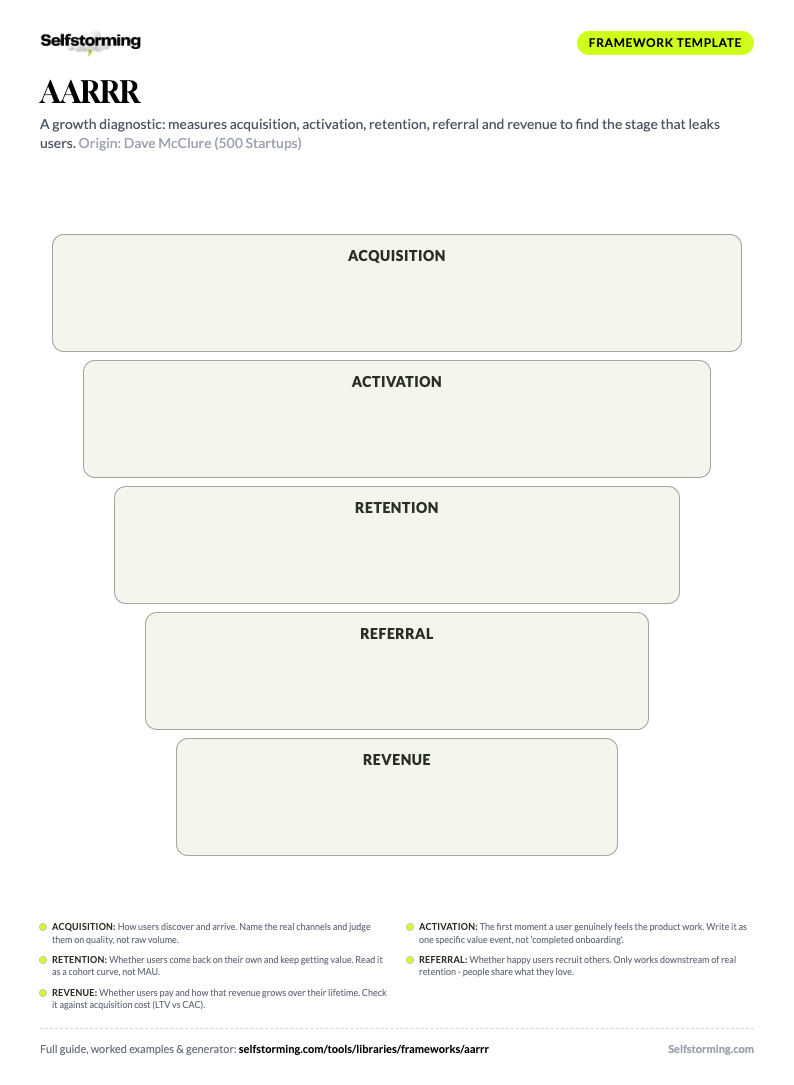
Print it. Fill it in.
The AARRR as a printable A4 worksheet - write straight into the framework, on paper or in any PDF app.
Download the PDF templateKnowledge Worth Paying For
A working library of brand strategy frameworks - with worked examples on real brands, sources, and decision criteria. Not vibes.
One good deck covers the subscription. The rest is profit.
Five stages mapping the whole customer life: Acquisition (how people find you), Activation (their first genuinely good experience), Retention (do they come back), Referral (do they bring friends), and Revenue (do they pay). Pick one number per stage, watch the conversion between stages, and fix the worst leak first. The rule that makes it useful: it's a measurement frame, not a growth lever - it shows you where the bucket leaks, not how to plug it. Many teams reorder it to put Retention first (RARRA), and they have a point.
Monzo
UK challenger bank / fintech app (founded 2015)Shows AARRR in a category where 'signup' and 'real customer' are wildly different things. Monzo's discipline was refusing to count installs as acquisition and instead measuring funded accounts - which forced every stage to be about behaviour, not vanity downloads.

Dropbox
Cloud storage / file sync SaaS (USA, founded 2007)The textbook AARRR story - and the textbook warning. Dropbox is famous for one letter (Referral), but the loop only worked because the reward fed the core habit, tying referral to retention. It's the cleanest example of why you read the funnel as a connected system, not five separate scoreboards.
Calm
Meditation and sleep app / consumer subscription (USA, founded 2012)A clean case for putting Retention at the centre (the RARRA flip). For a wellness app, a signup that never builds a habit is worthless, so Calm optimised the middle of the funnel hard and let revenue follow the habit rather than chasing the sale up front.
Monzo, Dropbox, Calm - filled in, line by line. Unlock to read them.
Monzo (UK challenger bank / fintech app (founded 2015))
Shows AARRR in a category where 'signup' and 'real customer' are wildly different things. Monzo's discipline was refusing to count installs as acquisition and instead measuring funded accounts - which forced every stage to be about behaviour, not vanity downloads.
Acquisition: The hot-coral card as a physical billboard plus a referral waitlist - people saw the card at a bar and asked about it, turning customers into a channel.
Activation: First card payment that triggers an instant notification - the moment the bank feels alive and responsive instead of a 90s web portal.
Retention: Salary deposited into the account; once Monzo is your main account, switching away is genuinely painful, so weekly active use stays high.
Referral: Skip-the-queue invites during the waitlist era plus 'Golden Tickets' that let users hand early access to friends.
Revenue: Interchange on spending, lending, and paid Plus/Premium tiers - revenue that scales with how much the account is actually used.
Dropbox (Cloud storage / file sync SaaS (USA, founded 2007))
The textbook AARRR story - and the textbook warning. Dropbox is famous for one letter (Referral), but the loop only worked because the reward fed the core habit, tying referral to retention. It's the cleanest example of why you read the funnel as a connected system, not five separate scoreboards.
Acquisition: Demo video on Hacker News and Digg that spoke directly to early adopters, plus an invite-driven beta waitlist that turned scarcity into demand.
Activation: First file synced across two devices - the moment 'it just works' lands and the magic becomes obvious rather than promised.
Retention: Files quietly stay in sync in the background; the product becomes the default place your stuff lives, so leaving means moving everything.
Referral: Two-sided storage reward: invite a friend, you both get more free space. The incentive deepened the core habit instead of just discounting it.
Revenue: Free tier hits a storage ceiling; heavy users upgrade to paid plans once the habit (and their files) are locked in.
Calm (Meditation and sleep app / consumer subscription (USA, founded 2012))
A clean case for putting Retention at the centre (the RARRA flip). For a wellness app, a signup that never builds a habit is worthless, so Calm optimised the middle of the funnel hard and let revenue follow the habit rather than chasing the sale up front.
Acquisition: App store search, celebrity sleep-story PR (Matthew McConaughey reading you to sleep), and a memorable single-word brand.
Activation: First completed session that actually calms you down - the user feels the benefit in their body, not just reads about it on a feature list.
Retention: Daily reminders, streaks, and fresh sleep-story content so the app earns a recurring slot in the bedtime routine.
Referral: Gift subscriptions and shareable sleep stories - people recommend the thing that genuinely helped them sleep.
Revenue: Free content as a taste, then an annual Premium subscription once the nightly habit makes the price feel obvious.
1. Acquisition
Where do people first come from, and which of those channels actually deliver people who stick around?
How users discover and arrive - search, paid, referral, content, app store. The wide top of the funnel. The trap is measuring volume in isolation: a channel that sends 50,000 cheap visitors who never activate is worse than one that sends 500 who do. Acquisition only means something when you read it against the stages below it.
In practice: Monzo measured acquisition by which channels produced people who actually funded an account, not by raw app installs. Word-of-mouth via the hot-coral card beat most paid channels on quality, so they leaned into the card as a billboard instead of buying installs.
Common mistake: Total signups: up 40% this quarter. A vanity number with no denominator and no downstream check. If those signups activate at 2%, you didn't grow - you just paid more to fill a leakier bucket.
2. Activation
What is the first moment a new user genuinely feels the product work - and how many actually reach it?
The first 'aha' - the experience that proves the product is worth coming back to. Not signing up, not poking around: the specific action that delivers real value. This is the highest-leverage letter because it sits between a curious stranger and a habit. Most teams can't name their activation moment precisely, which is exactly why they can't move it.
In practice: Notion treats activation as 'created a page you'd actually use again,' not 'account created.' Templates exist to shove people past the blank-canvas terror straight into a populated, useful workspace - the moment the tool stops feeling like homework.
Common mistake: Activation = completed onboarding tour. Clicking through five tooltips is not value. People can finish your tour, feel nothing, and churn the same afternoon - and your dashboard will report them as activated.
3. Retention
Do people come back on their own, without being bribed or nagged - and for how long?
Whether users return and keep getting value over time. The stage that quietly decides whether you have a business or a slow-motion leak. Retention is where growth actually compounds: improving it lifts every other letter at once, because retained users acquire (referral), activate faster, and pay longer. It's also the hardest to fake, which is why teams avoid looking at it.
In practice: Duolingo built the entire product around retention - streaks, reminders, leaderboards - because a language app with no return visits is just a download statistic. The streak is a retention mechanic disguised as a game, and it's why the owl lives rent-free in millions of heads.
Common mistake: Retention looks fine, MAU is growing. Monthly-active hides churn behind fresh signups. A cohort curve that flattens above zero is health; one that decays to nothing while MAU rises means you're outrunning churn by spending, not keeping people.
4. Referral
Do happy users bring other people in - and is the loop actually self-sustaining, or propped up by incentives?
Whether existing users recruit new ones. The cheapest acquisition channel there is, but only if the product is genuinely worth sharing. Referral is downstream of activation and retention for a reason: people don't recommend things they don't love. Bolting a referral program onto a product nobody returns to just pays users to spam their friends.
In practice: Dropbox ran the canonical referral loop: give free storage to both sides of an invite. It worked because the reward (more space) deepened the core habit - so referral and retention reinforced each other instead of competing. The incentive made the product more useful, not just cheaper.
Common mistake: Launching a referral program to fix flat growth. If users aren't retaining, a referral bonus just imports churn faster. You're paying people to recruit other people who will also leave - now with a finance line item attached.
5. Revenue
Do users pay, how much, and does that revenue grow as they stick around rather than churning before it pays off?
The payoff at the bottom of the funnel - conversion to paid, expansion, lifetime value against cost to acquire. McClure put Revenue last on purpose, to stop teams optimising for a sale before they've earned a habit. Plenty of operators argue it belongs earlier, and for transactional businesses they're right. But for habit-driven products, monetising before retention is solid just speeds up the churn you'll later have to explain.
In practice: Spotify earns revenue by converting hooked free users to Premium - the free tier is a retention engine, and the upgrade is the natural payoff once the habit is locked in. Revenue follows the habit instead of fighting it, which is why the conversion holds.
Common mistake: Hard paywall on day one to 'validate willingness to pay.' You'll validate that strangers won't pay for something they haven't experienced. Charging before activation measures your aggression, not your value.
Decide your starting point: You don't have to map the whole funnel in a blank spreadsheet. Right here on Selfstorming you can find inspiration and directions, or generate a first-draft AARRR funnel in minutes. Treat that draft as a head start - one candidate metric per stage with sensible definitions - then run it through the steps below to pressure-test it against your real numbers. Build-from-scratch and AI-draft-then-refine are both valid; most teams move faster starting from a draft.
Define each stage as an event, not a vibe: Before you measure anything, write the literal event that counts for each letter. 'Acquisition = first session,' 'Activation = created first project,' and so on. If your team can't agree on the event, you can't agree on the number - and you'll spend three meetings arguing about a chart instead of a hole in the bucket.
Pick one metric per stage and kill the rest: Each letter gets a single headline number with a clear owner. Five KPIs per stage is five ways to avoid accountability. The discipline of choosing forces the team to decide what actually matters at each step.
Measure the conversion between stages, not just the totals: The signal isn't '10,000 signups,' it's 'signup to activation = 14%.' Stage-to-stage conversion is where the leaks show. Build the funnel so you can see the percentage falling off at each step at a glance.
Find the worst leak before you touch the top: Resist the gravitational pull toward Acquisition. Sort the conversion rates and attack the lowest one first. Usually it's activation or early retention - the unglamorous middle - not the top everyone instinctively wants to spend on.
Settle the order debate for your business: For habit products, keep the canonical A-A-R-R-R and treat retention as the centre of gravity (this is the RARRA argument). For transactional or one-shot purchases, Revenue legitimately moves up. Decide consciously instead of inheriting McClure's order by default.
Sanity-check against unit economics: Pair Revenue and Acquisition into LTV vs CAC. A funnel that converts beautifully but loses money per customer is a very efficient way to go broke. The funnel tells you where; the ratio tells you whether it's worth fixing.
Turn the funnel into a weekly ritual, not a quarterly artifact: A finished AARRR fits on one screen. Put the five numbers and four conversion rates somewhere the whole team sees them weekly. The point isn't the dashboard - it's that the worst leak becomes impossible to ignore.
Best for: Diagnosing where a product loses customers across their whole lifecycle. Growth teams who need a shared, countable scoreboard from first visit to revenue. / Figuring out why a stage leaks or what to build next. AARRR locates the problem; it doesn't generate the solution or the strategy.
Output: Five headline metrics (one per stage) plus four stage-to-stage conversion rates on a single dashboard the whole team watches weekly. / A research report, a positioning statement, or a creative brief. AARRR produces numbers, not narrative or strategy.
Time to complete: A first pass in an afternoon if your event tracking is clean - define the five events, wire the funnel, read the conversions. / Long qualitative discovery projects. If you need to understand the why behind a leak, the funnel is the start of that work, not the deliverable.
vs Marketing Funnel (TOFU/MOFU/BOFU): AARRR covers the full life including retention and referral - it keeps going after the sale, which is where product-led growth lives. / The classic Marketing Funnel stops at conversion and is built around content and lead nurture. Better for demand-gen and sales handoff, weaker on post-purchase loops.
vs AIDA: AARRR is behavioural and measurable - every stage is an event you can count and a conversion you can optimise. / AIDA (Attention, Interest, Desire, Action) is a persuasion model for a single message or ad, not a product funnel. Use AIDA to write the ad; use AARRR to see whether the ad's customers stuck around.
vs North Star Metric: AARRR gives you the full breadth of the funnel - five stages so no part of the lifecycle goes unwatched. / A North Star Metric is one number capturing core value delivered, used to align the company. Use the North Star to focus the org; use AARRR to see which stage is dragging it down.
AARRR was coined by Dave McClure, founder of the startup accelerator 500 Startups, in a 2007 presentation titled 'Startup Metrics for Pirates' (the name is a pun on the sound 'AARRR' a pirate makes). McClure's pitch was a reaction against the vanity metrics dominating early Web 2.0 - registered-user counts, pageviews, press mentions - none of which told a founder whether the business actually worked. He argued for five behavioural metrics that track a user from first contact to paying customer, with conversion measured between each step. The model spread fast through Silicon Valley because it gave founders and early growth teams a teachable, countable structure at a moment when 'growth hacking' was becoming a discipline. It remains one of the most widely cited frameworks in product-led growth, even as practitioners argue about the order of the letters.
The honest criticisms of AARRR are worth taking seriously. First, it's a measurement frame, not a growth strategy - it tells you where customers leak but offers nothing on why or how to fix it, and plenty of teams mistake a full dashboard for a finished plan. Second, read carelessly it invites the exact vanity metrics McClure was rebelling against, because raw counts are easier to celebrate than conversion rates. Third, the funnel's shape biases teams toward top-of-funnel obsession, since Acquisition is the cheapest letter to move with a budget. The sharpest pushback is the order debate: growth practitioners like those behind RARRA argue retention should come first, because for habit-driven products that's where growth actually compounds - pumping acquisition into a leaky product just speeds up churn. Used well, AARRR is a scoreboard you read alongside qualitative research and unit economics; used badly, it's a slide that makes a stalling business look measured.
What is AARRR?
AARRR is a startup growth framework that breaks the entire customer lifecycle into five measurable stages: Acquisition (how people find you), Activation (their first genuinely good experience), Retention (whether they come back), Referral (whether they bring friends), and Revenue (whether they pay). You pick one metric per stage and watch the conversion between stages to find where customers leak out of the funnel. It's a diagnostic scoreboard, not a strategy - it shows you the hole, not how to plug it.
Why is it called Pirate Metrics?
Because the five initials spell AARRR - the noise a cartoon pirate makes. Dave McClure leaned into the pun when he introduced the model in his 2007 talk 'Startup Metrics for Pirates,' and the nickname stuck. It's a genuinely good piece of branding for a framework: nobody forgets a model that makes them sound like a pirate when they say it out loud, which is half the reason it's still quoted two decades later.
Who created the AARRR framework?
Dave McClure, founder of the accelerator 500 Startups, introduced AARRR in a 2007 presentation called 'Startup Metrics for Pirates.' He built it as a reaction against the vanity metrics of the early Web 2.0 era - registered users, pageviews, press hits - none of which told a founder whether the business actually worked. AARRR replaced them with five behavioural metrics tracking a real user from first contact to payment.
What's the difference between AARRR and RARRA?
Same five letters, different order and emphasis. AARRR runs Acquisition first; RARRA puts Retention first. The RARRA crowd argues that for most modern, habit-driven products retention is where growth actually compounds - so leading with acquisition just pumps more users into a leaky bucket. Both are valid; the right order depends on your business. Habit and subscription products lean RARRA; transactional, rare-purchase products can keep Revenue and Acquisition higher.
Is AARRR a growth strategy?
No, and treating it like one is the most common way teams misuse it. AARRR is a measurement frame - it tells you which stage is leaking, but it has no opinion on why or what to do about it. Think of it as the diagnostic that points everyone at the same problem. The actual strategy is the experiment you run on the worst-converting stage once the funnel has shown you where it is.
Which AARRR stage should I focus on first?
The one with the worst stage-to-stage conversion, which is almost never Acquisition even though that's where teams instinctively spend. Sort your five conversion rates and attack the lowest. For most products it's Activation or early Retention - the unglamorous middle of the funnel. Fixing a leak there makes every stage below it cheaper, whereas pouring money into the top just fills a leakier bucket faster.
How is AARRR different from the classic marketing funnel?
The traditional marketing funnel (awareness to conversion) usually stops at the sale. AARRR keeps going - Retention and Referral happen after someone becomes a customer, which is exactly where product-led growth lives. So the marketing funnel is better for demand generation and sales handoff, while AARRR is built for products where the customer relationship (and the compounding growth) starts after the first purchase, not before it.
Does AARRR work for B2B and enterprise products?
Yes, with adjustment. The five stages still apply, but the events change shape - Acquisition might be a demo request, Activation a successful pilot, Referral an internal champion expanding to another team. Sales cycles are longer and cohorts smaller, so conversions move slowly and you'll lean on qualitative signals more. The Pirate Metrics structure holds; you just measure it at the account level rather than the individual user level.
A growth diagnostic: measures acquisition, activation, retention, referral and revenue to find the stage that leaks users.
The trouble is that AARRR is a scoreboard, not a strategy. It tells you where customers are leaking out of the bucket. It does not tell you why, and it certainly doesn't fix the hole. Treated as a dashboard, it's one of the best one-page mental models in growth - it stops teams from obsessing over signups while retention quietly bleeds out. Treated as a growth plan, it produces the most common failure in the category: a team that pours money into the top of the funnel because Acquisition is the easiest letter to move and the easiest one to put on a slide. This page walks through each stage, the question that unlocks it, where the famous order debate actually matters, and how to tell whether you're using the funnel or just decorating a deck with it.