AIDA
The 125-Year-Old Funnel That Still Runs Your Ad Copy
AIDA is the oldest trick in the marketing book, and that's not an insult - it's nearly literal. A salesman named E. St. Elmo Lewis sketched it out around 1898, before radio, before TV, before anyone had a word for 'funnel'. Attention, Interest, Desire, Action. Four stages a stranger walks through on their way to buying something. It has outlived every framework that tried to replace it, mostly because it describes something true: nobody buys a thing they never noticed.
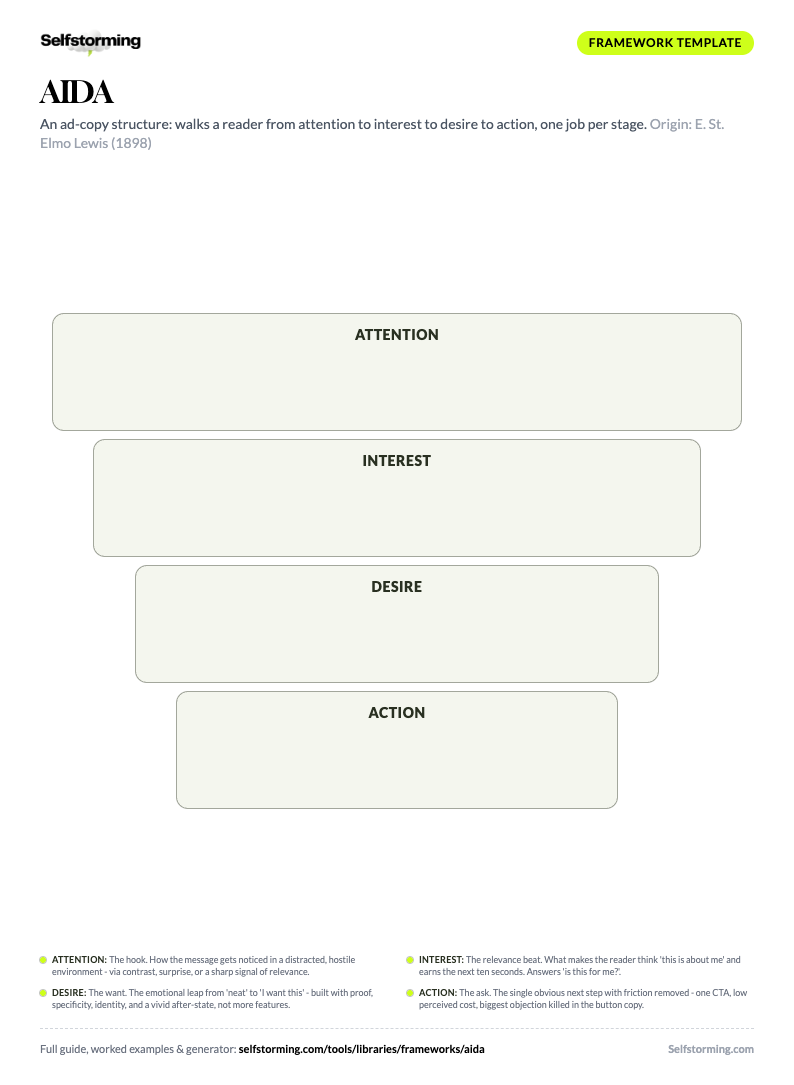
Print it. Fill it in.
The AIDA as a printable A4 worksheet - write straight into the framework, on paper or in any PDF app.
Download the PDF templateKnowledge Worth Paying For
A working library of brand strategy frameworks - with worked examples on real brands, sources, and decision criteria. Not vibes.
One good deck covers the subscription. The rest is profit.
Four stages a prospect moves through, top to bottom: Attention (get noticed in a hostile, distracted environment), Interest (earn a few more seconds with relevance), Desire (turn 'neat' into 'I want that'), and Action (make the next step obvious and frictionless). The bottom stage is the payoff - everything above it is rent you pay to get the click, the signup, the sale. Best used to structure a single ad, email, or landing page. Weak as a model of the whole customer journey, because it ignores loyalty, retention, and the fact that people loop back.
Dollar Shave Club
DTC razor subscription (USA, founded 2011, acquired by Unilever for ~$1bn in 2016)The cleanest AIDA case in modern advertising - a single 90-second film that walks a cold viewer through all four stages and ends on one obvious action. It crashed the company's own servers within hours and built a billion-dollar brand on a $4,500 video, which is what AIDA looks like when every stage actually does its job.

Duolingo
Language-learning app (USA, founded 2011, ~88m monthly active users)Shows AIDA running across a whole channel rather than one ad. The unhinged owl mascot does Attention, the app's relevance to lapsed learners does Interest, the streak mechanic manufactures Desire, and the install/notification does Action - while exposing AIDA's blind spot, since the streak is really a retention loop the four-stage model can't describe.
A regional B2B accounting SaaS
B2B SaaS for small-business bookkeeping (composite example, EU market)AIDA outside the consumer spotlight, where the temptation is to skip straight from Interest (features) to Action (book a demo) with no Desire in between - the single most common B2B funnel leak. Included to show the framework's value as a diagnostic: it tells you exactly which stage your boring landing page is missing.
Dollar Shave Club, Duolingo, A regional B2B accounting SaaS - filled in, line by line. Unlock to read them.
Dollar Shave Club (DTC razor subscription (USA, founded 2011, acquired by Unilever for ~$1bn in 2016))
The cleanest AIDA case in modern advertising - a single 90-second film that walks a cold viewer through all four stages and ends on one obvious action. It crashed the company's own servers within hours and built a billion-dollar brand on a $4,500 video, which is what AIDA looks like when every stage actually does its job.
Attention: Founder Michael Dubin deadpans 'Our blades are f*ing great' while walking through a chaotic warehouse - a tone so far from razor advertising you can't not watch.
Interest: He names the reader's exact annoyance: paying $20 a month for brand-name razors with vibrating handles and flashlights you never asked for.
Desire: Great blades delivered to your door for a dollar, plus the identity of someone too smart to be ripped off by the razor cartel - wanting framed as not-being-a-sucker.
Action: One offer, one button: join the club for $1 a month. No upsell, no thirty SKUs to compare, just the single obvious move.
Duolingo (Language-learning app (USA, founded 2011, ~88m monthly active users))
Shows AIDA running across a whole channel rather than one ad. The unhinged owl mascot does Attention, the app's relevance to lapsed learners does Interest, the streak mechanic manufactures Desire, and the install/notification does Action - while exposing AIDA's blind spot, since the streak is really a retention loop the four-stage model can't describe.
Attention: Duo the owl doing something genuinely deranged on TikTok - crying, threatening, twerking - in a format that doesn't read as an ad until you're already laughing.
Interest: The quiet, accurate jab: you said you'd learn Spanish this year and you have not opened the app since March.
Desire: The streak. A green number you don't want to break and a public identity as 'someone learning a language' - desire engineered out of loss aversion.
Action: One tap to a two-minute lesson. The next step is so small that 'I don't have time' stops being a valid excuse.
A regional B2B accounting SaaS (B2B SaaS for small-business bookkeeping (composite example, EU market))
AIDA outside the consumer spotlight, where the temptation is to skip straight from Interest (features) to Action (book a demo) with no Desire in between - the single most common B2B funnel leak. Included to show the framework's value as a diagnostic: it tells you exactly which stage your boring landing page is missing.
Attention: A headline that names the dread directly: 'Tax season shouldn't feel like a root canal.' Specific pain beats 'streamline your accounting'.
Interest: Relevance to the exact reader: built for solo founders and shops under ten staff who do their own books at 11pm, not for enterprise finance teams.
Desire: The after-state plus proof: 'close your month in an afternoon', a real customer who got six weekends back a year, and a screenshot of an actually finished dashboard.
Action: One button, friction killed: 'Import last year's data free - see your books sorted before you pay anything.' No demo-call gatekeeping.
1. Attention
In a feed full of noise, what makes someone stop scrolling for half a second longer than they meant to?
The wide top of the funnel. Before persuasion comes interruption - you have to be noticed in an environment built to ignore you. Attention is won by contrast, surprise, or a sharp signal of relevance, not by being louder. It's also the most perishable stage: you re-earn it with every single message.
In practice: The first three seconds of an Old Spice film where the man on the horse becomes the man on a boat. The cut is so abrupt your brain refuses to look away. Attention bought by genuine surprise, not by a louder logo.
Common mistake: A headline that says 'Welcome to our website' over a stock photo of people high-fiving. It interrupts nothing, signals nothing, and asks the reader to supply the interest the ad failed to create.
2. Interest
Now that they've stopped, what tells them this is actually about them and worth the next ten seconds?
The bridge between 'huh' and 'go on'. Interest is where you convert a startled glance into a deliberate read by making the message relevant to the person's situation, problem, or curiosity. It answers the brutal silent question every reader asks: 'is this for me?' Lose them here and the attention was wasted spend.
In practice: 'You're paying $20 a month to a razor company so a millionaire can feel rich.' Dollar Shave Club's setup names the reader's exact, slightly embarrassing situation - so of course they keep watching.
Common mistake: A wall of company history and 'our mission' boilerplate. Interesting to the brand, irrelevant to the reader. The prospect doesn't care that you were founded in 2014; they care whether you solve their problem.
3. Desire
What turns mild 'that's neat' into a felt 'I actually want this for myself'?
The stage everyone underbuilds. Desire is the leap from understanding the product to wanting it - the emotional shift where the reader pictures their life with it. It's built with proof, specificity, identity, and a vivid picture of the after-state, not with a longer feature list. Interest is rational; desire is the part that makes people open their wallet.
In practice: Showing a side-project shipped and live, with real users, by someone who 'isn't technical'. The reader doesn't want the feature list - they want to be the person who pulled that off. Desire is selling the after-photo.
Common mistake: Stacking more specs on the table and hoping wanting happens by itself. Features explain; they don't seduce. A bullet list of capabilities creates comprehension, never craving.
4. Action
What is the single next step, and have we removed every excuse not to take it right now?
The narrow bottom of the funnel - the only stage that pays the bill. Action turns built-up desire into a concrete move: buy, sign up, book, reply. It lives or dies on clarity and friction, not motivation. One obvious next step, low perceived cost, and zero hesitation beats three competing CTAs every time. If desire was real, the job here is mostly to get out of the way.
In practice: One button, one promise: 'Start free - no card needed'. A single action, the biggest objection (payment) killed in four words. Nothing competes with it on the screen.
Common mistake: Three CTAs of equal weight ('Learn more', 'Contact sales', 'Download') and a form asking for company size. Every extra choice and field is a fresh chance to leave. Desire leaks out through the cracks of a cluttered ask.
Decide your starting point: You don't have to draft AIDA from a blank page. Right here on Selfstorming you can pull inspiration and references, or generate a first-draft AIDA in minutes. Treat that draft as a head start, then run it through the steps below to sharpen each stage against your real audience and offer. Both routes work - most teams move faster starting from a draft and editing hard.
Pick one artifact, not the whole journey: AIDA structures a single message - one ad, one email, one landing page. Decide which piece you're writing before you start. Trying to map a six-month customer relationship onto four stages is where the framework breaks; trying to map one Instagram ad onto it is where it shines.
Write the Attention line first and last: Draft a hook, build the rest, then come back and rewrite the hook against the finished piece. The opening is the only line guaranteed to be read, so it earns the most rewrites. If it doesn't survive being read aloud to a distracted person, it's not done.
Make Interest pass the 'is this for me?' test: Read your second beat as a skeptical stranger. If it talks about you (your founding, your mission, your features) instead of them (their problem, their situation), rewrite it until the reader recognises themselves in the first sentence.
Build Desire with proof and after-state, not more features: For every capability you're tempted to list, ask 'so what does their life look like once they have it?' Show the after-photo - results, identity, a vivid picture of the better day. Specificity and proof create want; spec sheets create comprehension.
Strip the Action step to one move: Name the single next step and delete every competing CTA. Then attack friction: cut form fields, surface the biggest objection and answer it in the button copy ('no card needed', 'cancel anytime'). The number of choices should be one.
Pressure-test the seams between stages: Read the piece straight through. Does Attention actually hand off to a relevant Interest? Does Desire earn the Action, or does the button arrive before any wanting was created? Most weak copy has a gap between Interest and Desire - features, then button, no want in between.
Add the loop AIDA forgets: AIDA stops at the sale. Before you ship, decide what happens after Action - the onboarding email, the second purchase, the reason to come back. Hand that off to a retention model (AARRR) so your funnel doesn't treat every customer like a one-night stand.
Best for: Structuring a single persuasive artifact - an ad, email, landing page, sales script, or short video. Diagnosing why one piece of copy isn't converting. / Modelling a full customer relationship over time, mapping a complex multi-touch B2B journey, or planning retention and loyalty. AIDA stops at the sale.
Output: A four-stage spine for one message: hook, relevance, want, ask. Each stage clearly does one job and hands off to the next. / A lifecycle dashboard with retention cohorts, LTV, and referral loops. That's a metrics model, not a copywriting frame.
Time to complete: Minutes to an hour for a single piece - it's a writing scaffold, not a project. Fast enough to use on every ad you ship. / Multi-week funnel-analytics builds. AIDA isn't measured or instrumented; it's a way to draft and critique copy quickly.
vs Marketing Funnel (TOFU/MOFU/BOFU): AIDA is message-level and psychological - what happens inside one reader's head as they read. Sharper for writing a specific piece. / The Marketing Funnel is channel-and-stage-level - awareness, consideration, conversion across many touchpoints. Better for media planning and budget allocation.
vs AARRR (Pirate Metrics): AIDA covers the front end up to the first conversion and reads as copy psychology. Use it to win the click. / AARRR (Acquisition, Activation, Retention, Referral, Revenue) is built for what AIDA ignores - keeping and growing the customer after Action. Use it for the loop AIDA has no room for.
vs Get Who To By: AIDA tells you how to sequence a message stage by stage. Strong on structure and rhythm of persuasion. / Get Who To By is a single-sentence brief (get whom, to do what, by which insight) that defines the strategic job before you write. Use it to decide what the message should achieve; use AIDA to build it.
AIDA is one of the oldest models in all of marketing. It's credited to American advertising and sales pioneer E. St. Elmo Lewis, who formulated the slogan "attract attention, maintain interest, create desire" in 1898 and published versions of it in trade press like The Book-Keeper in 1903, adding "get action" later to complete the four stages. The catchy acronym itself came in 1921, when C. P. Russell pointed out in Printers' Ink that the four initials spell the opera "Aida". Lewis was describing the mechanics of a good salesman's pitch decades before anyone used the word "funnel" - the visual funnel shape was bolted on later (William W. Townsend drew AIDA as a funnel in his 1924 book Bond Salesmanship). Over the twentieth century the model was extended into variants that added Satisfaction, Conviction, and Retention (AIDAS, AIDCA, AIDAR), and absorbed into nearly every copywriting and sales-training curriculum. Its survival across radio, television, direct mail, and digital is less about academic rigour and more about the fact that it names a real, durable sequence: people genuinely do have to notice something before they can want it.
The honest critique of AIDA is that it's a tidy story about a messy reality. It treats buying as a smooth one-way descent - notice, want, buy - when actual customer journeys loop, stall, forget, and double back. It has no feedback loop and no memory: it ends at the sale and stays silent on loyalty, retention, advocacy, and repeat purchase, which is where most modern revenue actually lives. Academics have also flagged its weak predictive validity - a hierarchy-of-effects model that assumes a single linear path, when research suggests people process cognitively and emotionally at the same time. And it flatters the marketer with a false sense of control, implying that if you just write the four stages well, the prospect slides obediently to the bottom. The fair way to use it is narrow: a sharp scaffold for one piece of persuasion, pressure-tested against real behaviour - never mistaken for a map of how a customer relationship actually unfolds over time.
What is AIDA?
AIDA is a four-stage marketing and sales model describing the path a prospect takes toward buying: Attention (get noticed), Interest (earn relevance), Desire (create want), and Action (take the next step). It's most useful as a structure for a single persuasive message - an ad, email, or landing page - where each stage does one job and hands off to the next. The bottom stage, Action, is the conversion you're paying for.
Who created AIDA?
AIDA is credited to the American advertising pioneer E. St. Elmo Lewis, who set out the sequence around 1898 and published a version in print by the early 1900s. He was describing how an effective salesman moves a prospect from attention to action - decades before anyone drew it as a funnel. It's one of the oldest formal models in marketing, which is part of why so many later frameworks are really AIDA with extra stages bolted on.
Is AIDA still relevant in 2026?
Yes, but narrowly. AIDA is still an excellent scaffold for writing or critiquing a single piece of persuasion, because the underlying sequence is genuinely true - people must notice something before they can want it. Where it's outdated is as a model of the whole customer journey: it's linear, has no feedback loop, and ignores retention and loyalty. Use it for one message; use AARRR or a lifecycle model for the relationship.
What's the difference between AIDA and the marketing funnel?
AIDA is message-level and psychological - it describes what happens inside one reader's head as they move through a single piece of copy. The classic marketing funnel (awareness, consideration, conversion) is channel-and-stage-level - it describes how audiences move across many touchpoints. Use AIDA to write a specific ad or page; use the funnel to plan media spend and allocation across the journey.
Why is the Desire stage in AIDA so often missed?
Because it's the hardest and least mechanical of the four. Attention and Action have obvious levers (a hook, a button), and Interest is easy to fake with features. Desire requires an emotional leap - getting the reader to picture their life with the product and actually want it - which takes proof, specificity, and identity, not a longer spec list. Most weak copy jumps straight from explaining the product to asking for the sale, with no want created in between.
Does AIDA work for B2B?
It works for individual B2B assets - a cold email, a landing page, a sales deck slide - just as it does for B2C. Where it strains is the full B2B sales cycle, which involves buying committees, months of consideration, and lots of looping back. AIDA flattens all that into a tidy four-step descent. The most common B2B failure is skipping Desire: jumping from a feature list straight to 'book a demo' with no want built in between.
What are the variations of AIDA, like AIDAS and AIDCA?
Over the years marketers bolted extra stages onto AIDA to patch its gaps. AIDAS adds Satisfaction (the post-purchase experience). AIDCA inserts Conviction (overcoming doubt) between Desire and Action. AIDAR adds Retention. Each variant is an admission that the original four stages stop too early - they're trying to drag AIDA past the sale, which is honestly better handled by a dedicated retention model like AARRR.
An ad-copy structure: walks a reader from attention to interest to desire to action, one job per stage.
The catch is that AIDA's age is also its weakness. It treats buying like a tidy descent down a slide - one nudge and they slip from noticing to paying. Real humans don't behave like that. They notice, forget, get reminded, ignore three ads, then buy on a Tuesday for reasons they can't explain. AIDA has no memory, no loop, no second visit. So use it as a checklist for a single piece of persuasion - an ad, an email, a landing page - and it's brilliant. Use it as a model of how a customer relationship actually works over time, and it'll quietly lie to you. This page walks through each stage, the question that unlocks it, and where smart marketers stop trusting the slide.