Bullseye Customer
Aim at the Core, Then Widen
Everyone wants the whole market. The fastest way to get none of it is to ask for all of it on day one. The Bullseye Customer framework is the discipline of aiming at the smallest, sharpest, best-fit customer first - the centre of the target - and only widening to bigger circles once the middle is yours.
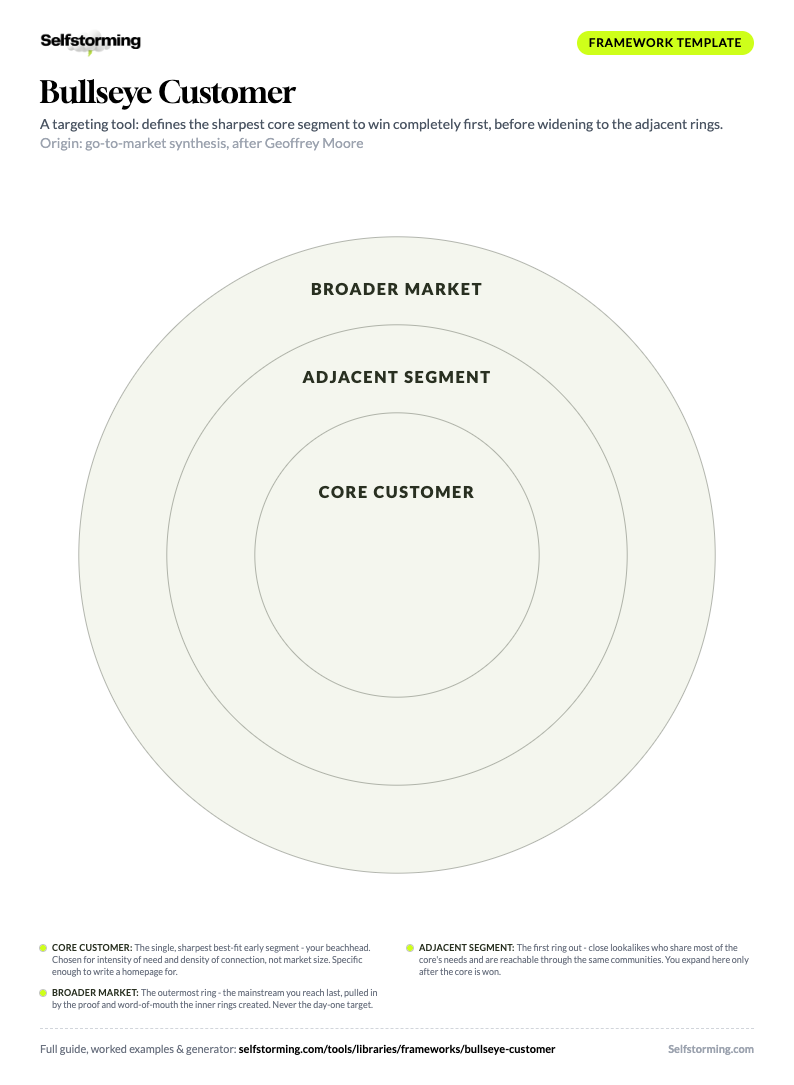
Print it. Fill it in.
The Bullseye Customer as a printable A4 worksheet - write straight into the framework, on paper or in any PDF app.
Download the PDF templateKnowledge Worth Paying For
A working library of brand strategy frameworks - with worked examples on real brands, sources, and decision criteria. Not vibes.
One good deck covers the subscription. The rest is profit.
The Bullseye Customer is three concentric rings of audience. The core is your sharpest, single best-fit early customer - the beachhead you win first. Ring 1 is the adjacent segment of close lookalikes you expand to next. Ring 2 is the broader mainstream you reach last. The discipline: dominate the smallest viable core before widening, because a tiny segment that loves you out-grows a huge segment that mildly tolerates you. Note this is the audience bullseye, distinct from the channel bullseye in Traction.
Notion
B2B SaaS workspace (founded 2016, USA)A clean beachhead story: Notion did not launch as 'a workspace for every team on Earth' - it won the densely-connected world of startup operators, designers, and indie makers first, who turned it into templates and tweets, and only then widened into mainstream teams. The core supplied the word-of-mouth the mass market later followed.
Strava
Fitness social app (founded 2009, USA)Strava chose the most fanatical, most connected core imaginable - serious cyclists obsessed with their numbers - and let their competitiveness do the marketing. Runners were the obvious adjacent ring, and only later did it widen to general fitness. Aiming at 'everyone who exercises' first would have produced a forgettable step-counter.
Monzo
UK challenger bank (founded 2015, UK)Monzo started with a coral prepaid card aimed at a tight core - young, urban, tech-forward Londoners who split bills and travelled - and built a famously connected community before widening to full current accounts and a broader UK public. The beachhead's bill-splitting habit was its own referral engine.
Notion, Strava, Monzo - filled in, line by line. Unlock to read them.
Notion (B2B SaaS workspace (founded 2016, USA))
A clean beachhead story: Notion did not launch as 'a workspace for every team on Earth' - it won the densely-connected world of startup operators, designers, and indie makers first, who turned it into templates and tweets, and only then widened into mainstream teams. The core supplied the word-of-mouth the mass market later followed.
Core Customer: Startup operators, designers, and indie makers who live in public and want one flexible tool to run docs, wiki, and tasks - and who will tweet a template the moment it works.
Adjacent Segment: Small cross-functional teams at growth-stage companies who discovered Notion through those makers and want to standardise on it.
Broader Market: Mainstream knowledge-work teams and large organisations adopting Notion once it is the obvious, proven category name.
Strava (Fitness social app (founded 2009, USA))
Strava chose the most fanatical, most connected core imaginable - serious cyclists obsessed with their numbers - and let their competitiveness do the marketing. Runners were the obvious adjacent ring, and only later did it widen to general fitness. Aiming at 'everyone who exercises' first would have produced a forgettable step-counter.
Core Customer: Serious road cyclists who train with power and heart-rate data and care intensely about segments, leaderboards, and beating yesterday's self.
Adjacent Segment: Dedicated runners who want the same competitive tracking, leaderboards, and social proof the cyclists already love.
Broader Market: General fitness enthusiasts - gym-goers, hikers, walkers - who join once Strava is the default place to log and share any workout.
Monzo (UK challenger bank (founded 2015, UK))
Monzo started with a coral prepaid card aimed at a tight core - young, urban, tech-forward Londoners who split bills and travelled - and built a famously connected community before widening to full current accounts and a broader UK public. The beachhead's bill-splitting habit was its own referral engine.
Core Customer: Young, urban, smartphone-first Londoners who split bills with friends, travel often, and hate foreign-transaction fees and clunky bank apps.
Adjacent Segment: Tech-forward UK professionals nationwide who want their main current account to feel as modern as that coral card their friends keep showing off.
Broader Market: The mainstream UK banking public switching from legacy high-street banks once Monzo is a trusted, full-service everyday account.
1. Broader Market
What is the mainstream we ultimately want, that we reach only once the core and the adjacent ring have given us proof, scale, and a story?
The outermost ring: the mass market, the 'total addressable' dream. You arrive here last, pulled in by the gravity of a proven core rather than chasing it from the start. By now your earlier rings supply the case studies, the word-of-mouth, and the muscle to compete broadly. Aiming here first is the classic way to spread thin and convince no one.
Good answer: Any small software company that wants modern customer support, reached via category-level demand once we are the obvious name among developers. The mainstream arrives because the core made you famous in a niche first.
Wrong answer: We launch to the entire software market at once because the TAM is huge. The TAM does not care that it is huge. Day-one mass targeting buys you a generic message nobody in particular feels - and no one to start the word-of-mouth.
2. Adjacent Segment
Once the core loves us, which closely-related group is the natural next step - similar enough to win, different enough to grow us?
The first ring out: lookalikes who share most of the core's needs but sit slightly outside it. You expand here only after the core is genuinely won, carrying the credibility and word-of-mouth you earned. The adjacency should be obvious - if you have to squint to see why this ring follows the core, it is too far out for ring one.
Good answer: Two-to-five-person app studios that just hired their first support person. One step out from solo indie developers - same world, slightly bigger, reachable through the exact same communities. A natural widening, not a leap.
Wrong answer: Then we go after large enterprises with procurement teams. That is not adjacent, it is a different planet - different buyer, different sales motion, different product. Skipping straight there from a solo-developer core snaps the flywheel.
3. Core Customer
Who is the single, sharpest group that needs us most acutely right now and would be genuinely upset if we vanished?
The bullseye itself: your beachhead, the one early-customer segment you can win completely. Chosen for intensity of need and density of connection, not market size. This is where all your resources, messaging, and product decisions point first. If you nail the core, the outer rings get easier; if you skip it, they never come.
Good answer: Indie iOS developers shipping solo who need to handle support without hiring. A specific, connected, intensely-needful group that talks to each other constantly - lose them and they would notice and complain loudly. That is a beachhead.
Wrong answer: Small and medium businesses that want to grow. That is not a core, it is a census category. No shared moment of need, no density, no edge. You cannot aim a slingshot at a continent.
Decide your starting point: You do not have to agonise over the core in a blank room. Right here on Selfstorming you can find inspiration and directions, or generate a first-draft Bullseye Customer in minutes. Treat that draft as candidate rings, then sharpen and validate them against real evidence using the steps below. Both pick-from-scratch and AI-draft-then-pressure-test are valid - most teams move faster starting from a draft.
List every plausible segment first: Before you can pick a core, you need candidates. Brainstorm every group that could conceivably buy - roles, situations, industries. You are not committing yet; you are filling the dartboard so the centre is a choice, not a default.
Score candidates on need-intensity and density: For each segment, rate how acutely they feel the problem and how connected they are to each other. The winning core is usually high on both - intense need plus dense word-of-mouth - not the biggest box on the slide.
Pick exactly one core: Resist the urge to crown three. The core is a single segment specific enough to write a homepage for. The test: would this group be genuinely upset if you disappeared tomorrow? If not, keep narrowing.
Write everything for the core only: Homepage, onboarding, pricing, the roadmap - all aimed at the bullseye. Generic positioning is the tax you pay for refusing to choose. Specific beats broad until you have earned the right to be broad.
Define ring 1 and ring 2 as a sequence: Name the adjacent segment you will grow into next and the broader market after that. Write down the trigger that says the core is 'won' and it is time to widen - revenue, share, or word-of-mouth saturation - so widening is a decision, not a drift.
Defend the core against premature widening: When sales drags in an off-target whale, weigh it against the focus it costs. A few lucrative misfits early can quietly drag your product and message out of the bullseye. Saying no is the framework working.
Widen only on evidence, then re-aim: Once the core is genuinely yours, expand to ring 1 and re-run the whole exercise - the adjacent ring has its own core. Bullseye is not a one-time pick; it is how you sequence growth, one ring at a time.
Best for: Choosing which customer segment to win first, sequencing market expansion, and forcing focus when a team insists the product is 'for everyone.' Strong for launches and challenger brands. / Established mass-market brands optimising for broad penetration, or deciding which acquisition channels to test - that is a different problem.
Output: Three concentric audience rings - a single core, an adjacent segment, and a broader market - plus the trigger that says when to widen from one to the next. / A media plan, a channel ranking, or a finished persona document. Those are downstream of, or different from, the bullseye choice.
Time to complete: A focused workshop to brainstorm and score segments, then a week of evidence-gathering to confirm the core - roughly one to two weeks to a confident bullseye. / A multi-quarter segmentation study with large-sample quant. Bullseye is a focusing tool, not a market-research programme.
vs Customer Persona: Bullseye decides which segment to prioritise and in what order - it is a choice about focus and sequence across the whole market. / A Persona describes one segment in rich detail (goals, behaviours, a name and a face). Use Bullseye to pick the segment, then a Persona to bring the core to life.
vs Positioning Statement: Bullseye names who you aim at first and how you widen. It answers 'who,' as the input to positioning. / A Positioning Statement claims a place in that audience's mind ('for X, we are the Y that Z'). Run Bullseye first, then write the Positioning Statement for the core.
vs Jobs To Be Done: Bullseye organises by segment and sequence - which group, in what order. Best when the question is 'who do we focus on first?' / Jobs To Be Done organises by the progress customers seek, cutting across segments entirely. Use JTBD to understand why the core hires you, Bullseye to decide which core to chase.
The Bullseye Customer has no single inventor - it is a synthesis of go-to-market ideas that all point the same way. Geoffrey Moore gave it the beachhead logic in Crossing the Chasm (1991): pick a target segment 'big enough to matter, small enough to lead,' win it, then expand. Seth Godin sharpened the same instinct into the smallest viable audience (also called the smallest viable market) - the smallest group whose love is enough to start, because they spread the word for you. The concentric-ring visual is borrowed shorthand. Crucially, this audience bullseye is distinct from the channel bullseye in Gabriel Weinberg and Justin Mares' Traction (2014), which uses the same three-ring shape to rank nineteen acquisition channels - a different question entirely.
The sharpest critique comes from the mass-reach school. Byron Sharp, in How Brands Grow, argues that brands grow mainly through broad market penetration and reaching all category buyers - including light buyers - and that narrow targeting tends to cap growth rather than fuel it. For established brands chasing scale, aiming at a tiny core can be exactly the wrong move. There are two more honest risks: premature niching (locking a core in before you have evidence, then optimising for the wrong people), and conflation with the Traction channel bullseye, where teams set out to choose a customer and accidentally end up ranking ad channels. The reconciliation most practitioners land on: aim at a sharp core to start and earn word-of-mouth, then widen toward penetration as you scale - the bullseye is a launch and sequencing tool, not a permanent ceiling.
What is the Bullseye customer?
The Bullseye customer is your sharpest, single best-fit early segment - the centre of a three-ring target. The core is the beachhead you win first; ring 1 is the adjacent segment of lookalikes you expand to next; ring 2 is the broader mainstream you reach last. The discipline is to dominate the smallest viable core completely before widening, because a small segment that loves you out-grows a huge one that merely tolerates you. It answers who you aim at, in what order.
Who created the Bullseye customer framework?
There is no single inventor. The beachhead logic comes from Geoffrey Moore's Crossing the Chasm (1991) - win a segment 'big enough to matter, small enough to lead,' then expand. Seth Godin sharpened it into the smallest viable audience. The concentric-ring shape is borrowed shorthand. It is a synthesis of go-to-market thinking, not one person's model.
Is the Bullseye customer the same as the Bullseye framework in Traction?
No, and this is the most common mix-up. The Bullseye customer (this framework) ranks audiences - which customer segment to win first, then widen. The Bullseye framework in Gabriel Weinberg and Justin Mares' book Traction ranks channels - which of nineteen acquisition channels to test and double down on. Same three-ring shape, completely different question. One is about who you target, the other about where you advertise.
How do you choose the core in the Bullseye customer?
Pick the single segment with the most intense need and the densest word-of-mouth - not the biggest box on the TAM slide. The test: would this group be genuinely upset if you disappeared tomorrow? If yes, and they are connected enough to spread the word, that is your beachhead. Choose exactly one, specific enough to write a homepage for. 'Small businesses' is a census category, not a core.
Doesn't aiming at a tiny Bullseye customer limit growth?
It can, which is the honest tension. Byron Sharp's How Brands Grow argues established brands grow through broad penetration, not narrow targeting. The reconciliation most teams use: the Bullseye customer is a launch and sequencing tool - aim at a sharp core to earn word-of-mouth and proof, then deliberately widen through ring 1 and ring 2 toward mass reach as you scale. It is a starting discipline, not a permanent ceiling.
How is the Bullseye customer different from a customer persona?
A persona describes one segment in rich detail - goals, behaviours, a name and a face. The Bullseye customer is a higher-level choice about which segment to prioritise and in what order across the whole market. Use the Bullseye to pick the core, then build a persona to bring that core to life. One sequences focus; the other adds texture to the segment you chose.
When should the Bullseye customer widen from the core to the next ring?
Only once the core is genuinely won - measured by revenue, share, or word-of-mouth saturation - and with a written trigger so widening is a decision, not a drift. Then expand to the adjacent ring and re-run the whole exercise, because ring 1 has its own core, needs, and message. Widening on a single big off-target deal, before the core is secured, is the classic way to snap the flywheel.
Does the Bullseye customer work for B2B?
Yes, and B2B is where the beachhead logic shines, because B2B word-of-mouth runs through tight, connected communities - a specific role, industry, or peer network. Winning a dense B2B core (say, solo developers or finance leads at seed-stage startups) gives you reference customers and referrals that the broader market later follows. The risk to watch is letting one large enterprise deal drag you out of the bullseye before the core is secure.
A targeting tool: defines the sharpest core segment to win completely first, before widening to the adjacent rings.
The instinct it fights is loud and constant: but our product is for everyone. Maybe eventually. But 'everyone' is not a customer, it is a fantasy with no objections, no use case, and no word-of-mouth. A real bullseye customer has a face, a budget, a moment of need, and friends exactly like them - which is how a tiny core becomes a flywheel instead of a footnote.
This is the audience bullseye: three concentric rings, from the core early customer out to the mainstream you reach last. One quick warning before we go on - this is not the channel bullseye from Weinberg and Mares' book Traction, which ranks acquisition channels. Same shape, completely different job. This page is about who you aim at, not where you advertise.
Related Frameworks
Brand Onion
Five concentric layers from outer to inner: Attributes (provable product facts), Benefits (functional + emotional outcomes), Personality (ho
Brand Pyramid
Four levels, bottom to top: Salience (do people know you, and for what?), Meaning (what are you - performance facts plus imagery association
Brand Archetypes
Twelve characters drawn from Jungian psychology, grouped into four families by core human motivation: Independence & Fulfillment (Innocent,
Purpose, Vision & Mission
Three tiers, narrowing to a point: Mission at the base (what we do every day, concretely, and for whom - present tense), Vision in the middl